
Selecting the right rust removal method for large-scale Florida infrastructure directly impacts maintenance costs, asset longevity, and project timelines. Florida’s humid coastal climate accelerates corrosion on bridges, water tanks, pipelines, and municipal structures, demanding tailored surface preparation solutions. This article compares the principal rust removal before painting methods, abrasive blasting, laser cleaning, and chemical removal, evaluating each on speed, environmental impact, substrate protection, and compliance with industry rust removal standards. You will learn which method suits your project scale, budget, and asset value, ensuring durable corrosion protection for critical infrastructure.
Table of Contents
- Rust Removal Selection Criteria For Florida Infrastructure
- Abrasive Blasting: The Powerhouse For Bulk Rust Removal
- Laser Cleaning: Precision And Sustainability For Complex Assets
- Chemical Removal: Traditional Method With Limitations
- Comparing Rust Removal Methods: Performance And Suitability
- Choosing The Right Rust Removal Solution For Your Florida Project
- Professional Sandblasting And Painting Services In Florida
- Frequently Asked Questions
Key takeaways
| Point | Details |
|---|---|
| Abrasive blasting speed | Delivers the fastest rust removal for large areas but produces hazardous waste requiring costly disposal. |
| Laser cleaning precision | Offers precision and environmental benefits, ideal for sensitive or high-value parts without substrate damage. |
| Chemical method risks | Slower and risks post-clean corrosion, typically reserved for small batch parts in controlled environments. |
| Industry standards guide | ISO 8501 and SSPC-SP10 define acceptable surface cleanliness levels for coating adhesion in Florida projects. |
| Hybrid approach benefits | Combining methods optimizes cost, speed, and surface integrity for complex infrastructure maintenance. |
Rust removal selection criteria for Florida infrastructure
Choosing the right rust removal method requires evaluating several critical factors specific to Florida’s environment and your project scope. Surface size is the first consideration: massive structures like bridges and water tanks demand high-throughput methods, while precision parts or welds need gentler, more controlled approaches. Rust severity also matters, deep pitting and scale require aggressive removal, whereas light surface oxidation can be handled with less invasive techniques.
Florida’s humid, coastal climate accelerates corrosion and complicates waste management. Salt-laden air and high moisture levels mean rust returns quickly if surfaces are not properly prepared and protected. Florida contractors commonly rely on SSPC standards for coastal corrosion protection and surface cleanliness. Compliance with standards like SSPC-SP10 ensures acceptable surface profiles for coatings, critical for long-term asset protection in harsh conditions.
Substrate sensitivity influences method choice significantly. High-value assets such as airport infrastructure, theme park equipment, or precision municipal machinery cannot tolerate substrate erosion or warping. Budget and project timeline heavily influence method selection, balancing upfront costs against operational efficiency and long-term maintenance savings.
Key selection criteria include:
- Surface area and project scale
- Rust severity and depth of corrosion
- Environmental impact and waste disposal requirements
- Substrate type and sensitivity to damage
- Speed and throughput requirements
- Safety and regulatory compliance
- Budget constraints and ROI timeline
Pro Tip: Always conduct a small test area before committing to a rust removal method on critical infrastructure. This reveals substrate response, throughput rates, and potential complications before scaling up.
Abrasive blasting: the powerhouse for bulk rust removal
Abrasive blasting uses compressed air or centrifugal force to propel abrasives like sand, steel grit, or garnet at rusted metal surfaces, mechanically stripping corrosion, old paint, and contaminants. This method is highly efficient for removing rust from large Florida infrastructure such as bridges, water tanks, and pipelines. Abrasive blasting removes rust at rates of 15-50 m²/hr but produces hazardous waste requiring disposal.
The process creates a rough surface profile ideal for coatings to adhere well, improving bond strength and extending protective coating lifespan. For massive steel structures where throughput is paramount, abrasive blasting delivers unmatched speed and cost efficiency. The industrial sandblasting process in Florida typically involves containment systems to capture abrasive waste and protect surrounding environments.
However, abrasive blasting has notable drawbacks. It produces hazardous abrasive waste requiring costly disposal and environmental controls, particularly in Florida’s sensitive coastal ecosystems. Substrate erosion occurs, acceptable for low-value structural steel but problematic for precision parts or thin-walled components. Dust and noise pollution require strict safety protocols, including respiratory protection and hearing conservation programs.
Key advantages:
- Fastest throughput for large surface areas
- Creates ideal surface profile for coating adhesion
- Cost-effective for bulk infrastructure projects
- Removes heavy rust, scale, and old coatings effectively
Key limitations:
- Generates hazardous waste requiring disposal
- Causes substrate erosion and dimensional changes
- High dust and noise levels demand safety controls
- Not suitable for precision or sensitive components
Pro Tip: For Florida coastal projects, use recyclable abrasives like steel grit or garnet to minimize waste volume and environmental impact. Closed-loop systems reduce disposal costs and improve sustainability.
Understanding sandblasting method selection helps optimize your surface prep workflows for specific infrastructure challenges.
Laser cleaning: precision and sustainability for complex assets
Laser cleaning uses pulsed fiber lasers to vaporize rust non-contact, leaving base metal intact without abrasive impact or chemical residue. This emerging technology is gaining traction in Florida infrastructure projects where substrate protection and environmental sustainability are priorities. High-power continuous wave laser cleaning achieves 20-90 m²/hr with no secondary waste and base metal preservation.
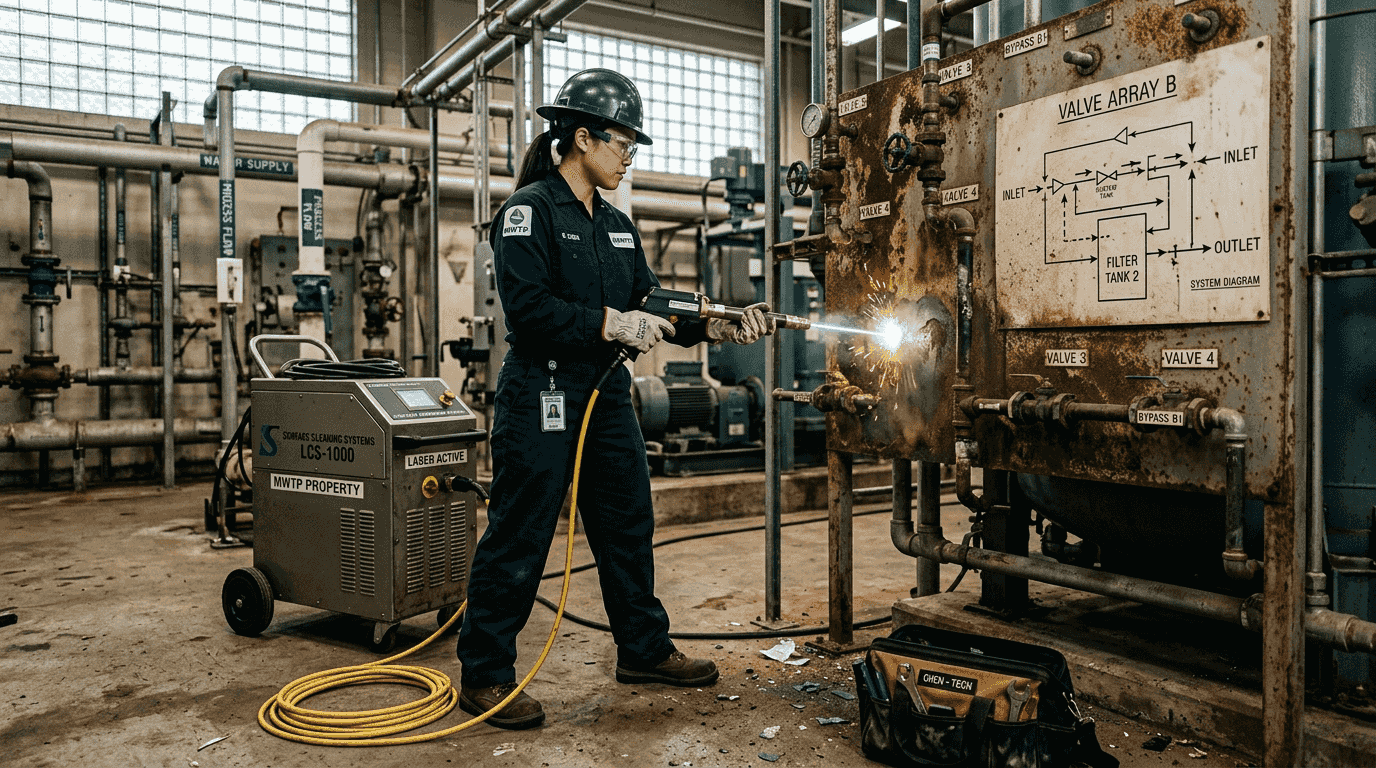
The process directs laser pulses at rusted surfaces, where photon energy breaks molecular bonds in corrosion layers, converting rust to vapor or fine powder easily removed by vacuum. No abrasive waste is produced, reducing environmental and cleanup concerns significantly. Laser cleaning is ideal for precision parts, welds, and molds, and increasingly viable for large steel surfaces as continuous wave laser technology advances.
Laser systems offer unmatched precision, selectively removing rust without damaging underlying metal or altering substrate dimensions. This makes them perfect for high-value assets like airport infrastructure, theme park equipment, and municipal machinery where dimensional tolerances are critical. The technology also eliminates chemical handling and abrasive disposal, aligning with Florida’s environmental regulations.
While slightly slower than blasting in pulsed mode, high-power continuous wave lasers are closing the gap, achieving competitive throughput rates for large surfaces. Higher upfront capital costs are offset by operational efficiencies: no consumables, minimal waste disposal, reduced labor, and faster project turnaround. ROI typically occurs in 12-18 months for facilities with recurring rust removal needs.
Key advantages:
- Zero substrate damage or dimensional change
- No abrasive waste or chemical residue
- Ideal for precision parts and sensitive surfaces
- Lower long-term operational costs
- Environmentally sustainable and compliant
Key limitations:
- Higher initial capital investment
- Slightly slower throughput than bulk blasting
- Requires operator training and safety protocols
- Not cost-effective for one-time large projects
Pro Tip: For Florida municipal projects involving both bulk structural steel and precision components, consider leasing laser equipment for the precision work while contracting traditional blasting for large flat surfaces. This hybrid approach maximizes efficiency and protects critical assets.
Explore surface preparation best practices and metal restoration guide for comprehensive infrastructure maintenance strategies.
Chemical removal: traditional method with limitations
Chemical rust removal involves immersion in acids like hydrochloric or phosphoric acid to chemically dissolve rust, converting iron oxide back to soluble iron salts. This method is typically used for small parts requiring batch processing due to lengthy immersion times, often 12 hours or more. Chemical pickling dissolves rust with acids but is slow, risks flash rust, hydrogen embrittlement, and pitting.
The process works well for small components like bolts, fasteners, or valve parts that can be fully immersed in acid baths. However, it is not practical or safe for large fixed Florida infrastructure like bridges, tanks, or pipelines. Risks include corrosion of the base metal if immersion time is not carefully controlled, flash rust formation immediately after cleaning if surfaces are not neutralized and protected, and hydrogen embrittlement in high-strength steels.
Post-treatment with rust inhibitors and primers is essential to prevent rapid re-corrosion in Florida’s humid environment. Even with inhibitors, flash rust can appear within hours if surfaces are not immediately coated. Chemical methods also generate hazardous acidic waste requiring neutralization and disposal, adding cost and environmental liability.
For large infrastructure, chemical removal is impractical due to the impossibility of immersing fixed structures, the long processing times that halt operations, and the safety hazards of handling large volumes of corrosive acids on-site. Understanding the risks of chemical rust removal helps facility managers avoid costly mistakes.
Key limitations for infrastructure:
- Requires full immersion, impossible for fixed structures
- Slow processing times of 12+ hours per batch
- Risks flash rust, pitting, and hydrogen embrittlement
- Generates hazardous acidic waste requiring disposal
- Not suitable for large-scale Florida projects
Chemical rust removal is best reserved for small batch parts in controlled environments where immersion is feasible and post-treatment can be immediately applied. For large infrastructure, abrasive or laser methods are far more practical and effective.
Comparing rust removal methods: performance and suitability
Throughput, environmental impact, substrate damage, cost, and precision vary significantly among rust removal methods. Abrasive blasting suits massive scale but requires waste handling and causes substrate erosion. Laser cleaning excels in precision and sustainability but has higher capital costs. Chemical removal is viable only for small parts due to time, risk, and corrosive effects.
Abrasive blasting offers fastest throughput but higher waste; laser cleaning balances precision and sustainability; chemical methods are slow and risky for large infrastructure. Selecting a hybrid approach can optimize speed, cost, and surface quality for complex Florida projects.
| Method | Throughput | Environmental Impact | Substrate Damage | Best Use Case |
|---|---|---|---|---|
| Abrasive Blasting | 15-50 m²/hr | High waste, disposal required | Moderate erosion | Large structural steel, tanks, bridges |
| Laser Cleaning | 20-90 m²/hr | Zero waste, sustainable | None, preserves base metal | Precision parts, welds, high-value assets |
| Chemical Removal | 12+ hrs per batch | Hazardous acidic waste | Risks pitting, embrittlement | Small batch parts, fasteners, valves |
For Florida infrastructure projects, the choice often comes down to scale and asset value. Massive municipal water tanks or bridge girders benefit from abrasive blasting’s speed and cost efficiency, provided waste disposal is managed properly. High-value airport infrastructure or theme park machinery demands laser cleaning’s precision and substrate protection. Small component refurbishment in controlled facilities can use chemical methods with proper safety protocols.
Hybrid approaches leverage the strengths of multiple methods: bulk abrasive blasting for large flat surfaces, followed by laser cleaning for intricate details, welds, or precision areas. This combination minimizes waste, protects asset integrity, and ensures thorough rust removal across diverse surface types.
Review surface prep contractor tips for expert guidance on method selection and project planning.
Choosing the right rust removal solution for your Florida project
For massive infrastructure with lower precision needs like bridges, pipelines, or storage tanks, abrasive blasting is usually the best choice. Its unmatched throughput and cost efficiency make it ideal for large-scale projects where substrate erosion is acceptable and waste disposal can be managed within budget. Ensure compliance with SSPC and ISO standards to achieve proper surface cleanliness for coating adhesion.
For high-value, sensitive parts or welds such as airport infrastructure, precision municipal machinery, or theme park equipment, laser cleaning is recommended for minimal substrate impact. The technology preserves dimensional tolerances, eliminates waste, and delivers superior surface quality for critical assets where failure is not an option.
Avoid chemical methods on fixed structures due to flash rust and pitting risks. Chemical removal is practical only for small batch parts in controlled environments where immersion is feasible and post-treatment can be immediately applied. For Florida infrastructure, the environmental and safety hazards outweigh any potential benefits.
Consider hybrid approaches to optimize project outcomes:
- Use abrasive blasting for bulk rust removal on large flat surfaces and structural steel.
- Apply laser cleaning for intricate details, welds, precision components, and high-value areas.
- Reserve chemical methods for small removable parts processed in controlled batch operations.
- Always apply rust inhibitors and primers immediately after rust removal to prevent flash rust.
- Follow SSPC-SP10 and ISO 8501 standards to ensure proper surface preparation for coatings.
Post-clean application of rust inhibitors and primers is essential after all rust removal methods to prevent flash rust. In Florida’s humid climate, surfaces can begin re-corroding within hours if not immediately protected. Coordinate rust removal with coating application to minimize exposure time and ensure long-term asset protection.
Pro Tip: For municipal and government projects, document your rust removal method selection and surface preparation process to demonstrate compliance with industry standards. This documentation supports warranty claims, regulatory audits, and future maintenance planning.
Explore surface prep best practices and industrial coating application for comprehensive infrastructure maintenance strategies.
Professional sandblasting and painting services in Florida
Rust removal is just the first step in protecting Florida infrastructure from corrosion. Southern Sandblasting & Painting offers expert abrasive blasting with full environmental compliance for projects across Central Florida. Their team understands the specific challenges of coastal corrosion and humid conditions, delivering surface preparation that meets SSPC and ISO standards for long-term asset protection.
Comprehensive services include sandblasting services in Orlando and protective coating application, ensuring your infrastructure receives complete corrosion protection from initial surface prep through final coating. With 20+ years of experience serving municipalities, contractors, and industrial facilities, they handle projects ranging from water tanks and pipelines to bridges and theme park infrastructure. Their sandblasting and painting services combine proven surface preparation techniques with industrial-grade coatings engineered for Florida’s harsh environment. Contact Southern Sandblasting to optimize your rust removal strategy and extend asset lifespan with professional industrial coating application steps tailored to your project requirements.
Frequently asked questions
What are the safest rust removal methods for large Florida structures?
Abrasive blasting is effective for large structures but requires proper waste containment, respiratory protection, and environmental controls to manage dust and hazardous debris. Laser cleaning provides a safer, non-contact alternative for sensitive surfaces, eliminating abrasive waste and chemical hazards entirely. Chemical methods pose significant safety risks including acid burns, toxic fumes, and hazardous waste generation, making them unsuitable for large fixed infrastructure. Post-clean application of rust inhibitors and primers improves safety by preventing flash rust and reducing the need for repeated surface preparation. Follow surface prep best practices to ensure worker safety and regulatory compliance.
How do industry standards influence rust removal choices in Florida?
Florida contractors use SSPC-SP10 and ISO 8501 standards to ensure proper surface cleanliness for corrosion protection. These standards define acceptable cleanliness levels and surface profiles required for effective coating adhesion, directly influencing method selection. Compliance ensures durability and regulatory approval in harsh Florida coastal conditions where corrosion rates are accelerated. Projects failing to meet these standards experience premature coating failure, requiring costly re-work and extended asset downtime. Review coatings compliance standards to understand specific requirements for your infrastructure type.
Can combining rust removal methods improve project outcomes?
A hybrid approach using bulk abrasive blasting followed by laser cleaning for details is often optimal. This combination leverages the speed and cost efficiency of blasting for large flat surfaces while protecting precision areas, welds, and high-value components with laser technology. The approach minimizes waste by limiting abrasive use to areas where substrate erosion is acceptable, reduces overall project cost compared to laser-only methods, and ensures thorough rust removal across diverse surface types. Hybrid strategies are particularly effective for complex Florida infrastructure projects involving both structural steel and precision mechanical components. Explore industrial surface prep workflow for implementation guidance.


