
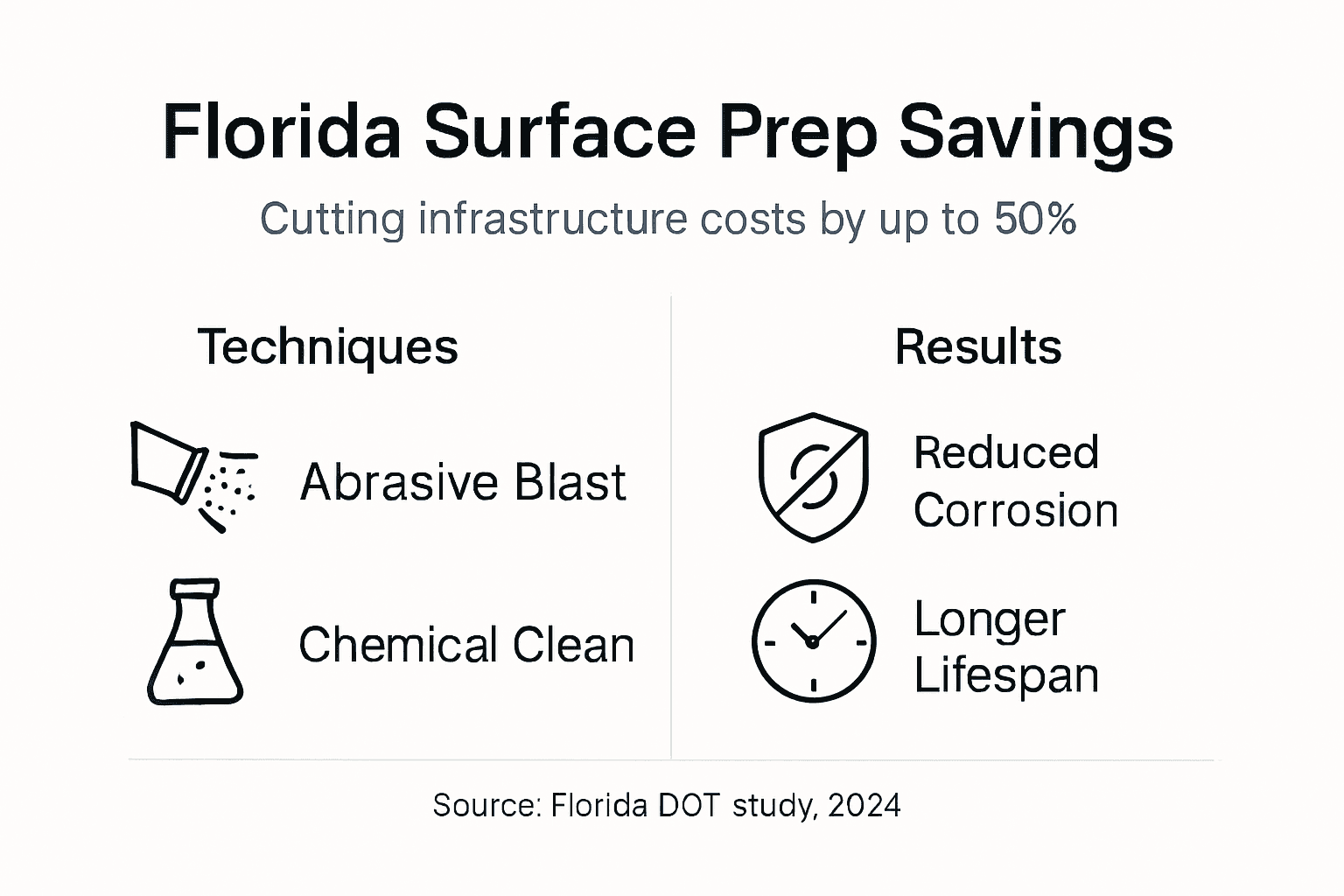
Many Florida infrastructure managers mistakenly treat surface preparation as optional, yet 50% of coating failures stem from inadequate surface preparation despite common belief it is discretionary. Proper surface preparation is essential to prevent premature corrosion and coating failure, especially in Florida’s harsh climate. This guide covers why surface preparation matters, Florida’s unique environmental challenges, proven techniques, compliance standards, and practical tips to protect your assets.
Table of Contents
- Understanding Surface Preparation and Its Importance
- Florida’s Environmental Challenges Impacting Surface Preparation
- Common Misconceptions and Mistakes in Surface Preparation
- Surface Preparation Techniques: Comparison and Suitability
- Industry Standards and Compliance for Protective Surface Preparation
- Real-World Benefits Demonstrated in Florida Infrastructure Projects
- Practical Guidance for Municipal and Commercial Managers
- Enhance Your Infrastructure Longevity with Expert Surface Preparation
- Frequently Asked Questions
Key Takeaways
| Point | Details |
|---|---|
| Extended Lifespan | Effective surface preparation extends coating lifespan by up to 50%, reducing replacement frequency. |
| Florida Climate Impact | Florida’s humidity and salt spray accelerate corrosion up to 5x without proper surface prep. |
| Common Failures | Skipping mechanical prep causes early coating failures, often within 2 to 5 years. |
| Sandblasting Efficiency | Sandblasting achieves ~99% rust removal and optimal surface profile per SSPC-SP10 standards. |
| Standard Compliance | Following SSPC-SP10 and NACE No. 2 standards reduces coating failures by over 40%. |
Understanding Surface Preparation and Its Importance
Surface preparation removes rust, oils, old coatings, and contaminants while creating a textured profile that allows protective coatings to bond mechanically. Without this critical step, coatings fail to adhere properly, leading to blistering, peeling, and accelerated corrosion. The science is clear: unprepared or poorly prepared surfaces can reduce coating lifespan by 40-60%, often causing premature failures within just 2 to 5 years.
Clean, properly profiled surfaces improve adhesion strength by up to 50%, directly increasing coating durability and infrastructure lifespan. When you skip or rush surface preparation, you sacrifice this adhesion advantage, leaving your assets vulnerable to moisture infiltration and corrosion. Research confirms that 95% of coating experts agree surface prep quality is the primary determinant of coating lifespan, underscoring its non-negotiable role.
Common contaminants that undermine coating performance include:
- Mill scale and rust that create weak interfaces
- Oils and greases that prevent chemical bonding
- Chloride salts from coastal exposure that promote corrosion
- Old, degraded coatings that lack structural integrity
Understanding surface treatment benefits helps you appreciate why investing in quality preparation pays dividends over decades. The role of surface preparation extends beyond simple cleaning to engineering a bond that withstands environmental stress. Following essential surface preparation tips ensures your projects meet industry expectations.
Pro Tip: Always verify surface cleanliness and profile depth before coating application using calibrated instruments and visual inspections to avoid costly rework.
“Surface preparation isn’t just a step in the coating process. It is the foundation that determines whether your protective system succeeds or fails.”
Florida’s Environmental Challenges Impacting Surface Preparation
Florida’s climate presents unique threats that make surface preparation even more critical than in other regions. High humidity levels year round create constant moisture exposure, while coastal areas face aggressive salt spray that deposits chlorides on metal surfaces. Infrastructure in coastal Florida experiences corrosion rates up to 5 times faster without proper surface preparation compared to inland locations.
Salt deposits act as hygroscopic agents, pulling moisture through microscopic coating defects and accelerating electrochemical corrosion at the metal interface. When surface preparation fails to remove these contaminants completely, they remain trapped under new coatings, creating corrosion cells that expand and blister the coating from within. This process happens faster in Florida’s warm, humid environment where electrochemical reactions accelerate.
Key environmental factors demanding superior surface preparation include:
- Persistent humidity above 70% promoting moisture infiltration
- Marine salt spray in coastal zones depositing chloride contaminants
- Intense UV radiation degrading coating chemistry over time
- Thermal cycling causing expansion and contraction stresses
Florida Corrosion Acceleration: Coastal infrastructure corrodes up to 5x faster than inland assets when surface preparation is inadequate.
Proper preparation significantly improves coating adhesion and corrosion resistance by removing these environmental contaminants before they’re sealed beneath protective layers. Understanding surface treatment benefits in Orlando helps managers differentiate coastal versus inland preparation strategies. Selecting appropriate industrial coatings for Florida matters little if the surface preparation foundation is compromised.
Managers must recognize that Florida’s environment amplifies every surface preparation shortcut. What might be acceptable elsewhere fails quickly under Florida’s aggressive conditions.
Common Misconceptions and Mistakes in Surface Preparation
Myth: Surface preparation is optional if you use premium coatings. Reality: Even the highest quality coatings fail when applied over improperly prepared surfaces. Poor surface preparation causes up to 50% of coating failures even when expensive, high-performance coatings are specified. The coating cannot compensate for inadequate mechanical bonding.
A frequent mistake is relying solely on chemical cleaning methods like solvent wiping or pressure washing. While these remove surface oils and loose debris, they fail to create the mechanical profile needed for coating adhesion. Chemical cleaning alone leaves surfaces too smooth for coatings to grip effectively.
Skipping or rushing surface preparation to save upfront costs backfires dramatically. Assets prepared inadequately require recoating within 2 to 5 years instead of lasting 10 to 15 years with proper preparation. The cost savings vanish quickly when you factor in scaffolding, surface access, production downtime, and repeated coating application expenses.
Common preparation shortcuts that guarantee problems:
- Hand tool cleaning instead of mechanical abrasion on corroded steel
- Skipping profile depth verification after blasting operations
- Coating over visible rust or mill scale to meet deadlines
- Ignoring humidity and temperature requirements during preparation
- Failing to remove chloride contamination in coastal environments
Following surface preparation standards in Florida eliminates guesswork and ensures consistent results. Implementing essential surface preparation tips protects your investment from these common pitfalls.
Pro Tip: Always demand written documentation of surface preparation methods, equipment used, and standard compliance before accepting contractor work to ensure accountability.
Surface Preparation Techniques: Comparison and Suitability
Mechanical methods like abrasive blasting physically remove contaminants and create the anchor profile needed for coating adhesion. Sandblasting achieves ~99% rust removal and optimal surface profiles compliant with SSPC-SP10 and NACE No.2 standards, making it the gold standard for critical infrastructure. The process propels abrasive media at high velocity to strip away rust, mill scale, and old coatings while etching a uniform texture.
Chemical cleaning uses solvents, degreasers, or acids to dissolve oils, greases, and organic contaminants. While effective for removing surface films, chemical methods do not create mechanical profile or remove tightly adhered rust. They serve as supplementary treatments rather than standalone solutions for structural steel preparation.
Industry standards like SSPC-SP10 (Near-White Blast Cleaning) and NACE No. 2 specify both cleanliness levels and surface profile requirements. These standards ensure surfaces are free of visible contaminants and possess sufficient roughness for coating systems to anchor mechanically. Sandblasting excels in Florida’s high-corrosion coastal environments where complete contaminant removal and proper profile are non-negotiable.
| Method | Rust Removal | Profile Creation | Standard Compliance | Best Use |
|---|---|---|---|---|
| Sandblasting | ~99% | Excellent 2 to 4 mil profile | SSPC-SP10, NACE No. 2 | Heavy rust, marine environments, critical infrastructure |
| Chemical Cleaning | Poor on rust | None | SSPC-SP1 | Light soiling, oil removal, pre-blast prep |
| Power Tool Cleaning | 60 to 80% | Limited | SSPC-SP3 | Spot repairs, maintenance touch-ups |
For Florida municipal projects, mechanical preparation methods provide the reliability and performance needed to justify long-term coating investments. Reviewing municipal surface preparation examples demonstrates real-world applications. Understanding surface preparation standards helps you specify appropriate methods for your assets.
Choosing the wrong technique compromises coating performance regardless of subsequent steps. Match preparation methods to asset criticality, environmental exposure, and performance expectations.
Industry Standards and Compliance for Protective Surface Preparation
SSPC-SP10 and NACE No. 2 define near-white blast cleaning as removing at least 95% of visible contaminants including mill scale, rust, coating residues, and foreign matter. These standards establish measurable criteria for surface cleanliness and profile depth, eliminating subjective interpretation. Adhering to SSPC-SP10 and NACE No. 2 standards substantially lowers coating failure risks and extends maintenance intervals by ensuring proper coating adhesion.
Compliance reduces coating failures by over 40% compared to non-standard preparation methods. When specifications reference these standards, they provide legal and technical benchmarks for quality assurance. Contractors must demonstrate compliance through inspection documentation, profile measurements, and photographic evidence.
Regulatory projects in Florida frequently mandate SSPC and NACE standards for municipal water tanks, bridges, and treatment facilities. Government agencies recognize that standard compliance protects taxpayer investments by maximizing coating system longevity. Private facility managers benefit equally from these proven guidelines.
Key compliance requirements include:
- Visual cleanliness verification against standard reference photographs
- Surface profile measurement between 2.0 and 4.0 mils using replica tape
- Removal of nearly all mill scale, rust, and previous coatings
- Documentation of environmental conditions during preparation
- Third-party inspection for critical infrastructure projects
Implementing surface preparation compliance practices in Florida ensures your projects meet regulatory expectations. Following compliance standards for industrial painting protects against contractor shortcuts and premature failures.
Standards provide the framework for accountability. Insist on documented compliance rather than accepting verbal assurances that preparation meets “industry standards” without specifics.
Real-World Benefits Demonstrated in Florida Infrastructure Projects
A documented Florida water tank rehabilitation project demonstrates the economic value of professional surface preparation and coating. Proper sandblasting and coating extended water tank service life from 8 to over 15 years and halved maintenance costs compared to previous coating cycles using inadequate preparation. The municipality saved over $180,000 in avoided early recoating and repair expenses.
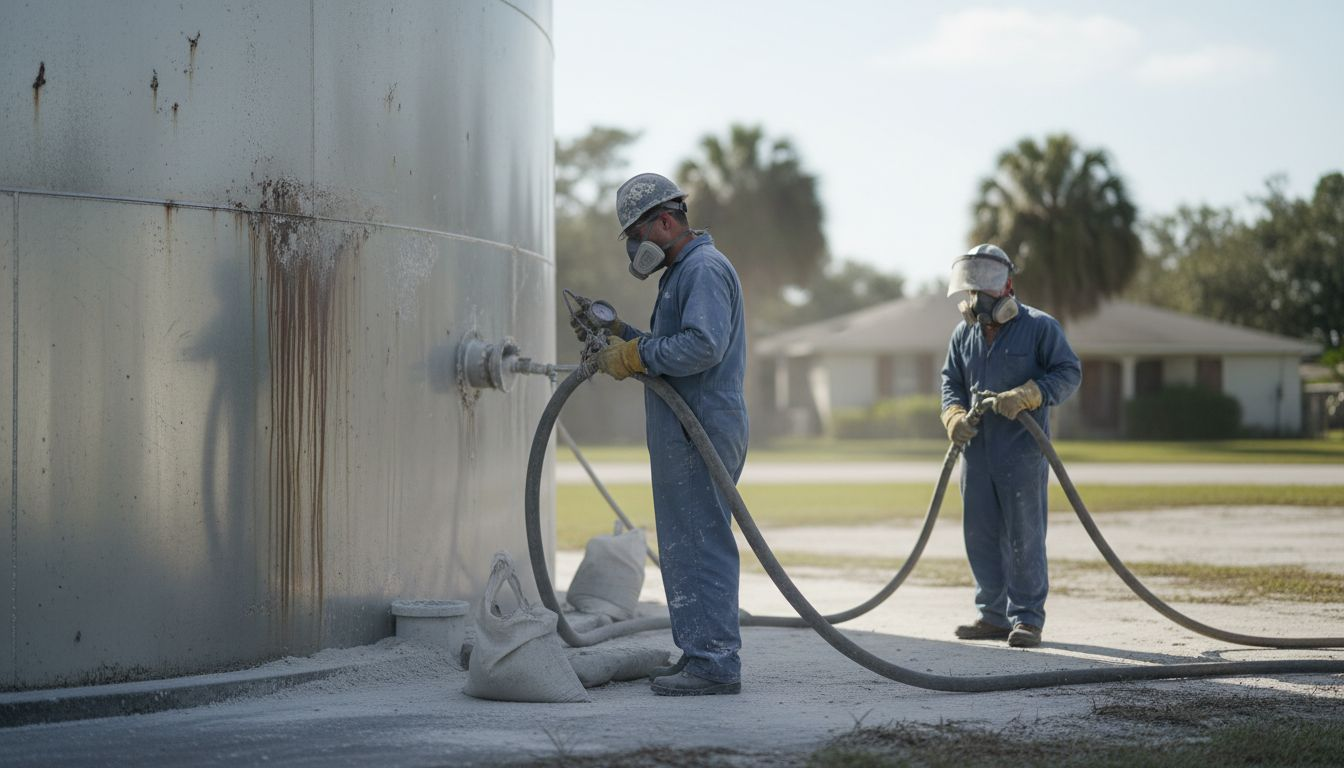
The project followed SSPC-SP10 standards for abrasive blasting, achieving near-white surface cleanliness and a 2.5 to 3.5 mil anchor profile. Subsequent high-performance epoxy and polyurethane coatings bonded tenaciously to the properly prepared substrate, resisting Florida’s humidity and occasional salt exposure without degradation.
| Metric | Before Improved Prep | After Professional Prep | Improvement |
|---|---|---|---|
| Service Life | 8 years | 15+ years | +87% lifespan |
| Coating Condition at 7 Years | Significant rust, peeling | Excellent, minimal wear | Dramatic |
| 15-Year Maintenance Cost | $360,000 (2 recoats) | $180,000 (1 recoat) | 50% reduction |
| Downtime Events | 3 major repairs | 1 scheduled recoat | 67% fewer |
This case proves that investing in thorough surface preparation yields significant lifecycle savings through extended coating performance and reduced maintenance frequency. The municipality avoided production interruptions, emergency repairs, and the political fallout from visible asset deterioration.
“The difference between adequate and excellent surface preparation is measured in years of service life and hundreds of thousands in avoided costs. It’s the best invisible investment we make.”
Applying surface prep best practices delivers these quantifiable benefits to your infrastructure portfolio. The evidence clearly supports prioritizing preparation quality over speed or initial cost savings.
Practical Guidance for Municipal and Commercial Managers
Selecting qualified surface preparation contractors requires evaluating specific capabilities beyond general painting experience. Verify contractors possess appropriate abrasive blasting equipment, environmental containment systems, and trained operators familiar with Florida’s climate challenges. Request documentation of previous municipal or industrial projects demonstrating standard compliance.
Critical questions to ask potential contractors:
- What SSPC or NACE standards do you follow for our asset type?
- How do you verify and document surface cleanliness and profile?
- What abrasive media and equipment will you use for this project?
- How do you manage environmental conditions during surface preparation?
- Can you provide references from similar Florida infrastructure projects?
Signs of inadequate surface preparation include uneven surface texture, visible rust or mill scale in crevices, oily residue or discoloration, and coating that easily peels during adhesion testing. Catching these issues before coating application saves enormous rework costs.
Oversight steps managers should implement:
- Require written surface preparation specifications referencing SSPC/NACE standards
- Conduct pre-work meetings to align on quality expectations and inspection procedures
- Perform random inspections during preparation to verify compliance
- Document surface profile and cleanliness with measurements and photographs
- Insist on third-party adhesion testing before accepting completed preparation
- Review all documentation before authorizing coating application
Following a comprehensive surface preparation checklist for city projects ensures consistent quality. Implementing proven surface prep best practices protects your assets and budget.
Pro Tip: Insist on third-party adhesion and cleanliness testing before coating application to identify preparation deficiencies while they’re still easy to correct, avoiding costly coating failures later.
Enhance Your Infrastructure Longevity with Expert Surface Preparation
Applying the insights from this guide requires partnering with experienced professionals who understand Florida’s unique challenges and industry standards. Southern Sandblasting & Painting offers expert surface preparation services ensuring compliance with SSPC and NACE standards, delivering the cleanliness and profile your coatings need to perform.
Our specialized sandblasting services in Orlando address Florida’s aggressive environmental conditions, removing contaminants completely while creating optimal anchor profiles for long-lasting coating adhesion. With over 20 years serving municipal and commercial infrastructure clients, we understand the technical requirements and budget realities you face. Our comprehensive sandblasting and painting services integrate surface preparation with protective coating application for seamless project execution.
Choose proven local experts who specialize in infrastructure surface preparation rather than general contractors learning on your assets. Implementing surface prep best practices transforms your asset protection strategy from reactive maintenance to proactive preservation. Contact us to discuss how professional surface preparation extends your infrastructure lifespan while cutting long-term maintenance costs by up to 50%.
Frequently Asked Questions
What is the role of surface preparation in infrastructure maintenance?
Surface preparation ensures protective coatings adhere properly to metal substrates, preventing moisture infiltration and corrosion that cause structural degradation. Proper preparation extends coating lifespan by 40 to 60%, directly reducing maintenance frequency and costs over your asset’s lifecycle.
How does Florida’s environment affect surface preparation requirements?
Florida’s high humidity and coastal salt spray deposit corrosive contaminants that accelerate coating failure up to 5 times faster than inland environments. Thorough surface preparation must remove these hygroscopic salts completely, as they pull moisture through coating defects and promote rapid corrosion underneath.
What are signs of inadequate surface preparation?
Common indicators include coating blistering within 2 to 3 years, visible rust spots bleeding through new coatings, premature peeling at edges or seams, and uneven surface texture. Failed adhesion testing before coating application definitively identifies preparation deficiencies while correction remains simple.
Why are industry standards like SSPC-SP10 important?
SSPC-SP10 and NACE No. 2 provide measurable benchmarks for surface cleanliness and profile depth, eliminating subjective quality disputes between contractors and clients. Following these standards reduces coating failures by over 40% and ensures your preparation investment delivers expected long-term performance.
How can I verify the quality of surface preparation?
Request detailed inspection reports documenting visual cleanliness ratings, surface profile measurements using replica tape, and photographic evidence comparing surfaces to standard reference images. Insist contractors provide these before coating application, and consider third-party inspection for critical assets exceeding $50,000 in coating investment.
Recommended
- Surface Treatment Benefits: 50% Longer Lifespan in Orlando
- Surface Preparation Standards 2025: Raising Compliance in Florida
- Types of Industrial Coatings for Florida Infrastructure
- Why Industrial Coatings Matter for Florida Infrastructure
- Sandblasting Contractor Baldwin Park FL
- Sandblasting Services Oviedo FL


