
Most American public works see up to 30 years of extended service life with advanced industrial coatings in place. In Central Florida, constant exposure to moisture, UV rays, and coastal elements pushes municipal infrastructure to its limits. With strict compliance demands and rising costs, choosing the right coating makes the difference between reliable operations and costly repairs. Discover which technologies deliver the protection and compliance your assets need to stand up to American infrastructure challenges.
Table of Contents
- Defining Industrial Coatings For Public Assets
- Major Categories Of Industrial Coatings
- Key Features And Application Methods
- Regulatory Compliance And Safety Factors
- Cost Considerations And Common Pitfalls
Key Takeaways
| Point | Details |
|---|---|
| Importance of Industrial Coatings | Industrial coatings are vital for protecting public infrastructure from environmental degradation, extending asset lifespans, and reducing maintenance costs. |
| Categories of Coatings | Coatings fall into three main categories: architectural, industrial OEM, and special purpose, each catering to specific protective needs. |
| Application Methods | Various application methods, including spraying and powder coating, require precise surface preparation to ensure optimal performance. |
| Regulatory Compliance | Compliance with environmental regulations and safety standards is essential for ensuring the efficacy and safety of industrial coatings. |
Defining Industrial Coatings for Public Assets
Industrial coatings represent specialized protective layers designed to shield critical public infrastructure from environmental degradation. These advanced materials form a crucial defensive barrier that prevents moisture, chemicals, and mechanical stress from compromising structural integrity. Protective industrial coatings are thin layers of solid material applied to surfaces to enhance protective properties, specifically engineered to safeguard assets in challenging environments like Florida’s coastal regions.
The primary function of industrial coatings extends beyond simple aesthetic enhancement. These technical solutions provide comprehensive protection for infrastructure components such as bridges, water towers, transportation facilities, and utility systems. By creating a resilient barrier, these coatings significantly extend the operational lifespan of public assets, reducing maintenance costs and preventing premature structural failure. Industrial coatings are primarily applied for corrosion control and protection of public infrastructure, with regulatory frameworks like EPA VOC regulations ensuring environmental safety and performance standards.
Key characteristics of effective industrial coatings include superior adhesion, chemical resistance, UV stability, and durability under extreme temperature variations. Municipal infrastructure managers must consider multiple factors when selecting appropriate coating systems, including substrate material, environmental exposure, expected service life, and specific performance requirements. Modern coating technologies offer specialized formulations tailored to unique infrastructure challenges, ranging from marine environments to high-traffic urban settings.
Pro Tip: Always conduct a comprehensive surface preparation assessment before applying any industrial coating to ensure maximum adhesion and long-term protection.
Major Categories of Industrial Coatings
Industrial coatings represent a critical technological solution for protecting infrastructure, with distinct categories designed to address specific environmental and functional challenges. Industrial coatings primarily fall into three broad categories: architectural coatings, industrial original equipment manufacturer (OEM) coatings, and special purpose coatings. Each category serves unique protective and performance objectives tailored to different infrastructure requirements.
Architectural coatings focus on protecting and decorating buildings, providing aesthetic and protective layers for structural surfaces. Industrial OEM coatings are applied in factory settings to enhance performance and durability of manufactured goods, ensuring robust protection during production and initial deployment. Special purpose coatings represent a versatile category that includes protective and traffic marking paints critical for infrastructure maintenance, offering specialized solutions for complex environmental challenges.
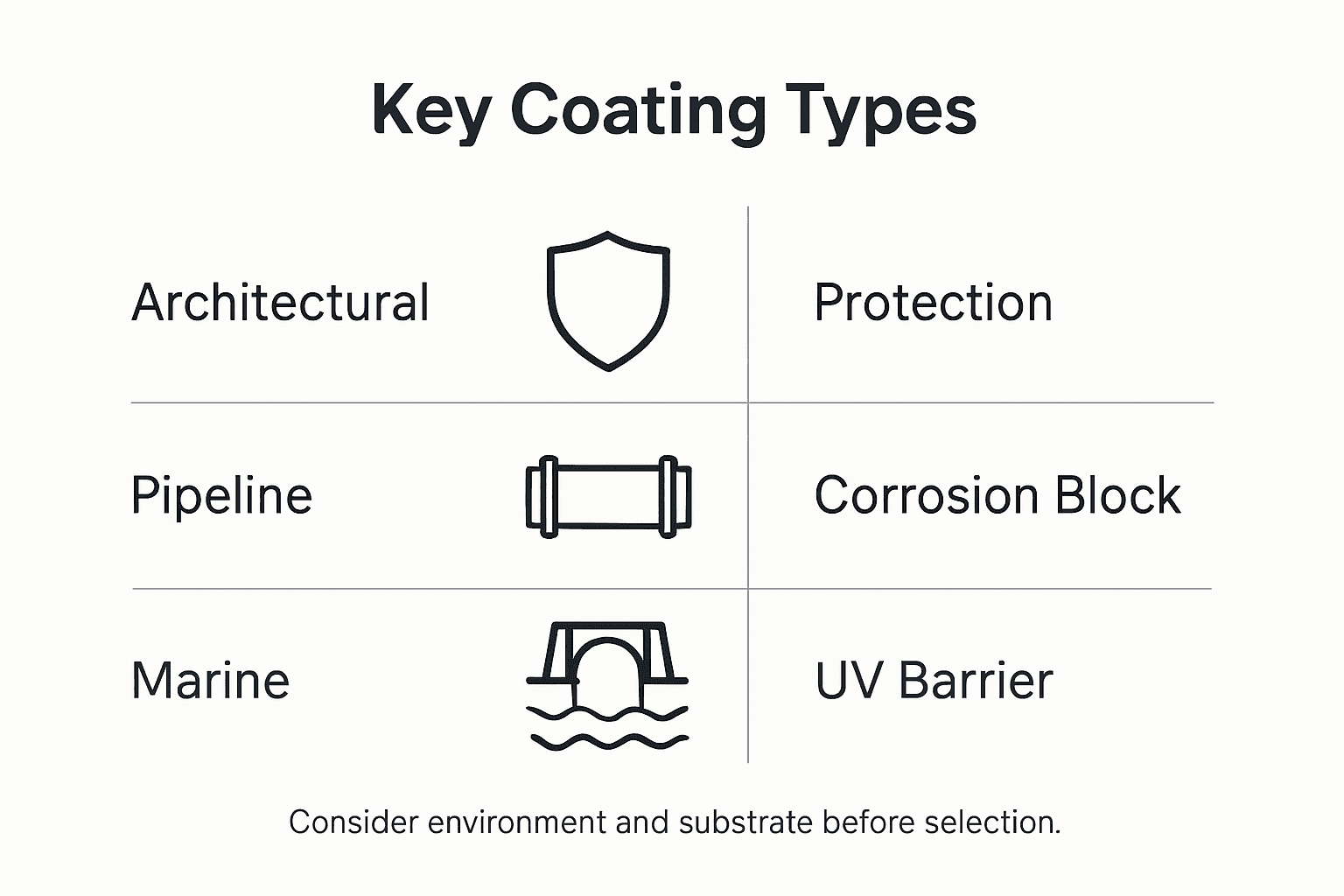
Pipeline infrastructure demonstrates the nuanced application of industrial coating categories, with specific coating types like fusion bond epoxy powder coatings for buried systems, liquid-applied epoxies for joint coatings, and multilayer shrink wraps. These specialized coating systems are engineered to meet stringent standards for corrosion protection, environmental safety, and application efficiency, reflecting the sophisticated technological approaches required for modern infrastructure maintenance.
Pro Tip: Always evaluate the specific environmental conditions and substrate materials before selecting an industrial coating to ensure maximum performance and longevity.
Here is a summary comparing the major categories of industrial coatings and their typical uses:
| Coating Category | Main Purpose | Common Application Areas | Key Benefit |
|---|---|---|---|
| Architectural | Protect and decorate | Buildings, walls | Aesthetic enhancement |
| Industrial OEM | Production protection | Factory-manufactured goods | Durability during transit |
| Special Purpose | Specialized performance | Pipelines, road surfaces | Extreme condition resilience |
Key Features and Application Methods
Industrial coatings represent complex protective systems with sophisticated performance characteristics critical for infrastructure resilience. Key features of industrial coatings include their corrosion resistance, adhesion, mechanical durability, chemical resistance, and environmental adaptability. These technical properties determine the coating’s effectiveness in protecting surfaces against environmental degradation and mechanical stress.
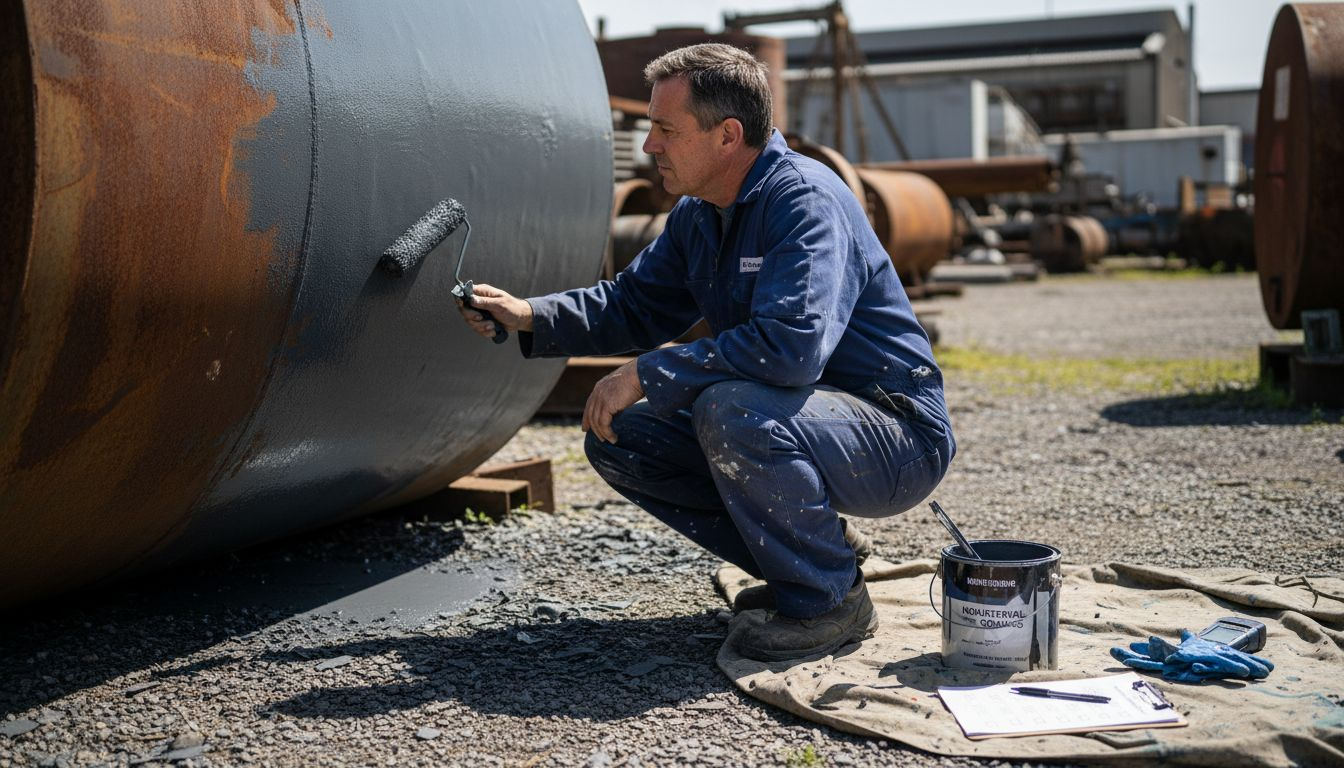
Application methods for industrial coatings are diverse and highly specialized, requiring precise technical expertise. Coating techniques can involve brushing, rolling, spraying, and powder coating, typically preceded by rigorous surface preparation like blast cleaning. Each method offers unique advantages depending on the substrate material, environmental conditions, and specific performance requirements. Proper surface preparation is crucial, as it ensures optimal adhesion and significantly extends the coating’s operational lifespan.
Standards and testing protocols guide the selection and application of industrial coatings, with comprehensive evaluations for durability, water resistance, film thickness, and chemical resistance. These technical standards ensure that coating systems meet stringent performance criteria for infrastructure applications. Factors such as substrate composition, expected environmental exposure, and long-term performance expectations play critical roles in determining the most appropriate coating technique and formulation.
Pro Tip: Always conduct comprehensive surface profile measurements and environmental assessments before selecting and applying industrial coatings to guarantee maximum protection and durability.
Below is a comparison of common industrial coating application methods and their suitability:
| Application Method | Surface Types | Typical Use Case | Advantage |
|---|---|---|---|
| Brushing | Small, detailed areas | Maintenance, touch-ups | Precision for edges |
| Rolling | Flat surfaces | Large walls, floors | Quick coverage, less waste |
| Spraying | Complex shapes | Structural steel, pipes | Uniform thickness, fast |
| Powder Coating | Metal components | OEM, factory settings | Durable, low VOC emissions |
Regulatory Compliance and Safety Factors
Industrial coating regulations represent a critical framework designed to protect public health and environmental safety. Industrial coatings are subject to strict regulations, including limits on volatile organic compound (VOC) content as defined by the EPA to reduce air pollution and health risks. These comprehensive guidelines ensure that coating materials meet stringent performance and environmental standards while minimizing potential negative impacts on workers and surrounding ecosystems.
The regulatory landscape for industrial coatings involves multiple layers of compliance, addressing both environmental and occupational safety concerns. ASTM standards specify detailed performance and safety requirements, including comprehensive tests for corrosion resistance, UV exposure, and chemical durability. Municipal infrastructure managers must navigate these complex requirements, ensuring that coating selections not only provide optimal protection but also adhere to local, state, and federal regulatory frameworks.
Key compliance considerations extend beyond chemical composition to include application processes, worker protection, and long-term environmental impact. Safety protocols demand rigorous worker training, appropriate personal protective equipment, and careful management of application techniques to minimize potential health risks. Environmental regulations continue to evolve, pushing industrial coating technologies toward more sustainable and less harmful formulations that balance performance with ecological responsibility.
Pro Tip: Maintain comprehensive documentation of coating specifications, application processes, and compliance certifications to streamline regulatory inspections and demonstrate commitment to safety standards.
Cost Considerations and Common Pitfalls
Industrial coating investments require comprehensive financial analysis that extends far beyond initial material expenses. Cost considerations for industrial coatings involve not only the material price but also surface preparation, labor, application methods, and maintenance frequency. Municipal infrastructure managers must adopt a holistic approach to budgeting that accounts for the total lifecycle cost of protective coating systems.
Navigating the complex landscape of industrial coating expenses demands strategic decision-making and proactive risk management. Critical financial factors include long-term durability, potential maintenance requirements, and the potential economic impact of premature coating failure. Infrastructure projects require careful evaluation of coating performance against initial and projected expenses, considering factors such as environmental exposure, substrate complexity, and expected service life.
Common pitfalls in industrial coating selection can dramatically inflate project costs and compromise infrastructure integrity. Inadequate surface preparation, improper coating selection for specific environmental conditions, and overlooking regulatory compliance represent significant risks that can lead to premature coating failure. These missteps not only increase immediate repair and replacement expenses but also potentially compromise the structural safety and operational efficiency of critical public assets.
Pro Tip: Conduct a comprehensive total cost of ownership analysis that includes initial application, potential maintenance, expected lifespan, and potential replacement costs before selecting an industrial coating system.
Protect Your Florida Infrastructure with Expert Industrial Coatings and Surface Preparation
Florida’s unique environment demands specialized industrial coatings that deliver lasting corrosion resistance, UV stability, and chemical protection for public assets. If you are managing municipal infrastructure like bridges, pipelines, or water tanks, addressing challenges such as surface degradation and regulatory compliance is crucial. At Southern Sandblasting & Painting LLC, we understand these complexities and offer tailored solutions to extend your asset lifespan while meeting strict environmental standards.

Discover our industry-leading Industrial Painting services combined with precision Sandblasting to ensure optimal surface preparation before applying advanced coatings. Serving Central Florida for over 20 years, we bring trusted expertise and local knowledge to every project. Don’t risk premature coating failure or costly maintenance delays. Visit Southern Sandblasting & Painting LLC today for a consultation and protect your infrastructure investment with durable coatings designed specifically for Florida’s challenging conditions.
Frequently Asked Questions
What are industrial coatings and their primary functions?
Industrial coatings are specialized protective layers designed to shield infrastructure from environmental degradation. Their primary functions include corrosion protection, moisture resistance, and extending the lifespan of public assets, while also reducing maintenance costs.
What are the main categories of industrial coatings?
The main categories of industrial coatings include architectural coatings, which protect and enhance buildings; industrial OEM coatings, applied to manufactured goods for durability; and special purpose coatings, which address specific performance needs for infrastructure maintenance, such as protective and traffic marking paints.
How do application methods affect the performance of industrial coatings?
Application methods, including brushing, rolling, spraying, and powder coating, significantly impact the adhesive properties, thickness, and uniformity of the coating. Each method has its advantages depending on surface types and environmental conditions, affecting overall performance and longevity.
What are the key compliance and safety factors to consider when using industrial coatings?
Key compliance factors include adherence to regulatory standards related to volatile organic compounds (VOCs) and performance tests for corrosion and chemical resistance. Safety factors involve ensuring worker protection via training and personal protective equipment, as well as strict management of application techniques to mitigate health risks.


