
When unexpected coating failures disrupt city infrastructure, Central Florida municipal managers know the stakes are high. Reliable surface preparation and protective coatings are crucial for maximizing asset longevity, reducing costs, and meeting legal expectations. With detailed guidance from ASTM International paint standards, you gain clarity on essential coating properties, performance benchmarks, and compliance requirements, empowering you to safeguard vital assets against Florida’s harsh environmental challenges while ensuring every project meets industry standards.
Table of Contents
- Defining Industry Standards For Coatings
- Essential Coating Types And Specifications
- Governing Bodies And Regulatory Frameworks
- Testing Methods For Surface Preparation Quality
- Key Compliance Challenges And Common Pitfalls
Key Takeaways
| Point | Details |
|---|---|
| Importance of Coating Standards | Establishing clear industry standards ensures consistency, safety, and reliability in municipal coating projects, protecting investments and public infrastructure. |
| Choosing Coating Types | Selecting the appropriate coating type based on environmental conditions is critical for durability and performance of city assets in Central Florida. |
| Regulatory Compliance | Understanding the role of various regulatory bodies helps navigate compliance requirements and ensures project standards are met across federal, state, and local levels. |
| Surface Preparation Testing | Proper surface preparation is vital; using standardized testing methods can prevent premature coating failures and ensure long-lasting results. |
Defining Industry Standards for Coatings
Industry standards for coatings exist to create consistency, safety, and reliability across surface protection projects. When you’re managing city infrastructure like water treatment tanks, bridge structures, or parking garages, you need to know exactly what “industrial-grade coating” means and what performance guarantees come with it. Without clear definitions, a contractor could apply any paint with minimal oversight, leaving your municipality exposed to premature failure and costly repairs.
Coating standards and specifications define everything from how surface preparation should occur to what chemical properties the final coating must possess. These standards specify testing procedures that verify a coating can withstand specific environmental conditions, adhesion requirements, thickness measurements, and durability timelines. For Central Florida infrastructure, this matters considerably since your assets face intense UV exposure, salt air corrosion from inland water systems, and temperature cycling that stresses protective coatings year-round. ASTM International provides detailed guides on application methods and helps both manufacturers and end-users understand appropriate testing and coating procedures for compliance.
The U.S. standards system, guided by frameworks like ANSI’s United States Standards Strategy, ensures that coatings used in municipal projects meet national requirements for competitiveness, innovation, safety, and consistent performance. When you specify a coating for city assets, you’re essentially saying: “This product must meet ASTM D standards for exterior durability” or “This application follows ASTM standards for surface preparation.” This creates accountability. The contractor knows what’s expected. You know what you’re paying for. The coating manufacturer knows their product will be tested and verified.
Understanding industrial coating terminology helps you communicate with contractors about these standards in practical terms. When someone mentions “SSPC standards” or “ISO certifications,” they’re referencing specific compliance frameworks that define how coatings perform and how they should be applied. Your city’s coating projects don’t operate in a vacuum. They follow established benchmarks that protect public safety and ensure taxpayer dollars fund solutions that actually last.
Pro tip: Request documentation proving your contractor follows ASTM D standards for surface preparation and coating application before signing any agreement, especially for high-value municipal assets like water infrastructure or structural elements.
Essential Coating Types and Specifications
Not all coatings perform the same job. When you’re protecting city infrastructure in Central Florida, choosing the right coating type makes the difference between a 5-year coating failure and a 15-year durable solution. Municipal managers need to understand what separates a basic industrial coating from a specialized formulation designed for your specific environmental challenges. The coating you select determines how well your assets resist salt spray, UV radiation, moisture intrusion, and chemical exposure.
Coating types fall into distinct categories based on their composition and application method. Liquid coatings like waterborne and solvent-based formulations dominate municipal projects because they offer flexibility in application and clear visibility of surface coverage. Waterborne coatings contain lower volatile organic compound (VOC) content, which matters if your city has air quality regulations or wants to minimize environmental impact during application. Solvent-based coatings typically provide superior durability and moisture resistance, making them ideal for water treatment facilities, bridge structures, or parking decks exposed to standing water. Powder coatings and specialty formulations fill niches where specific performance is required, though they’re less common for field application on existing infrastructure.
ASTM standards define detailed specifications for each coating type, covering physical properties like dry film thickness, adhesion strength, and flexibility, as well as chemical resistance and weathering performance. When a contractor specifies a coating as “ASTM D3276 compliant,” they’re saying the coating meets documented performance benchmarks. This standardization protects you because it means the coating’s behavior is predictable and testable. Your municipality isn’t gambling on untested products.
For Central Florida assets, the most common choice combines surface-tolerant epoxy primers with polyurethane topcoats. This two-coat system provides corrosion resistance in humid, salt-laden environments while allowing the topcoat to reflect UV radiation and resist chalk development. Water tank interiors often require food-grade epoxies that prevent coating breakdown from constant moisture contact. Bridge steel exposed to traffic salt requires high-build epoxy systems that seal corrosive surfaces completely. Understanding what protective coating means for your specific asset helps you communicate technical requirements with contractors and avoid costly mismatches between coating type and end-use environment.
Here’s a summary of common industrial coating types and their optimal use cases for municipal infrastructure:
| Coating Type | Best Application | Key Advantage |
|---|---|---|
| Waterborne | Urban structures, low VOCs | Environmentally friendly |
| Solvent-based | Water facilities, bridges | Superior moisture resistance |
| Powder coating | Deck railings, metalwork | Highly durable finish |
| Food-grade epoxy | Water tank interiors | Safe for potable water |
| Polyurethane topcoat | Bridge steel, exposed metal | UV-resistant, long-lasting |
Pro tip: Request the manufacturer’s technical data sheet and ASTM compliance documentation for any coating before approval, and verify the coating type matches your asset’s exposure conditions and lifespan expectations.
Governing Bodies and Regulatory Frameworks
Your municipality doesn’t set coating standards in isolation. Multiple federal agencies, standards organizations, and regulatory bodies establish the rules that govern how coatings are formulated, applied, and verified. Understanding who sets these rules and why helps you navigate compliance requirements and ensures your city infrastructure projects meet current and future standards without costly revisions or project delays.
The American National Standards Institute (ANSI) serves as the central coordinator for voluntary U.S. standards development, including comprehensive coating standards. ANSI facilitates collaboration between industry manufacturers, government agencies, and academic institutions to create standards that balance innovation with safety and performance. The organization’s United States Standards Strategy emphasizes market-driven development while maintaining alignment with international standards, ensuring American coatings manufacturers can compete globally without maintaining separate product lines for domestic versus export markets. This matters for Central Florida because it means coating products you specify today will remain compliant with evolving international trade requirements through 2026 and beyond.
The National Institute of Standards and Technology (NIST) translates standards strategy into federal implementation, actively supporting coating standards development across government procurement and critical infrastructure projects. NIST’s involvement in standards implementation aligns national priorities for innovation, safety, and economic growth, ensuring that coatings used on federally funded or regulated infrastructure meet rigorous requirements. When your city applies for federal grants to rehabilitate water systems, bridges, or other critical assets, the coatings you specify must meet NIST-aligned standards. This creates accountability throughout the supply chain, from coating manufacturers to applicators to inspection personnel.
Beyond federal frameworks, state environmental agencies oversee VOC limits and air quality impacts from coating application. Florida’s environmental regulations may restrict certain solvent-based coatings or require documentation of emissions during application. Local building codes in Orange County, Seminole County, and other Central Florida municipalities often reference ASTM or SSPC standards as the baseline for acceptable performance. The key takeaway is that your coating project operates within nested regulatory layers: federal standards provide the foundation, state environmental rules add restrictions, and local codes may impose additional requirements. When contractors propose coating solutions, they must satisfy all three levels simultaneously.
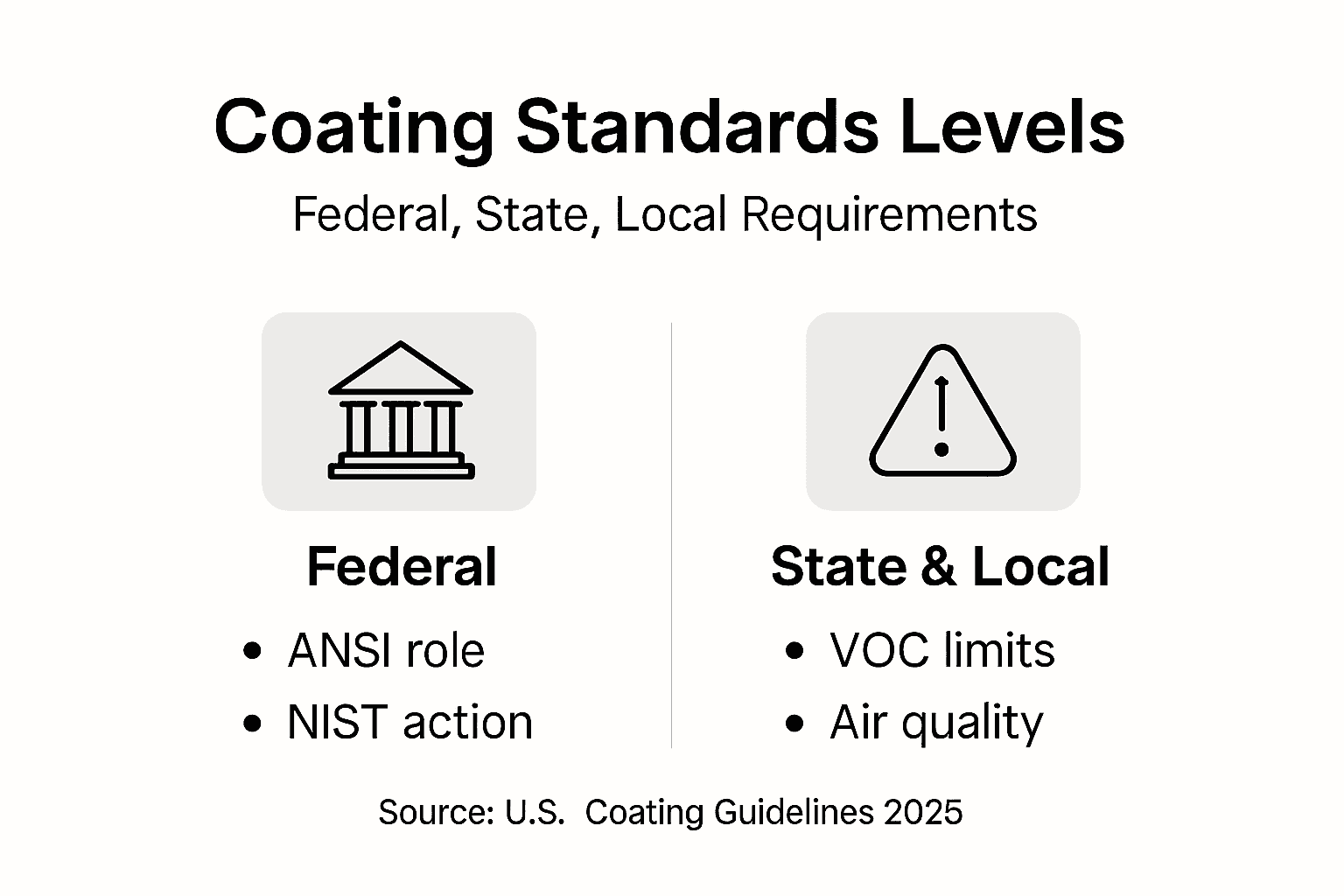
To help ensure compliance and avoid pitfalls in coating projects, here is a comparison of key regulatory levels and their focus:
| Regulatory Level | Main Role | Common Requirement |
|---|---|---|
| Federal | Sets foundation standards | ASTM, ANSI, NIST compliance |
| State | Adds environment regulation | VOC limitations, emission controls |
| Local | Refines for local needs | Specific code references, approvals |
Pro tip: Request written confirmation from your contractor that proposed coatings meet ANSI standards, comply with current Florida VOC regulations, and satisfy your local municipality’s specific code references before project approval.
Testing Methods for Surface Preparation Quality
Surface preparation quality determines whether your coating investment lasts 5 years or 15 years. You can specify the best coating available, but if the underlying surface isn’t properly prepared, that coating will fail prematurely. Municipal infrastructure managers need to understand how surface quality gets measured and verified before any paint goes on steel, concrete, or other substrates. This is where testing methods separate professional contractors from amateurs cutting corners.
Standard testing methods ensure that surfaces meet documented readiness requirements before coating application begins. ASTM standards establish specific procedures for surface preparation on different materials, including cold-rolled steel panels and zinc coatings. These procedures cover blast cleaning to specific standards like SSPC-SP6 (Commercial blast cleaning) or SP10 (Near-white blast cleaning), which define how much rust, mill scale, and corrosion must be removed. For concrete surfaces, preparation standards address moisture content, pH levels, and surface profile depth. The testing isn’t theoretical. Inspectors use pull-off adhesion testers that measure the actual strength of coating bonds, salt spray chambers that simulate years of Florida humidity and salt exposure in weeks, and surface profile gauges that verify the substrate texture meets specification. Without these documented tests, you’re trusting a contractor’s word instead of physical evidence.
Military and federal standards provide additional rigor for critical infrastructure. Protective coating technical guidance requires detailed surface preparation documentation for materials like metal and concrete to prevent deterioration and ensure long-term performance. When federal agencies specify coatings for airports, water systems, or bridges, they require contractors to document every preparation step. Your municipality benefits from adopting similar documentation practices even for local projects. Photographic records of surfaces before and after blasting, adhesion test reports, and surface profile measurements create accountability and protect your city if coating failure occurs years later.
The most practical testing approach combines visual inspection with measurable verification. A contractor should provide surface profile readings confirming the roughness matches coating requirements, adhesion test results from applied test panels, and blast cleaning standard documentation. For water tank projects or bridge rehabilitation, insist on independent third-party inspection during preparation stages. This prevents disputes about whether surfaces were truly cleaned to specification. When coating failure happens, you’ll have evidence proving either the contractor failed to meet standards or the coating itself was defective.
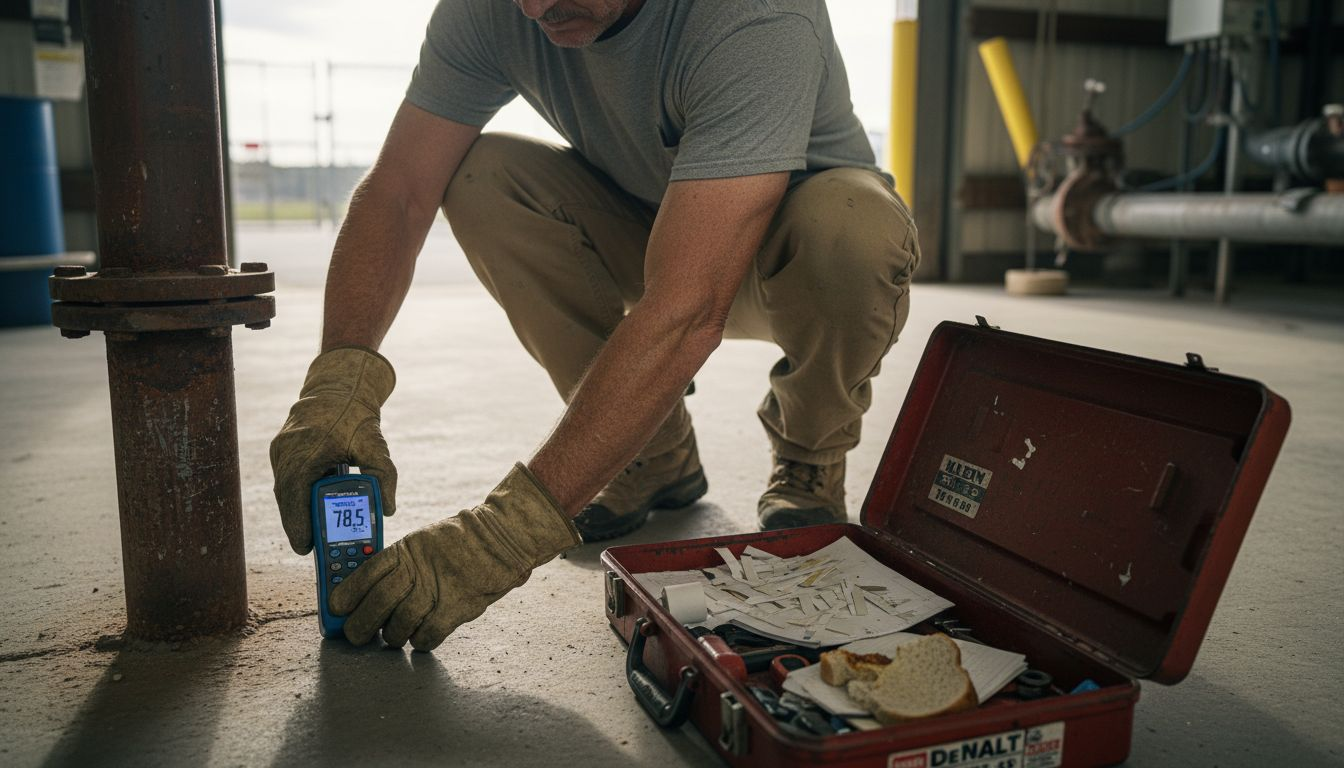
Pro tip: Require contractors to provide baseline surface profile and adhesion testing documentation before coating application, and schedule independent reinspection during surface preparation to verify work meets ASTM standards before final approval.
Key Compliance Challenges and Common Pitfalls
Compliance failures don’t happen because municipalities ignore standards. They happen because the gap between specification and execution widens without attention. When a water tank coating fails in three years instead of the promised fifteen, it’s rarely because the standard was wrong. It’s because something in the preparation, application, or material selection deviated from what standards required. Understanding the most common pitfalls helps you prevent expensive project failures and protect your infrastructure investment.
The coatings industry faces evolving regulatory pressures that affect what contractors can specify and how they apply coatings. Environmental regulations around PFAS elimination and VOC reduction create formulation challenges that impact performance, durability, and cost. A coating that met all standards in 2024 might be reformulated in 2025 to eliminate per-and polyfluoroalkyl substances, which could affect its corrosion resistance or adhesion properties. Central Florida municipalities must understand that newer, compliant formulations sometimes require adjusted surface preparation protocols or application methods. This isn’t a contractor making excuses. It’s the reality of evolving environmental compliance. When you approve a coating, you’re approving the current formulation. If regulations change mid-project, your contractor may need to switch products or adjust specifications.
Inconsistent application and inadequate surface preparation remain the leading causes of coating system failure. Industry standards from PCA and FCA address quality painting practices to prevent these pitfalls, including proper film thickness, cure time verification, and documented surface preparation steps. Most failures trace to one of three errors: contractors failing to remove all mill scale and rust before painting, applying coating in improper temperature or humidity conditions, or applying inadequate film thickness to save time and money. You can have perfect specifications on paper, but if the contractor applies a coating at 35 degrees Fahrenheit when the standard requires 50 degrees minimum, the cure will fail and the coating will eventually peel. Documentation prevents these mistakes. Require contractors to submit daily weather records, surface temperature readings, and film thickness measurements throughout application.
Another common pitfall involves mixing coating products that don’t work together. Using a primer from one manufacturer with a topcoat from another, or applying a new coating over existing coatings without proper compatibility testing, creates adhesion failures that appear months or years after project completion. Contractors sometimes make these substitutions to reduce costs or meet schedule pressures. Specification documents must clearly state that all coating components must be from the same manufacturer’s system unless written approval is provided after compatibility testing. This single requirement prevents more coating failures than almost any other control.
Pro tip: Establish a pre-project meeting requiring the contractor to submit material safety data sheets for all coatings, compatibility certifications between primer and topcoat products, and a detailed application schedule showing temperature, humidity, and cure time verification methods before any work begins.
Ensure Your Infrastructure Meets Industry Standards With Expert Surface Preparation and Coating
Navigating complex industry standards for coatings presents challenges that can cost your municipality time and money if not handled correctly. From strict ASTM requirements to environmental regulations in Central Florida, the key to long-lasting, compliant protective coatings is thorough surface preparation followed by precise application. At Southern Sandblasting & Painting LLC, we understand these critical steps. Our 20+ years of experience delivering professional sandblasting services ensure removal of rust and contaminants to meet SSPC and ASTM surface cleanliness standards. Then our industrial-grade coating applications, backed by industry best practices and compliance knowledge, protect your assets where they face UV exposure, salt air corrosion, and humidity.
Don’t leave your city’s infrastructure vulnerable to premature coating failure or costly rework. Benefit from our expertise in industrial painting designed specifically for Florida’s challenging environment. Connect with us now at https://southernsandblastingandpainting.com to safeguard your critical assets with coatings that meet and exceed 2026 compliance requirements. Act today to ensure your projects pass inspections and stand the test of time.
Frequently Asked Questions
What are industry standards for coatings?
Industry standards for coatings are guidelines that ensure consistency, safety, and reliability in surface protection projects. They define specifications for surface preparation, chemical properties, and performance requirements of coatings used in various applications.
Why are ASTM standards important for municipal coating projects?
ASTM standards provide documented performance benchmarks for coatings, ensuring they meet specific requirements for durability, adhesion, and environmental resistance. This helps municipalities avoid costly failures and ensures accountability from contractors and manufacturers.
How do surface preparation and testing methods impact coating durability?
Proper surface preparation, verified through standardized testing methods, is crucial for coating durability. Failing to prepare surfaces correctly can lead to premature coating failure, making it essential for municipalities to enforce strict preparation and testing standards before application.
What compliance challenges should municipalities consider when specifying coatings?
Municipalities should be aware of evolving environmental regulations and standards, particularly regarding VOC limits and product formulations. Additionally, they must ensure that contractors follow proper surface preparation, application methods, and compatibility requirements to avoid common pitfalls that lead to coating failures.
Recommended
- Protective Coating Trends 2025: Innovations for Infrastructure
- Role of Coatings in Longevity – Extending Asset Lifespans
- 7 Essentials for Your Industrial Coatings Checklist
- How to Maintain Coatings for Long-Lasting Protection
- Commercial Pest Protocols: Ensuring Safe, Compliant Spaces
- Sandblasting Contractor Baldwin Park FL
- Sandblasting Services Oviedo FL


