
TL;DR:
- 78% of epoxy coating failures in Florida result from poor surface preparation.
- Epoxy offers high strength, chemical resistance, and long-lasting moisture barrier benefits essential for Florida.
- Proper oversight and adherence to surface prep standards are critical for coating longevity and success.
Surface preparation failures cause 78% of epoxy coating breakdowns in Florida, yet most facility managers only discover this after a costly re-coat. Florida’s climate is relentless: salt air from the coast, year-round humidity, and flooding cycles that push ordinary coatings past their limits within just a few years. Choosing epoxy is a smart start, but choosing it without understanding the science, the prep requirements, and the contractor standards is where budgets get burned. This guide gives you the evidence-backed framework to make confident coating decisions for your facility or infrastructure project.
Table of Contents
- The science behind epoxy coatings
- Key benefits for Florida infrastructure
- Surface preparation: Why it makes or breaks your coating
- Epoxy compared to other protective coatings
- A facility manager’s perspective: What most guides miss about epoxy coatings
- Connect with Florida’s epoxy and asset protection experts
- Frequently asked questions
Key Takeaways
| Point | Details |
|---|---|
| Superior durability | Epoxy coatings create a seamless, high-strength barrier that withstands heavy use and harsh Florida environments. |
| Surface prep is critical | Most failures result from inadequate prep, making contractor expertise and rigorous standards essential. |
| Cost-effective protection | Epoxy extends asset life, reduces maintenance, and equals long-term savings compared to traditional coatings. |
| Best for demanding facilities | Municipal and commercial projects in Florida benefit most from epoxy’s resilience and chemical resistance. |
The science behind epoxy coatings
Epoxy is not just a tough paint. It is a chemically engineered thermoset polymer, meaning it forms through an irreversible chemical reaction between a resin and a hardener. Once cured, the molecular network is locked in place. It cannot melt, re-flow, or revert to a softer state the way thermoplastic coatings can. That distinction matters enormously for critical infrastructure exposed to thermal cycling, chemical spills, and heavy mechanical loads.
The numbers back this up. Epoxy delivers 10,000 to 14,000 psi compressive strength and 6,000 to 8,000 psi tensile strength, making it one of the strongest protective coatings available for concrete and steel surfaces. Compare that to a standard latex paint, which offers virtually no structural contribution to the substrate beneath it.
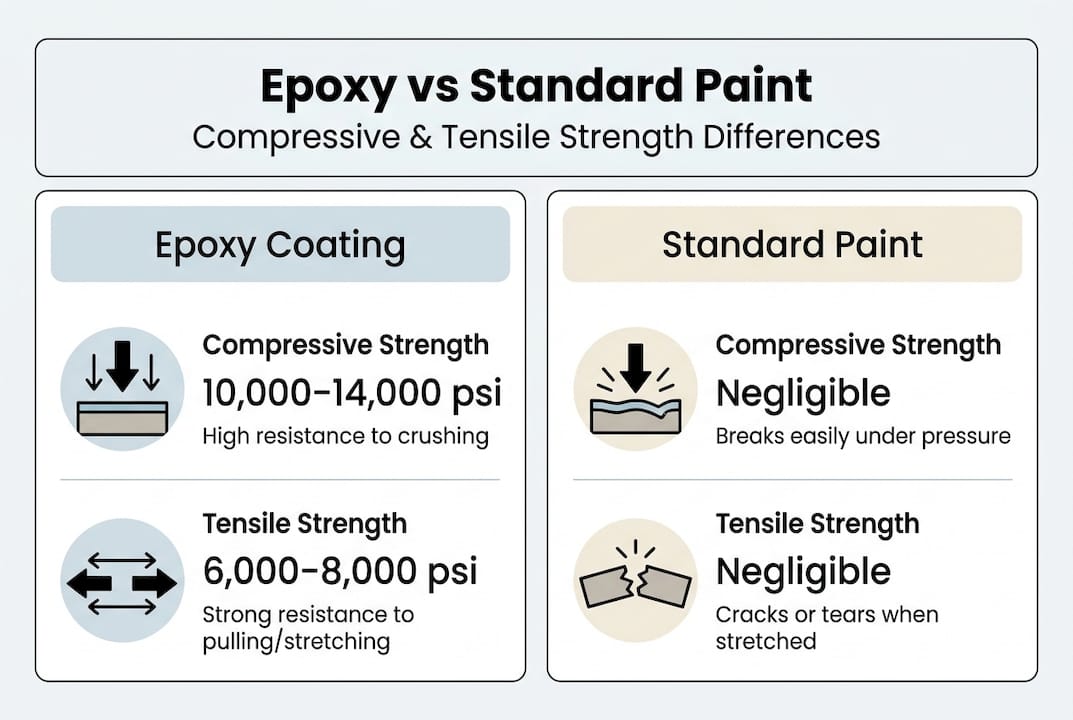
Epoxy performance benchmarks at a glance
| Property | Epoxy coating | Standard paint |
|---|---|---|
| Compressive strength | 10,000–14,000 psi | Negligible |
| Tensile strength | 6,000–8,000 psi | Negligible |
| Surface porosity | Non-porous, seamless | Porous |
| Chemical resistance | High | Low |
| Bond mechanism | Chemical adhesion | Mechanical adhesion |
The seamless, non-porous surface is what sets epoxy apart for moisture-sensitive environments. Unlike paint or sealant, which sit on top of a substrate and can peel or crack, epoxy penetrates and bonds chemically. It creates a continuous barrier with no microscopic gaps for water vapor, chlorides, or acids to migrate through. For water treatment plants, parking structures, and industrial floors in Florida, that barrier is not a luxury. It is a necessity.
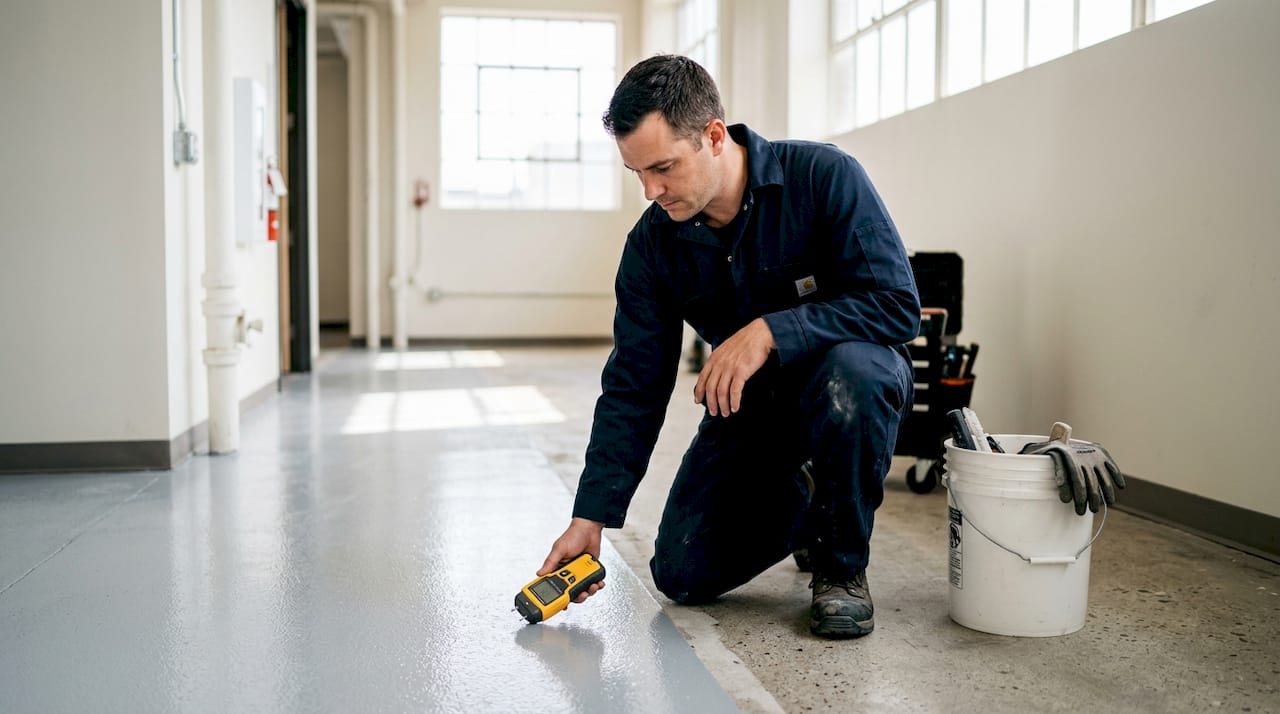
Understanding the coating application steps is equally important because even the best epoxy formulation fails if applied incorrectly. The chemistry only works as intended when the substrate is properly prepared and environmental conditions during application are controlled.
Key benefits for Florida infrastructure
Florida’s environment is uniquely aggressive. Coastal salt air accelerates corrosion on steel and degrades standard coatings faster than in inland regions. Humidity regularly exceeds 80% for months at a time, and seasonal flooding puts concrete and steel assets under hydrostatic pressure that most coatings simply were not designed to handle.
Epoxy bonds chemically and provides seamless, long-lasting protection against moisture and physical stress, which is exactly what Florida facilities need. Here is what that translates to in practical terms:
- Moisture resistance: The non-porous surface prevents water vapor transmission, protecting concrete from spalling and rebar from corrosion.
- Chemical resistance: Epoxy withstands exposure to fuels, oils, acids, and cleaning agents common in municipal and industrial settings.
- Abrasion resistance: High foot traffic, vehicle loads, and equipment movement cause minimal wear on a properly applied epoxy system.
- Impact resistance: Epoxy absorbs and distributes impact energy without cracking or delaminating.
- Longevity: Well-applied epoxy systems routinely last 10 to 20 years, compared to 3 to 5 years for standard industrial paint.
The lifetime cost advantage is significant. A facility that repaints every four years spends far more over two decades than one that invests in a quality epoxy system upfront. Reduced downtime for re-coating also matters in operational environments like airports, water treatment plants, and municipal garages where shutting down a zone carries real cost.
Pro Tip: Before approving any coating project, ask your contractor to walk you through the surface preparation for longevity plan in writing. If they cannot produce one, that is a red flag.
For facilities managing multiple asset types, reviewing asset protection coatings options across different substrates helps you standardize specifications and simplify contractor oversight.
Surface preparation: Why it makes or breaks your coating
Here is the uncomfortable truth about epoxy failures: most of them have nothing to do with the epoxy itself. Poor prep causes 78% of failures in Florida, and concrete preparation to CSP 2 through 6 is critical for proper adhesion. CSP stands for concrete surface profile, a standardized roughness scale used to measure how well a surface is ready to accept a coating.
In Florida’s humid climate, surface prep is even more demanding. Moisture in the concrete substrate can prevent proper chemical bonding, causing the epoxy to blister or delaminate within months. This is why prep is not just a checklist item. It is the single most important variable in your coating project.
Surface prep methods compared
| Method | CSP achieved | Best use case | Florida humidity risk |
|---|---|---|---|
| Shotblasting | CSP 3–6 | Large concrete floors | Low if timed correctly |
| Diamond grinding | CSP 2–4 | Smaller areas, overlays | Moderate |
| Acid etching | CSP 1–2 | Light-duty applications | High (moisture retention) |
| Scarifying | CSP 4–9 | Heavy coatings, overlays | Low |
The steps that matter most before any epoxy application:
- Test the concrete for moisture vapor emission rate (MVER) before scheduling work.
- Remove all existing coatings, oils, and contaminants down to bare concrete.
- Achieve the specified CSP using mechanical methods such as shotblasting or diamond grinding.
- Inspect for cracks, spalls, or voids and repair them before coating.
- Confirm ambient temperature and dew point are within the epoxy manufacturer’s application window.
Pro Tip: Require your contractor to provide a written moisture test result and CSP measurement before they open a single bucket of epoxy. This one step alone can prevent the majority of premature failures.
Reviewing best practices for surface prep gives you a solid baseline for writing your own project specifications. For larger projects, understanding the full surface preparation workflow helps you sequence tasks efficiently. And if you are still weighing whether to blast before coating, the performance data strongly favors it for any substrate exposed to Florida’s conditions.
Epoxy compared to other protective coatings
Not every coating job calls for epoxy, but for most Florida commercial and municipal infrastructure, it is the strongest performer in the field. Understanding how it stacks up against alternatives helps you write better specs and push back on contractors who suggest cheaper substitutes.
Epoxy outperforms acrylics and polyurethanes in compressive and tensile strength and chemical resistance, but each coating type has a legitimate role depending on the application.
Coating comparison for Florida infrastructure
| Coating type | Compressive strength | Chemical resistance | UV stability | Best application |
|---|---|---|---|---|
| Epoxy | 10,000–14,000 psi | Excellent | Poor (yellows) | Floors, tanks, industrial interiors |
| Polyurethane | Moderate | Good | Excellent | Topcoats, exterior surfaces |
| Acrylic | Low | Fair | Good | Light-duty floors, decorative use |
| Polyurea | Very high | Excellent | Good | Secondary containment, fast-cure needs |
Key takeaways for decision-makers:
- Choose epoxy for interior concrete floors, water and wastewater structures, chemical storage areas, and any surface requiring maximum hardness and chemical resistance.
- Layer polyurethane over epoxy on exterior surfaces or areas with UV exposure, since epoxy alone will chalk and yellow outdoors.
- Avoid acrylic for high-traffic or chemically exposed areas in municipal or industrial settings. It simply does not hold up.
- Consider polyurea when fast return-to-service is critical, though it demands even more precise surface prep and skilled applicators.
For a broader view of your options, the types of industrial coatings available in Florida covers substrate-specific recommendations. A side-by-side coating solutions comparison can help you align product selection with project requirements before you go to bid.
A facility manager’s perspective: What most guides miss about epoxy coatings
Most coating guides stop at product specs. They tell you epoxy is strong, moisture-resistant, and long-lasting, then leave you to figure out the rest. What they miss is the organizational side of coating success.
The real reason coating projects fail is not chemistry. It is accountability. Facility managers who get involved early, set clear prep standards in writing, and hold contractors to measurable benchmarks see dramatically better outcomes than those who hand off the project and hope for the best. The industrial coating application steps are not just a contractor’s concern. They are your quality assurance checklist.
Epoxy is not a magic solution you apply and forget. It is the result of a process. When that process is owned by someone who understands the lifecycle cost of failure, the results speak for themselves. Invest in oversight, not just materials.
Connect with Florida’s epoxy and asset protection experts
If you manage commercial or municipal infrastructure in Florida, the stakes are too high to leave coating decisions to chance. Southern Sandblasting & Painting LLC brings 20+ years of hands-on experience with industrial coatings for Florida infrastructure, from water treatment facilities and municipal garages to airports and industrial plants across Central Florida.
Our team follows rigorous surface prep best practices on every project, so you get the full lifespan out of every coating system we apply. Whether you need a consultation, a project spec review, or a full-service quote, our sandblasting and painting services team is ready to help you protect your assets the right way.
Frequently asked questions
How long do epoxy coatings typically last in Florida conditions?
With proper surface preparation, epoxy coatings can last 10 to 20 years even in Florida’s humid, salt-air climate. Skipping or rushing prep is the fastest way to cut that lifespan short.
What causes epoxy coatings to fail most often?
In Florida, 78% of epoxy failures trace back to inadequate surface preparation before application, not product quality. Moisture in the substrate and insufficient concrete surface profile are the top culprits.
Are epoxy coatings safe for municipal water or wastewater facilities?
Yes. Epoxy’s non-porous, seamless barrier makes it a trusted choice for protecting concrete in municipal water and wastewater infrastructure, where chemical exposure and constant moisture are everyday realities.
Can epoxy coatings be applied over old paint or coatings?
Generally, no. Existing coatings must be removed to bare concrete to achieve the concrete surface profile required for proper epoxy adhesion. Applying over old coatings is a common shortcut that leads to premature delamination.
How should I choose a contractor for epoxy coating work in Florida?
Prioritize contractors who provide written moisture test results and CSP measurements before application, and who have documented experience with Florida’s humidity challenges. Local knowledge and strict prep standards matter more than price alone.
Recommended
- Role of Coatings in Longevity – Extending Asset Lifespans
- How to Apply Protective Coatings for Lasting Asset Durability
- What Is Protective Coating and Why Asset Longevity Depends On It
- How to Maintain Coatings for Long-Lasting Protection
- Garage building types 2026: 4 options with 20-50 year warranties
- Industrial Painting Services in Orlando, FL
- Sandblasting Services in Orlando, FL


