
Over half of American municipal assets in Central Florida face premature deterioration due to inadequate surface preparation and coating selection. Every infrastructure manager knows that small oversights can lead to costly repairs and compliance headaches. This guide reveals proven step-by-step methods for protective coating application, helping you extend asset life, meet local standards, and prevent failures before they start.
Table of Contents
- Step 1: Assess and Prepare Surfaces Thoroughly
- Step 2: Select and Mix Protective Coatings Properly
- Step 3: Apply Coatings Using Industry-Standard Techniques
- Step 4: Monitor Curing and Environmental Conditions
- Step 5: Inspect and Test Final Coating Quality
Quick Summary
| Key Point | Explanation |
|---|---|
| 1. Thorough Surface Preparation Is Crucial | Proper surface cleaning optimizes coating adhesion and longevity. Techniques include abrasive blasting and chemical treatments tailored to specific contaminants. |
| 2. Choose the Right Coating System | The coating must align with environmental conditions and substrate characteristics. Consider factors like corrosion resistance and temperature exposure. |
| 3. Follow Industry-Standard Application Techniques | Application method should match coating type and surface conditions. Controlled application prevents defects and ensures uniform coverage. |
| 4. Monitor Curing Conditions Diligently | Environmental factors like temperature and humidity significantly affect curing. Maintain ideal conditions to ensure proper hardening for maximum performance. |
| 5. Conduct Comprehensive Inspection and Testing | Final inspection validates coating integrity through visual checks, thickness measurement, and adhesion tests, ensuring protective effectiveness against environmental challenges. |
Step 1: Assess and Prepare Surfaces Thoroughly
Surface preparation is the foundation for successful protective coating application. Your goal is to create an optimal surface condition that ensures maximum coating adhesion and long-term performance. Thorough preparation involves multiple strategic steps to remove contaminants and create the ideal surface profile for coating application.
Begin by conducting a comprehensive surface inspection that identifies existing conditions. Look for rust, old paint, mill scale, grease, oils, and other potential contaminants that could compromise coating performance. Surface preparation techniques from ISO 12944 standards recommend systematic removal of these elements through mechanical or chemical methods. Blasting with abrasive materials or using chemical treatments can effectively clean metal surfaces, removing oxides and creating a microscopic profile that enhances coating adhesion.
Carefully evaluate the surface texture after cleaning. The ideal surface profile allows sufficient mechanical interlocking between the substrate and coating. Use profilometers or comparison gauges to measure surface roughness and ensure you meet coating manufacturer specifications. Different coating systems require specific surface profiles ranging from near-white metal to commercial blast cleaning standards.
Pro tip: Always document your surface preparation process with detailed photographs and measurements to provide a clear record for quality control and future maintenance tracking.
Here’s a summary of common surface preparation methods and their best-use scenarios:
| Method | Best For | Advantages | Limitations |
|---|---|---|---|
| Abrasive Blasting | Heavily rusted metal | Deep cleaning, creates rough profile | Requires containment, noisy |
| Chemical Treatments | Oil/grease contaminated | Penetrates oils, effective removal | Chemical hazards, disposal |
| Manual Cleaning | Light contamination | Low cost, simple tools | Labor intensive, less consistent |
| Power Tool Cleaning | Minor rust or paint | Fast for small areas | May miss fine contaminants |
Step 2: Select and Mix Protective Coatings Properly
Selecting the right protective coating is critical to ensuring long-term asset durability and performance. Your coating selection must account for specific environmental conditions, substrate characteristics, and intended protective requirements for your infrastructure project.
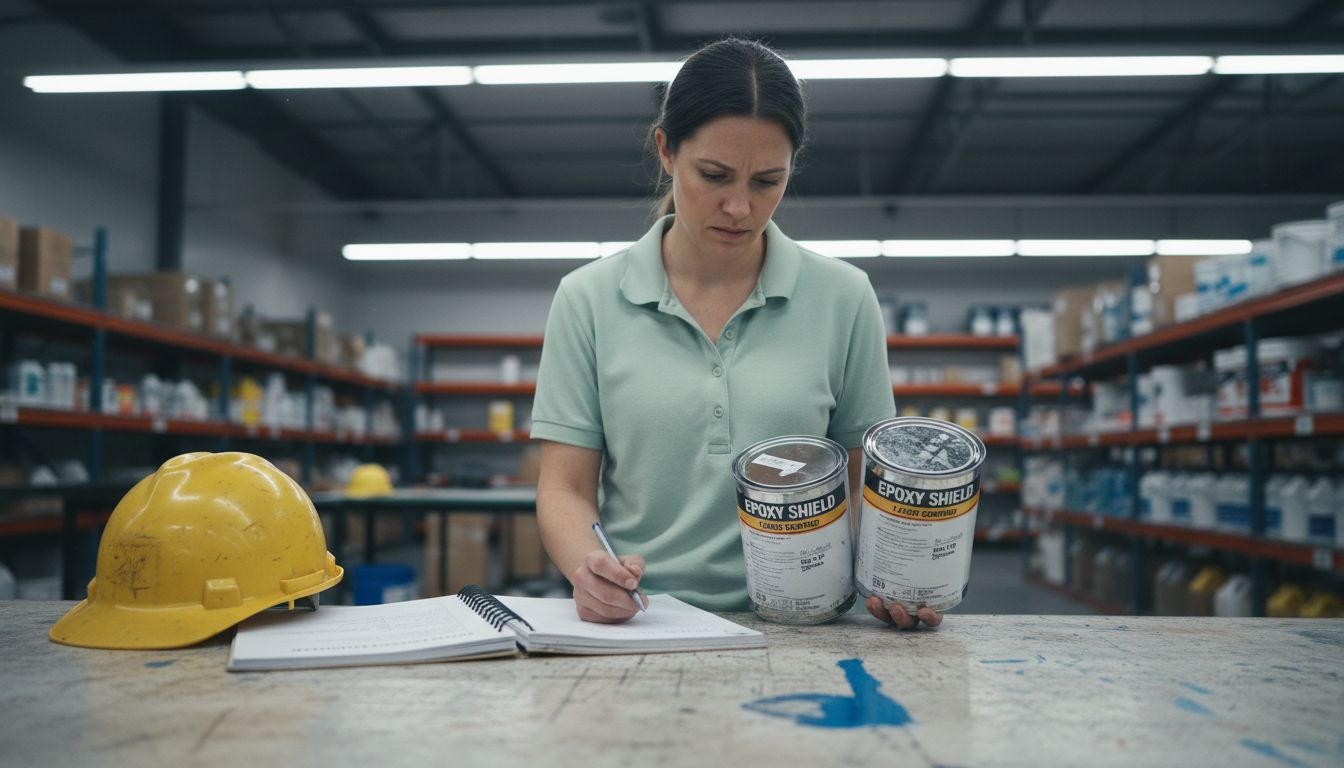
Begin by thoroughly analyzing the surface material and anticipated environmental exposures. Coating selection depends on multiple technical factors including substrate type, temperature ranges, chemical exposure, and potential mechanical stress. Different environments require specialized coating formulations industrial settings might need corrosion resistant epoxies, while coastal areas demand marine grade protective systems with enhanced salt resistance.
Mixing protective coatings requires precision and attention to manufacturer specifications. Carefully measure each component according to technical data sheets, maintaining exact ratios of base materials, hardeners, and additives. Use clean mixing containers and mechanical mixers designed to create uniform distribution without introducing air bubbles. Maintain recommended mixing temperatures and durations to ensure chemical compatibility and optimal coating performance.
Pro tip: Always keep detailed batch records documenting mixing conditions, component ratios, and environmental parameters to track coating performance and support future maintenance strategies.
Step 3: Apply Coatings Using Industry-Standard Techniques
Applying protective coatings requires precision and strategic technique to ensure maximum asset durability and performance. Your application method must match the specific coating type, substrate characteristics, and environmental conditions you are working within.
Coating application techniques vary based on project requirements including spray, brush, roller, and electrostatic methods. Professional applicators typically choose spray application for large surface areas to achieve uniform coverage and consistent film thickness. Select equipment calibrated for your specific coating viscosity and ensure proper nozzle size and air pressure to create optimal droplet distribution. Maintain consistent motion and overlap each spray pass by approximately 50% to prevent thin spots or uneven coverage.
Environmental conditions play a critical role during coating application. Monitor ambient temperature, humidity, and surface temperature to prevent potential defects like blistering, runs, or inadequate adhesion. Ideal application conditions typically range between 50 to 85 degrees Fahrenheit with relative humidity below 85%. Use climate controlled environments when possible and implement careful environmental monitoring throughout the coating process.
Pro tip: Always perform a small test application on a representative surface sample to validate coating performance and application technique before executing your full project.
Step 4: Monitor Curing and Environmental Conditions
Curing is a critical phase where your protective coating transforms from a liquid application to a fully hardened protective barrier. Successful monitoring ensures the coating achieves maximum durability and performance characteristics across your infrastructure project.
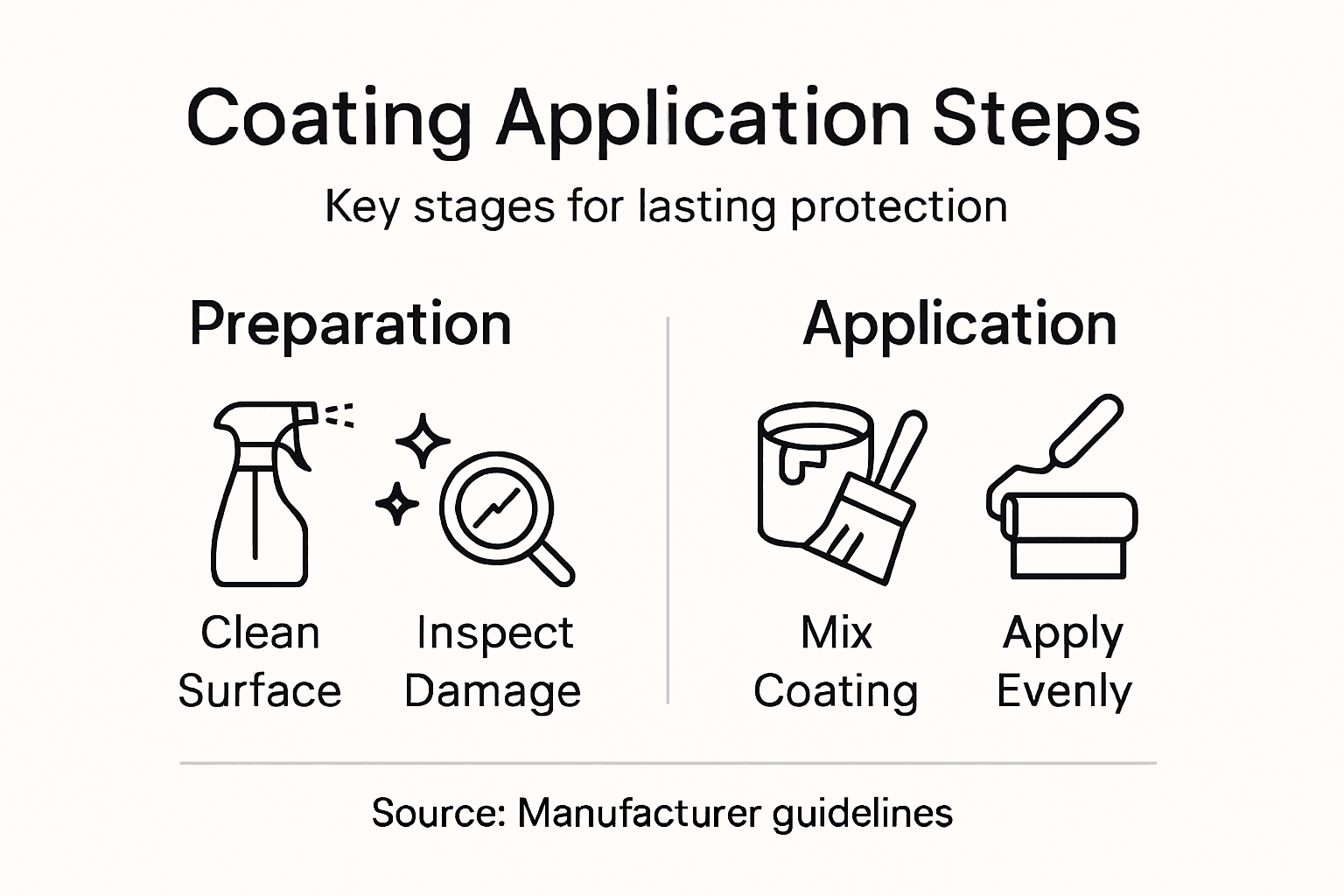
Coating curing involves precise environmental control to guarantee proper chemical crosslinking and optimal performance. Temperature plays a crucial role temperature ranges between 60 and 80 degrees Fahrenheit provide ideal curing conditions. Use digital thermometers and hygrometers to continuously track ambient temperature and humidity levels. Maintain consistent airflow without direct drafts that could disrupt the curing process. Track time requirements specific to your coating system most industrial coatings require 24 to 48 hours of controlled environmental conditions to achieve full chemical hardening.
Implement systematic testing protocols to verify coating cure progression. Conduct solvent resistance tests by gently rubbing a small solvent saturated cloth across the coating surface. A properly cured coating will show minimal material removal and maintain its structural integrity. Document environmental conditions temperature, humidity, and airflow during each stage to create a comprehensive quality control record that supports long term asset maintenance strategies.
Pro tip: Keep detailed environmental logs and coating manufacturer specification sheets together to quickly reference ideal curing parameters for future projects.
Step 5: Inspect and Test Final Coating Quality
Inspecting and testing your protective coating represents the final critical step in ensuring long-term asset durability and performance. Your comprehensive evaluation will validate the coating’s structural integrity and confirm its ability to protect infrastructure against environmental challenges.
Coating inspection programs require systematic assessment of multiple quality parameters. Begin with visual inspection to identify surface irregularities like pinholes, runs, sags, or uneven coverage. Measure coating thickness using digital micrometers at multiple points to verify consistent application across the entire surface. Conduct adhesion tests by performing crosshatch or pull-off tests that evaluate the coating’s bonding strength to the substrate. Check for potential contaminants using specialized surface contamination detection methods that identify residual salts or particulate matter that could compromise coating performance.
Utilize precision measurement tools and follow standardized testing protocols to document your findings. Employ digital imaging and detailed measurement techniques to create a comprehensive quality assurance record. Pay special attention to areas with complex geometries or high stress potential. Compare your test results against original coating specifications and manufacturer recommended performance standards to ensure complete compliance and optimal protective characteristics.
Pro tip: Invest in calibrated measurement equipment and maintain detailed photographic documentation to create a robust quality control archive that supports future maintenance and warranty claims.
This table highlights key coating quality tests and what they evaluate:
| Test Type | Main Purpose | What It Measures | Equipment Needed |
|---|---|---|---|
| Visual Inspection | Detect surface flaws | Pinholes, sags, uniformity | Magnifier, camera |
| Thickness Test | Confirm coat uniformity | Film thickness at multiple spots | Digital micrometer |
| Adhesion Test | Verify bonding strength | Pull-off/crosshatch performance | Adhesion tester |
| Solvent Resistance | Assess cure completion | Surface durability to solvents | Solvent, clean cloth |
Ensure Lasting Asset Protection with Expert Surface Preparation and Coatings
Applying protective coatings properly begins with thorough surface preparation and precise application techniques. If rust, contamination, or inconsistent coating threaten the durability of your critical infrastructure, it is essential to partner with trusted professionals who understand these challenges and deliver proven solutions. From abrasive blasting that eliminates stubborn rust and mill scale to industrial-grade painting designed for harsh environments, every step plays a vital role in maximizing asset lifespan and minimizing costly maintenance.
Trust Southern Sandblasting & Painting LLC to bring over 20 years of specialized expertise to your project. Explore our Sandblasting services to prepare surfaces with precision. Then, enhance protection with our expert Industrial Painting applications tailored to your environment. Ready to safeguard your assets with the highest standards in Central Florida Reach out today at https://southernsandblastingandpainting.com and make your infrastructure stand the test of time.
Frequently Asked Questions
How do I assess and prepare surfaces before applying protective coatings?
To assess and prepare surfaces effectively, start by conducting a comprehensive inspection for contaminants like rust, grease, or old paint. Remove these elements using methods such as abrasive blasting or chemical treatments to create an optimal surface profile for better adhesion.
What factors should I consider when selecting protective coatings?
When selecting protective coatings, consider the environmental conditions, substrate characteristics, and the specific protective requirements for your project. Evaluate factors such as temperature range, chemical exposure, and potential mechanical stress to ensure you choose the right formulation.
How can I ensure proper mixing of protective coatings?
Ensure proper mixing of protective coatings by carefully measuring each component according to the manufacturer’s specifications and maintaining exact ratios. Use clean mixing containers and mixers designed to distribute materials uniformly, and maintain recommended mixing temperatures to reach optimal performance.
What application techniques are best for applying protective coatings?
The best application techniques include spray, brush, or roller methods depending on the coating type and the project’s requirements. For large areas, use spray application to achieve even coverage and maintain consistent overlap to avoid thin spots.
How do I monitor the curing process of protective coatings?
To monitor the curing process, track environmental conditions such as temperature and humidity, as they significantly affect curing effectiveness. Use digital thermometers and hygrometers, ensuring that conditions remain optimal, typically between 60 to 80 degrees Fahrenheit, for at least 24 to 48 hours.
What steps should I take to inspect the quality of the final coating?
To inspect the quality of the final coating, conduct a thorough visual inspection for defects, measure the coating thickness at multiple points, and perform adhesion tests to check bonding strength. Document your findings carefully to ensure compliance with performance standards and support future maintenance efforts.
Recommended
- Role of Coatings in Longevity – Extending Asset Lifespans
- What Is Protective Coating and Why Asset Longevity Depends On It
- Protective Coating Trends 2025: Innovations for Infrastructure
- Complete Guide to Asset Protection Coatings for Infrastructure
- Wooden Window Maintenance Explained: Complete Guide
- Industrial Painting Services in Orlando, FL
- Sandblasting Services Orlando FL


