
TL;DR:
- Powder coating provides a durable, long-lasting protective layer ideal for outdoor infrastructure in Florida.
- Proper surface prep and application techniques are critical to avoid thin coverage and ensure coating performance.
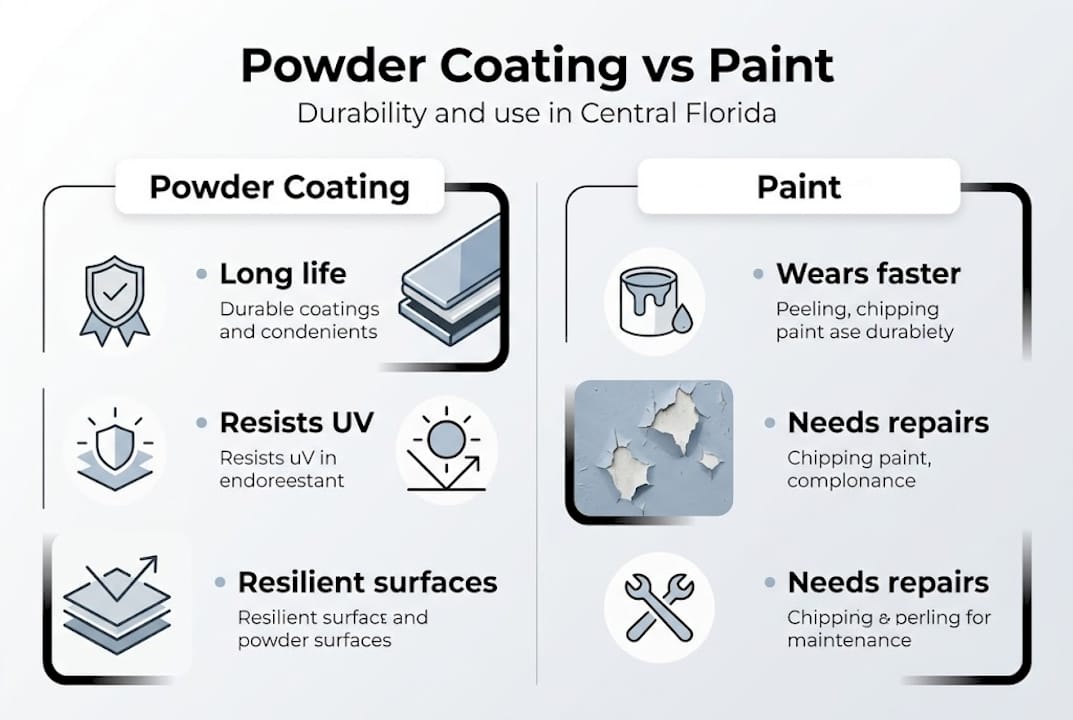
- It offers superior resistance to salt, UV, impact, and abrasion compared to liquid paint, reducing maintenance costs.
Many facility managers assume that a fresh coat of industrial paint is enough to protect their municipal assets from Florida’s relentless heat, humidity, and salt air. It is not. Standard liquid paint chips, fades, and corrodes far faster than most lifecycle budgets account for. Powder coating is a dry finishing process that cures into a harder, more uniform protective layer, and it outperforms liquid paint on virtually every durability metric that matters for exposed infrastructure. This guide walks you through exactly how powder coating works, where it excels, where it has limits, and how to specify it correctly for your next project.
Table of Contents
- Powder coating basics: Process and principles
- Key advantages of powder coating for facility managers
- Limits and challenges: Edge cases, coverage, and Faraday effect
- Where powder coating excels: Best-use scenarios and specification tips
- A seasoned perspective: What most coating specs overlook
- Get expert help for your Central Florida assets
- Frequently asked questions
Key Takeaways
| Point | Details |
|---|---|
| Superior durability | Powder coating lasts longer than paint, resisting impacts and weather effectively. |
| Lower maintenance needs | Powder coated surfaces require less frequent repairs and upkeep compared to liquid paint. |
| Edge case awareness | Addressing the Faraday cage effect and complex geometries ensures full coverage and performance. |
| Sustainability benefits | Powder coating produces fewer emissions and supports green building standards. |
Powder coating basics: Process and principles
Powder coating is not paint. That distinction matters from the moment you write a specification. Where liquid paint relies on solvents to carry pigment onto a surface, powder coating uses electrostatically charged dry particles. Those particles are sprayed onto a grounded metal substrate, cling to the surface without running or sagging, and are then baked in a curing oven at temperatures between 325 and 450 degrees Fahrenheit. The heat melts the powder and triggers a chemical cross-linking reaction that forms a continuous, seamless film. The result is a finish that is measurably tougher than most liquid coatings.
For facility managers overseeing assets in Central Florida, that process matters because the cured film resists UV degradation, moisture intrusion, and the kind of thermal cycling that accelerates coating failure on outdoor infrastructure. A properly applying protective coatings process combined with powder coating can extend asset service life significantly compared to conventional paint systems.
Here is a simplified view of what a standard powder coating process involves:
- Surface cleaning: Remove all rust, mill scale, grease, and existing coatings, typically through abrasive blasting or chemical pretreatment.
- Pretreatment: Apply a phosphate or chrome-free conversion coating to improve adhesion and corrosion resistance.
- Powder application: Use an electrostatic spray gun to deposit charged powder particles onto the grounded part.
- Curing: Move the part into an oven and hold it at the required temperature for the specified dwell time.
- Inspection: Check film thickness, adhesion, and appearance before the part leaves the shop.
| Stage | Key quality factor | Common failure point |
|---|---|---|
| Surface prep | Cleanliness and profile | Skipped or rushed blasting |
| Pretreatment | Chemical coverage | Missed corners and welds |
| Application | Consistent film build | Faraday-shielded areas |
| Curing | Temperature uniformity | Cold spots in the oven |
| Inspection | Film thickness verification | No test panel used |
Typical municipal applications include powder-coated handrails, park benches, traffic signage frames, bollards, and light poles. Each of these assets sees direct sun and rain daily in Florida, which is precisely where powder coating earns its keep.

Pro Tip: Surface preparation is responsible for roughly 80% of coating performance. Skipping or shortcutting the blast profile before powder application is the single fastest way to waste your coating budget.
Key advantages of powder coating for facility managers
The practical case for powder coating starts with durability and ends with total cost of ownership. Liquid paint systems on outdoor metal infrastructure often require recoating every three to five years in Florida’s climate. A well-applied powder coating system on the same asset can last 15 to 20 years with minimal maintenance. That gap in service intervals translates directly into reduced labor costs, fewer project mobilizations, and less disruption to your operations.
Beyond longevity, powder coating offers a set of protective coating advantages that matter for specific municipal risks:
- Salt spray resistance: Critical for coastal and near-coastal Central Florida properties where airborne chlorides accelerate metal corrosion.
- Chemical resistance: Municipal water treatment facilities, parking structures, and maintenance yards expose metal assets to fuel, cleaners, and mild acids.
- Impact and abrasion resistance: Powder-coated bollards and fencing take repeated physical contact far better than liquid paint.
- Chip resistance: Unlike liquid paint, powder coating is less likely to crack and peel in ways that expose bare metal to moisture.
- UV stability: Outdoor furniture and signage retain color and gloss far longer under Florida’s intense sun when coated with UV-stabilized powder formulations.
The sustainability profile matters too, particularly for municipalities pursuing green certifications. Powder coating contains coating longevity benefits alongside near-zero volatile organic compound (VOC) emissions, since the process uses no solvents. Overspray is also reclaimed and reused, reducing material waste compared to liquid spray painting. These characteristics can support LEED credit documentation and help procurement officers meet environmental compliance targets.
Pro Tip: Schedule a baseline inspection 12 months after installation rather than waiting for visible failure. Catching minor film damage early costs a fraction of what a full recoat project does after corrosion sets in.
Limits and challenges: Edge cases, coverage, and Faraday effect
Powder coating has real technical limits, and understanding them is what separates a successful specification from a costly field problem. The most significant challenge on complex geometry is the Faraday cage effect. In simple terms, the electrostatic field that attracts charged powder particles to a grounded surface becomes disrupted inside corners, recesses, and deep channels. The existing charge on the deposited powder repels incoming particles before they can reach the interior surfaces, resulting in thin or bare spots.
Faraday cage effect thin coverage in corners and recesses can range from 0.5 to 1 mil, while flat exterior surfaces consistently achieve 2 to 3 mil of build. On a park bench frame or a welded steel bollard, those recesses and welds are exactly where corrosion will initiate if film thickness is inadequate.
“Key edge cases include Faraday cage effect causing thin coverage in corners, recesses, and sharp edges (0.5-1 mil vs 2-3 mil on flats); mitigated by lower voltage, preheating, tribo guns, or two-coat systems.”
Mitigation options exist and experienced applicators use them routinely. Lowering the electrostatic voltage reduces the repulsion effect and allows powder to penetrate deeper into recesses. Preheating the part before application improves powder flow into tight areas. Tribo guns, which charge powder through friction rather than a high-voltage field, sidestep the Faraday problem on some geometries. Two-coat systems add a primer layer that ensures minimum film build on problem areas before the topcoat is applied.
| Factor | Strength | Challenge |
|---|---|---|
| Flat surfaces | Consistent 2-3 mil build | N/A |
| Corners and recesses | Mitigated with proper technique | Thin coverage risk (0.5-1 mil) |
| VOC emissions | Near zero | N/A |
| Part size | Large fabrications coat efficiently | Oven size limits very large parts |
| Repair | Field touch-up possible | Full recoat requires stripping |
This is exactly why complex municipal assets like fabricated steel light poles, intricate railing systems, and welded equipment frames require applicators with direct experience in surface prep for coatings and Faraday mitigation. A contractor who simply sprays and bakes without addressing geometry risks is setting your asset up for premature failure.
Where powder coating excels: Best-use scenarios and specification tips
Knowing where powder coating delivers the most value helps procurement officers write better specifications and avoid expensive mismatches. The asset types that benefit most are those made from steel or aluminum, exposed to the elements, subject to physical contact, and expected to remain in service for a decade or more without recoating.
Ideal applications for Central Florida municipal and commercial properties include:
- Playground equipment: High abrasion, UV exposure, and safety appearance standards make powder coating the clear choice.
- Park benches and picnic tables: Powder-coated steel resists the combination of wet grass, rainfall, and direct sun far better than painted steel.
- Fencing and bollards: Physical impact from vehicles and pedestrian traffic demands a finish that will not chip and expose bare metal.
- Light poles: Tall poles face full sun on all sides. UV-stable polyester powder systems maintain appearance and corrosion protection for years.
- Handrails and safety barriers: Regulatory appearance requirements and safety implications make durable coatings non-negotiable.
When deciding between powder coating and other systems, consider the exposure environment, expected abrasion, appearance requirements, and total budget over the asset’s service life. For assets exposed to waterproofing surface preparation conditions or standing water, pairing powder coating with appropriate substrate treatment is critical to preventing undercutting corrosion.
For infrastructure coating explained projects with complex geometry or unusual exposure conditions, the best specifications are written collaboratively between the facility manager, the coating supplier, and the application contractor. A specification checklist should address environment type (coastal, inland, industrial), expected maintenance intervals, minimum film thickness by surface type, performance testing requirements, and inspection protocols at delivery.
A seasoned perspective: What most coating specs overlook
After more than 20 years working on municipal and commercial assets across Central Florida, we have seen the same pattern repeat. A facility manager receives a manufacturer’s spec sheet showing a 15-year service life and writes that number into the project budget. Three years later, they are calling for early recoating because the spec sheet never accounted for the actual geometry of the asset, the quality of surface prep in the field, or the severity of Florida’s coastal humidity.
Spec sheets describe ideal conditions. Real projects do not deliver them. Push your coating contractor to provide test panels on representative samples of the actual asset geometry, not flat coupons from a laboratory. Require film thickness readings at corners and welds, not just flat faces.
Florida’s seasonal rainfall and UV cycles accelerate coating wear in ways that northern-climate specs do not capture. Build inspection audits into your coating maintenance guidance program on a 12 to 18 month cycle rather than waiting for visible failure. Real maintenance schedules tied to actual site conditions will always outperform theoretical lifespans for asset managers working within fixed budgets.
Get expert help for your Central Florida assets
Powder coating delivers measurable advantages for municipal and commercial infrastructure, but only when the surface preparation, application technique, and inspection protocols are executed correctly for your specific assets and environment.

Southern Sandblasting & Painting LLC brings over 20 years of hands-on experience preparing and coating complex infrastructure across Central Florida. From sandblasting and pretreatment through final inspection, we manage every step with the precision your assets require. Explore our full range of industrial coatings for Florida infrastructure projects, or review the types of industrial coatings we apply to help you match the right system to your specific project conditions. Contact us to discuss your next project.
Frequently asked questions
What is powder coating and how does it differ from paint?
Powder coating is a dry finishing process where electrostatically charged particles are baked onto a metal surface, forming a tough, seamless layer. Unlike liquid paint, it contains no solvents and cures into a significantly harder, more durable film.
How does powder coating hold up in Florida’s humid climate?
Powder coating resists humidity, corrosion, and UV exposure far better than liquid paint because the cured film is chemically cross-linked and non-porous. This makes it especially well-suited for Central Florida’s outdoor infrastructure exposed to daily rain and intense sun.
What is the Faraday cage effect in powder coating?
The Faraday cage effect causes powder to deposit too thinly in corners, recesses, and sharp edges, sometimes as low as 0.5 to 1 mil versus 2 to 3 mil on flat surfaces. Experienced applicators mitigate this using lower voltage settings, preheating, tribo guns, or two-coat systems.
What surfaces are best suited for powder coating?
Steel and aluminum surfaces on fences, benches, light poles, bollards, and playground equipment benefit most from powder coating because of its superior impact resistance and long-term corrosion protection.
Can powder coated surfaces be repaired?
Minor damage can be addressed with touch-up powder products or compatible liquid coatings, but the best strategy is a proactive inspection program that catches film degradation before bare metal is exposed.


