

TL;DR:
- Florida’s harsh environment accelerates corrosion, biofilm growth, and coating degradation in water tanks.
- Proper interior and exterior coatings are essential for water safety, durability, and long-term asset protection.
- Using specialized, certified coatings and proper application techniques can extend tank lifespan to 30+ years.
Even the cleanest-looking water tank can be quietly failing. Beneath a smooth exterior, unprotected steel corrodes, biofilm grows, and metal particles leach into drinking water before anyone notices a problem. For Florida’s municipal infrastructure managers and facility operators, painting a water tank is not a cosmetic decision. It is a structural and public health decision. Florida’s climate is one of the most aggressive in the country for metal infrastructure, and the cost of ignoring a tank’s coating system can run into the millions. This article breaks down exactly why coating matters, what the best options are, and how to protect your assets for the long term.
Table of Contents
- The real threats to Florida water tanks
- How interior and exterior coatings work
- Specialized coatings: What Florida tanks really need
- The bottom-line impact: Lifespan, maintenance, and safe water
- Our take: What most Florida infrastructure managers overlook
- Protect your water tanks with expert painting and coatings
- Frequently asked questions
Key Takeaways
| Point | Details |
|---|---|
| Critical infrastructure protection | Painting water tanks is key to preventing corrosion, compliance risks, and water quality problems in Florida’s harsh environment. |
| Modern coatings extend lifespan | Specialized coatings can give Florida tanks over 30 years of safe, reliable service with proper selection and application. |
| Compliance ensures safety | Choosing coatings that meet NSF/ANSI and AWWA standards guarantees both water safety and regulatory peace of mind. |
| Cost savings over time | Investing in quality coatings and professional application reduces long-term maintenance and replacement costs dramatically. |
The real threats to Florida water tanks
Florida is not a forgiving environment for metal infrastructure. Your tanks face a combination of stressors that most other states simply do not deal with at the same intensity or frequency. Understanding these threats is the first step toward making smart coating decisions.
Here is what your tanks are up against every single day:
- Year-round humidity: Florida’s average relative humidity sits above 70% for most of the year, accelerating oxidation on any exposed steel surface.
- Salt air penetration: Even tanks located 50 or more miles inland are exposed to salt-laden air carried by Gulf and Atlantic weather systems. Salt is one of the most aggressive accelerants of steel corrosion.
- Intense UV radiation: Florida receives more solar radiation than almost any other state. UV breaks down unprotected coatings and weakens the surface beneath them.
- Frequent storm cycles: Heavy rain, wind-driven debris, and pressure changes during storm season create repeated mechanical stress on tank surfaces.
- Temperature swings: While Florida avoids extreme cold, daily and seasonal temperature cycles cause metal to expand and contract, opening micro-cracks in degraded coatings.
A single breach in a coating system, even a pinhole, is enough to start a corrosion cycle that spreads rapidly beneath the surface. Once rust forms under a coating, it lifts the surrounding material and accelerates the damage exponentially. Beyond the structural risk, breached interior coatings allow bacteria and biofilm to colonize the tank walls, directly threatening water quality.
Exterior coatings shield against UV, humidity, salt spray, and temperature fluctuations, making them essential rather than optional for Florida’s coastal and humid conditions.
Understanding municipal infrastructure coating basics helps operators see why surface protection is a system, not a single product. The right coating acts as a continuous barrier, and when it is properly applied and maintained, it keeps corrosion, contamination, and structural failure at bay for decades. Choosing the right water tank coating types for your specific environment is where the real decision-making begins.
How interior and exterior coatings work
Not all coatings do the same job. Interior and exterior systems are engineered for completely different threats, and confusing the two or skimping on either one creates serious risk.
Interior coatings protect potable water quality by preventing metal leaching and blocking contaminants, and they must comply with NSF/ANSI 61 and AWWA D102 standards. These are not optional benchmarks. They are the regulatory floor for any tank that holds drinking water.
Here is a direct comparison of how the two systems differ:
| Feature | Interior coatings | Exterior coatings |
|---|---|---|
| Primary function | Prevent metal leaching, block biofilm | Shield against UV, salt, moisture, and impact |
| Key standards | NSF/ANSI 61, AWWA D102 | SSPC, manufacturer specs |
| Typical products | Epoxy linings, polyurethane | Fluoropolymers, alkyd, acrylic |
| Compliance focus | Drinking water safety | Structural and weather protection |
| Failure consequence | Water contamination | Corrosion, structural damage |
The benefits of asset coating go well beyond compliance. Interior coatings create a smooth, non-porous surface that resists biofilm adhesion, making routine cleaning faster and more effective. Exterior coatings reduce the rate of steel degradation so dramatically that a properly coated tank can outlast an uncoated one by 20 years or more.
For municipal water tank coatings, the specification process matters as much as the product itself. Surface preparation, application temperature, cure time, and film thickness all determine whether a coating performs as designed or fails prematurely.
Pro Tip: Always verify NSF/ANSI 61 and NSF/ANSI 600 compliance for any coating used in potable water applications. Ask your contractor for the product’s certification documentation before work begins, not after.
The coating advantages for managers are clearest when you look at lifecycle costs. A well-specified coating system costs more upfront than a generic paint job, but it avoids the emergency repairs, regulatory fines, and public health incidents that follow coating failures.
Specialized coatings: What Florida tanks really need
Generic industrial coatings are not built for Florida. The state’s combination of UV intensity, salt exposure, and humidity demands products engineered for extreme environments.
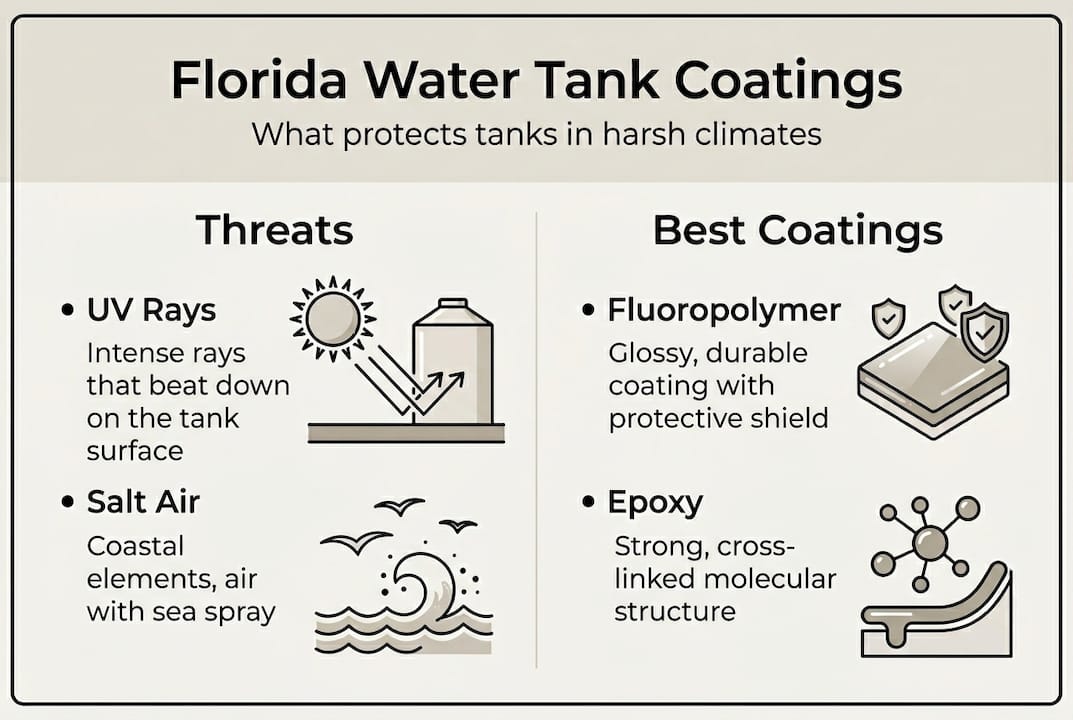
Coastal Florida tanks benefit from UV and chemical-resistant fluoropolymers such as HydroFlon with LUMIFLON, which can deliver 30-plus year service cycles without requiring a clear coat. That is a significant advantage over standard epoxy systems that may need recoating every 10 to 12 years in harsh conditions.
Here is a breakdown of coating options suited to Florida’s environment:
| Coating type | Typical lifespan | Best use case | Compliance |
|---|---|---|---|
| Fluoropolymer (HydroFlon) | 30+ years | Coastal, high-UV exposure | NSF 61, AWWA D102 |
| High-build epoxy | 15 to 20 years | Interior lining, potable water | NSF/ANSI 61 |
| Polyurethane topcoat | 10 to 15 years | Exterior finish over epoxy primer | SSPC |
| Zinc-rich primer | 20+ years | Corrosion control on steel | SSPC-PA 1 |
Beyond product selection, application technique is where many projects succeed or fail. Stripe coating is essential for high-risk areas such as welds, seams, and ladder connection points. These areas have irregular geometry that causes standard spray application to leave thin spots. A stripe coat, applied by brush before the main coat, ensures full coverage where failure is most likely to start.
Key features to verify with any contractor before signing off on a Florida water tank project:
- NSF/ANSI 61 and 600 certification for all interior products
- AWWA D102 compliance for application methods
- Stripe coating specified for all welds and seams
- Surface preparation to SSPC-SP 6 minimum, ideally SSPC-SP 10
- Low-VOC formulations to meet Florida environmental regulations
- Fast-cure options to minimize service interruption
Pro Tip: Fast-cure, low-VOC coatings reduce tank downtime and limit environmental impact. In Florida, where tanks often cannot be taken offline for extended periods, cure time is a real operational variable, not just a product spec.
Exploring coating types for Florida and reviewing protective coating options for related infrastructure can help managers build a consistent asset protection strategy across their entire system.
The bottom-line impact: Lifespan, maintenance, and safe water
The numbers make a compelling case. Painted and coated tanks in Florida routinely reach 30 or more years of service life. Uncoated or poorly coated tanks often require major intervention within 10 to 15 years. That is a 15-to-20-year difference in asset life, which translates directly into capital budget savings.
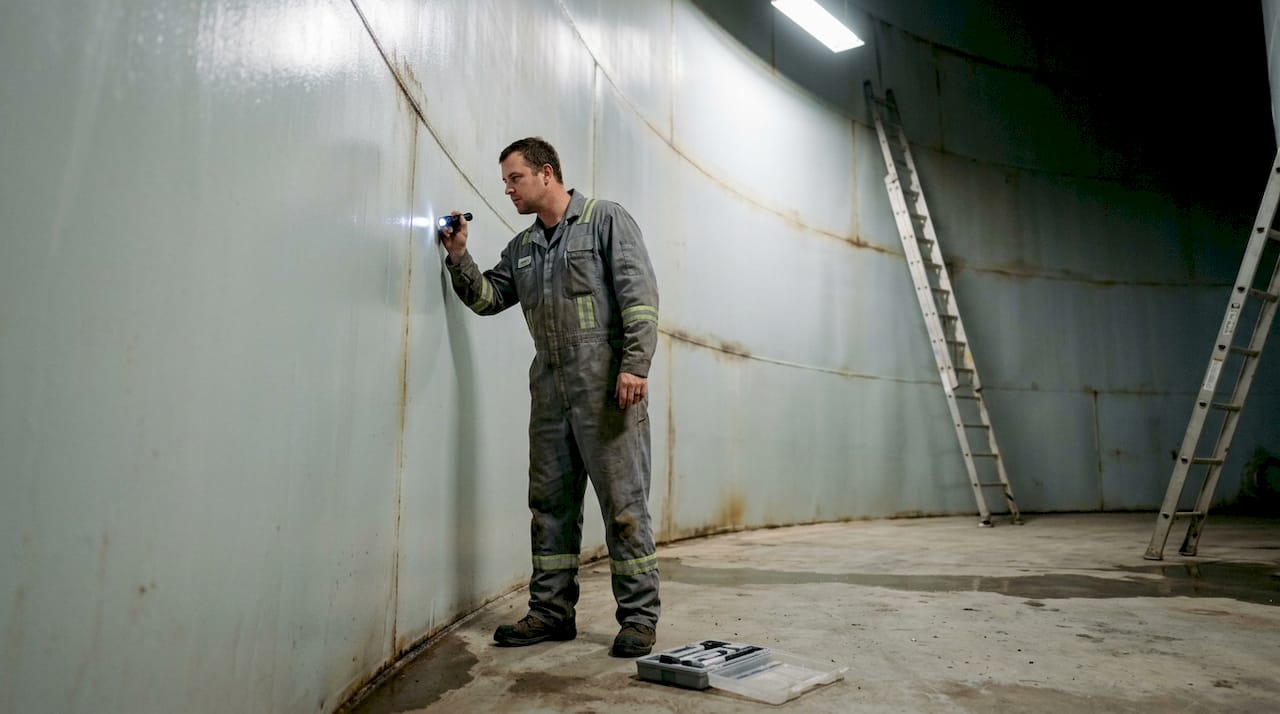
Key statistic: Steel tanks with quality coatings outperform uncoated concrete in every major performance category, including biofilm resistance, ease of cleaning, and resistance to cracking and leaking.
Here is how a proper coating program extends tank lifespan step by step:
- Surface preparation removes existing corrosion and creates a clean, profiled surface for the new coating to bond to. Without this step, even premium coatings fail early.
- Primer application seals the steel and provides a corrosion-inhibiting base layer that protects even if the topcoat is breached.
- Interior lining prevents contamination, stopping metal ions from entering the water supply and blocking biofilm from establishing on tank walls.
- Exterior topcoats block environmental stressors, reflecting UV, shedding moisture, and resisting salt and chemical exposure.
- Regular inspections catch early failures before they spread, allowing low-cost touch-ups instead of full recoating.
- Documented compliance records support regulatory audits and demonstrate due diligence to state and federal oversight agencies.
The role of coatings in longevity is not theoretical. Every year a tank stays in service without a major repair event is a year of capital budget that can be directed elsewhere. Following coating maintenance best practices is what separates municipalities that manage their assets proactively from those that react to failures.
Public health is the other side of this equation. A tank with a compromised interior coating is a contamination risk. Biofilm, metal leaching, and bacterial growth are not hypothetical outcomes. They are documented consequences of deferred coating maintenance, and they carry regulatory and liability exposure that no municipality wants to face.
Our take: What most Florida infrastructure managers overlook
After more than 20 years of working on water tanks across Central Florida, we have seen the same pattern repeat itself. A municipality selects the lowest bid, the contractor uses a generic coating that is not rated for coastal conditions, and the surface prep is rushed to meet a tight schedule. Five years later, the coating is failing, and the repair cost is three times what a proper job would have cost the first time.
The uncomfortable truth is that cheap paint is not cheap. It is a deferred expense with interest. Florida’s environment does not forgive shortcuts. Salt air, UV, and humidity will find every weakness in an under-specified coating system.
What we recommend to every infrastructure manager we work with: specify the coating system before you bid the job, not after. Define the surface prep standard, the product requirements, and the compliance certifications in the scope of work. That way, every bidder is pricing the same job, and you are not comparing a proper fluoropolymer application to a two-coat alkyd system.
The industrial painting advantages for water infrastructure are real, but only when the work is done right the first time.
Protect your water tanks with expert painting and coatings
Florida’s water tanks carry a responsibility that goes beyond infrastructure. They protect public health, support regulatory compliance, and represent decades of capital investment. Getting the coating system right is not a luxury. It is the baseline.

Southern Sandblasting & Painting LLC brings 20-plus years of hands-on experience with Florida industrial coatings for municipal water systems. Our team specifies and applies coating systems engineered for Florida’s real conditions, not generic specs from a catalog. Explore our full range of Florida sandblasting and painting services or review our asset protection coatings guide to see how we approach long-term infrastructure protection. Contact us to discuss your next water tank project.
Frequently asked questions
How often should water tanks in Florida be repainted?
Most Florida water tanks need repainting every 10 to 15 years, but coastal tanks using fluoropolymers can extend that cycle to 30 or more years with proper maintenance. Visible damage or coating breaches should trigger inspection regardless of schedule.
Do painted water tanks require special maintenance?
Yes. Painted tanks need annual visual inspections and periodic coating assessments to catch breaches early. NSF 61/600 compliance must be maintained throughout the tank’s service life, which means documenting any repairs and touch-ups properly.
What standards must Florida water tank coatings meet?
Interior coatings must meet NSF/ANSI 61 for drinking water safety and AWWA D102 for application quality. Exterior coatings follow SSPC standards for surface preparation and application.
Why are steel tanks with coatings better than uncoated concrete tanks?
Steel tanks with quality coatings resist biofilm better, clean more easily, and do not crack or leak the way aging concrete tanks do. The coating system is what makes the difference in long-term performance.
Can painting water tanks really impact public health?
Directly. Interior coatings prevent metal leaching and block contamination pathways that would otherwise introduce harmful substances into drinking water. A failed interior coating is a public health event waiting to happen.
Recommended
- Why paint infrastructure: extend asset life and cut costs
- Water tank coating types: 40% longer lifespan in Florida
- Infrastructure painting checklist for Florida 2026
- Role of painting contractors in Florida projects 2026
- Industrial Painting Services in Orlando, FL
- Sandblasting Services in Orlando, FL


