
Corrosion wreaks havoc on industrial infrastructure, with maintenance costs reaching 20-25% of budgets annually across the U.S. Quality control in protective coatings is not just a procedural checkbox but a strategic defense against this silent destroyer. By implementing rigorous inspection protocols and testing methods throughout the coating process, facility managers in Central Florida can dramatically extend asset lifespans while slashing repair frequencies. This article explores how systematic quality control transforms coating performance, protecting municipal water tanks, industrial pipelines, and critical infrastructure from Florida’s demanding climate.
Table of Contents
- Why Quality Control Matters For Asset Longevity
- Critical Role Of Surface Preparation In Quality Control
- Environmental Impact On Coating Performance In Central Florida
- Quality Control Testing And Inspection Techniques
- Common Misconceptions About Coating Quality And Warranty Claims
- Practical Steps For Facility Managers To Implement Coating Quality Control
- Coating Selection And Quality Control Requirements By Asset Type And Environment
- Protect Your Assets With Expert Coating Services In Central Florida
Key takeaways
| Point | Details |
|---|---|
| Quality control prevents premature failures | Rigorous testing and inspection protocols reduce coating breakdowns that lead to costly emergency repairs. |
| Surface preparation determines success | Proper contaminant removal and profile creation form the foundation for long-lasting coating adhesion. |
| Testing methods verify coating integrity | Holiday detection, thickness measurement, and adhesion tests confirm specification compliance before asset exposure. |
| Environment-specific strategies improve longevity | Matching coating selection and inspection frequency to local conditions counters humidity, UV, and salt spray degradation. |
| Documentation protects warranty claims | Complete quality control records validate compliance and prevent costly claim denials after coating failures. |
Why quality control matters for asset longevity
Premature coating failure triggers a cascade of expensive consequences. When protective barriers break down early, underlying substrates corrode rapidly, forcing emergency shutdowns and accelerating replacement timelines. The economic burden is staggering. Corrosion accounts for 20-25% of industrial maintenance costs nationwide, draining budgets that could fund expansion or upgrades.
The mechanics of coating failure often trace back to quality control lapses during application. Inadequate surface preparation leaves contaminants that prevent proper adhesion. Improper thickness creates weak spots where moisture penetrates. Environmental factors ignored during coating selection accelerate degradation. Each oversight compounds into premature failure.
Rigorous quality control reverses this trajectory. Extending coating life by 30-50% becomes achievable when systematic testing verifies every application phase. This extension translates directly into reduced maintenance cycles and lower lifecycle costs. A water tank requiring recoating every 8 years instead of 5 years saves municipalities tens of thousands in labor and material expenses.
Quality control is not overhead but insurance against the catastrophic costs of premature asset degradation and unplanned infrastructure failures.
The role of coating inspectors becomes critical in this equation. Trained professionals identify defects before they propagate, catching application errors when correction costs pennies compared to post-failure repairs. Understanding how to maintain coatings after initial application further extends these quality control benefits across the asset’s entire service life.
Critical role of surface preparation in quality control
Surface preparation determines whether coatings last years or decades. The majority of coating failures originate from inadequate substrate preparation rather than coating material defects. When contaminants remain on surfaces, even premium coatings fail to bond properly, creating pathways for moisture intrusion and corrosion initiation.
Common contaminants include rust, mill scale, oil residues, grease, salt deposits, and previous coating layers. Each interferes with adhesion differently. Rust creates uneven surfaces that trap air pockets. Oil prevents chemical bonding. Salt attracts moisture that accelerates corrosion beneath intact-looking coatings. Surface preparation best practices address these threats systematically.
Sandblasting removes contaminants while creating the proper surface profile for mechanical bonding. The profile’s depth and consistency matter enormously. Too smooth and coatings lack sufficient grip. Too rough and coating material cannot fill valleys, leaving voids. Profile gauges measure this critical dimension, ensuring specifications are met before application begins.
Inspection technologies verify preparation quality:
- Profile gauges confirm surface roughness meets coating requirements
- Adhesion pull-off testers validate bonding strength on test patches
- Visual audits identify remaining contaminants or surface defects
- Conductivity meters detect soluble salts that accelerate corrosion
Pro Tip: Always perform a visual inspection under strong lighting at multiple angles after sandblasting to catch subtle contamination that instruments might miss, especially in corners and welds.
The inspection of surface preparation must occur immediately before coating application. Delay allows flash rusting or recontamination, negating preparation work. Following proper coating application steps immediately after preparation ensures the substrate remains in optimal condition for bonding.
Environmental impact on coating performance in Central Florida
Central Florida’s climate punishes protective coatings relentlessly. High humidity, intense UV exposure, and coastal salt spray combine to create one of the nation’s most challenging environments for coating longevity. Quality control protocols must account for these specific stressors or face rapid coating degradation.
Humidity accelerates corrosion by providing the moisture necessary for electrochemical reactions beneath coatings. Even microscopic coating defects become entry points for water vapor. Once moisture reaches the substrate interface, it initiates corrosion that spreads laterally under intact coating, causing blistering and delamination long before visible surface rust appears.
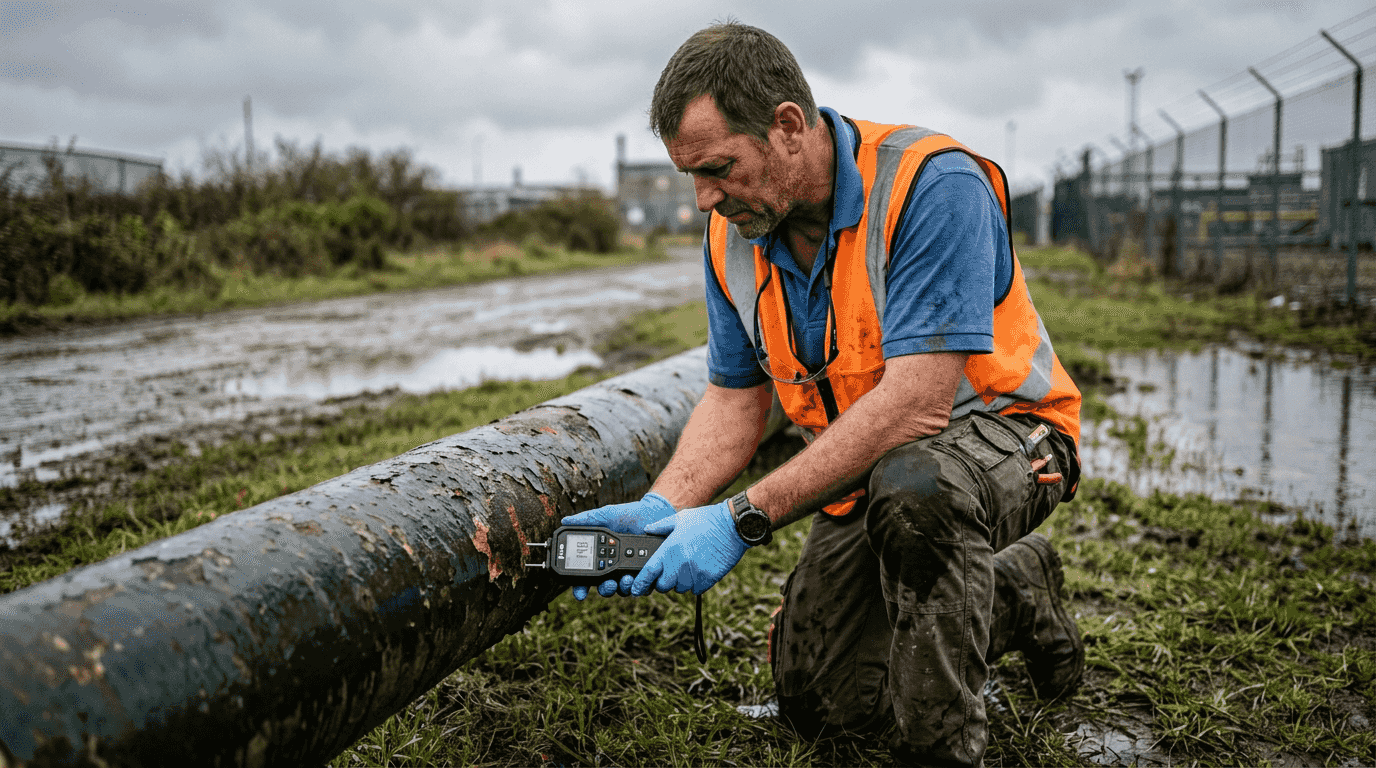
UV radiation degrades coating polymers through photochemical breakdown. The intense Florida sun causes chalking, color fading, and eventual coating embrittlement. Brittle coatings crack under thermal expansion cycles, creating pathways for moisture intrusion. UV-resistant formulations mitigate but cannot eliminate this degradation without proper quality control during selection and application.
Salt spray in coastal areas introduces chloride ions that penetrate coatings and accelerate corrosion rates dramatically. Marine environments see coating failure rates up to 3 times higher than inland locations. Salt also increases the electrical conductivity of moisture, intensifying electrochemical corrosion beneath compromised coatings.
Mitigation strategies within quality control frameworks include:
- Selecting UV-stabilized coating formulations rated for Florida’s solar intensity
- Specifying moisture-cured or high-solids coatings that resist humidity penetration
- Increasing coating thickness in coastal zones to extend barrier protection
- Scheduling more frequent inspections in high-stress environments
- Applying zinc-rich primers for sacrificial cathodic protection in marine settings
Understanding types of industrial coatings suited for Florida becomes essential for matching material capabilities to environmental demands. Quality control ensures the selected coating receives proper application conditions, from temperature and humidity monitoring during cure to thickness verification at completion.
Quality control testing and inspection techniques
Systematic testing verifies coating integrity at every phase. Industry-recognized methods provide objective data confirming specifications are met, creating documented proof of quality for warranty protection and regulatory compliance. ASTM standards guide testing methods that ensure consistent, reproducible results across projects and contractors.
Holiday detection identifies pinholes, voids, and coating discontinuities invisible to visual inspection. Low-voltage detectors for thin coatings and high-voltage spark testers for thick coatings send electrical current across the coating. Complete circuits indicate coating breaches requiring repair before the asset enters service. This test is critical for immersion service and underground applications where undiscovered defects cause rapid localized corrosion.
Thickness measurement ensures coatings meet specified dry film thickness (DFT) ranges. Too thin and protection fails prematurely. Too thick and coatings may crack or sag. Magnetic gauges for ferrous substrates and ultrasonic gauges for non-ferrous materials provide instant, non-destructive readings. Multiple measurements across surfaces confirm uniform application.
Adhesion testing validates the mechanical bond between coating and substrate. Pull-off adhesion testers apply perpendicular force until coating failure occurs, quantifying bond strength in PSI. Results confirm whether surface preparation and coating application achieved specification requirements. This test predicts long-term coating performance better than any other single quality control measure.
Key testing procedures follow this sequence:
- Verify surface preparation meets cleanliness and profile specifications before coating
- Monitor environmental conditions during application to ensure temperature and humidity compliance
- Measure wet film thickness during application to predict final DFT
- Check dry film thickness after cure using calibrated gauges at multiple locations
- Perform holiday detection across entire coated surface
- Conduct adhesion tests on representative areas to validate bonding
| Test Method | Purpose | Timing | Acceptance Criteria |
|---|---|---|---|
| Profile Gauge | Surface roughness verification | Post-preparation | 2-4 mils typical |
| Holiday Detector | Pinhole and void detection | Post-application | Zero defects |
| DFT Gauge | Thickness confirmation | After cure | Within spec ±10% |
| Adhesion Tester | Bond strength validation | 24-48 hours post-cure | >350 PSI minimum |
Pro Tip: Photograph all test locations and results with date stamps, creating a visual record that supplements written documentation and provides compelling evidence for warranty claims or dispute resolution.
The role of coating inspectors involves executing these tests systematically and interpreting results accurately. Inspectors trained in ASTM methods provide independent verification that protects facility managers from contractor shortcuts and ensures specification compliance.
Common misconceptions about coating quality and warranty claims
Several persistent myths about protective coatings undermine quality control efforts and lead to expensive failures. Understanding these misconceptions helps facility managers make informed decisions that protect assets and preserve warranty coverage.
The belief that thicker coatings always provide better protection drives many coating failures. While adequate thickness is essential, excessive thickness causes problems. Over-applied coatings trap solvents that create blisters during cure. Thick layers may crack under thermal stress. Some coating chemistries perform optimally only within narrow thickness windows. Quality control ensures thickness falls within specification ranges, neither too thin nor excessively thick.
Warranty invalidation due to missing quality control documentation catches many facility managers by surprise. Coating manufacturers specify application conditions, surface preparation standards, and inspection requirements. Failure to document compliance with these requirements provides grounds for warranty denial when premature failure occurs. Even legitimate coating defects become the owner’s problem without quality control records proving proper application.
Another dangerous assumption holds that all coatings perform equally under identical conditions. Coating chemistry determines performance characteristics. Epoxies excel in chemical resistance but chalk under UV exposure. Polyurethanes offer UV stability but limited chemical resistance. Zinc-rich primers provide cathodic protection but require topcoats. Matching coating selection to specific environmental exposures and substrate types is fundamental to quality control.
Additional misconceptions include:
- Believing surface preparation can be shortened to save costs without performance consequences
- Assuming visual inspection alone verifies coating quality without instrumental testing
- Thinking that all contractors follow the same quality standards regardless of oversight
- Expecting coatings to perform beyond their design life without maintenance inspections
Quality control combats these misconceptions through systematic testing, documentation, and adherence to manufacturer specifications. The investment in proper quality control pays dividends by preventing the far greater costs of premature failure and denied warranty claims.
Practical steps for facility managers to implement coating quality control
Implementing effective quality control requires structured processes at three critical stages. This framework provides facility managers with actionable steps to ensure coating durability regardless of project scale or contractor experience.
Pre-application verification focuses on surface preparation readiness. Before coating application begins:
- Inspect substrate cleanliness using visual standards and contamination testing
- Measure surface profile with calibrated gauges to confirm specification compliance
- Verify environmental conditions meet coating manufacturer requirements for temperature and humidity
- Review contractor certifications and equipment calibration records
- Establish documentation protocols for all test results and inspection findings
Controlled application monitoring ensures proper coating placement and thickness. During application:
- Measure wet film thickness continuously to predict final DFT before cure
- Monitor ambient conditions hourly, halting work if parameters drift outside specifications
- Verify mixing ratios and pot life compliance for multi-component coatings
- Document application rates, number of coats, and re-coat intervals between layers
- Photograph application progress and any anomalies for permanent records
Post-application testing validates coating integrity before asset return to service. After cure:
- Conduct comprehensive DFT measurements across minimum 20% of coated area
- Perform holiday detection on 100% of critical surfaces and 20% of general areas
- Execute adhesion testing on representative locations per ASTM standards
- Complete final visual inspection under strong lighting from multiple angles
- Compile all test data, photos, and certifications into permanent quality control package
Pro Tip: Require contractors to notify you 24 hours before each quality control checkpoint, giving you time to arrange third-party inspector presence for critical tests and preventing after-the-fact documentation disputes.
Following best surface preparation practices establishes the foundation for quality outcomes. Understanding proper coating maintenance extends quality control benefits throughout the asset’s service life. Adhering to systematic coating application steps ensures consistency across projects and contractors.
Coating selection and quality control requirements by asset type and environment
Matching coating systems to specific substrates and environmental conditions within quality control frameworks maximizes durability and cost-effectiveness. Mismatched coatings fail prematurely regardless of application quality, wasting resources and exposing assets to accelerated degradation.
Substrate compatibility determines initial coating selection. Steel substrates require corrosion-inhibiting primers like zinc-rich or epoxy systems. Concrete needs specialized coatings that accommodate alkalinity and moisture transmission. Galvanized surfaces demand coatings formulated to bond with zinc without causing galvanic reactions. Quality control verifies the selected coating matches substrate metallurgy and surface characteristics.
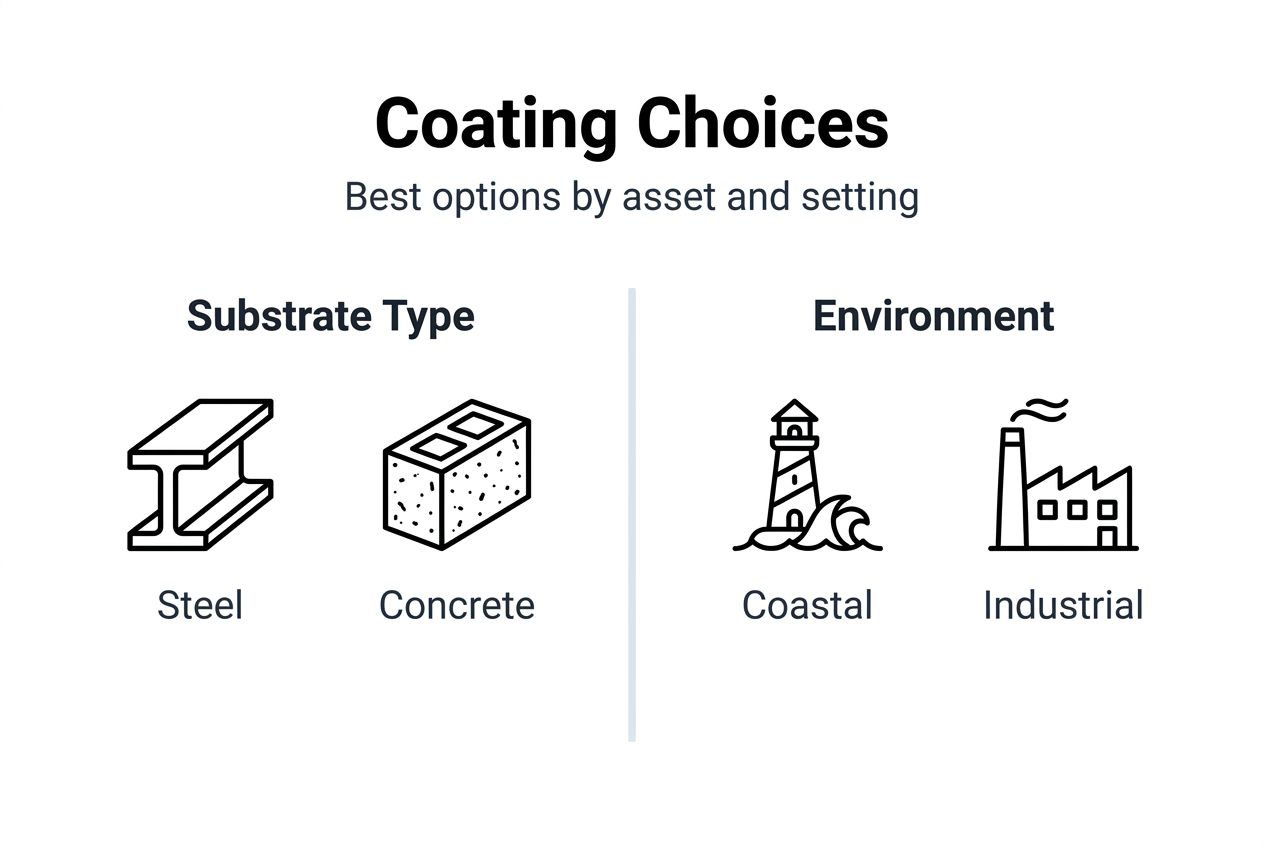
Environmental exposure dictates topcoat requirements. Immersion service demands coatings with superior water resistance and minimal permeability. Atmospheric exposure in humid climates requires moisture-tolerant formulations with strong adhesion under wet conditions. Chemical plant environments need coatings resistant to specific solvents or acids present in operations.
ASTM and industry standards vary by application. Potable water tank coatings must meet NSF/ANSI 61 certification for drinking water contact. Marine structures follow SSPC or ISO standards for atmospheric and immersion zones. Each standard imposes specific surface preparation grades, coating thickness requirements, and inspection protocols that quality control must verify.
| Asset Type | Environment | Recommended Coating | Key Quality Control Requirements |
|---|---|---|---|
| Water Tanks | Potable water immersion | NSF-certified epoxy | Holiday testing, NSF certification verification |
| Structural Steel | Coastal atmospheric | Zinc-rich primer + polyurethane | Salt contamination testing, UV resistance verification |
| Pipeline Exteriors | Buried soil contact | Fusion-bonded epoxy | Holiday testing 100%, cathodic protection integration |
| Theme Park Rides | High humidity, UV | Polyurethane or polysiloxane | Adhesion testing, color retention verification |
| Industrial Equipment | Chemical exposure | Chemical-resistant epoxy | Specific chemical immersion testing |
Cost and lifespan implications of coating selection become clear through lifecycle analysis. Premium coatings cost 30-50% more initially but may last twice as long as economy alternatives, reducing total cost of ownership substantially. Quality control documentation enables accurate lifecycle tracking, proving the value of specification-grade materials over time.
Understanding industrial coating types available in Florida helps facility managers select appropriate systems for local conditions. Quality control then ensures selected coatings receive proper application according to manufacturer specifications and industry standards.
Protect your assets with expert coating services in Central Florida
Quality control transforms from theory to reliable asset protection when backed by experienced professionals who understand Florida’s demanding industrial environments. The difference between adequate coating work and exceptional longevity lies in systematic quality assurance throughout every project phase.

Southern Sandblasting and Painting delivers comprehensive quality control as standard practice, not an optional add-on. Our sandblasting services in Orlando establish the clean, profiled surfaces essential for coating adhesion. We follow strict ASTM surface preparation standards verified through testing before coating application begins. Our team’s 20+ years serving Central Florida municipalities and industrial facilities means we understand local environmental challenges and specify coating systems proven in this climate. Complete sandblasting and painting services include pre-application inspections, controlled application monitoring, and post-coating testing that creates documented quality control records. We match industrial coating types to Florida conditions, ensuring your assets receive protection engineered for humidity, UV exposure, and coastal salt spray. Contact us to discuss how systematic quality control protects your infrastructure investment and extends asset service life.
FAQ
How frequently should protective coatings be inspected to maintain quality control?
Inspection frequency depends on environmental exposure severity and coating system type. Coastal or industrial assets in harsh conditions require annual inspections, while inland structures in moderate climates may extend to biennial cycles. More frequent inspections identify minor defects before they propagate into costly failures.
What are the most common surface contaminants that must be removed before coating?
Rust, mill scale, oil, grease, and salt deposits represent the most frequent contaminants interfering with coating adhesion. Previous coating layers often require complete removal to prevent incompatibility issues. Sandblasting effectively removes these contaminants while creating the proper surface profile for mechanical bonding.
Can coating warranty claims be denied if quality control steps are not documented?
Yes, manufacturers routinely deny warranty claims lacking quality control documentation proving specification compliance. Application records showing surface preparation verification, environmental conditions, thickness measurements, and inspection results protect warranty coverage. Without these records, even legitimate coating defects become the owner’s financial burden rather than the manufacturer’s responsibility.
How does humidity specifically affect the durability of protective coatings?
Humidity provides moisture that initiates corrosion beneath coatings through microscopic defects or permeable areas. Water vapor penetration causes substrate corrosion, leading to coating blistering and delamination. Quality control mitigates humidity effects by selecting moisture-resistant coating chemistries and verifying proper cure conditions that minimize coating permeability.


