
TL;DR:
- Proactive maintenance strategies significantly reduce equipment failures and repair costs in Florida’s harsh environment.
- Surface preparation, coatings, and inspection routines must be tailored to Florida’s humidity, salt exposure, and UV conditions.
- Partnering with local experts ensures maintenance practices are calibrated for Florida’s unique industrial challenges.
Florida’s industrial facilities face a relentless combination of high humidity, salt exposure, intense UV radiation, and heavy operational demands that accelerate asset wear far faster than in drier climates. For facility managers and maintenance directors, the difference between a well-maintained asset and a costly failure often comes down to whether your program is built on proven best practices or improvised responses. This guide walks you through the foundational strategies, proven techniques, and practical implementation frameworks that protect your equipment, extend asset lifespan, and keep your operation running without surprise shutdowns.
Table of Contents
- Establishing a proactive maintenance strategy
- Top 5 industrial maintenance best practices
- Comparing maintenance techniques: What works best?
- Implementing best practices at your facility
- Why best practices alone aren’t enough in Florida’s tough industrial environment
- Get expert help protecting your assets
- Frequently asked questions
Key Takeaways
| Point | Details |
|---|---|
| Proactive strategies win | Planned maintenance cuts costs and prevents equipment failure. |
| Local adaptation is vital | Florida facilities should tailor best practices to local climate and hazards. |
| Surface prep matters most | Proper cleaning and coating dramatically increase asset longevity. |
| Implementation is key | Success depends on clear process rollout, training, and tracking. |
| Partner with experts | Local specialists bring strategic advice for complex industrial needs. |
Establishing a proactive maintenance strategy
Reactive maintenance, fixing things after they break, is the most expensive way to run a facility. You pay emergency labor rates, rush-order parts, and absorb the cost of unplanned downtime. Proactive maintenance flips that model entirely. You schedule interventions before failures occur, which means predictable budgets, fewer emergencies, and assets that last years longer.
Facilities with proactive maintenance programs reduce unexpected equipment failures and cut repair costs significantly. That is not a small margin. For a mid-sized Central Florida facility running dozens of assets, that difference can represent hundreds of thousands of dollars over a five-year period.
Building a proactive program starts with these foundational steps:
- Create a complete asset inventory. Document every piece of equipment, its age, material composition, and current condition. You cannot protect what you have not cataloged.
- Develop maintenance protocols for each asset class. Pumps, structural steel, storage tanks, and conveyor systems each have different failure modes. Protocols should address those specifically.
- Build a master maintenance schedule. Assign tasks to team members with clear deadlines. Use calendar-based triggers for routine checks and condition-based triggers for more complex assessments.
- Identify high-risk equipment first. Prioritize assets that, if they fail, would halt production or create safety hazards. These get the most frequent attention.
- Review and refine the program quarterly. Track what you expected versus what actually happened. Adjust intervals and protocols based on real data.
Pro Tip: Rank your assets by criticality and failure consequence. The top 20% of your equipment by risk should receive 80% of your proactive attention. This approach keeps your team focused where it counts most.
“A maintenance program that anticipates failure is always cheaper than one that reacts to it. The math is simple: planned work costs a fraction of emergency repair, and the asset lasts longer too.”
Review proactive maintenance benchmarks from industry sources to see how your current program compares to top-performing facilities. The data consistently shows that facilities investing in planned maintenance outperform reactive operations on every key metric, from uptime to total cost of ownership.
Top 5 industrial maintenance best practices
With a proactive strategy in place, the next step is executing the right practices consistently. These five areas deliver the highest return for Central Florida industrial facilities.
- Lubrication schedules. Improper lubrication causes a significant share of mechanical failures. Use manufacturer specifications as a baseline, then adjust intervals based on your operating environment. Florida’s heat accelerates lubricant breakdown, so check viscosity and contamination more frequently than standard guides suggest.
- Routine inspections. Visual and instrument-based inspections catch early warning signs before they become failures. Inspect for corrosion, unusual vibration, leaks, and surface degradation on a fixed schedule. Document findings every time, even when nothing appears wrong.
- Surface preparation and protective coatings. This is where many facilities underinvest. Bare or degraded metal surfaces corrode rapidly in Florida’s humidity. Sandblasting and industrial painting are proven methods for asset longevity in harsh environments. Proper surface prep removes rust, mill scale, and old coatings so that new protective layers bond correctly and last as intended.
- Maintenance documentation. Every task performed should be logged with date, technician, findings, and materials used. This creates a traceable history that supports warranty claims, regulatory audits, and smarter future scheduling.
- Staff training on current standards. Maintenance standards evolve. Your team needs regular training on updated procedures, safety requirements, and new materials. An undertrained technician applying the wrong coating system can undo months of careful planning.
For coatings specifically, understanding the industrial painting process used in Florida conditions is critical. The wrong product applied to an improperly prepared surface will fail within months, not years.
Pro Tip: Review industrial painting best practices before specifying any coating system. Product selection and application method matter as much as the coating itself.
For additional context on broader maintenance strategies, additional maintenance tips from Reliable Plant offer useful benchmarks for industrial operations of all sizes.
Comparing maintenance techniques: What works best?
Not every maintenance technique performs equally well in Florida’s climate. Choosing the wrong method wastes money and leaves assets vulnerable. Here is a direct comparison of the most common approaches.
| Technique | Best for | Florida performance | Key limitation |
|---|---|---|---|
| Manual cleaning | Light surface dirt, small areas | Moderate | Labor-intensive, misses embedded rust |
| Sandblasting | Heavy rust, old coatings, large surfaces | Excellent | Requires containment setup |
| Epoxy coatings | Chemical resistance, floors, tanks | Very good | Brittle in thermal cycling |
| Urethane coatings | UV resistance, exterior surfaces | Excellent | Higher cost per gallon |
| Zinc-rich primers | Steel corrosion protection, structural | Excellent | Requires clean surface (SSPC-SP 10) |
Certain coatings and techniques provide superior corrosion and humidity resistance in Florida conditions. Zinc-rich primers, for example, offer sacrificial protection, meaning the zinc corrodes before the steel does, buying years of additional service life. Urethane topcoats resist UV degradation far better than standard alkyd paints, which chalk and crack within 18 to 24 months under Florida sun.
When deciding which technique fits your situation, consider these factors:
- Choose sandblasting when surfaces have heavy rust, multiple old coating layers, or when the coating specification requires a near-white metal blast per SSPC-SP 10 or SSPC-SP 6 standards.
- Choose manual cleaning only for light maintenance touch-ups on small, accessible areas where full blast prep is not practical.
- Choose epoxy systems for tank interiors, chemical storage areas, and concrete floors where chemical resistance is the priority.
- Choose urethane systems for exterior structural steel, equipment housings, and any surface exposed to direct sunlight.
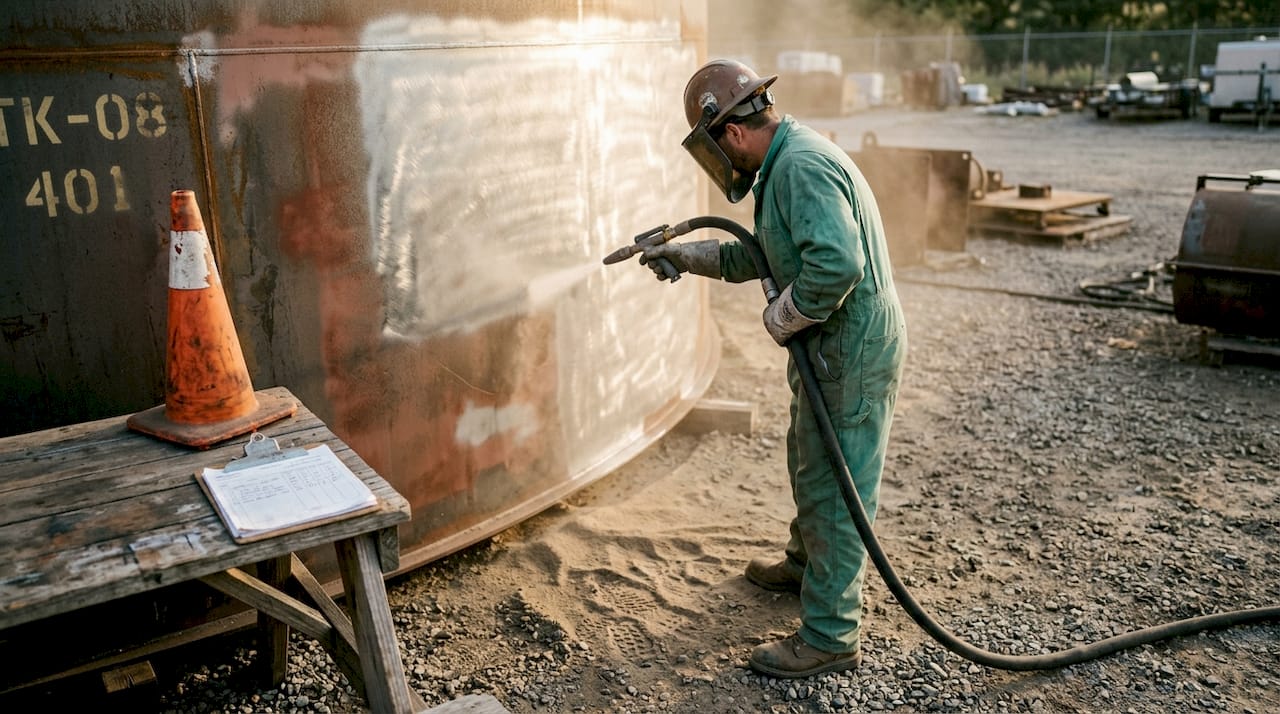
For sandblasting for tank maintenance, the surface cleanliness standard directly affects how long the coating lasts. Skipping proper prep to save time is the single most common reason coatings fail prematurely. The importance of surface prep is well-documented across the industry and should never be treated as optional.
Implementing best practices at your facility
Understanding techniques is one thing. Rolling them out across a real facility with competing priorities, budget constraints, and staffing limits is another challenge entirely. Here is a practical framework to make implementation stick.
- Audit your current state. Walk every asset and document condition, last service date, and known issues. This baseline drives everything that follows.
- Assign ownership. Every asset needs a named responsible party. Shared responsibility usually means no responsibility.
- Build your documentation system. Whether you use a CMMS (computerized maintenance management system) or a structured spreadsheet, every task must be logged.
- Schedule your first 90 days. Focus on your highest-risk assets first. Complete overdue inspections, surface treatments, and lubrication checks before expanding the program.
- Set compliance checkpoints. Monthly reviews of completed versus scheduled tasks keep the program on track and surface gaps before they become failures.
Pro Tip: Use a CMMS with mobile access so technicians can log work in the field in real time. This eliminates the paper trail problem and gives you live visibility into program compliance.
Here is a sample quarterly maintenance schedule for a Central Florida industrial facility:
| Asset type | Task | Frequency | Responsible party |
|---|---|---|---|
| Structural steel | Visual corrosion inspection | Monthly | Maintenance lead |
| Storage tanks | Surface and coating check | Quarterly | Coating specialist |
| Mechanical equipment | Lubrication and vibration check | Monthly | Technician |
| Exterior surfaces | UV and weather damage review | Quarterly | Facility manager |
| Drainage systems | Blockage and corrosion check | Bi-monthly | Maintenance crew |
Structured implementation of maintenance frameworks leads to higher regulatory compliance and fewer asset failures. For facilities subject to municipal or government oversight, a documented program is not just good practice, it is often a compliance requirement.
Review the sandblasting guide for facility managers to understand how surface preparation fits into your broader maintenance calendar. A clear surface prep workflow prevents scheduling conflicts and ensures coating work happens at the right point in your maintenance cycle. The maintenance checklist from IFM is a useful external reference for building out your own task library.
Why best practices alone aren’t enough in Florida’s tough industrial environment
Here is something most maintenance guides will not tell you: following a generic best practices checklist is not enough in Florida. The state’s combination of coastal salt air, near-daily summer storms, and humidity that rarely drops below 60% creates conditions that punish standard maintenance intervals and coating systems designed for milder climates.
We have seen facilities that followed textbook maintenance programs and still experienced premature coating failures and accelerated corrosion because the protocols were built for the Midwest, not Orlando. The difference is not effort. It is local calibration.
The facilities that perform best over the long term are the ones that partner with contractors who understand Florida’s specific demands. They adjust inspection frequencies, specify coatings rated for high-humidity environments, and schedule surface prep work around the rainy season rather than fighting it. Generic checklists are a starting point, not a finish line.
For deeper insight into how Florida’s conditions affect surface treatment decisions, local sandblasting insights from contractors working in this environment daily are far more reliable than national averages. Invest in that local knowledge. It pays for itself quickly.
Get expert help protecting your assets
Maintaining industrial assets in Florida is a complex task, and the stakes are high. Premature failures, compliance violations, and unplanned downtime all carry real costs that compound over time.
At Southern Sandblasting & Painting LLC, we bring 20+ years of hands-on experience with Central Florida’s toughest industrial environments. Our sandblasting services remove rust, old coatings, and contaminants down to the metal, and our coating teams apply systems engineered for Florida’s humidity and UV exposure. From water tanks to structural steel, we follow a proven coating application guide that ensures every job meets spec and lasts. Explore our industrial coatings for Florida infrastructure projects and contact us to schedule a site assessment.
Frequently asked questions
What is the difference between preventive and predictive maintenance?
Preventive maintenance follows a fixed schedule regardless of equipment condition, while predictive techniques use real-time data and sensors to trigger service only when measurements indicate an approaching problem. Predictive approaches reduce unnecessary interventions and unscheduled downtime.
How often should routine maintenance be scheduled for industrial equipment in Florida?
Most industrial assets require quarterly inspections as a baseline, but routine schedules should adjust for humid conditions, meaning high-humidity Florida facilities often benefit from monthly checks on corrosion-prone assets.
Is industrial sandblasting safe for all facility types?
Sandblasting is safe when performed by trained professionals with proper containment, ventilation, and PPE in place. Safety practices must always be followed to protect workers and surrounding areas from abrasive media and dust.
Can industrial coatings really extend asset life in a coastal Florida facility?
Yes. Coatings are critical for protection in harsh climates because they create a barrier against salt, moisture, and chemical exposure that would otherwise cause rapid corrosion and structural degradation.
Recommended
- Industrial Painting Process—Ensuring Asset Longevity
- Role of Coatings in Longevity – Extending Asset Lifespans
- Role of Surface Preparation in Asset Longevity
- Industrial Painting Trends 2025: Impact on Facility Longevity
- Coffee Machine Service Contracts | Maintenance Plans | Devon Somerset
- Industrial Painting Services in Orlando, FL
- Sandblasting Services in Orlando, FL


