
Selecting the right sandblasting projects is critical for facilities managers and contractors tasked with maintaining industrial infrastructure in Central Florida’s punishing high-humidity environment. With corrosion accelerated by moisture and salt air, the difference between effective surface preparation and premature asset failure often comes down to understanding which projects benefit most from professional sandblasting. This article examines real-world examples and selection criteria that help you maximize infrastructure lifespan, reduce replacement costs, and make informed decisions about when sandblasting delivers the highest return on investment for your facility.
Table of Contents
- Key Criteria For Selecting Sandblasting Projects In Industrial Settings
- Concrete Sandblasting Projects: Restoring And Protecting Infrastructure
- Industrial Equipment Sandblasting: Maintenance And Corrosion Removal
- Case Study: Sandblasting And Coating For Industrial Pump Rehabilitation
- Comparing Popular Abrasive Materials And Techniques For Your Sandblasting Projects
- Explore Professional Sandblasting And Coatings Services In Central Florida
- FAQ
Key takeaways
| Point | Details |
|---|---|
| Sandblasting removes contaminants | Proper abrasive blasting creates clean surfaces essential for coating adhesion and long-term protection. |
| Abrasive selection matters | Different media types suit specific substrates, from delicate concrete to heavy industrial equipment. |
| Surface prep prevents failure | Inadequate preparation causes premature coating breakdown and costly asset replacement. |
| Combined treatments extend lifespan | Sandblasting plus protective coatings can extend infrastructure life by 30-50% in humid climates. |
| Project selection impacts ROI | Choosing appropriate sandblasting applications maximizes cost savings and operational efficiency. |
Key criteria for selecting sandblasting projects in industrial settings
Before committing resources to any sandblasting project, you need a framework for evaluating which assets will benefit most from surface preparation investment. The substrate material forms your foundation. Metal structures respond differently than concrete surfaces, and industrial equipment requires approaches distinct from architectural elements. Understanding these material characteristics prevents costly mistakes and ensures your sandblasting contractor applies appropriate techniques.
Environmental conditions in Central Florida create unique challenges that influence project selection. High humidity accelerates corrosion on exposed metal and drives moisture into porous concrete. The longevity of any structure in Central Florida is determined by the quality of its initial prep work, making thorough surface preparation non-negotiable for critical infrastructure. Coastal proximity, industrial chemical exposure, and temperature fluctuations all factor into whether sandblasting represents a sound investment for a particular asset.
Abrasive media selection directly impacts project outcomes and costs. Consider these factors when evaluating projects:
- Substrate hardness and sensitivity to abrasive damage
- Required surface profile depth for coating adhesion
- Environmental regulations governing dust and waste disposal
- Budget constraints and abrasive media availability
- Safety requirements for workers and nearby operations
Coating compatibility represents another critical criterion. The protective coating system you plan to apply dictates the surface profile requirements, which in turn influences abrasive selection and blasting parameters. Budget considerations extend beyond the immediate sandblasting cost to include coating materials, downtime impact, and long-term maintenance savings. Environmental compliance and worker safety protocols add layers of complexity that experienced contractors navigate routinely.
Pro Tip: Consult with sandblasting services orlando fl specialists before selecting abrasive media, as incorrect choices can permanently damage sensitive substrates or create inadequate surface profiles that compromise coating performance.
Regulatory compliance deserves careful attention, particularly for municipal and government projects. OSHA standards, EPA regulations, and local ordinances govern abrasive blasting operations. Projects involving lead paint removal or silica dust generation require specialized protocols. When evaluating potential sandblasting projects, factor in permitting requirements, containment systems, and waste disposal obligations that may significantly impact project feasibility and cost.
Concrete sandblasting projects: restoring and protecting infrastructure
Concrete infrastructure forms the backbone of industrial facilities across Central Florida, from loading docks and parking structures to containment areas and equipment foundations. Concrete sandblasting is essential for preparing surfaces in high-humidity environments to prevent moisture intrusion and extend life by 30-50%, making it one of the highest-value applications for facilities managers concerned with asset longevity.
Sandblasting removes contaminants that compromise concrete integrity and coating adhesion. Oil stains from equipment leaks, chemical residues from industrial processes, failed sealants that trap moisture, and biological growth all create barriers to effective surface treatment. These contaminants prevent new sealants and coatings from bonding properly, leading to premature failure and accelerated deterioration. Abrasive blasting strips away these layers, exposing clean concrete ready for protective treatment.
High humidity presents specific challenges for concrete structures in Central Florida. Moisture penetrates porous concrete surfaces, carrying dissolved salts and chemicals that cause spalling and reinforcement corrosion. Traditional cleaning methods like pressure washing often drive contaminants deeper into the concrete matrix rather than removing them. Sandblasting creates a controlled surface profile that opens pores for sealer penetration while removing embedded contaminants.
Key benefits of concrete sandblasting include:
- Complete removal of old sealants and coatings that have lost effectiveness
- Exposure of subsurface cracks and damage for repair before recoating
- Creation of optimal surface texture for mechanical bonding of new protective systems
- Restoration of slip-resistant surfaces on walkways and work areas
- Aesthetic improvement through removal of stains and discoloration
Pro Tip: Schedule regular inspections of concrete infrastructure to identify areas needing sandblasting before visible damage progresses to structural concerns, saving significant repair costs.
Concrete sandblasting restores safety and appearance by removing grime, oil stains, and failed sealants, transforming deteriorated surfaces into protected assets.
The windermere concrete sandblasting process typically involves containment setup, abrasive selection based on concrete age and condition, systematic blasting to achieve uniform profile, and thorough cleaning before sealer application. This comprehensive approach ensures maximum coating adhesion and longevity, protecting your concrete infrastructure investment for decades.
Industrial equipment sandblasting: maintenance and corrosion removal
Industrial and agricultural equipment represents substantial capital investment that sandblasting helps preserve through effective corrosion removal and surface preparation. Trailers, tractors, manufacturing machinery, and material handling equipment all suffer from rust and coating failure in Central Florida’s corrosive environment. Sandblasting removes corrosion from industrial equipment without damaging metal integrity using appropriate abrasive media, offering a cost-effective alternative to premature replacement.
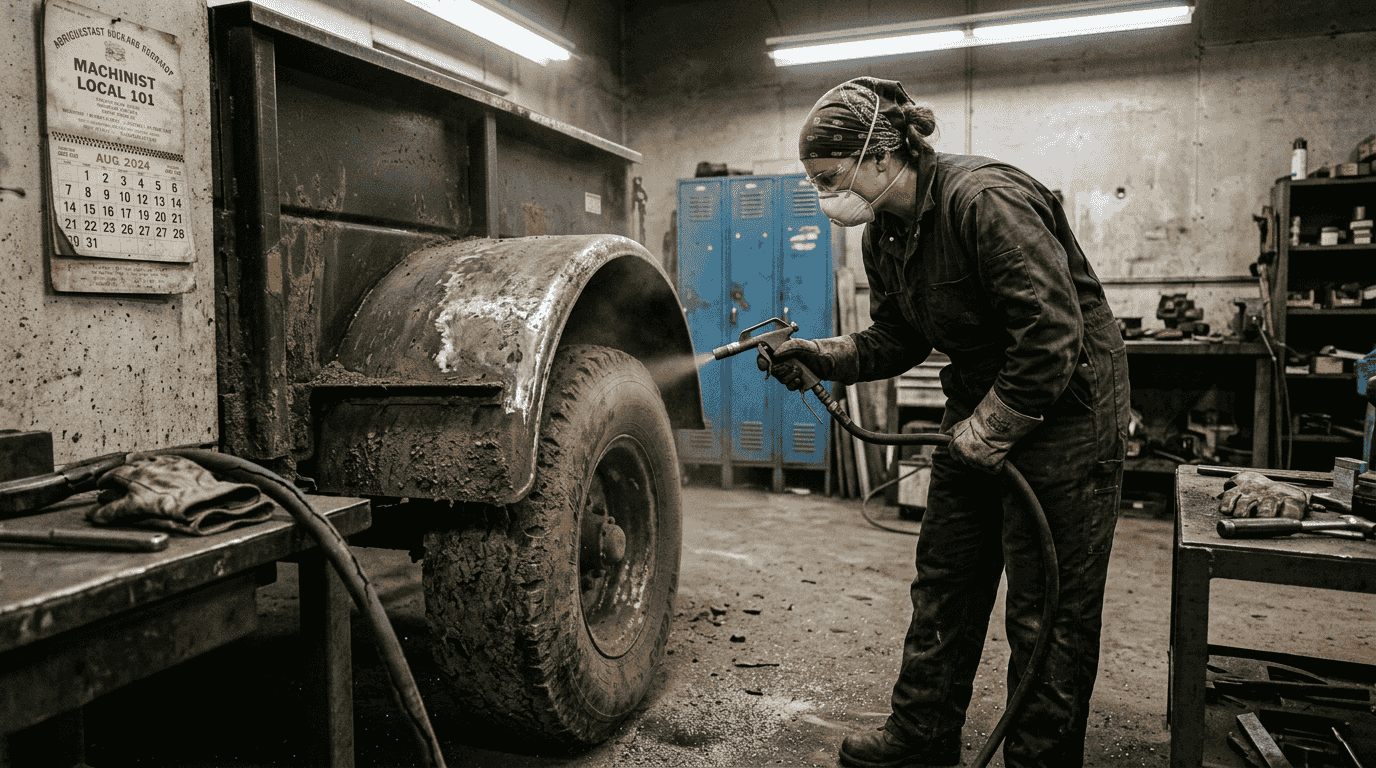
The substrate material and equipment function dictate abrasive selection and blasting parameters. Heavy steel farm equipment tolerates aggressive abrasives like steel grit that quickly remove thick rust layers. Precision manufacturing machinery with tight tolerances requires gentler media like crushed glass or walnut shells to clean without dimensional changes. Aluminum components demand specialized approaches to prevent surface embedment and galvanic corrosion issues.
Corrosion removal through sandblasting addresses both active rust and the weakened metal beneath oxidized layers. Surface rust appears as the obvious problem, but pitting and metal loss beneath visible corrosion often determine whether equipment remains serviceable. Thorough sandblasting exposes the true condition of metal substrates, allowing you to make informed decisions about repair versus replacement before investing in protective coatings.
Surface preparation for protective coatings represents the primary value proposition for equipment sandblasting:
- Complete removal of mill scale, rust, and old paint that prevent coating adhesion
- Creation of anchor profile that mechanically locks coatings to metal surfaces
- Exposure of surface defects, cracks, and damage requiring repair
- Uniform surface condition that ensures consistent coating thickness and performance
- Extended equipment service life through prevention of corrosion recurrence
Pro Tip: Partner with experienced Oviedo industrial sandblasting contractors who understand equipment-specific requirements and can recommend appropriate abrasive media and blasting parameters for your particular machinery.
The cost-benefit analysis for equipment sandblasting strongly favors maintenance over replacement. A trailer that costs $15,000 to replace might require only $2,000 for comprehensive sandblasting and protective coating, extending its service life by 10-15 years. Manufacturing equipment with six-figure replacement costs becomes economically viable to maintain through regular sandblasting and recoating cycles. This preventive approach minimizes downtime, preserves capital budgets, and maintains operational capacity.
Case study: sandblasting and coating for industrial pump rehabilitation
Industrial pumps represent critical infrastructure whose failure causes costly downtime and emergency replacements. A detailed rehabilitation project demonstrates how combined sandblasting and protective coatings deliver exceptional return on investment. This case study examines a split case pump restoration that saved over $1 million in replacement costs through proper surface preparation and coating application.
The rehabilitation process followed a systematic approach:
- Complete disassembly and inspection to assess corrosion extent and mechanical condition
- Sandblasting to bare metal using angular steel grit to achieve SSPC-SP 10 near-white finish
- Thorough cleaning and solvent wipe to remove all abrasive residue and contaminants
- Application of ARC 858 epoxy coating system in multiple layers to specified thickness
- Quality control inspection of coating thickness, adhesion, and surface finish
- Reassembly with new seals and bearings for complete operational restoration
Coating selection played a crucial role in project success. The ARC 858 system provides exceptional corrosion resistance in wet service environments, with chemical resistance suitable for the pumped media. Alternative coating SD4i offers similar protection with faster cure times for projects requiring rapid turnaround. Both systems require proper surface preparation through sandblasting to achieve their rated service life.
Sandblasting to bare metal followed by ARC 858 coating significantly extended pump life and eliminated the need for emergency replacement during peak operational periods.
The financial comparison reveals compelling economics:
| Approach | Cost | Downtime | Service Life |
| — | — | — |
| New pump replacement | $1,200,000 | 8-12 weeks | 15-20 years |
| Sandblast and recoat | $180,000 | 3-4 weeks | 12-15 years |
| Savings | $1,020,000 | 5-8 weeks | Comparable |
Surface preparation quality directly impacts coating performance and pump longevity. The coating application process guide emphasizes achieving proper surface profile depth, typically 2-3 mils for epoxy systems. Insufficient profile prevents mechanical bonding, while excessive roughness creates peaks that coating cannot adequately cover. Professional sandblasting contractors use profile gauges and replica tape to verify surface preparation meets coating manufacturer specifications.
Regular inspection programs identify pumps requiring rehabilitation before catastrophic failure occurs. Visual inspection reveals coating breakdown, while ultrasonic thickness testing detects metal loss beneath intact coatings. Scheduling rehabilitation during planned maintenance windows minimizes operational impact. The surface prep contractors guide provides frameworks for developing inspection schedules based on equipment criticality and operating conditions.
Comparing popular abrasive materials and techniques for your sandblasting projects
Abrasive material selection fundamentally influences sandblasting project outcomes, costs, and environmental impact. Choice of abrasive impacts cleaning efficiency, surface roughness, coating adhesion, and environmental safety, making informed selection critical for project success. Understanding the characteristics of common abrasive media helps you match materials to specific applications.
| Abrasive Type | Best Applications | Surface Profile | Environmental Impact | Relative Cost |
|---|---|---|---|---|
| Silica sand | Heavy rust removal, aggressive cleaning | Deep, angular | High dust, health hazard | Low |
| Garnet | General metal prep, moderate profiles | Medium, consistent | Low dust, recyclable | Medium |
| Walnut shells | Delicate substrates, paint removal | Light, minimal damage | Biodegradable, low dust | Medium-High |
| Crushed glass | Concrete, general cleaning | Variable, controllable | Recyclable, low silica | Medium |
| Steel grit | Heavy equipment, fast cutting | Very deep, angular | Recyclable, minimal dust | Low |
Silica sand offers aggressive cutting action and low cost but poses serious health risks through crystalline silica dust exposure. OSHA regulations strictly control silica sand use, requiring extensive dust control and worker protection measures. Many facilities have eliminated silica sand entirely in favor of safer alternatives that provide comparable performance without the health hazards.
Garnet has emerged as a popular alternative, offering excellent cutting speed with lower dust generation and no silica content. Its angular particles create good surface profiles for coating adhesion, and spent garnet can often be recycled through several blasting cycles. Garnet works well for general metal preparation and provides consistent results across varied substrates.
Specialty abrasives address specific project requirements:
- Walnut shells and corn cob media for cleaning without substrate damage
- Aluminum oxide for extremely hard surfaces and precision profiles
- Sodium bicarbonate for sensitive equipment and historical restoration
- Plastic media for paint removal from fiberglass and composites
- Coal slag for economical general blasting with moderate profiles
Pro Tip: Use proper containment systems and dust collection equipment regardless of abrasive type to protect workers, comply with environmental regulations, and maintain good relationships with neighboring facilities.
Blasting technique influences results as much as abrasive selection. Nozzle size, air pressure, standoff distance, and angle of attack all affect cleaning efficiency and surface profile. The best surface preparation solutions 2026 incorporate operator training and quality control procedures that ensure consistent results. Experienced contractors adjust parameters based on real-time observation of substrate response and coating requirements.
Environmental considerations extend beyond worker safety to include waste disposal, dust control, and community impact. Spent abrasive containing heavy metals or hazardous contaminants requires special handling and disposal. Facilities near residential areas need enhanced containment to prevent dust complaints. Selecting recyclable abrasives and implementing closed-loop blasting systems reduces environmental footprint while controlling operating costs.
Explore professional sandblasting and coatings services in Central Florida
Protecting your industrial assets in Central Florida’s demanding environment requires specialized expertise and proven surface preparation techniques. Southern Sandblasting & Painting LLC brings over 20 years of experience delivering comprehensive sandblasting services Orlando FL solutions tailored to municipal, commercial, and industrial clients.
Our team understands the unique challenges humidity and salt air pose to infrastructure longevity. We provide complete sandblasting & painting services Orlando from initial surface assessment through final coating application, ensuring your assets receive protection engineered for Central Florida conditions. Our industrial coatings Florida portfolio includes epoxy, polyurethane, and specialized systems proven to extend service life and reduce maintenance costs. Contact us today to discuss your project requirements and discover how professional surface preparation protects your infrastructure investment.
FAQ
What are the typical substrates sandblasting can effectively clean and prepare?
Sandblasting works effectively on concrete, structural steel, industrial machinery, farm equipment, storage tanks, and infrastructure surfaces. Each substrate requires appropriate abrasive media selection to avoid damage while achieving proper surface profile. Experienced contractors match blasting parameters to substrate hardness and coating requirements.
How does sandblasting improve the lifespan of industrial pumps?
Sandblasting removes corrosion, old coatings, and contaminants that cause premature pump failure. It creates the proper surface profile for protective coating adhesion, preventing moisture intrusion and chemical attack. Properly prepared and coated pumps can operate 12-15 years before requiring rehabilitation, compared to 5-7 years for inadequately protected equipment.
What are the environmental considerations when choosing abrasive materials?
Silica sand poses serious health risks through crystalline silica dust exposure and faces strict OSHA regulations. Alternatives like garnet, crushed glass, and organic media reduce health hazards while providing effective cleaning. Proper containment, dust collection, and waste disposal remain mandatory regardless of abrasive type. Consult experienced contractors to balance cleaning effectiveness with environmental compliance and worker safety.
When should facilities managers schedule sandblasting maintenance projects?
Schedule sandblasting when regular inspections reveal coating failure, visible corrosion, or surface contamination that compromises asset protection. Proactive scheduling during planned maintenance windows prevents emergency repairs and costly downtime. Consider environmental exposure severity, asset criticality, and coating manufacturer recommendations when developing maintenance intervals. Coordinate sandblasting with overall facility maintenance cycles for operational efficiency and budget optimization.
Recommended
- Choosing Sandblasting Methods for Infrastructure
- Role of Sandblasting in Tank Maintenance Success
- Role of Surface Preparation in Asset Longevity
- Surface Treatment Process for Durable Infrastructure Results
- BRCKS | Construction Project Communication Software
- Industrial Painting Services in Orlando, FL


