
TL;DR:
- Proper coating thickness measurement is critical for ensuring durability in Florida’s harsh climate.
- Using the correct testing method and standards prevents costly rework and premature failure.
- Integrating thickness data with adhesion and hardness tests improves asset longevity predictions.
Protective coatings are only as effective as their application. A high-grade epoxy system applied at the wrong film build can fail just as badly as the cheapest paint job, and in Central Florida’s heat, humidity, and storm exposure, that failure arrives fast. Coating thickness measurement is the non-destructive or destructive process of verifying that protective layers meet specifications for corrosion resistance and durability. For facility managers and contractors overseeing airports, water tanks, pipelines, and city infrastructure, getting this right is not optional. It is the difference between a coating that lasts a decade and one that begins peeling before the warranty expires.
Table of Contents
- What is coating thickness testing and why does it matter?
- Core methods and standards for coating thickness testing
- Benchmarks, accuracy, and what really challenges measurement
- What most pros overlook: layer thickness isn’t the whole story
- A smarter QA mindset: what Central Florida teams should do differently
- Get expert coating testing and protection for your Florida assets
- Frequently asked questions
Key Takeaways
| Point | Details |
|---|---|
| Precision drives durability | Accurate coating thickness testing directly determines asset lifespan and performance. |
| Choose the right method | Match testing approaches to substrate and project requirements for reliable results. |
| Local conditions matter | Florida’s climate demands more stringent checks and regular calibration for compliance. |
| Integrate tests for true assurance | Thickness plus hardness and adhesion data provide the best prevention against failure. |
What is coating thickness testing and why does it matter?
Coating thickness testing is the precise measurement of a protective layer’s build on a substrate, whether steel, concrete, aluminum, or another base material. The number you get from that gauge reading tells you whether the coating system will perform as intended or become a liability. It is that direct.
The purpose goes beyond checking a box for the spec sheet. Testing confirms that your corrosion barrier is thick enough to do its job, that adhesion layers are within tolerance, and that the entire system will hold up through its expected service life. For water tank coatings, FDOT bridge projects, or airport infrastructure in Florida, compliance with these measurements is mandatory. Failing an inspection due to out-of-spec film thickness can trigger recoating costs, project delays, and serious regulatory consequences.
Coating thickness testing ensures optimal performance like corrosion resistance. Too thin, and the coating fails to protect the substrate. Too thick, and you risk cracking or adhesion failure that lets moisture in from the opposite direction.
The consequences of getting it wrong in Central Florida are amplified compared to most other markets:
- Humidity above 90% for extended periods accelerates oxidation beneath thin coatings
- Hurricane-force wind-driven rain exposes pinholes, holidays, and under-film voids in ways that normal weather does not
- UV exposure degrades binder systems faster, especially when film thickness is marginal
- Saltwater proximity for coastal and port infrastructure accelerates delamination at undercoated spots
- FDOT and municipal compliance requirements apply strict DFT (dry film thickness) acceptance criteria
“A coating that is even slightly underbuilt in Florida’s environment will not fail gradually. It tends to fail suddenly, at the worst possible time.”
Understanding why coatings fail in Florida requires recognizing that thickness is the first line of defense. You can learn more about how protecting infrastructure with paint plays out in real projects to appreciate how critical that defense is.
Core methods and standards for coating thickness testing
Knowing that you need to test is only the start. The method you use has to match the substrate and coating type. Using the wrong instrument on the wrong base material produces readings that are completely unreliable, and that false confidence is worse than not testing at all.
The primary methodologies break down as follows:
- Magnetic induction for non-magnetic coatings on ferrous substrates like structural steel
- Eddy current for non-conductive coatings on non-ferrous metals like aluminum
- Ultrasonic pulse echo for thick, multi-layer, or non-metal substrates like concrete or plastics
- Destructive cross-section microscopy for reference-level accuracy in lab environments or failure analysis
Here is a quick comparison of when each method applies in common Central Florida project types:
| Method | Substrate | Typical application | Accuracy |
|---|---|---|---|
| Magnetic induction | Steel, iron | Bridges, tanks, pipelines | ±1 to 3 µm |
| Eddy current | Aluminum, copper | Airport structures, HVAC housings | ±1 to 3 µm |
| Ultrasonic | Concrete, plastics | Parking structures, water treatment plants | ±2 to 5 µm |
| Destructive | All | Failure analysis, lab validation | Highest |
The standards governing these methods are not suggestions. Knowing them keeps your project defensible in a compliance review:
- ISO 2178: Magnetic method for non-magnetic coatings on ferrous metal
- ISO 2360: Eddy current method for non-conductive coatings on non-ferrous metal
- ISO 2808: Paint and varnish film thickness measurement, multiple methods
- ASTM D7091: Non-destructive measurement on metal substrates
- ASTM B499: Magnetic method for anodic coatings on aluminum
Knowing which standard governs your project is part of surface prep best practices, and the role of coating inspectors in selecting and applying the right standard is significant.
Pro Tip: For steel structures where you are unsure of the exact alloy or where magnetic interference from rebar is possible, use a combination F/NF (ferrous/non-ferrous) gauge. These instruments automatically detect the substrate type and switch modes, which eliminates human error in method selection. Always calibrate on a clean, uncoated sample of the actual substrate material before taking any readings.
Benchmarks, accuracy, and what really challenges measurement
Passing a thickness test on paper is one thing. Getting readings that actually reflect field reality is another challenge entirely. Seasoned contractors know that the biggest accuracy problems rarely come from the gauge itself. They come from the conditions around the measurement.
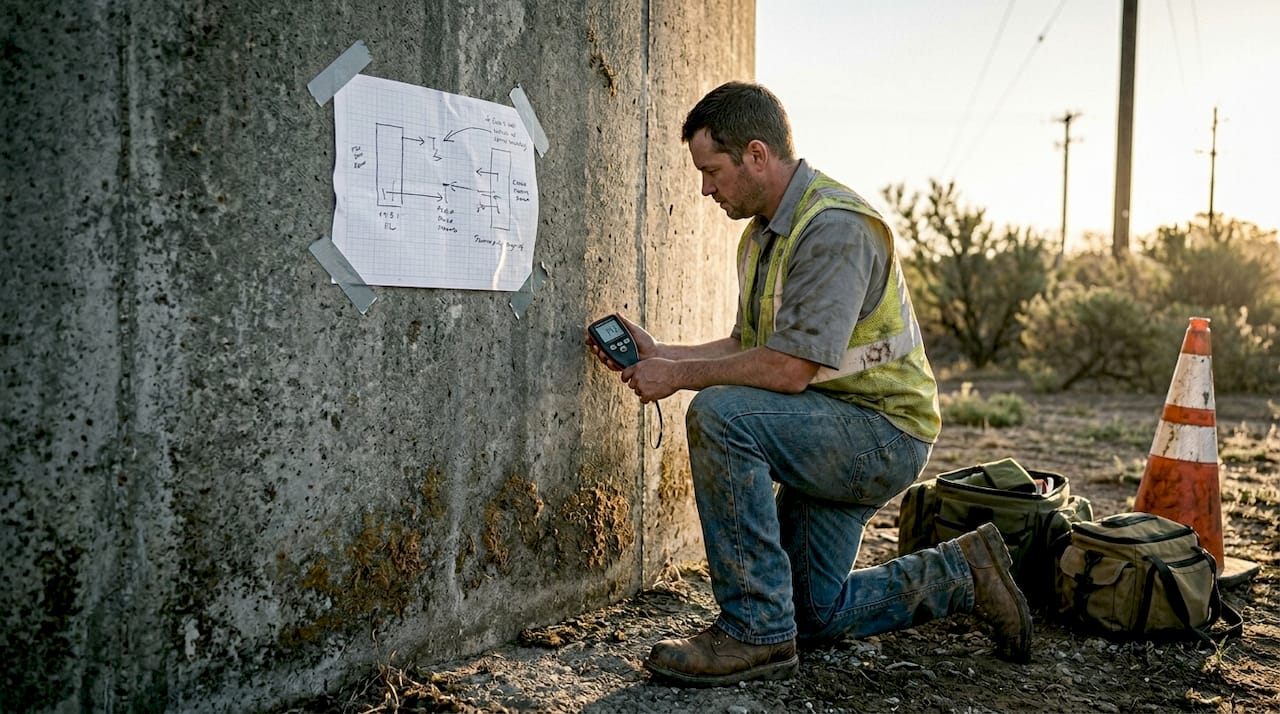
Standard DFT benchmarks for industrial protective coatings on infrastructure typically fall in the 50 to 200 µm range, depending on the coating system and service environment. For acceptance, ISO 19840 is the dominant framework: 90% of all spot readings must meet or exceed the minimum specified DFT, and no single reading may fall below 80% of that minimum. Gauge accuracy typically runs ±1 to 3 µm for quality instruments.
Here is how different project types translate those standards into real numbers:
| Infrastructure type | Typical DFT target | ISO 19840 minimum floor | Environment risk |
|---|---|---|---|
| Municipal water tanks | 125 µm | 100 µm | High, interior corrosion |
| FDOT bridges | 100 to 175 µm | 80 to 140 µm | High, salt and humidity |
| Airport taxiways/structures | 75 to 150 µm | 60 to 120 µm | Moderate to high |
| Stormwater infrastructure | 100 to 200 µm | 80 to 160 µm | Very high, continuous exposure |
But here is what even experienced contractors miss when interpreting results: curved or rough surfaces, multi-layer stacks, and temperature effects all skew readings in ways that are not immediately obvious.
Common measurement challenges that cost projects money:
- Rough surface profiles from abrasive blasting add apparent thickness that is not real coating build
- Curved steel on tanks, pipelines, and structural elements causes probe lift-off errors
- Multi-layer systems where individual coats must meet separate minimums, not just the total
- Temperature swings in Florida’s climate affect both substrate expansion and gauge calibration stability
- Edges and weld seams are natural thin spots where inspectors must increase spot check density
“The edges of a steel member can run 30 to 50% thinner than adjacent flat areas due to surface tension during application. That is exactly where corrosion starts.”
The cost of overcoating is real too. Excess film build past the manufacturer’s published maximum DFT leads to internal stress, cohesive cracking, and adhesion failure. On a multi-story parking structure or a water treatment facility, ripping off a failed overcoated system and reapplying from scratch costs far more than the original job. Understanding the full range of coating types for Florida infrastructure helps in setting realistic DFT targets from the start. Pairing that knowledge with a plan for maintaining painted surfaces extends the interval between major recoating events significantly.
Multiple spot checks with defined spacing grids, documented calibration records, and traceable gauge certifications are non-negotiable for any Florida project that will face regulatory review or warranty claims.
What most pros overlook: layer thickness isn’t the whole story
This is where a lot of QA programs fall short. A coating can pass every thickness check and still fail in the field. That is not a hypothetical. It happens on Florida infrastructure projects, and when it does, the thickness records become evidence in a dispute rather than proof of quality.
Thickness alone is insufficient for predicting service life. Combining thickness results with hardness testing (using the UCI, or Ultrasonic Contact Impedance, method) and adhesion pull-off testing gives a much more complete picture of whether a coating will survive in an aggressive climate like Central Florida’s. A coating that passes hardness testing but is thin or uneven in areas is a prime candidate for early failure.
What a complete QA program looks at alongside thickness:
- Adhesion strength using ASTM D4541 pull-off testing to confirm the coating is actually bonded
- Holiday detection using high-voltage spark testing to find pinholes and voids the gauge cannot see
- Surface profile measurements to confirm proper anchor pattern before application begins
- Cure verification through hardness or solvent rub testing to confirm the coating reached full cross-link density
- Environmental logging to document temperature and relative humidity during application windows
The predictive angle is especially important for Florida projects. Coatings applied during the wrong ambient conditions, even at correct thickness, cure differently and perform poorly under thermal cycling and moisture cycling. A coating inspector who checks only film build and signs off is leaving the asset owner exposed.
Pro Tip: Always calibrate your gauge on a representative substrate, not just a smooth calibration shim. For rough-blasted steel or textured concrete, the surface profile itself affects readings. Use the same surface roughness and substrate alloy as the actual project substrate when establishing your calibration baseline.
Following an infrastructure painting checklist that integrates all these testing points prevents the “passes on paper, fails in the field” outcome that undermines confidence in the whole project.
A smarter QA mindset: what Central Florida teams should do differently
After 20-plus years working on water tanks, bridges, airport facilities, theme parks, and municipal infrastructure across Central Florida, we have seen the same failure pattern repeat. A project hits its thickness numbers. The coating inspector signs off. Eighteen months later, rust bleed appears at a weld seam or a lap joint, and everyone is pointing fingers.
The problem is not the measurement. The problem is treating thickness as the finish line rather than one critical input in a broader QA system.
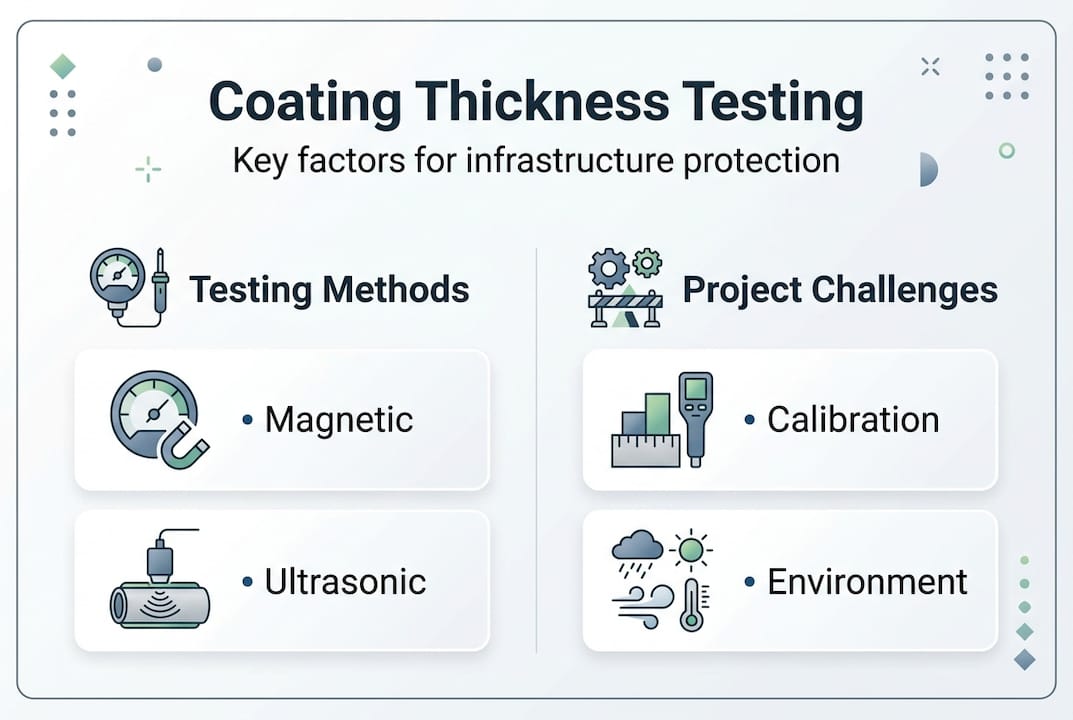
For Central Florida infrastructure, the stakes demand that you prioritize ferrous magnetic testing and ISO 19840 acceptance criteria for steel corrosion protection in humid and salt-influenced environments. You need to calibrate for rough and curved concrete-steel interfaces specifically, not just run a standard calibration. And you need to make sure your QA program is built around FDOT compliance and hurricane durability, not just minimum spec compliance.
The teams that get this right share a few habits that separate them from the ones who end up in recoating disputes. They integrate thickness data with adhesion and hardness results before signing off. They run spot check patterns that specifically target edges, welds, and geometric transitions. They use calibration records that are traceable and substrate-specific. And they rely on inspectors who understand Central Florida’s climate stresses, not just standard industry procedures.
Checkbox compliance is a liability when the checkbox was designed for a different environment. The role of coating inspectors should be active and advisory, not passive and confirmatory. An experienced inspector on a Florida infrastructure project is a risk management asset. Pair that with the right zinc-rich corrosion protection systems chosen for your specific exposure profile, and you are building assets that outlast their design life rather than assets that barely make it to the first maintenance cycle.
The takeaway is straightforward: measure thickness, but do not stop there. Interpret the full data set. Lean on experience with the region. And make sure every QA step is traceable and documented so you have a defense when the Florida weather does what it always eventually does.
Get expert coating testing and protection for your Florida assets
At Southern Sandblasting & Painting LLC, we do not just apply coatings. We back every project with the testing, documentation, and regional expertise that ensures your infrastructure holds up through Florida’s demanding conditions.
Our team delivers industrial coatings for Florida infrastructure with integrated thickness testing, surface prep verification, and full compliance documentation built into every project scope. From initial blast profile checks through final DFT acceptance testing, we follow the industrial coating application steps that meet FDOT standards and exceed typical spec requirements. Our sandblasting services in Orlando create the surface profiles that give coatings the anchor they need to last. Contact us today for an on-site assessment and find out how Southern Sandblasting & Painting can protect your next project from the ground up.
Frequently asked questions
How often should coating thickness testing be performed on Florida infrastructure?
Testing is recommended during initial application at each coat stage and at scheduled maintenance intervals, with additional checks following major weather events like hurricanes that may stress the coating system.
What is the difference between destructive and non-destructive coating thickness testing?
Non-destructive methods are fast, field-ready, and leave the coating intact, while destructive testing provides lab-grade accuracy through physical cross-sectioning but permanently damages the sampled area.
Which coating thickness testing method is best for concrete structures in Florida?
Ultrasonic methods work best for thick or multilayer coatings on concrete, and destructive cross-section sampling provides validation where accuracy requirements are highest, such as water treatment or potable water contact surfaces.
What are the main standards Florida projects should comply with for coating thickness?
The primary compliance standards are ISO 2178, ISO 2360, ISO 2808, ASTM D7091, and ISO 19840, with FDOT project specifications often referencing these directly for acceptance criteria.
Can coating thickness testing predict how long a coating will last?
Thickness alone gives a partial picture. Combining thickness data with adhesion pull-off results and hardness testing provides a far more reliable prediction of service life, especially in Florida’s aggressive exposure conditions.


