
TL;DR:
- Corrosion causes significant damage and costs billions annually, often preventable with proper coatings.
- Surface preparation is crucial; inadequate prep is the main reason coatings fail early.
- Choosing the right coating system based on environment and ensuring proper application extends asset lifespan.
Corrosion is not a cosmetic problem. It is a structural, financial, and public safety crisis hiding in plain sight across Central Florida’s bridges, water tanks, pipelines, and commercial facilities. Global corrosion damage runs $2.5 trillion annually, roughly 3.4% of world GDP, and most of that loss is preventable with the right protective coatings applied at the right time. For municipal infrastructure managers and facility operators, understanding why industrial painting matters is the first step toward smarter asset management. This article covers the real cost of neglect, the science behind modern coating systems, how to choose the right product, and why surface preparation is the variable that determines everything.
Table of Contents
- The real cost of neglect: Hidden risks in unpainted infrastructure
- How protective coatings defend your assets
- Choosing the right system: Coating types, durability, and innovations
- Surface preparation: The foundation of long-term protection
- Why most infrastructure painting failures are about process, not products
- Get expert surface prep and painting for lasting results
- Frequently asked questions
Key Takeaways
| Point | Details |
|---|---|
| Corrosion is costly | Neglected coating leads to expensive damage, downtime, and safety risks. |
| Coatings boost longevity | The right system can extend infrastructure life up to 75 years. |
| Surface prep is critical | Proper preparation prevents premature failures and maximizes ROI. |
| Innovation is emerging | New eco-friendly coatings show promise but require careful evaluation. |
| Expert process wins | Success depends more on proper workflow and supervision than just product choice. |
The real cost of neglect: Hidden risks in unpainted infrastructure
Most facility budgets treat painting as discretionary. That assumption is expensive. When protective coatings degrade or are never applied, steel begins oxidizing immediately in Florida’s humid, salt-laden air. What starts as surface rust becomes section loss, then structural compromise, then liability.
The numbers are sobering. Corrosion causes $2.5 trillion in annual damage worldwide, and a significant portion hits public infrastructure. Locally, Central Florida’s subtropical climate accelerates that timeline. High humidity, seasonal flooding, UV intensity, and proximity to coastal salt air push exposed steel assets into the most aggressive corrosion categories faster than managers often realize.
Here is what deferred painting actually costs you:
- Direct repair costs: Structural steel replacement runs 5 to 10 times more than a proactive coating cycle
- Downtime and disruption: Corroded bridges, tanks, and pipelines require extended shutdowns for remediation
- Legal and insurance exposure: Deteriorated infrastructure creates liability when failures injure workers or the public
- Regulatory penalties: OSHA and EPA standards require maintained protective systems on many facility types
- Public trust erosion: Visible deterioration on municipal assets signals neglect to the communities you serve
| Risk category | Short-term impact | Long-term impact |
|---|---|---|
| Structural corrosion | Surface rust, staining | Section loss, failure risk |
| Compliance gaps | Inspection flags | Fines, forced shutdowns |
| Deferred maintenance | Budget pressure | Accelerated capital replacement |
| Safety incidents | Worker exposure | Litigation, insurance claims |
Early intervention changes this equation entirely. Facilities that extend asset life and cut costs through scheduled coating programs avoid the compounding costs of reactive repair. Understanding corrosion protection basics is not optional for anyone managing steel assets in Florida’s environment. It is a core operational responsibility.
The real cost of skipping paint is not the price of a coating job. It is the price of a structural failure, a regulatory shutdown, or a public safety incident.
Painting is not maintenance. It is risk management.
How protective coatings defend your assets
A well-designed coating system does not just cover steel. It creates a layered defense that blocks moisture, oxygen, chlorides, and UV radiation from reaching the substrate. Each layer plays a specific role, and skipping any one of them compromises the whole system.
Here is how a complete coating system works:
- Surface preparation: Abrasive blasting removes mill scale, rust, and contaminants, creating a profile that anchors the coating mechanically
- Primer application: Zinc-rich or epoxy primers bond to the prepared surface and provide cathodic or barrier protection
- Intermediate coat: Builds film thickness and adds chemical resistance
- Topcoat: Provides UV resistance, color retention, and the final barrier against environmental exposure
The international standard for this is ISO 12944, which classifies environments from C1 (dry interiors) to C5 (industrial coastal) and CX (offshore). Central Florida facilities near the coast or with high humidity exposure typically fall in the C4 to C5 range. Selecting a coating system rated for your actual exposure category is not a detail. It is the difference between a 5-year failure and a 25-year service life.
Anti-corrosion coatings extend steel bridge service life up to 75 years when selected per ISO 12944 categories and applied with proper durability ratings. That number should reframe how you think about coating budgets.
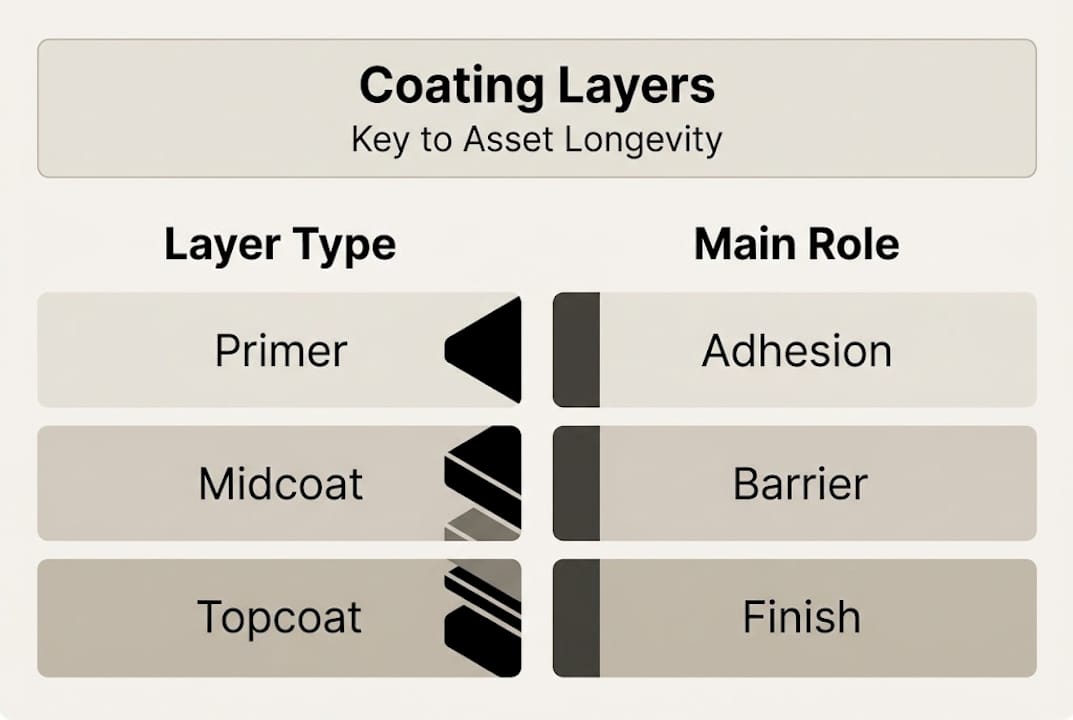
| Coating layer | Primary function | Typical material |
|---|---|---|
| Primer | Adhesion and corrosion inhibition | Zinc-rich epoxy |
| Intermediate | Film build and chemical resistance | High-build epoxy |
| Topcoat | UV and weathering resistance | Polyurethane or acrylic |
Understanding protective coatings and safety means recognizing that each layer is load-bearing in a chemical sense. Facilities managing multiple asset types should also review facility management durability standards and consider how paint piping benefits apply to their specific infrastructure inventory.
Pro Tip: Schedule coating inspections at the 40% mark of your expected service life. Catching early film degradation before it reaches the primer layer costs a fraction of a full system replacement.
Choosing the right system: Coating types, durability, and innovations
Not all coatings are equal, and in Florida’s environment, the wrong choice costs you years of service life. The major industrial coating families each have distinct strengths, limitations, and total ownership costs.
| Coating type | Durability | VOC level | Best application | Approx. service life |
|---|---|---|---|---|
| Zinc-rich epoxy | Very high | Moderate | Primers, submerged steel | 20-30 years |
| High-build epoxy | High | Moderate | Intermediate coats, tanks | 15-25 years |
| Polyurethane | High | Low to moderate | Topcoats, UV exposure | 15-25 years |
| Moisture-cure urethane | High | Low | Humid or damp conditions | 15-20 years |
| Bio-coatings | Unproven | Very low | Experimental applications | TBD |
Low-VOC epoxies and polyurethanes are the current standard for C4 coastal environments, offering 15 to 25 year service lives when properly applied. Their total ownership cost is lower than frequent recoats with cheaper systems, even if the upfront price is higher.
Here is what to evaluate when comparing systems:
- ISO 12944 durability rating: Match the system’s rated environment to your actual site conditions
- Salt spray test hours: Higher ratings indicate better resistance to chloride penetration
- VOC compliance: Florida DEP regulations limit emissions on many project types
- Recoat window: Systems with longer recoat windows allow better scheduling flexibility on active facilities
- Compatibility: Primers, intermediates, and topcoats must be from compatible chemistry families
On the innovation side, bio-coatings using microbial biofilms show real promise for reducing health and environmental risks associated with traditional chemical coatings. However, they remain unproven at infrastructure scale. For a bridge, a water tank, or a commercial facility, proven chemistry is the responsible choice right now.
Pro Tip: Do not choose a coating system based on price per gallon. Calculate the full cost over the expected service life, including surface prep, labor, downtime, and recoat frequency. The cheapest product almost never wins that comparison. Review industrial painting best practices before finalizing any specification.
Surface preparation: The foundation of long-term protection
You can specify the best coating system on the market and still watch it fail in three years. The reason, almost every time, is inadequate surface preparation. Prep is where industrial painting projects succeed or fail, and it is the step that gets compressed when schedules tighten or budgets shrink.
The best-practice workflow for steel surface preparation follows this sequence:
- Contamination removal: Solvent clean or pressure wash to remove oils, salts, and biological growth before abrasive work begins
- Abrasive blasting: Achieve the specified surface profile (SSPC-SP 6 minimum, SP 10 near-white for aggressive environments)
- Surface profile measurement: Confirm anchor profile depth matches coating manufacturer requirements
- Chloride testing: Use salt contamination tests to verify chloride levels are below threshold before priming
- Environmental monitoring: Confirm ambient temperature, relative humidity, dew point, and substrate temperature are within spec
- Prime within the window: Apply primer before flash rust forms, typically within four hours in Florida conditions
Central Florida’s climate creates specific prep challenges. High relative humidity accelerates flash rust formation after blasting. Coastal chloride contamination can penetrate steel pores and cause underfilm corrosion even through an intact topcoat. ML models now predict coastal chloride risk for coatings with more accuracy than traditional accelerated salt spray tests, which often fail to replicate real in-service degradation patterns.
This matters for your specifications. Standard lab testing may underestimate the actual corrosion risk at your specific site. Local knowledge and field monitoring fill that gap.
Surface preparation is not the step before the coating job. It is the coating job. Everything else is just chemistry on top of it.
Review surface prep best practices and the full surface preparation workflow before scoping any project. For 2026 projects specifically, updated surface preparation tips address Florida’s evolving regulatory and environmental conditions.
Pro Tip: Never allow coating application to begin without a documented environmental check. Relative humidity above 85% or substrate temperature within 5°F of the dew point will compromise adhesion regardless of coating quality.
Why most infrastructure painting failures are about process, not products
After more than 20 years working on bridges, water tanks, pipelines, and commercial facilities across Central Florida, the pattern is consistent. When coatings fail early, the investigation almost never points to the paint. It points to what happened before the paint went on.
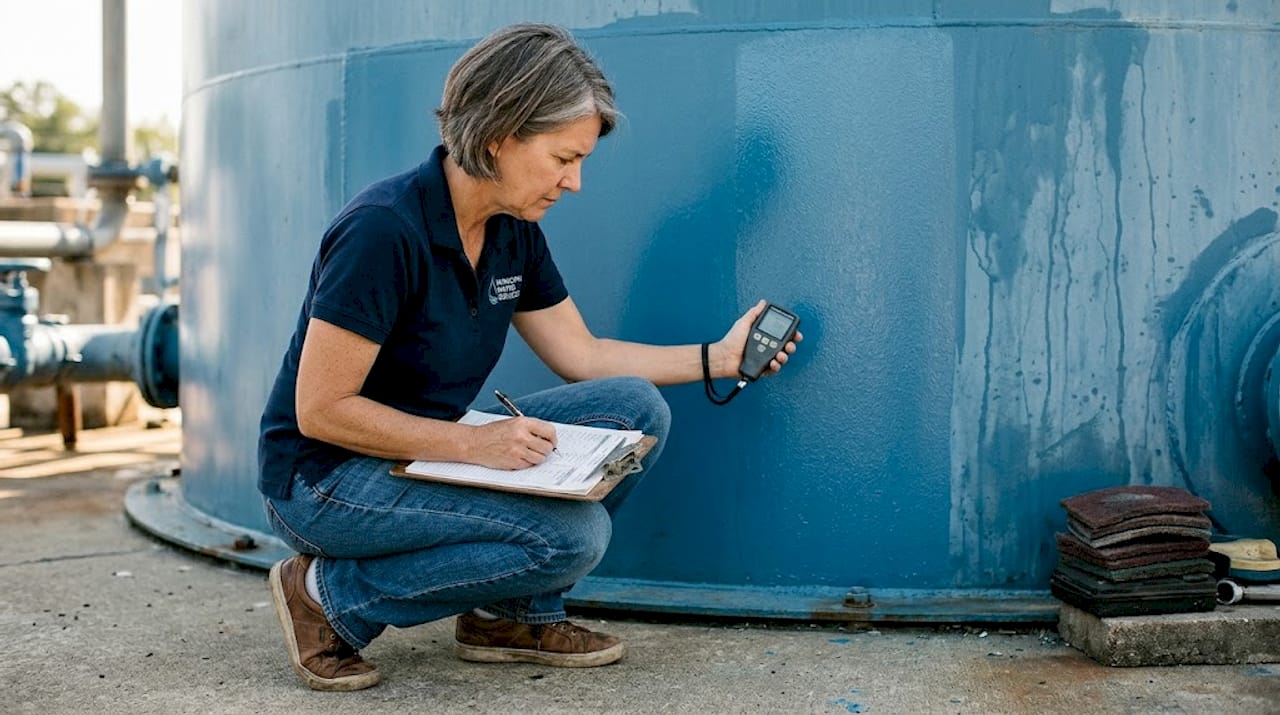
Rushed prep. Skipped chloride tests. Application outside environmental windows. Inadequate film thickness checks. These are process failures, and they are entirely preventable with qualified supervision and documented quality control.
Suppliers will always tell you their product is the answer. And good products do matter. But a premium coating applied over a contaminated surface will fail faster than a mid-grade coating applied over a properly prepared one. The human factor, meaning the crew, the supervisor, the checklist, and the documentation, determines outcomes more than the specification sheet.
Facility managers who engage a skilled contractor oversight model, with clear hold points, third-party inspection, and written quality records, consistently see longer coating service lives. The takeaway is simple: slow down at the critical steps. The cost of doing it right once is always less than doing it twice.
Get expert surface prep and painting for lasting results
If you manage infrastructure or commercial facilities in Central Florida, the challenges covered in this article are not theoretical. Florida’s humidity, UV intensity, and coastal salt exposure are working against your assets every day. The right coating system, applied over properly prepared steel, is your most cost-effective defense.
Southern Sandblasting & Painting LLC brings 20+ years of local experience to industrial coatings for Florida infrastructure, from municipal water tanks and bridges to commercial facilities and pipelines. Our professional sandblasting services deliver the surface profiles that coatings need to perform. Explore our full-service painting solutions or contact us to discuss your project and schedule a site assessment.
Frequently asked questions
How often should municipal infrastructure be repainted?
Repainting schedules depend on environment and coating type, but top industrial coatings can last 15 to 25 years in Florida’s C4 conditions when applied over properly prepared surfaces using ISO 12944 high-durability rated systems.
What is the main cause of premature coating failure?
Failure is most often caused by inadequate surface preparation before coating application. Surface preparation is the foundational variable that determines whether even a premium coating system achieves its rated service life.
Are eco-friendly coatings a proven solution for steel infrastructure?
Bio-coatings aim to reduce health and environmental risks but remain unproven at infrastructure scale, making traditional epoxy and polyurethane systems the responsible choice for critical assets in 2026.
How do I select the right coating system for coastal facilities?
Use ISO 12944 classifications to match your coating system to the actual corrosion category at your site, and work with local experts who understand Central Florida’s specific exposure conditions.
Recommended
- Role of Coatings in Longevity – Extending Asset Lifespans
- Why paint infrastructure: extend asset life and cut costs
- What Is Protective Coating and Why Asset Longevity Depends On It
- Industrial Painting Process—Ensuring Asset Longevity
- Vehicle Detailing: How It Prolongs Car Lifespan
- Industrial Painting Services in Orlando, FL
- Sandblasting Services in Orlando, FL


