
TL;DR:
- Missed surface preparation windows can delay projects, compromise coating performance, and expose assets to damage. Proper timing, standards adherence, phased work zones, and scheduled inspections are essential for successful industrial coating projects in Florida. Local expertise and thorough planning help prevent costly delays caused by weather, permits, or inspector availability.
Missed surface preparation windows don’t just delay your project, they compromise the entire coating system’s performance and leave your assets exposed. Many facility managers and municipal project owners assume coating begins naturally once construction wraps up, but the reality is more complicated. Surface preparation is a precision-timed activity that depends on completed structural work, approved permits, proper weather conditions, and scheduled inspections. Get the sequence wrong, and you pay twice. This guide walks through every phase of the timeline so you can plan projects with accuracy, protect compliance, and avoid the costly rework that comes from scheduling surface prep at the wrong moment.
Table of Contents
- The phases of an industrial project: Setting the timeline context
- Specifying surface preparation: Standards and quality requirements
- Phased work zones: Managing uptime and production schedules
- Inspection and quality control: Integrating checkpoints into project schedules
- What most guides miss about surface prep and coating timelines
- Get expert support for your next industrial project
- Frequently asked questions
Key Takeaways
| Point | Details |
|---|---|
| Timeline sequencing matters | Surface preparation cannot begin until earlier project phases are complete. |
| Standards drive scheduling | Industry standards dictate when and how surface prep and coating occur. |
| Phasing supports uptime | Phased work zones can keep facility operations running during coating projects. |
| Inspection prevents delays | Inspection checkpoints in project schedules avoid costly rework. |
| Local expertise is crucial | Florida’s climate and permitting add unique risks best managed by professionals. |
The phases of an industrial project: Setting the timeline context
With context on why timelines matter, let’s review how project stages shape when coating work happens.
Industrial projects follow a structured sequence that directly controls when sandblasting and coating can be scheduled. According to the 6 stages of construction, projects move through pre-construction planning, design and engineering, permits and approvals, procurement, construction execution, and finally closeout. Surface preparation and coating almost always live in that final construction execution window, but they depend on every earlier stage completing without gaps.
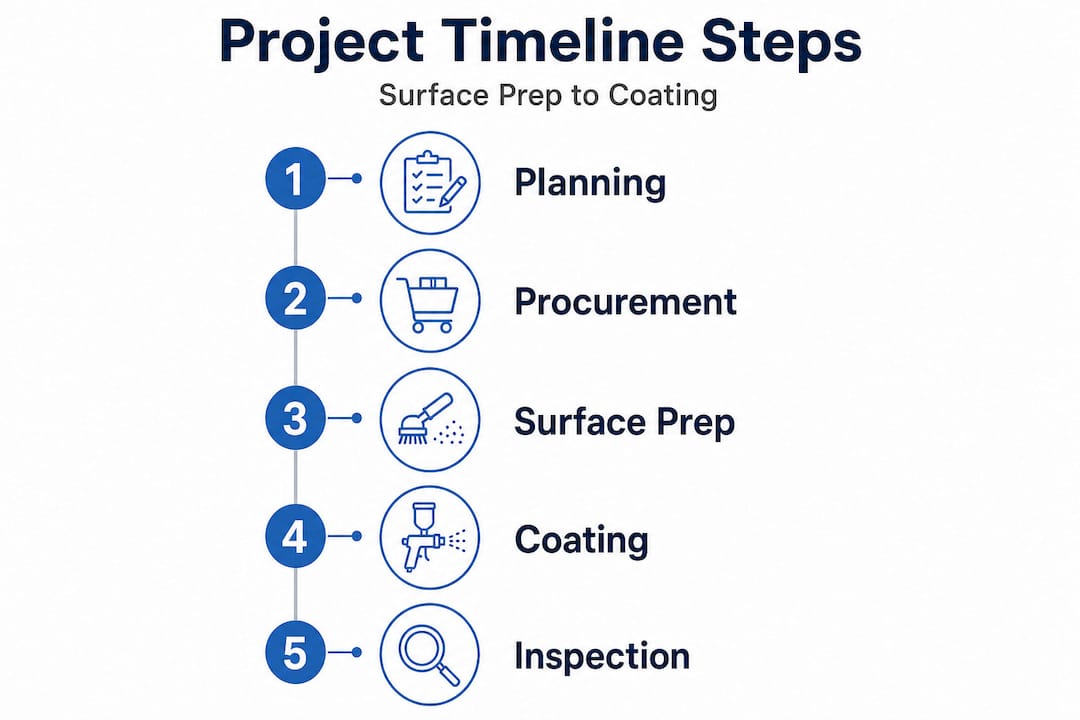
Understanding this chain matters more than most managers realize. Procurement delays push material delivery dates, which push surface prep start dates. Permit hold-ups can freeze a project mid-construction, leaving steel or concrete exposed to Central Florida’s humidity and salt air longer than expected. Each delay compounds the surface contamination problem.
Here is how project stages map to surface preparation dependencies:
| Project stage | Typical duration | Surface prep dependency |
|---|---|---|
| Pre-construction planning | 2 to 6 weeks | Establishes coating spec and standards |
| Design and engineering | 4 to 12 weeks | Determines substrate types and profile requirements |
| Permits and approvals | 2 to 8 weeks | Required before any physical work begins |
| Procurement | 3 to 10 weeks | Coating materials must arrive before prep starts |
| Construction execution | Variable | Surface prep follows structural completion |
| Inspection and closeout | 1 to 3 weeks | Final coating inspection confirms compliance |
The most common triggers for starting surface preparation within a project include:
- Structural steel or concrete substrate fully installed and cured
- All welding, grinding, and modifications to the substrate completed
- Coating materials on-site and quality checked
- Environmental conditions verified (humidity, temperature, dew point)
- Inspection hold points reviewed and cleared by the owner or engineer
Starting timing surface prep too early means you may be blasting a surface that still needs welding or modification, which recontaminates everything you just cleaned. Starting too late creates scheduling bottlenecks that compress the coating application window and force crews into rushed, non-compliant work. Either direction costs money and project credibility.
Pro Tip: Build a surface prep start date into your project schedule as a formal milestone, not an afterthought. Treat it the same way you treat concrete pours or steel erection dates.
Specifying surface preparation: Standards and quality requirements
Once the timeline is set, project specifications drive the quality and scheduling of surface preparation.
Every serious coating specification references formal industry standards to define what “clean” actually means. For steel substrates, cleanliness and profile standards come from AMPP (formerly SSPC/NACE), which rates surface cleanliness from SP 1 solvent cleaning through SP 5 white metal blast cleaning. For concrete, ICRI (International Concrete Repair Institute) provides CSP (Concrete Surface Profile) ratings from CSP 1 through CSP 10, defining how much texture the surface needs to accept a coating properly.
These standards are not suggestions. They are contractual requirements written into project specs that determine whether a coating manufacturer will honor their warranty. A missed profile level on a water tank or bridge structure can void the entire warranty, leaving your municipality holding the bill for early coating failure.
Here is a comparison of the key standards you will encounter in Central Florida industrial projects:
| Standard | Substrate | What it measures | Typical requirement |
|---|---|---|---|
| AMPP SP 2 | Steel | Hand tool cleaning | Light rust removal, general maintenance |
| AMPP SP 6 | Steel | Commercial blast | 2/3 of surface free of all mill scale |
| AMPP SP 10 | Steel | Near-white blast | Removes 95% of all contaminants |
| AMPP SP 5 | Steel | White metal blast | 100% clean, high-performance coatings |
| ICRI CSP 3 to CSP 5 | Concrete | Surface profile depth | Typical for epoxy and polyurethane coatings |
To properly specify and quality-assure surface prep requirements, follow this sequence:
- Identify substrate type and condition before writing or reviewing the spec. Steel with heavy mill scale needs different prep than weathered concrete.
- Reference the correct standard in the project specification document. Name the standard by number, not just by description.
- Define acceptable cleanliness level and anchor profile (surface roughness depth, measured in mils) required for the intended coating system.
- Establish inspection hold points at the specification stage so the QA process is scheduled before mobilization begins.
- Confirm testing equipment is available on-site, including surface comparators, Elcometer profile gauges, and dew point meters.
- Document and sign off at each checkpoint before allowing coating application to proceed.
Staying current with coatings compliance standards is especially important for municipal projects in Florida, where regulatory scrutiny on water infrastructure and public facilities is intense. An organized surface preparation workflow that ties directly to these standards keeps projects on schedule and reduces disputes at closeout.
Pro Tip: Leverage your spec’s standards list to schedule required inspections before coating mobilizes. If your spec calls for SP 10 near-white blast, book the inspector to sign off on blasting before the coating crew arrives. Waiting until after mobilization creates pressure to rush inspections, which leads to rejected work.
Phased work zones: Managing uptime and production schedules
For operational facilities, keeping production running is critical, so timelines require flexible solutions.

Not every industrial coating project happens on a new construction site. Many of our most complex projects occur inside active facilities, including theme parks, airports, manufacturing plants, and water treatment facilities. These clients cannot simply shut down operations for weeks while surface prep and coating happen. The answer is phased work zones.
A real-world example of this strategy comes from a factory roof restoration project where the facility used phased, contained work zones so production could continue throughout the coating process. Instead of treating the facility as a single project zone, the work was divided into sections. One zone was sealed off, blasted, coated, and cured while the rest of the facility remained fully operational. The next zone started after the previous one cleared final inspection.
Best practices for planning a phased work schedule in operating facilities include:
- Map facility zones before mobilization, assigning each zone a start and finish window tied to production schedules.
- Set up temporary containment systems to prevent abrasive media, dust, and coating overspray from contaminating active production areas.
- Schedule high-dust activities (sandblasting) during off-shifts or weekends when production volumes are lowest.
- Coordinate material deliveries zone by zone rather than receiving all materials at once, which reduces staging conflicts and prevents coating materials from sitting open too long.
- Build weather contingency windows into each zone’s schedule. Central Florida’s afternoon thunderstorms are reliable enough that you should plan for lost time rather than hoping for dry days.
- Confirm ventilation and air quality requirements in each zone before work begins, especially where food, pharmaceuticals, or electronics are produced nearby.
For projects involving theme park surface treatment, phased work zones become even more important. Rides and attractions cannot close indefinitely, and the guest experience depends on seamless operations. Tight zone planning and precise scheduling are what separate a successful coating project from one that makes headlines for the wrong reasons.
“In a multi-zone coating project for an active manufacturing facility, our team completed six zones over nine weeks without a single production shift being lost. The key was treating each zone as its own mini-project with its own mobilization, prep, application, and inspection sequence.”
Pro Tip: Coordinate material logistics zone by zone rather than project-wide. Coating materials have limited pot life (the time they remain usable after mixing) and receiving too much product at once leads to waste, substitutions, and schedule problems.
Inspection and quality control: Integrating checkpoints into project schedules
Quality control is woven into every stage, and inspection checkpoints anchor the timeline.
Inspection is not the last step. It is embedded throughout the project, and treating it as a final activity is one of the most expensive mistakes facility managers make. The AMPP Coating Inspector Program (CIP 1) formalizes quality control and inspection capabilities, training inspectors on surface preparation verification, environmental condition monitoring, coating application quality testing, and film thickness measurement. This tells you something important: professional inspection is a scheduled discipline, not a walk-through.
Every timeline for a coating project should include the following inspection checkpoints:
- Pre-blast inspection: Substrate condition documented, defects noted, spec reviewed.
- Mid-blast inspection: Cleanliness level verified at multiple points within the work zone.
- Post-blast inspection: Final cleanliness grade and anchor profile confirmed before any coating is applied.
- Environmental conditions check: Humidity, temperature, and dew point verified immediately before coating application.
- Wet film thickness check: Confirmed during application to catch problems before the coating cures.
- Dry film thickness (DFT) check: Final measurement taken after full cure, documented for the project record.
- Holiday testing (for tank linings and immersion coatings): Electrical spark or low-voltage testing detects pinholes in the cured film.
The role of coating inspectors in ensuring asset longevity is directly tied to their ability to enforce these checkpoints in real time, not after the fact. For municipal infrastructure like water tanks and stormwater structures, quality control in coatings is also a regulatory requirement, not just a best practice.
Skipping or rushing coating inspection checkpoints creates cascading problems. A missed post-blast inspection may allow a contaminated surface to be coated. The contamination causes adhesion failure six months later. The coating delaminates, corrosion starts, and now you are replacing the entire coating system instead of spending an extra hour on inspection. The math is not complicated.
What most guides miss about surface prep and coating timelines
Most industry content lays out the steps correctly but skips the part that actually makes projects fail in Central Florida. Let me be direct about what we see repeatedly after 20-plus years working on municipal and commercial projects in this region.
Florida’s climate adds timing risks that do not exist in most of the country. Afternoon humidity in Orlando regularly climbs above 80 percent in summer, which can violate coating application windows even when mornings look perfect. Dew point conditions can disqualify an entire workday by noon. Many managers building timelines with national averages in mind find their schedules collapsing in July and August when weather contingencies were never built in.
Florida’s permitting environment also creates unpredictable delays. Environmental permits for work near water bodies, stormwater systems, or protected zones take longer and require more documentation than most project managers budget for. We have seen well-planned projects pushed back four to six weeks purely because environmental hold points were not identified at the planning stage.
The other thing most guides ignore is inspection lead time. A certified coating inspector is not always available the day you need them. In a busy construction market like Orlando, lead times for qualified inspectors can run two to three weeks. If you build a schedule that assumes inspection can happen on demand, you will either delay coating or apply coating without proper sign-off. Both outcomes cost you.
Reading through industrial painting best practices is a good starting point, but the real differentiator is local expertise and experience. A contractor who knows Central Florida’s permitting offices, seasonal weather patterns, and inspection resource availability brings something that no national specification template can replace.
Pro Tip: Build at least five to ten business days of schedule slack around each major surface prep milestone. Rushed prep almost always costs more than the time you saved by skipping the buffer.
Get expert support for your next industrial project
Understanding these timelines is the first step, but executing them on a live project requires experience, equipment, and deep local knowledge. Southern Sandblasting and Painting LLC brings over 20 years of hands-on industrial project experience in Central Florida, working on everything from municipal water tanks and city infrastructure to airports and theme parks.

Whether your project involves understanding industrial coatings for Florida infrastructure, applying the right surface prep best practices for complex substrates, or scheduling professional Orlando sandblasting services that align with your project milestones, our team is ready to walk through your timeline and flag potential issues before they become problems. Reach out to discuss your next project and get a timeline review from specialists who know what Central Florida projects actually demand.
Frequently asked questions
What are the typical stages in an industrial surface preparation project?
Industrial projects sequence through pre-construction planning, design, permits, procurement, construction execution, and closeout, with surface preparation and coating work scheduled during the construction execution phase after structural work is complete.
What surface preparation standards should Florida projects reference?
Most projects reference AMPP/SSPC-NACE standards for steel substrates and ICRI CSP ratings for concrete, with the specific cleanliness level and anchor profile defined in the coating specification.
How do factories maintain uptime during coating projects?
Facilities use phased, contained work zones to isolate coating activity to one section at a time, keeping the rest of operations running while each zone completes its full prep, coating, and inspection sequence.
Why are inspection checkpoints critical in coating timelines?
AMPP’s Coating Inspector Program formalizes that inspection must happen at each project stage, not just at the end, because applying coating over unverified surface preparation leads to adhesion failure and full system replacement.
What is the biggest scheduling mistake in industrial coating projects?
Overlooking inspection lead times and failing to book certified inspectors in advance forces either delayed coating starts or non-compliant application, both of which cost significantly more than a properly planned inspection schedule would have.


