
TL;DR:
- Facility managers in Florida often underestimate the importance of system design and proper application when choosing epoxy coatings. Properly specified and applied epoxy systems provide long-term protection against UV, humidity, and chemical exposure, unlike standard paints that fail quickly. Success depends on substrate testing, meticulous surface preparation, correct product layering, and adherence to regulatory requirements, ensuring durability and compliance over decades.
Many facility managers across Florida assume that any commercial-grade floor coating will hold up under daily operational demands. That assumption gets expensive fast. Florida’s combination of intense UV exposure, near-constant humidity, thermal cycling, and strict health regulations creates conditions that standard paints and basic coatings simply cannot survive long-term. Epoxy coating systems, when properly specified and applied, offer a fundamentally different level of protection for municipal and commercial facilities. This guide breaks down exactly what epoxy is, how it performs, where it excels, and where you need a smarter system design to get the results your facilities require.
Table of Contents
- What is epoxy coating and how does it work?
- Essential properties and advantages of epoxy coatings
- Proper application: The key to longevity
- Epoxy coating compliance: Meeting Florida’s regulatory requirements
- Key limitations and modern alternatives in Florida’s climate
- A Florida facility manager’s perspective: What most guides miss about epoxy systems
- Next steps: Protect your Florida facilities with proven coating expertise
- Frequently asked questions
Key Takeaways
| Point | Details |
|---|---|
| Epoxy coating basics | Epoxy is a two-part thermoset system that creates a tough, seamless protective surface for commercial and municipal facilities. |
| Core advantages | Its high strength, adhesion, and resistance to moisture, chemicals, and impact makes epoxy ideal for demanding Florida environments. |
| Critical application steps | Proper surface preparation and curing are essential for longevity, especially with Florida climate challenges. |
| Compliance matters | For kitchens and other regulated spaces, epoxy supports health code and FDA requirements for seamless floors. |
| Florida-specific limitations | UV exposure and humidity require hybrids or expert-applied topcoats to avoid premature epoxy failure outdoors. |
What is epoxy coating and how does it work?
Epoxy coating is not just a tougher paint. It is a chemically distinct protective system. Epoxy coating is a thermoset polymer formed by mixing epoxy resin with a hardener, typically a polyamine or polyamide curing agent, triggering a chemical cross-linking reaction that creates a rigid, durable, chemically resistant surface. Once cured, this cross-linked matrix is essentially permanent. It cannot be melted, dissolved, or re-shaped the way thermoplastic coatings can.
Here is what makes this chemistry critical for your facilities:
- Cross-linking density: The tighter the cross-link network, the harder and more chemically resistant the cured film becomes.
- Bond formation: Epoxy chemically bonds to properly prepared concrete, creating adhesion that mechanical fastening cannot replicate.
- Seamless surface: Unlike tile or pavers, a cured epoxy floor has zero grout lines or joints where bacteria, chemicals, or moisture can infiltrate.
- Thermal stability: Within typical indoor operating ranges, cured epoxy resists deformation under load without creeping or softening.
“The cross-linking reaction is irreversible. Once epoxy cures, the film is a rigid thermoset network that cannot be re-melted or re-dissolved. This is what separates epoxy from alkyd or latex paint systems, which remain thermoplastic and are far more vulnerable to chemical softening.”
For facility managers overseeing food processing plants, water treatment infrastructure, or high-traffic public corridors, understanding the epoxy coating performance difference between a thermoset and a thermoplastic system is not academic. It directly affects how often you resurface, whether you pass inspections, and how your total cost of ownership stacks up over a 10-to-20-year asset cycle.
Essential properties and advantages of epoxy coatings
Understanding what epoxy is chemically points toward its standout advantages, which are particularly important for Florida’s municipal and commercial environments.
Key properties include high compressive strength, excellent adhesion to concrete (requiring substrate tensile strength greater than 1.5 MPa), chemical and moisture resistance, impact resistance, and a seamless, non-porous finish. These are not marketing claims. They are engineering specifications that directly answer the demands of regulated, high-use facilities.
Comparison: Epoxy vs. standard paint vs. polyurethane topcoat
| Property | Standard paint | Epoxy coating | Polyurethane topcoat |
|---|---|---|---|
| Compressive strength | Low | Very high | Moderate |
| Chemical resistance | Poor | Excellent | Good |
| UV stability | Poor | Poor (yellows) | Good to excellent |
| Seamlessness | Yes | Yes | Yes |
| Adhesion to concrete | Moderate | Excellent | Moderate |
| Flexibility | Low | Low | High |
| Typical lifespan | 2-5 years | 10-20 years | 5-10 years as topcoat |
Durability benchmarks show 10-20 or more years in commercial and industrial settings when properly installed, with chemical resistance rated on a 0-to-5 scale where epoxy consistently scores 5 for most industrial chemicals. However, Florida garages exposed to direct sunlight can see performance drop to just 3-5 years without a UV-stable topcoat. That lifespan gap is significant and something every Florida manager must factor into system specification.
Additional advantages worth understanding in depth:
- Non-porous finish: Bacteria, mold spores, and industrial chemicals cannot penetrate the surface, which directly supports sanitation compliance in food-grade environments.
- Forklift and heavy equipment resistance: High compressive strength means the surface resists indentation under concentrated point loads, critical in warehouse and logistics applications.
- Chemical splash protection: Whether you manage a municipal water treatment facility or a commercial kitchen, chemical resistance prevents surface degradation from cleaning agents, fuels, or process chemicals.
- Easy maintenance: Smooth, seamless surfaces clean faster and with fewer labor hours, which matters when you’re managing large square footage with a limited team.
The long-term durability of epoxy depends heavily on substrate preparation and system design, not just product quality alone.
Pro Tip: Always verify your concrete substrate’s tensile strength and moisture vapor emission rate before specifying an epoxy system. A substrate testing below 1.5 MPa tensile strength or above 3 pounds per 1,000 square feet per 24 hours on a calcium chloride moisture test will compromise adhesion, regardless of product quality. These tests are inexpensive compared to a full resurfacing project. Check epoxy maintenance tips to understand ongoing care requirements after installation.
Proper application: The key to longevity
Of course, even the highest quality epoxy is only as effective as its application, especially in challenging climates like Florida.
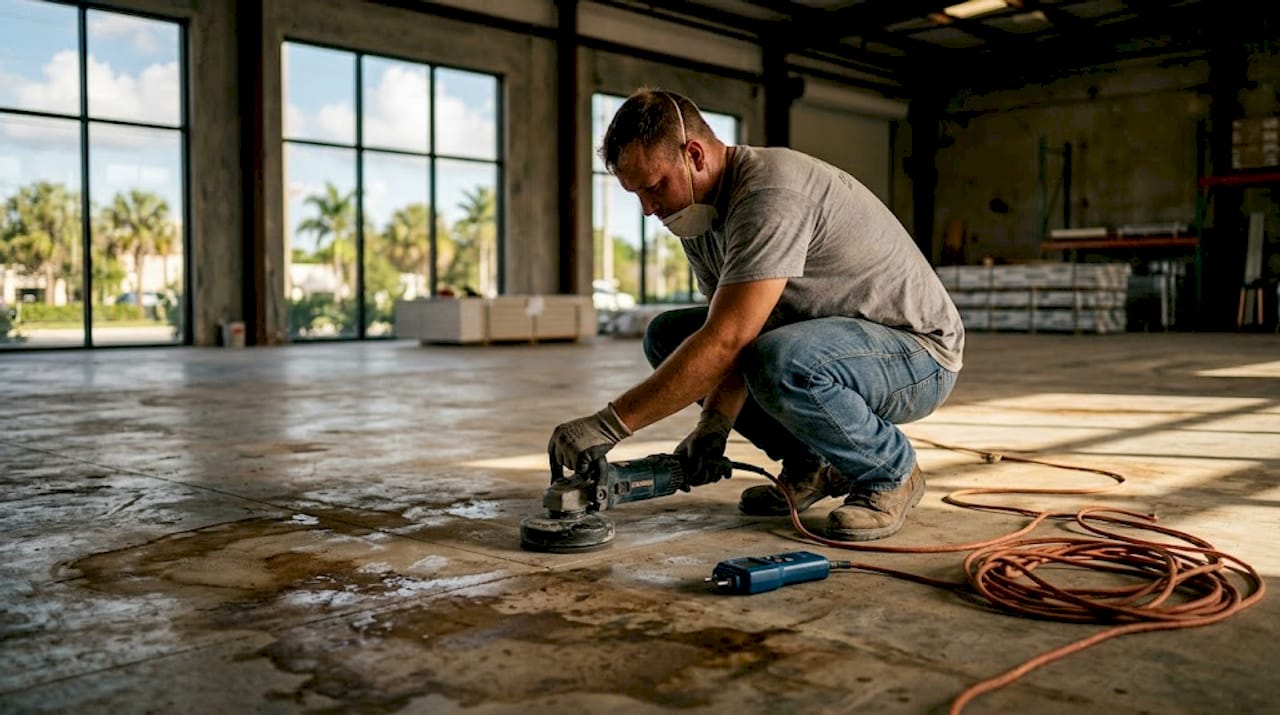
Application methodology makes or breaks an epoxy system. Surface preparation requires acid etching or shot blasting to achieve a concrete surface profile of CSP 2-3, followed by a moisture test confirming readings below 3 pounds CaCl before coating begins. After prep, resin and hardener are mixed in precise ratios and applied at 10-20 mils for commercial applications or 125-375 mils for heavy industrial uses via roller or squeegee. Cure time runs 24-72 hours for foot traffic and a full 7 days before returning to heavy use.
Here is a step-by-step breakdown of what proper application looks like on a Florida municipal or commercial project:
- Substrate assessment: Test for moisture vapor emission, tensile strength, existing coatings, and contamination before any work begins. In Florida, elevated groundwater tables make this step non-negotiable.
- Surface preparation: Shot blast or diamond grind to CSP 2-3 profile. Remove all laitance, curing compounds, oils, and bond-breaking contaminants. Follow best practices for surface prep at every stage.
- Primer application: Apply an appropriate penetrating primer to seal the substrate and maximize adhesion. Skip this step and you are gambling with the entire system’s bond strength.
- Base coat mixing: Mix resin and hardener in the exact manufacturer-specified ratio. Off-ratio mixes result in soft, under-cured films that fail prematurely.
- Controlled application: Apply at the correct mil thickness using the appropriate tool. Too thin, and the system lacks the barrier properties you’re specifying for. Too thick, and you risk cracking from internal stress.
- Broadcast (if applicable): Add anti-slip aggregate or decorative broadcast media while the base coat is still wet for high-traffic safety compliance.
- Topcoat application: Apply a compatible topcoat, especially a UV-stable aliphatic urethane if the area receives any sunlight or is exposed outdoors.
- Cure management: Protect the surface from foot traffic for 24-72 hours and from heavy equipment for a full 7 days. In Florida, this also means managing ambient temperature and humidity during and after application.
Pro Tip: Florida’s summer humidity regularly exceeds 80%, and afternoon temperatures commonly push above 90°F. Both conditions accelerate pot life, meaning your usable working time per mixed batch shortens significantly. Schedule large pours for early morning hours when temperatures are lower and dew points are more manageable. Rushing this step is the single most common cause of preventable application failures we see in Central Florida. Review the step-by-step coating application process before mobilizing any crew.
Epoxy coating compliance: Meeting Florida’s regulatory requirements
Alongside technical excellence, legal compliance is non-negotiable, especially for public and commercial infrastructure in Florida’s highly regulated environment.
Florida compliance requires adherence to FDA 21 CFR 175.300 and 117 for food-grade facilities, mandating seamless, non-absorbent, and easily cleanable floors in commercial kitchens and food processing environments. Integral cove bases are also required, meaning the epoxy system must continuously transition from floor to wall with no exposed joint, eliminating the gap where contamination would otherwise accumulate. Health department inspections actively check for these conditions.
Facilities that fall under these requirements include:
- Commercial kitchens and restaurants operating under state and local health department jurisdiction
- Food processing and distribution warehouses subject to FDA oversight
- Municipal water treatment facilities with sanitary zones requiring non-porous, chemical-resistant surfaces
- Healthcare-adjacent facilities including commissaries and sterile storage areas
- Public restrooms and locker rooms in government-owned buildings where mold resistance is specifically regulated
The documentation side of compliance catches many facility managers off guard. You need not only a properly installed floor but also product data sheets confirming food-grade certification, application records showing cure conditions and mil thickness readings, and contractor qualifications. Health department inspectors do not accept “we used a good product” as a substitute for records. Maintain a project file that includes the manufacturer’s certification, installer’s application log, and inspection photos before, during, and after coating.
“Compliance failures in food-grade environments are not just about fines. A failed inspection can result in facility shutdown until corrective coatings are installed, often at emergency rates and with significant operational disruption.”
See our detailed breakdown of compliance standards for epoxy to understand which certifications apply to your specific facility type.
Key limitations and modern alternatives in Florida’s climate
Once you understand compliance, it’s equally crucial to confront the environmental challenges unique to Florida, and where to consider alternatives.
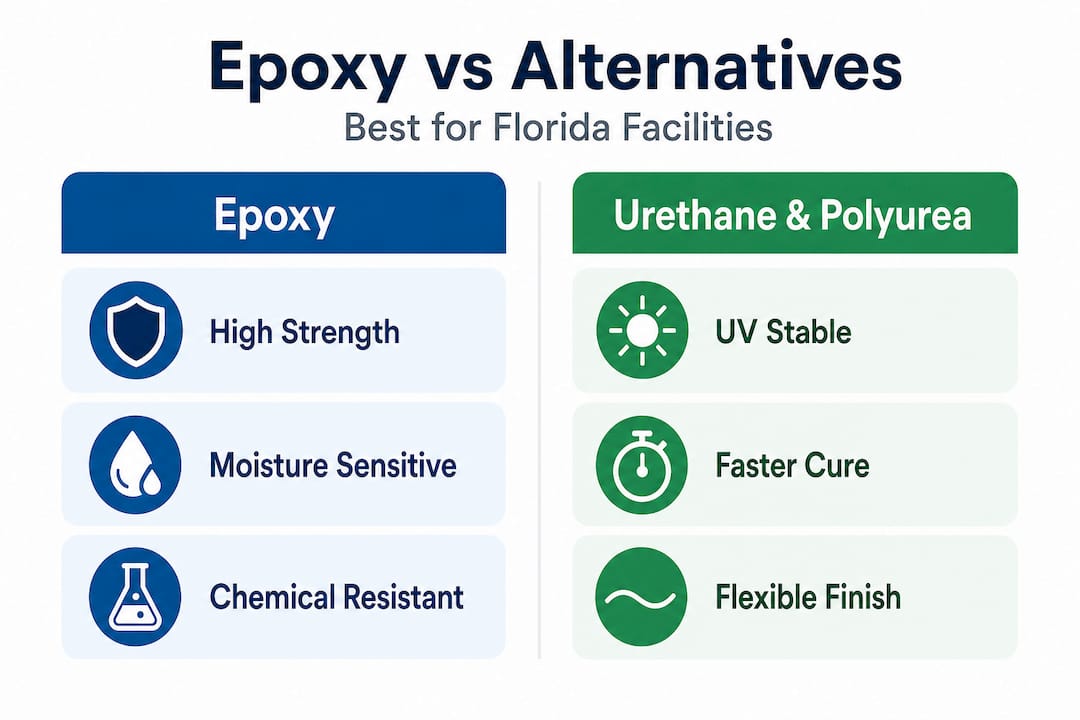
Epoxy is not a universal answer to every Florida surface protection need. Epoxy is sensitive to moisture and humidity above 65% during the cure phase, causing bubbling and delamination. It yellows under UV exposure from Florida’s intense sun without an aliphatic topcoat, and its low elongation of approximately 13% makes it brittle under thermal expansion cycles common in Florida’s climate. Pot life also shortens at temperatures above 90°F.
Performance comparison: Epoxy vs. alternatives for Florida conditions
| Factor | Epoxy | Urethane | Polyurea |
|---|---|---|---|
| Chemical resistance | Excellent | Good | Good |
| UV stability | Poor | Good | Excellent |
| Elongation/flexibility | ~13% | Moderate | 200%+ |
| Abrasion resistance | Good | 4x better than epoxy | Very high |
| Cure speed | 24-72 hrs | 12-24 hrs | Hours |
| Best use case | Indoor chemical areas | UV-exposed surfaces | Outdoor/thermal cycling |
Epoxy offers superior chemical resistance and moisture resistance compared to urethane or polyaspartic alternatives, but it is inferior in UV resistance, abrasion resistance, and flexibility. Urethane provides approximately four times the abrasion resistance of epoxy, while polyurea delivers over 200% elongation versus epoxy’s 13%, making it far better suited to surfaces that expand and contract with Florida’s temperature swings. Hybrid systems combining an epoxy base coat with a polyurethane or polyaspartic topcoat are recommended for most Florida infrastructure applications.
When to choose each system:
- Pure epoxy: Interior spaces with no UV exposure, high chemical loads, and stable temperatures, such as water treatment wet wells or commercial kitchen floors
- Epoxy with aliphatic urethane topcoat: Any interior-to-exterior transition, loading docks, covered parking structures
- Hybrid epoxy/polyurea: Outdoor secondary containment areas, airport aprons, and any surface subject to significant thermal movement
- Pure polyurea: Exterior surfaces, water storage tanks, and situations requiring rapid return to service
Refer to our analysis of humidity effects on coatings to see documented failure patterns from Florida projects where system design did not account for local climate conditions.
A Florida facility manager’s perspective: What most guides miss about epoxy systems
Most technical guides on epoxy coating focus on the product. After more than 20 years applying protective coatings to Florida’s municipal water tanks, airports, food processing plants, and city infrastructure, we can tell you clearly: the product is rarely where projects fail.
The majority of premature epoxy failures we assess come down to two issues. First, inadequate surface preparation on substrates that were assumed to be ready but tested poorly. Second, application conditions that were not properly managed for Florida’s climate. Neither is a product problem. Both are execution problems that a qualified contractor with local experience prevents before they become your problem.
Here is what most guides do not say plainly: in Florida, a pure epoxy system is almost never the right final answer for exposed or mixed indoor/outdoor applications. A properly designed hybrid system, using epoxy as the structural base and a UV-stable urethane or polyaspartic as the finish layer, outperforms pure epoxy on every critical metric that matters in this climate. The upfront cost difference is modest. The lifecycle performance difference is substantial.
The compliance angle is equally underappreciated. We see facility managers invest in good products but skip the documentation and substrate verification steps. Then, during a health department inspection, they face a corrective action order because the application records do not exist or the cove base detail was missed. The cost of professional installation with full documentation is a fraction of an emergency remediation project under inspection pressure.
Protecting your assets with epoxy for asset protection requires treating system design, surface prep expertise, and compliance documentation as equal priorities, not afterthoughts to the coating product itself.
Next steps: Protect your Florida facilities with proven coating expertise
Understanding epoxy’s strengths and limitations gives you a foundation, but long-lasting results start with action and trusted expertise. Knowing the chemistry matters, but selecting the right system design for your specific facility type, climate exposure, and compliance requirements is where results actually happen.
Southern Sandblasting & Painting LLC brings 20 or more years of hands-on experience applying industrial coatings for Florida infrastructure, from municipal water systems and airport surfaces to commercial kitchens and public facilities across Central Florida. We handle full-scope projects including surface assessment, professional shot blasting, primer and base coat application, topcoat finishing, and compliance documentation. Whether you need a compliant food-grade floor or a UV-stable exterior system, our team specs the right solution and delivers it correctly the first time. Start with our surface preparation best practices resource to understand what your project needs before the first coat goes down.
Frequently asked questions
How long does epoxy coating last in Florida facilities?
Epoxy coatings last 10-20 years in commercial and industrial settings with proper installation, but Florida garages without a UV-protective topcoat may see performance degrade within 3-5 years due to sun exposure.
What are the biggest risks when applying epoxy coatings in Florida?
Humidity above 65% and temperatures over 90°F during application cause bubbling, delamination, and shortened pot life, making climate-aware scheduling and substrate testing essential for Florida projects.
Are epoxy coatings required for compliance in food service facilities?
Yes. FDA 21 CFR 175.300 and 117 require seamless, non-absorbent, cleanable floors in commercial kitchens and food-grade facilities, and epoxy systems with integral cove bases directly satisfy these requirements.
Can I use epoxy coating outdoors in Florida?
Epoxy can be applied to outdoor surfaces, but UV yellowing without an aliphatic topcoat will degrade both appearance and performance quickly in Florida’s climate, making a UV-stable finish coat mandatory for any exterior application.
What facilities benefit most from epoxy coatings?
Facilities with high chemical loads and sanitation demands, including kitchens and warehouses, benefit most from epoxy’s chemical resistance and seamless finish, especially when paired with a UV-protective topcoat for mixed-exposure environments.
Recommended
- Why use epoxy coatings? Durable long-term asset protection
- Water tank coating types: 40% longer lifespan in Florida
- Powder Coating Explained: Durable Protection for Central Florida
- Zinc-Rich Coatings: Florida Asset Corrosion Protection
- Sandblasting Contractor Baldwin Park FL
- Sandblasting Services Oviedo FL


