
TL;DR:
- Proper surface preparation and strict workflow adherence are essential to prolonging municipal infrastructure lifespan and avoiding costly early replacements. Comprehensive planning, correct media selection, and real-time quality control are critical steps in the sandblasting and coating process. Continuous compliance documentation and scheduled maintenance cycles significantly improve asset durability and safety.
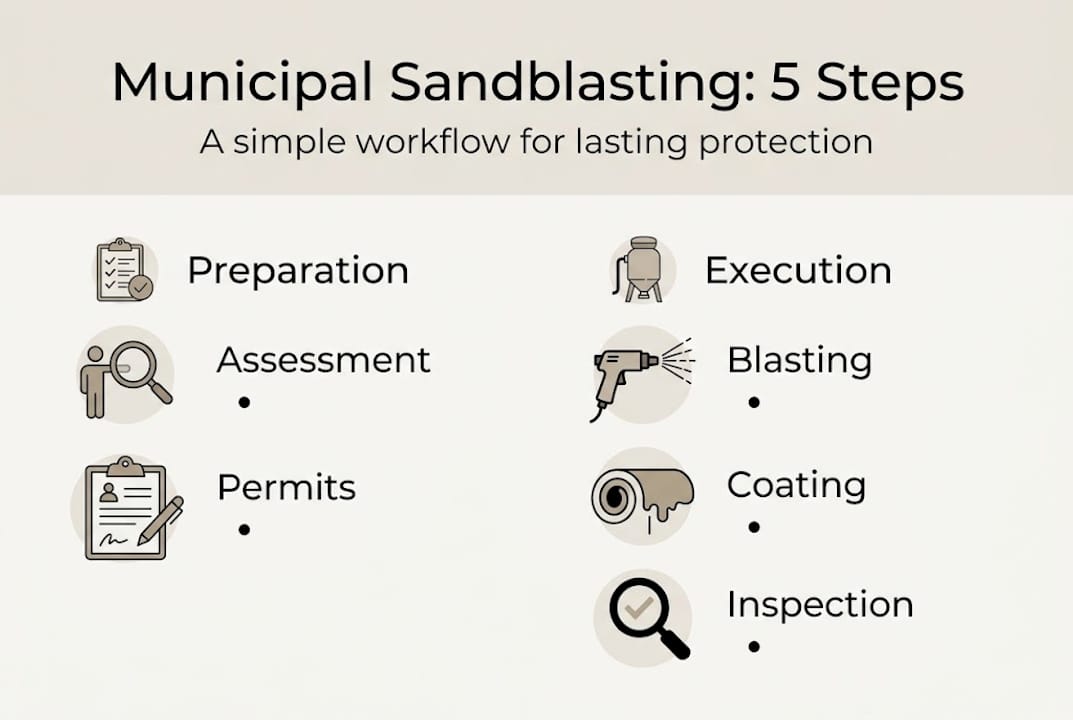
Skipping a single step in your sandblasting workflow can shorten a municipal asset’s lifespan by a decade or more, costing cities millions in early replacements and emergency repairs. For infrastructure managers overseeing water towers, pipelines, bridges, and public facilities across Central Florida, that’s not a theoretical risk. It’s a budget crisis waiting to happen. The NACE No. 2/SSPC-SP-10 framework exists precisely because surface preparation failures are the leading cause of coating breakdown. This guide walks you through every phase of a compliant, effective municipal sandblasting workflow, from first inspection to final sign-off.
Table of Contents
- Pre-project assessment and planning
- Choosing the right cleaning method and media
- Executing sandblasting safely and effectively
- Coating application and final quality verification
- Our take: Why workflow discipline matters more than technology
- Get reliable sandblasting and coating for your project
- Frequently asked questions
Key Takeaways
| Point | Details |
|---|---|
| Rigorous planning | Preparation and precise assessment are essential for workflow efficiency and compliance. |
| Media and method choice | Select abrasive and cleaning method based on material, corrosion level, and local regulations. |
| Immediate coating | Applying coatings immediately after blasting prevents flash rust and extends asset life. |
| Strict documentation | Accurate records ensure quality control and compliance for municipal audits. |
| Scheduled cycles | Proactive sandblasting and coating every 2–5 years cuts costs and maximizes infrastructure value. |
Pre-project assessment and planning
Every durable coating job begins long before the blasting equipment arrives on site. A thorough pre-project assessment is what separates a properly protected asset from one that fails within three to five years. This phase sets the technical and logistical foundation for everything that follows.
Start with a formal surface inspection. Use moisture meters to detect subsurface dampness that would trap corrosion under new coatings, and deploy dry film thickness gauges to measure existing coating layers. Visual inspection identifies active rust, surface pitting, mill scale, and contamination zones. Technical checklists should document all findings against the specific surface preparation standards your project requires.
Key inspection tools for your pre-project checklist:
- Moisture meters (ASTM D4263 tape test method)
- Dry film thickness gauges (per SSPC-PA 1)
- Surface profile comparators (Keane-Tator or Testex Press-O-Film)
- Salt contamination test kits (Bresle method)
- Photographic documentation log
The infrastructure coating process demands compliance with specific SSPC standards. SSPC-SP6 (Commercial Blast) is acceptable for mildly corroded surfaces where coating performance requirements are moderate. For critical structures like potable water tanks and structural steel bridges, SSPC-SP10/NACE No.2 (Near-White Metal Blast) is the benchmark. Both define exactly how much visible mill scale, rust, and old coatings may remain after blasting. The 5-step municipal workflow codified in NACE No. 2 is the industry standard for a reason: it closes every gap that leads to premature failures.
Planning also means securing the right permits. OSHA 29 CFR 1910.1025 covers lead paint abatement, which is common in older municipal assets. EPA regulations under 40 CFR Part 63 govern hazardous air pollutants from abrasive blasting. Containment structures, vacuum-equipped blast systems, and waste disposal plans must be documented before any work begins.
| Planning factor | Standard or requirement |
|---|---|
| Surface cleanliness grade | SSPC-SP6, SSPC-SP10/NACE No.2 |
| Lead paint abatement | OSHA 29 CFR 1910.1025 |
| Air emission control | EPA 40 CFR Part 63 |
| Moisture limit for coating | Below 50% RH or per manufacturer |
| Surface profile target | 1.5 to 4.5 mils (anchor profile) |
Pro Tip: In Central Florida, humidity above 85% is common from May through September. Schedule sandblasting for early morning hours when temperatures are lower and relative humidity has not peaked. This one scheduling decision dramatically reduces your flash rust risk between blasting and primer application.
Choosing the right cleaning method and media
After your initial assessment and planning, the next step is selecting the right surface cleaning approach. Not every surface requires the same abrasive or the same delivery method. Using the wrong combination wastes time, damages the substrate, or produces a surface profile that coatings simply will not bond to.
Abrasive media selection depends on the base material and the target cleanliness level. Steel grit creates the aggressive angular profile needed for heavy industrial coatings on structural steel. Aluminum oxide is harder and sharper, well-suited for concrete and masonry where you need to open the surface without damaging embedded rebar. Garnet is a lower-dust option often preferred for enclosed spaces or sensitive environments, such as work near active water intakes.
The blasting techniques for infrastructure you choose also depend on the degree of corrosion present. As noted in a coating project case study, the decision between sandblasting and water blasting should be based on corrosion severity: sandblasting is far superior for heavy rust but brings higher dust generation and permit requirements. Water blasting works well for maintaining already-coated surfaces with light contamination.
Factors to weigh when selecting your cleaning method:
- Type and extent of surface corrosion (light, moderate, severe)
- Substrate material (steel, concrete, aluminum)
- Environmental sensitivity of the work zone
- Permit requirements for dust or runoff
- Required surface profile depth per the coating manufacturer’s spec sheet
For large municipal projects, production rate matters. Manual blasting averages 300 to 500 square feet per hour, depending on surface condition. Automated or robotic blasting systems can reach 2,000 square feet per hour on flat steel panels, making them cost-effective on water towers and large tank exteriors.
| Method | Production rate | Best use case | Permit burden |
|---|---|---|---|
| Manual abrasive blast | 300 to 500 sq ft/hr | Irregular surfaces, edges | Moderate |
| Robotic abrasive blast | Up to 2,000 sq ft/hr | Large flat panels, tanks | Moderate |
| Wet abrasive blast | 200 to 400 sq ft/hr | Dust-sensitive areas | Lower |
| Hydroblasting | 500 to 1,500 sq ft/hr | Light contamination only | Lower |
A real-world scale reference: one municipal wastewater project in Lincoln used approximately 40 tons of abrasive media to prepare a single large structure. That volume underscores why procurement, logistics, and waste containment must be locked in during planning, not on the job site. For guidance on choosing sandblasting methods specific to Florida conditions, local environmental and climate factors should always inform your final selection.
Pro Tip: Request a test panel from your abrasive supplier before finalizing your media selection. A 4-by-4-foot test blast on a representative section of your actual asset gives you real data on profile depth and cleanliness level. It costs almost nothing and can save you from specifying the wrong media across hundreds of thousands of square feet.
Executing sandblasting safely and effectively
Equipped with the optimal cleaning plan, it’s time to execute sandblasting in the field. This phase demands strict adherence to OSHA and NACE/SSPC requirements at every step. No improvising.
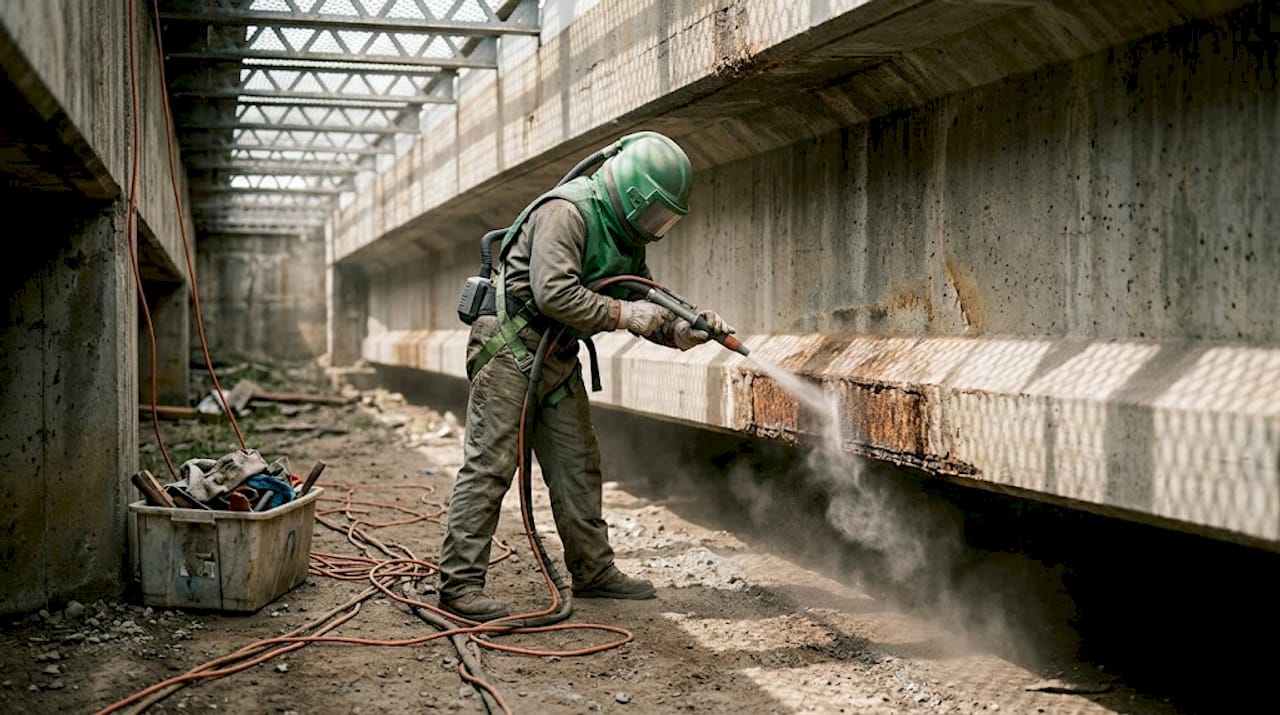
Begin with site setup. Erect perimeter warning signs and barriers. Verify that all workers wear supplied-air respirators (not just dust masks), full-body blast suits, hearing protection, and safety glasses under their blast hoods. Deploy containment shrouding or vacuum-shrouded blast heads to control abrasive and debris. Check that your containment system meets EPA requirements for the specific media and substrate you are working with.
Step-by-step field execution sequence:
- Perform a test blast on a 2-by-2-foot section to confirm nozzle pressure (90 to 100 psi is typical for structural steel), profile depth, and cleanliness level.
- Set nozzle-to-surface distance at 6 to 18 inches, adjusting for surface hardness and profile target.
- Work in consistent overlapping passes (roughly 50% overlap) to avoid striping or missed spots.
- Give extra attention to corners, edges, and welds. These zones corrode fastest and are hardest to clean. Use a smaller nozzle or a crevice attachment for tight geometry.
- Apply stripe coats (a brush-applied first coat) on all edges and corners before rolling or spraying the full primer coat.
- Inspect cleaned areas immediately with a surface profile comparator and salt contamination test before any coating is applied.
“Apply industrial-grade coatings immediately to prevent flash rust, especially in Florida humidity.”
The top blasting techniques for municipal infrastructure emphasize real-time quality control. Do not wait until the end of a shift to inspect. A crew lead should be spot-checking profile depth and cleanliness at regular intervals throughout the day. Any surface that fails to meet the specified cleanliness grade must be re-blasted before coating. Document every deviation with photographs and notes. This is not optional. It is a contract compliance requirement on virtually every public project.
Pro Tip: Always complete a test blast and adjust your parameters before going full-scale. A 30-minute adjustment phase at the start of each new surface type saves hours of rework. Refer to your sandblasting workflow and quality protocol document on-site so crew leads have a physical reference for each required check.
Coating application and final quality verification
Once sandblasting is complete, rapid and precise coating is critical for lasting protection. The window between a clean, profiled surface and flash rust formation can be as short as 30 minutes in Florida’s summer humidity. This is not the phase to slow down.
For potable water assets, coatings must carry NSF/ANSI 61 certification to ensure they are safe for contact with drinking water. For structural steel, pipelines, and wastewater infrastructure, industrial-grade epoxy primers and urethane topcoats are the standard. Always follow the coating manufacturer’s data sheet for minimum and maximum recoat windows, application temperatures, and thinning ratios.
Coating application sequence:
- Apply stripe coats to all edges, welds, bolts, and corners using a brush before the first spray pass.
- Apply primer coat within the timeframe specified in your project spec, typically the same day as blasting and within two to four hours in humid conditions.
- Allow primer to cure to the minimum recoat interval specified on the product data sheet.
- Apply intermediate and topcoats according to the system specification, maintaining specified wet film thickness at each pass.
- Conduct dry film thickness readings across the full surface using a calibrated gauge per SSPC-PA 1 protocols.
| QC check | Method | Acceptable result |
|---|---|---|
| Dry film thickness | Calibrated magnetic gauge (SSPC-PA 1) | Within plus or minus 20% of spec DFT |
| Adhesion test | Pull-off test (ASTM D4541) | Per coating manufacturer minimum |
| Surface profile | Testex Press-O-Film tape | 1.5 to 4.5 mils (typical for epoxy) |
| Holiday detection | Low-voltage wet sponge test | Zero holidays in potable water applications |
Final coating process for infrastructure documentation must include inspection reports, QC sign-off sheets, product data sheets, and safety data sheets for every coating used. Review protective coating best practices to confirm your documentation package meets current public project requirements.
Required QC documentation for public projects:
- Pre-blast surface condition report (photographs and written)
- Abrasive type, size, and lot number records
- Blast cleanliness and profile inspection reports
- Coating product names, batch numbers, and application conditions
- Dry film thickness readings by zone (mapped to drawing)
- Post-application inspection sign-off by qualified inspector
Pro Tip: Photograph every phase, not just the final product. Before, during blast, immediately post-blast, after primer, and after topcoat. These images become your compliance record and your baseline for the next maintenance cycle, saving your team significant audit time in future years.
Our take: Why workflow discipline matters more than technology
After more than 20 years working on Central Florida’s public infrastructure, we have seen one pattern repeat itself: failures trace back to shortcuts in the workflow, not to outdated equipment. A brand-new robotic blasting system operated without proper surface profiling checks or immediate recoating will fail faster than a well-disciplined crew using conventional equipment.
Florida’s climate makes this especially unforgiving. High humidity and warm temperatures mean that flash rust can begin forming within minutes on a freshly blasted steel surface. No coating system survives that kind of contamination. Workflow discipline, meaning immediate recoating, real-time QC, and documentation, is the only reliable defense.
The bigger picture is financial. Proactive 2 to 5 year maintenance cycles extend asset life by up to 20 years. That is the municipal “insurance policy” for infrastructure: regular, standards-driven maintenance scheduled before failure, not after. Check your surface treatment for durability records. If you are beyond your last scheduled cycle, the clock is already running against you.
Get reliable sandblasting and coating for your project
When your project calls for a proven, standards-driven partner, here’s how we can help.
Southern Sandblasting & Painting LLC brings 20-plus years of compliant, high-performance surface preparation and coating work to Central Florida’s municipalities, utilities, and public agencies. We follow NACE/SSPC standards on every project and carry the equipment, certifications, and local knowledge to meet your schedule and budget. Whether you need a single-site workflow audit, an annual maintenance contract, or competitive bids on a new capital project, our sandblasting services in Orlando are ready to mobilize. Explore our industrial coatings for Florida infrastructure and review the full coating application steps we use on every job. Contact us today to get started.
Frequently asked questions
What SSPC/NACE standard is most commonly used for municipal sandblasting?
SSPC-SP6 and SSPC-SP10/NACE No.2 define the cleaning levels most commonly required for municipal infrastructure steel and concrete maintenance. SP10 is typically mandated for potable water and critical structural applications where coating failure carries safety consequences.
How fast should coatings be applied after sandblasting?
Apply primers on the same day as blasting, ideally within two to four hours, to prevent flash rust. In Florida’s humid summers, same-day coating application is not just best practice, it is a quality assurance requirement.
What documentation is required for municipal sandblasting projects?
Documentation must cover inspection reports, surface profiles and abrasive records, coating product batch numbers, dry film thickness readings by zone, and before/after photographs as part of full process compliance.
How often should municipal sandblasting and coating be scheduled?
Proactive maintenance cycles every 2 to 5 years dramatically extend asset life and keep total ownership costs manageable compared to reactive repair after coating failure.


