
Misreading a single blasting term in a contractor’s spec sheet can stall a municipal infrastructure project for weeks, trigger a compliance review, or inflate your budget before the first nozzle fires. For facility managers and procurement officers in Central Florida, where water tanks, pipelines, and city structures demand regular surface maintenance, that risk is real and recurring. This guide cuts through the jargon and gives you working definitions of the terms you will encounter most often, from Powder Factor to decoupling ratios, so you can scope projects accurately, evaluate bids confidently, and keep your assets protected and compliant.
Table of Contents
- Core industrial blasting terms every manager should know
- Types of blasting abrasives and their applications
- Understanding methods and compliance: wet blasting, decoupling, and Florida rules
- Best practices for safety and efficiency in industrial blasting
- An expert’s take: why mastering terminology is a game-changer for Central Florida projects
- Get expert help for your next blasting project in Central Florida
- Frequently asked questions
Key Takeaways
| Point | Details |
|---|---|
| Know the core terms | Understanding terminology like ‘Blasting Agent’ and ‘Powder Factor’ reduces costly errors. |
| Choose abrasives wisely | Selecting the right abrasive can improve safety and efficiency while meeting Florida regulations. |
| Follow local compliance | Florida has unique storage and safety requirements all blasting project leads must know. |
| Prioritize safety steps | Reduce health risks and avoid fines with dust control, PPE, and proactive training. |
Core industrial blasting terms every manager should know
With the importance established, let’s clarify the core terminology so you can communicate confidently with any contractor or inspector.
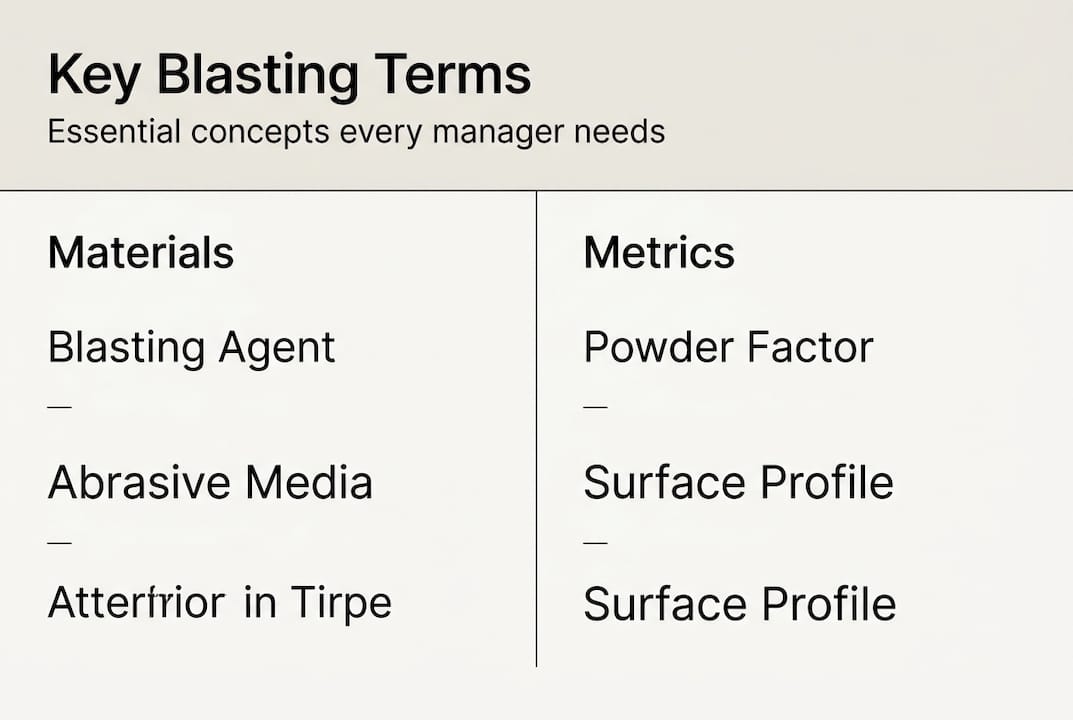
The blasting terms you will encounter most often fall into five categories that directly affect project planning and cost:
- Acceptor: The explosive charge that receives detonation energy from a donor charge. In sequential blasting operations, the acceptor’s sensitivity rating determines whether a chain reaction fires correctly. Specifying the wrong acceptor sensitivity can cause misfires and costly delays.
- Air Blast: The pressure wave produced when an explosive detonates. In urban Central Florida projects near occupied buildings, air blast levels must stay within safe thresholds to avoid structural complaints or regulatory violations.
- ANFO (Ammonium Nitrate Fuel Oil): A widely used bulk blasting agent made by mixing ammonium nitrate prills with fuel oil. It is cost-effective for large-scale rock excavation but requires dry conditions to perform reliably.
- Blasting Agent: A material that is not itself classified as an explosive but becomes one when combined with a detonator. Procurement officers often confuse this with high explosives, which carry different storage, transport, and permit requirements.
- Powder Factor: The amount of explosive used per unit of material broken, typically expressed in pounds per cubic yard. It is a direct cost driver and a quality indicator.
Here is a quick reference for Powder Factor ranges across common infrastructure materials:
| Material type | Typical powder factor (lb/yd³) | Notes |
|---|---|---|
| Soft limestone | 0.25 to 0.50 | Lower cost, easier fragmentation |
| Hard granite | 0.75 to 1.25 | Higher energy demand |
| Concrete demolition | 0.50 to 1.00 | Varies by reinforcement density |
| Clay or soft soil | 0.10 to 0.25 | Rarely requires blasting agents |
For a broader look at how these concepts apply to surface work, the sandblasting guide for managers at Southern Sandblasting & Painting provides practical context. You can also review blasting technique best practices for application-specific guidance.
Types of blasting abrasives and their applications
Now that you recognize key terminology, picking the right abrasive is the next essential step in scoping any surface preparation project.
Abrasive types fall into three main classes, each with distinct performance profiles, safety considerations, and reuse potential:
| Abrasive class | Examples | Reuse cycles | Key hazard | Best for |
|---|---|---|---|---|
| Mineral | Aluminum oxide, garnet | 3 to 10 | Dust inhalation | Steel structures, tanks |
| Metallic | Steel grit, steel shot | 50 to 200 | Spark ignition near fuel | Heavy rust removal |
| Organic | Walnut shells, corn cob | 1 to 3 | Combustion risk | Soft metals, wood |
Mineral abrasives like garnet are popular in Florida infrastructure work because they produce a consistent surface profile and generate less dust than many alternatives. Aluminum oxide cuts aggressively and works well on hardened steel surfaces like bridge components or water tank interiors.
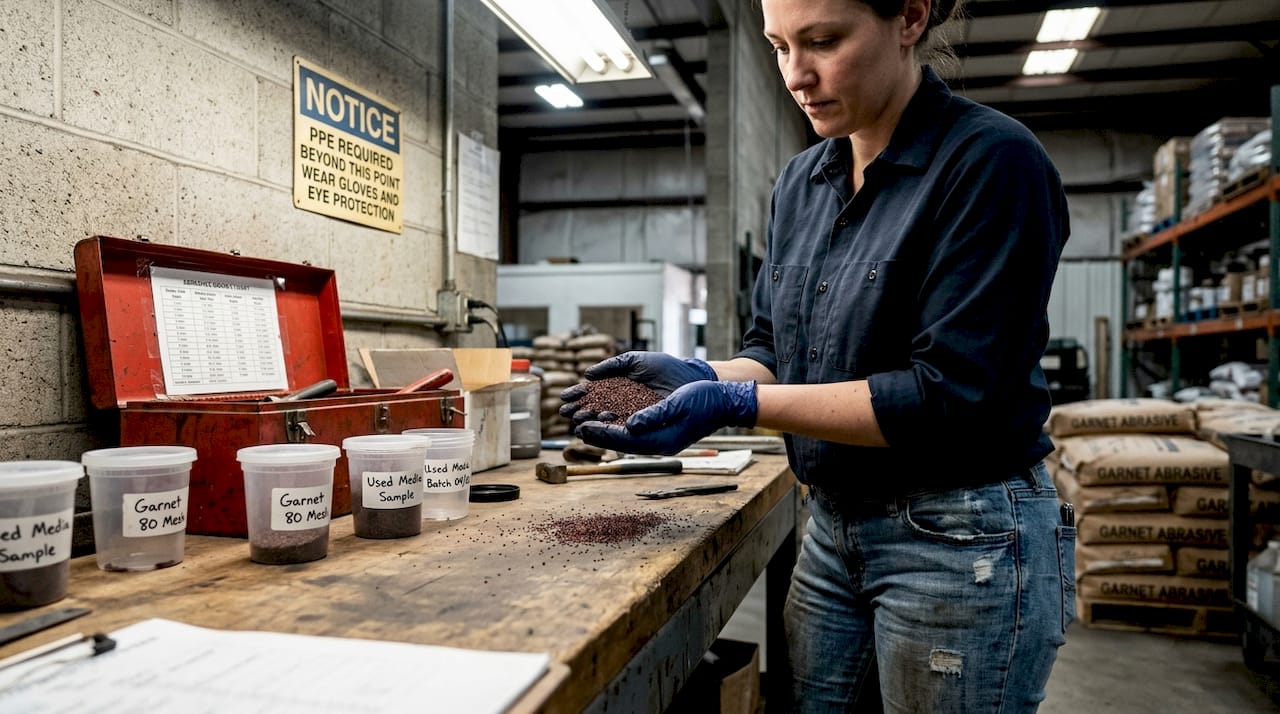
Metallic abrasives, particularly steel grit, are the workhorses of large-scale industrial jobs. They can be recycled dozens of times, which reduces waste disposal costs on long projects. However, they require careful containment to prevent contamination of surrounding soil or waterways, which matters significantly near Florida’s wetland-adjacent infrastructure.
Organic abrasives are gentler and biodegradable, making them suitable for historic structures or surfaces where aggressive profiling would cause damage. The trade-off is that walnut shells and corn cob media can combust under certain conditions, so storage and handling protocols must be strict.
One abrasive you will not see reputable contractors specify is silica sand. Florida projects follow OSHA guidance that recognizes silica sand as a silicosis hazard due to the crystalline silica particles it releases. Exposure causes irreversible lung damage, and liability exposure for municipal clients is significant.
Pro Tip: When reviewing contractor bids, ask specifically which abrasive media they plan to use and request the Safety Data Sheet. If a bid lists “sand” without further specification, treat that as a red flag and request clarification before signing.
For more on matching abrasives to project conditions, see surface prep abrasive tips and real-world examples at preserving assets with abrasives.
Understanding methods and compliance: wet blasting, decoupling, and Florida rules
Choosing the right abrasive also means knowing the best method and the legal requirements specific to Florida.
The two primary surface blasting methods are dry blasting and wet blasting. Dry blasting uses compressed air to propel abrasive media at high velocity. It is faster and more aggressive, making it ideal for heavy rust removal on steel water tanks or pipeline exteriors. Wet blasting mixes water with the abrasive stream, which reduces airborne dust substantially. That dust reduction matters for compliance near occupied facilities or sensitive environmental zones.
However, wet blasting introduces a critical secondary concern: flash rusting. When water contacts bare steel, oxidation begins almost immediately. Contractors must apply a rust inhibitor to the water mix or coat the surface within a very short window after blasting. Skipping this step can undo the entire surface preparation investment.
Decoupling is another concept that comes up in excavation and demolition contexts. The decoupling ratio describes the relationship between the borehole diameter and the explosive charge diameter. A higher ratio means less energy transfers to the surrounding rock or structure, which is useful for controlled demolition near existing infrastructure. Here is a simplified overview of the process:
- Determine the required fragmentation or cut precision for the project.
- Calculate the borehole diameter based on rock type and equipment.
- Select a charge diameter that achieves the target decoupling ratio.
- Verify that the ratio complies with any site-specific vibration or air blast limits.
- Document all calculations for the compliance record.
Florida adds its own layer of requirements on top of federal standards. Florida blasting regulations mandate concrete flooring in blasting agent storage facilities and prohibit storage in basements. Speed limits for vehicles transporting blasting agents on public roads are also strictly enforced. Titanium and certain reactive metals require special handling protocols because of their ignition sensitivity.
For a deeper look at staying compliant on Florida projects, review environmental compliance practices and painting compliance tips. You can also explore industrial sandblasting benefits to understand how proper method selection extends asset life.
Best practices for safety and efficiency in industrial blasting
Armed with terminology and compliance know-how, you need strong safety and workflow habits to protect your team, your assets, and your budget.
The most overlooked hazards in industrial blasting are not the explosive charges themselves but the secondary risks that accumulate during surface preparation work:
- Combustible dust: Organic abrasives like walnut shells can create explosive dust clouds if allowed to accumulate in enclosed spaces. Ventilation and regular cleanup are non-negotiable.
- Silica exposure: Even when contractors avoid silica sand, some mineral substrates release crystalline silica when blasted. Require air monitoring data on any enclosed or semi-enclosed blasting job.
- PPE gaps: Proper PPE for blasting includes supplied-air respirators, not just dust masks. Verify that contractor staff are equipped and trained, not just compliant on paper.
- Containment failures: Abrasive media and paint debris must be contained and disposed of according to Florida environmental rules. Failures here create liability for the facility owner, not just the contractor.
- Electrical hazards: Blasting near conduit, lighting, or control systems requires a documented lockout/tagout protocol before work begins.
On the workflow side, efficiency gains come from sequencing work correctly. Surface preparation should always be completed and inspected before any coating application begins. Rushing this step is the single most common cause of premature coating failure on Florida infrastructure.
Pro Tip: Train your internal project coordinators to review contractor spec sheets for terminology red flags. If a spec lists “blasting agent” where a surface abrasive is intended, or uses “air blast” loosely without specifying pressure parameters, that contractor may not have the compliance depth your project requires. Catching these issues before contract signing saves far more than it costs.
For structured workflow guidance, the blasting workflow tips resource walks through sequencing steps for large-scale industrial projects.
An expert’s take: why mastering terminology is a game-changer for Central Florida projects
Pulling these concepts together, let’s step back for an insider explanation of why terminology deserves as much attention as technical skill.
After more than 20 years working on water tanks, airport infrastructure, and city assets across Central Florida, we have seen the same pattern repeat: projects stall not because of equipment failure or weather but because of language gaps. A procurement officer approves a bid that lists a “blasting agent” for a surface prep job. The contractor arrives with materials suited for rock excavation. The inspector flags it. Work stops. The municipality pays for the delay.
That scenario sounds unlikely until you have watched it happen. The term “blasting agent” has a precise regulatory definition, and its misuse in a contract document can trigger a compliance review that takes weeks to resolve. Municipal funds and infrastructure timelines pay the price.
What we have learned is that terminology fluency is not just an engineering skill. It is a procurement skill and a risk management skill. When your team can read a spec sheet and immediately recognize whether the listed abrasive, method, and compliance references align with Florida’s actual requirements, you eliminate an entire category of preventable cost.
The industrial sandblasting process in Florida has enough complexity that even experienced facility managers benefit from a terminology refresh before scoping a major project.
Get expert help for your next blasting project in Central Florida
If you want expert guidance to turn terminology into asset longevity and compliance, here’s how to connect your project with local professionals.
Southern Sandblasting & Painting LLC has spent over two decades working alongside facility managers and procurement officers across Central Florida, translating complex blasting and coating requirements into compliant, durable results. Our team speaks the language of your inspectors, your regulators, and your contractors.
Whether you are scoping a water tank rehabilitation, a pipeline exterior treatment, or a city infrastructure project, our specialists can review your requirements and help you build a spec that holds up. Explore our sandblasting services in Orlando, review our complete sandblasting and painting solutions, or learn more about our industrial coatings for Florida infrastructure. Reach out today to schedule a project consultation.
Frequently asked questions
What is the most commonly misunderstood industrial blasting term?
Powder Factor often causes confusion because it directly affects cost and blast results but varies significantly by material type and application context.
Why is silica sand banned or avoided in most blasting jobs?
Silica sand is avoided due to the high risk of silicosis, a serious and irreversible lung disease, and stricter OSHA safety regulations that hold facility owners accountable for contractor practices.
How does wet blasting improve safety and compliance?
Wet blasting reduces airborne dust substantially compared to dry methods, but it requires rust inhibitors in the water mix to prevent flash corrosion on bare metal surfaces immediately after blasting.
What Florida-specific regulations impact industrial blasting?
Florida mandates concrete flooring for blasting agent storage facilities and prohibits storage in basements, with additional speed restrictions for vehicles transporting blasting agents on public roads.


