
TL;DR:
- Florida infrastructure requires tailored maintenance due to salt, storms, and strict building codes.
- Regular inspections and documentation prevent costly emergency repairs caused by deferred maintenance.
- Effective planning involves asset inventory, regulatory compliance, scheduled inspections, and stakeholder alignment.
Florida infrastructure managers face a uniquely demanding environment. Between hurricane season, coastal salt exposure, stormwater regulations, and Florida Building Code requirements, a maintenance plan that works in Ohio simply will not cut it here. Annual maintenance calendars reduce emergencies and stabilize budgets for Florida infrastructure operators who take the time to build them correctly. This article breaks down an evidence-based, step-by-step maintenance planning checklist designed specifically for municipal infrastructure managers and commercial property operators working across Florida’s diverse and demanding landscape.
Table of Contents
- Core criteria for a Florida maintenance planning checklist
- Breakdown of essential maintenance items and schedules
- Preventive maintenance and documentation: Protecting asset longevity
- Situational adjustments: Adapting for Florida’s climate and compliance landscape
- Summary checklist: Decision-making for lasting protection in 2026
- The hard truths about maintenance planning few consider
- Connect with Florida’s surface coating experts
- Frequently asked questions
Key Takeaways
| Point | Details |
|---|---|
| Address Florida-specific risks | Checklists must factor in climate, code, and hurricane risk for long-lasting assets. |
| Prioritize preventive maintenance | Routine inspections and documentation prevent emergencies and premature failures. |
| Integrate compliance and budgets | Align checklist schedules with regulatory milestones and reserve planning for stability. |
| Update and adapt yearly | Annual reviews ensure maintenance plans stay relevant to new laws and conditions. |
Core criteria for a Florida maintenance planning checklist
Every effective maintenance planning checklist for Florida starts with a clearly defined scope. Before you can schedule a single inspection, you need to know exactly what assets you are responsible for, which regulatory frameworks apply, and what failure looks like for each critical component.
Florida is not a forgiving environment. Salt air accelerates corrosion, heavy rainfall overwhelms drainage systems, and the Florida Building Code sets specific standards that municipalities and commercial operators must meet. Municipal checklists in Florida must cover site plans, drainage, erosion control, utilities, and full Building Code compliance from the start.
A solid checklist foundation includes three maintenance layers working together:
- Proactive maintenance: Scheduled tasks performed before failure occurs, like reapplying protective coatings or clearing drainage inlets before the rainy season
- Preventive maintenance: Routine inspections and adjustments that catch early-stage deterioration, such as checking surface coating adhesion on water tanks or bridges
- Replacement maintenance: Planned asset replacement cycles informed by reserve studies and asset condition ratings
Vendor management and documentation are equally important. Every inspection and repair should generate a dated record tied to a specific asset. This protects you in compliance audits, informs future budget decisions, and provides legal protection when issues arise.
Pro Tip: Before building your checklist, consult our city projects checklist and review coating explained for durability to understand how surface preparation requirements should be built into your planning framework from day one.
Breakdown of essential maintenance items and schedules
Knowing what to inspect is only half the job. Scheduling those inspections at the right intervals is what separates reactive crisis management from genuine asset preservation.
Here is a numbered breakdown of core maintenance categories and their recommended cycles for Florida operators:
- Roads and paths: Quarterly visual inspections for cracking, pothole formation, and drainage flow. Leon County’s road program covers pothole repair, curb and gutter repair, and drainage maintenance as a baseline safety requirement.
- Surface coatings and protective finishes: Bi-annual inspection for adhesion failure, rust bleed-through, or coating delamination. High-humidity and salt-exposed surfaces may require quarterly checks.
- Drainage and stormwater systems: Pre and post-storm inspections with formal documentation at least twice per year.
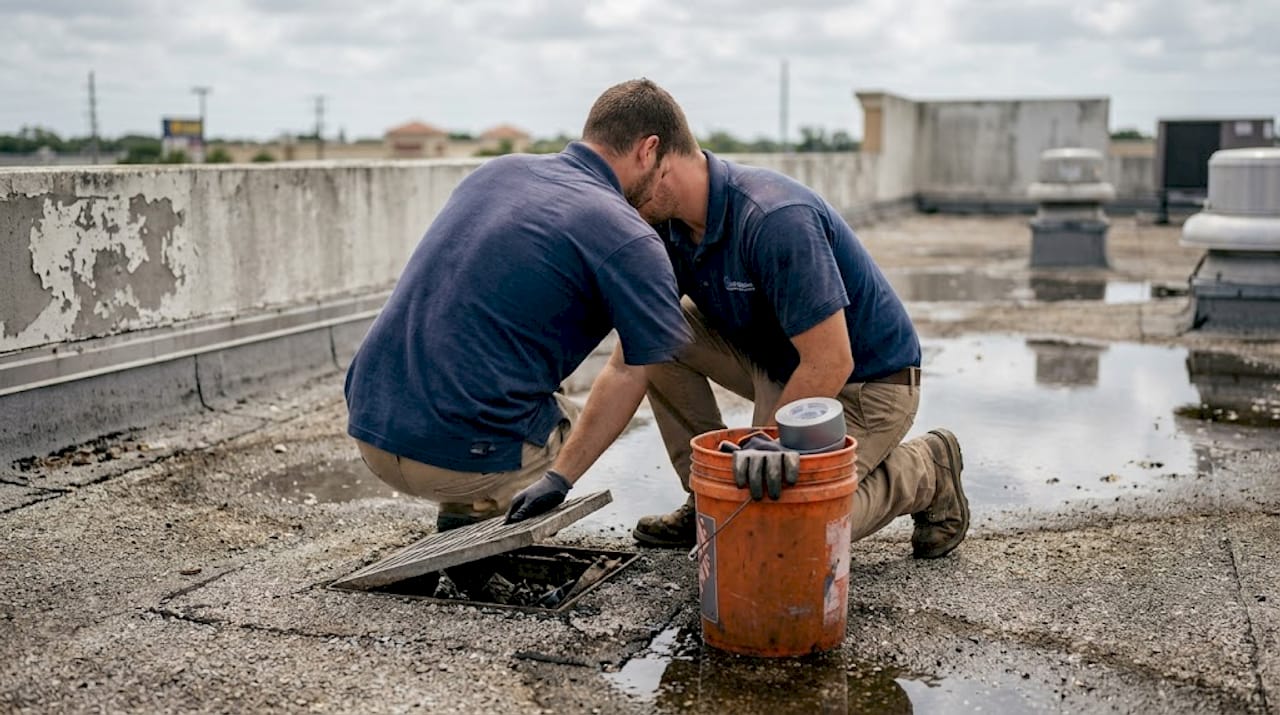
- Roofs and membrane systems: Commercial roofs require biannual inspections focused on membrane seams, ponding water, and drainage, with particular urgency before hurricane season.
- Safety systems and compliance checks: Annual review aligned with Florida Building Code update cycles and OSHA requirements.
Pro Tip: Use a dedicated facility maintenance checklist to map each category above to a named responsible party and a due date. Accountability gaps are where deferred maintenance starts.
| Checklist type | Inspection frequency | Key focus areas |
|---|---|---|
| HOA property | Quarterly and annual | Drainage, roofing, exterior coatings, landscaping |
| Municipality | Bi-annual and post-storm | Roads, bridges, utilities, surface coatings |
| Commercial operator | Bi-annual and quarterly | Roofs, HVAC, coatings, drainage, compliance |
Hurricane season runs June through November, and any inspection schedule that ignores this reality will eventually fail. Plan your most critical inspections for April and May so corrective work can be completed before storm exposure begins.
Preventive maintenance and documentation: Protecting asset longevity
Preventive maintenance is not an expense. It is the single most cost-effective strategy available to Florida asset managers. The challenge is quantifying its value clearly enough to justify it in budget conversations year after year.
Florida bridges and roads depend on preventive maintenance to stay in good condition while addressing ongoing water and stormwater vulnerability. When deferred maintenance compounds over multiple budget cycles, the cost of emergency repair typically exceeds what preventive action would have cost by a factor of three to five.
Core documentation practices every operator should maintain include:
- Digital maintenance logs: Timestamped records for every inspection, repair, and coating application tied to specific asset IDs
- Inspection forms with photographic evidence: Before and after photos reduce disputes and strengthen compliance submissions
- Reserve study integration: Maintenance logs feed directly into reserve studies, ensuring your financial projections match real asset condition
Quarterly and bi-annual PM tasks, including HVAC servicing, drainage clearing, and roof cleaning, represent the highest-return investments available to Florida associations and municipalities.
| Benchmark metric | Industry standard |
|---|---|
| Maintenance cost per sq ft | $4.82 median |
| Preventive task completion rate | 85% target |
| Deferred maintenance threshold | 10% or less |
| Citizen or tenant response time | 1.8 days average |
Linking your preventive schedule to industrial maintenance best practices ensures you are not reinventing the wheel. Similarly, understanding how to maintain painted surfaces in Florida’s climate will directly inform how frequently you schedule coating inspections and touch-up cycles.
Situational adjustments: Adapting for Florida’s climate and compliance landscape
Generic maintenance checklists fail Florida operators because they do not account for the state’s specific environmental pressures. Adapting your plan to these realities is not optional. It is the difference between a checklist that sits in a filing cabinet and one that actually protects your assets.
Key situational adjustments to build into your 2026 maintenance plan include:
- Hurricane preparation protocol: Complete structural and roof inspections by May, clear all drainage inlets before June, and document conditions in writing before storm season
- Coastal salt rinsing: Hurricane preparation and coastal salt rinsing require heightened urgency because salt deposits accelerate coating breakdown and corrosion on exposed steel and concrete
- Ponding water management: Post-storm site walks should specifically target low-lying areas where water pools, as prolonged moisture contact degrades protective coatings and membrane systems faster than almost any other factor
- Regulatory milestone alignment: Florida’s Structural Integrity Reserve (SIR) inspection requirements and milestone inspections for older buildings must be woven directly into your annual maintenance calendar
“Proactive, climate-aware maintenance planning consistently outperforms generic checklists in Florida. The organizations that invest in adapting their plans to local conditions avoid the emergency spending that puts reactive operators in budget crises year after year.”
Annual calendars integrating regulatory inspections with preventive maintenance stabilize budgets and align with reserve requirements under Florida law. This is especially critical for condo associations and municipal agencies facing Tallahassee’s expanding compliance requirements.
Scheduling regular coating inspections aligned with seasonal transitions and building active corrosion prevention steps into your annual cycle are two of the highest-impact adjustments you can make today.
Summary checklist: Decision-making for lasting protection in 2026
With the framework established, here is a ready-to-use maintenance planning checklist for Florida asset managers. Review and update this list annually, and ensure every item is assigned to a responsible party with a documented completion date.
- Confirm asset inventory: List every structure, surface coating system, drainage component, and mechanical system under your responsibility
- Assign maintenance categories: Label each asset as proactive, preventive, or replacement-cycle priority
- Map regulatory requirements: Identify all applicable Florida Building Code provisions, SIR milestones, OSHA standards, and EPA requirements. HOA maintenance plans must cover manufacturer, OSHA, and EPA compliance alongside proactive and reactive schedules
- Set inspection frequencies: Assign quarterly, bi-annual, or annual inspection cycles to each asset category based on risk level and climate exposure
- Schedule pre-hurricane inspections: Lock in April and May dates for roofs, drainage, and exterior coatings before storm season
- Establish vendor relationships: Identify licensed contractors for surface preparation, coating application, structural repair, and mechanical systems in advance
- Create documentation workflows: Define how inspection records, photos, and repair orders are filed, stored, and linked to reserve studies
- Conduct annual plan review: Every January, review the prior year’s maintenance records, update asset conditions, and revise schedules based on what the previous hurricane season revealed
- Outsource complex work to licensed professionals: Surface preparation, sandblasting, and industrial coating applications should never be treated as DIY tasks on public infrastructure
- Align with your reserve study: Confirm that your preventive maintenance schedule matches the assumptions built into your reserve fund projections
Reviewing the coating process guide for municipal projects will help you set realistic timelines and budget estimates for surface-related line items in this checklist.
The hard truths about maintenance planning few consider
After working across Florida’s infrastructure landscape for more than 20 years, we have observed a consistent pattern: the organizations that struggle most are rarely the ones with the worst budgets. They are the ones with the worst stakeholder alignment.
When facility managers, finance officers, legal teams, and elected officials are not working from the same maintenance picture, plans stall. Approvals get delayed. Preventive work gets deferred until it becomes emergency repair. The cost difference is enormous, and it compounds every year the problem is allowed to drift.
The other failure we see constantly is the paper checklist problem. A checklist stored in a shared drive that nobody updates is not a maintenance system. It is liability documentation waiting to become a problem. Living maintenance systems require assigned owners, digital tracking, automated reminders, and regular audits.
Short-term budget cuts to maintenance spending almost always cost more in three to five years than the savings generated. We have seen $8,000 coating touch-ups deferred until they became $90,000 full recoating jobs because corrosion had progressed to the substrate. That math is hard to argue with, yet the pattern repeats everywhere.
Building in regular coating inspections as a non-negotiable line item is not overhead. It is asset protection at the most basic level.
Connect with Florida’s surface coating experts
A checklist is only as effective as the team executing it. Southern Sandblasting & Painting LLC brings 20+ years of specialized experience in surface preparation, sandblasting, and industrial coatings for Florida infrastructure across water tanks, bridges, airports, and municipal facilities throughout Central Florida.

We work directly with municipal managers and commercial property operators to assess coating conditions, schedule surface preparation, and apply protective systems that meet Florida’s regulatory and climate demands. Our team understands surface prep best practices at the industrial scale your assets require. Contact Southern Sandblasting & Painting LLC today to schedule an assessment and put your maintenance checklist into action with experts who know Florida infrastructure from the ground up.
Frequently asked questions
What are the most critical checklist items for Florida infrastructure maintenance?
Drainage control, surface coating inspections, and regulatory compliance are the top priorities. Municipal checklists must cover site plans, drainage, erosion control, utilities, and Florida Building Code compliance as foundational requirements.
How often should commercial roofs in Florida be inspected?
At least twice per year, with priority given to inspections before hurricane season. Biannual commercial roof inspections should focus on membrane seams, ponding water, drainage, and insulation condition.
How can I ensure my maintenance checklist remains compliant with evolving Florida regulations?
Conduct annual checklist reviews against updated regulatory requirements and integrate milestone and SIR inspections into your calendar. Annual maintenance calendars that align inspections with vendor management and reserve studies keep compliance current.
What is the recommended budget allocation for preventive maintenance?
Industry benchmarks suggest a median spend of $4.82 per square foot with an 85% preventive task completion rate as the target for optimal performance and cost control.


