
TL;DR:
- Premature coating failures on municipal infrastructure lead to costly repairs, extended closures, and compliance issues, especially in Florida’s harsh climate. Proper substrate analysis, preparation, and inspection—tailored to concrete and steel—are essential to prevent early delamination and corrosion-related problems. Adapting scheduling, conducting test patches, and involving third-party inspectors are vital strategies for reliable coating performance in Florida’s demanding environment.
Premature coating failures on municipal infrastructure do not just look bad. They cost city budgets hundreds of thousands of dollars in emergency repairs, force extended closures of public assets, and trigger compliance headaches that take months to resolve. In Florida, where relentless humidity, UV intensity, and unpredictable storm activity put every coating system under constant stress, the margin for error is almost zero. This guide walks municipal infrastructure managers and commercial facility operators through the full process: substrate analysis, preparation, coating selection, application, and quality assurance, so you can stop replacing coatings ahead of schedule and start protecting the assets taxpayers depend on.
Table of Contents
- Understanding substrate challenges and why they matter
- Prepping city infrastructure: key requirements and pitfalls
- Choosing and applying protective coatings: methods that work
- Quality assurance, inspection, and documentation essentials
- Why “checklists” alone fail Florida infrastructure: our take
- Expert coating solutions for Florida municipalities
- Frequently asked questions
Key Takeaways
| Point | Details |
|---|---|
| Substrate-specific prep | Every material—concrete, steel, weld—requires a different surface prep plan for coatings to last. |
| Weather constraints | Coating application must be carefully timed around Florida humidity and rain to avoid costly failures. |
| Documentation is essential | Maintaining daily QA and condition reports is crucial for performance and compliance. |
| Test patches add certainty | Small trial areas can catch potential failures before they affect the full asset. |
| Planning reduces risk | Coordinating utility schedules and pre-verifying readiness saves time and disruption. |
Understanding substrate challenges and why they matter
The foundation of every coating project is the substrate beneath the paint, and no two substrates are the same. Concrete and steel behave completely differently under coatings, and treating them identically is one of the most expensive mistakes a project team can make. Each material has its own failure modes, its own moisture dynamics, and its own preparation requirements.
For concrete structures such as bridge decks, water tank walls, and utility vaults, concrete surface preparation is specified using ICRI Concrete Surface Profile (CSP) ranges that vary by coating type, and treating all coatings the same is a recognized specification mistake. A thin penetrating sealer might only need a CSP 1 or 2, while a thick epoxy lining may require a CSP 5 or higher. Get this wrong, and even a premium coating system will delaminate within two years.
Steel assets like water towers, pipelines, structural supports, and lift station components follow a different framework entirely. Surface cleanliness levels for steel are benchmarked using SSPC/AMPP blast-cleaning standards, with SSPC-SP10 Near-White Metal Blast being the most commonly specified level for immersion and high-performance coating systems. This means removing nearly all mill scale, rust, and existing coatings down to bare metal before any primer touches the surface.
Beyond the primary substrate material, certain zones on any structure demand extra scrutiny. Welds, expansion joints, cracks, and narrow corners are where adhesion failures concentrate. These areas trap moisture, resist thorough blasting, and often receive uneven coating thickness during application. Ignoring them in your specification scope almost guarantees a localized failure that spreads outward over time.
The infrastructure coating durability of any system depends on getting the prep specification right from the start. Reviewing the asset protection coatings guide before finalizing your scope can help you align preparation requirements with the specific coating product your project demands.
| Substrate type | Recommended prep method | Profile standard | Common failure if skipped |
|---|---|---|---|
| Concrete (thin coat) | Acid etch or light abrasive | ICRI CSP 1-3 | Poor adhesion, early delamination |
| Concrete (thick lining) | Shot blast or scarification | ICRI CSP 4-6 | Coating separation under hydrostatic load |
| Carbon steel (atmospheric) | Abrasive blast | SSPC-SP6 Commercial Blast | Surface rust bleed-through |
| Carbon steel (immersion) | Near-white metal blast | SSPC-SP10 | Undercutting corrosion at holidays |
| Welds and edges | Power tool or blast with edge retention | NACE SP0178 | Pinhole failures at weld toes |
Pro Tip: Before any blasting begins, conduct a pull-off adhesion test on a representative sample area. This gives you a baseline reading that lets you compare final results and catch adhesion problems before the full coat goes down.
Prepping city infrastructure: key requirements and pitfalls
Understanding what makes each substrate unique, managers then face practical requirements. This is where theory meets operational reality, and in Florida, operational reality is complicated.
Municipal protective coating scopes for water and wastewater assets typically cover both concrete and steel protection, including rehabilitation of piping, structures, and manholes using modified epoxy or polymorphic resin systems. That scope requires a preparation workflow that is disciplined, documented, and coordinated across multiple stakeholders before a single blast nozzle is pointed at a surface.
Florida adds its own layer of difficulty. Municipal coating schedules often need to be coordinated around utilities and business continuity, meaning you may only have access to a structure during off-peak hours, or not at all if an adjacent utility emergency pulls your crew away. Planning for these interruptions is not optional. Build them into the project schedule before you commit to a timeline with elected officials or oversight boards.
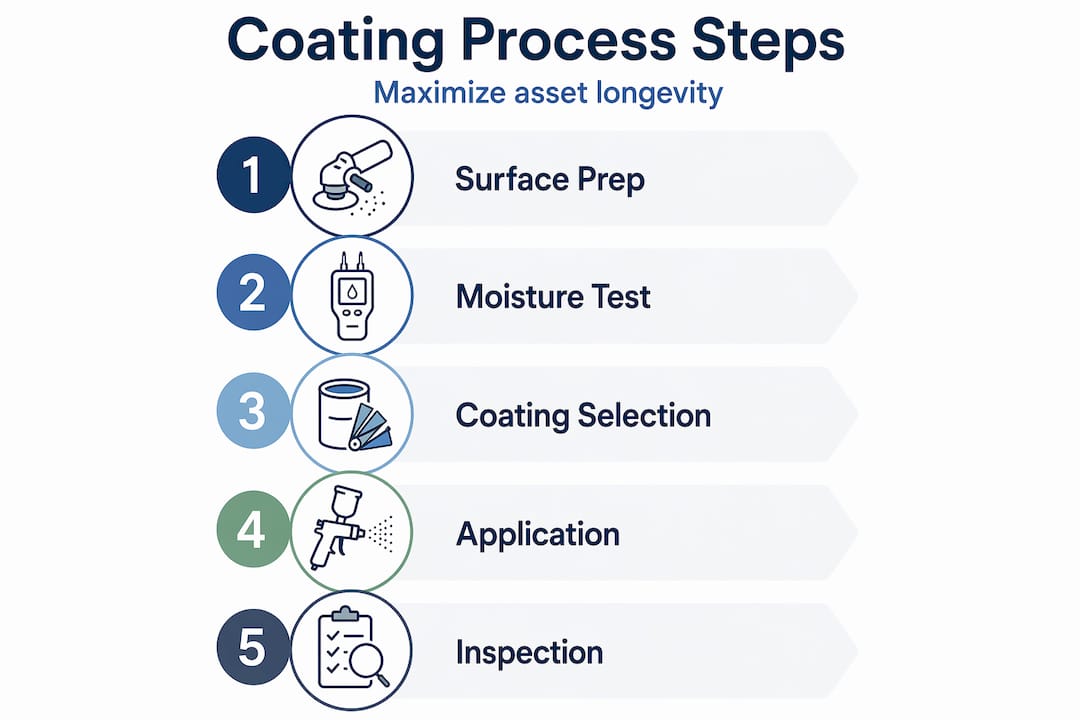
Here is a critical preparation sequence for city infrastructure assets:
- Site survey and hazard assessment. Document existing coating condition, substrate defects, and any environmental hazards like lead paint or chloride contamination before mobilizing equipment.
- Utility coordination. Notify relevant utility operators and establish access windows. Confirm shutoff schedules for water and wastewater assets that need to be taken offline.
- Surface cleaning and contaminant removal. Pressure wash to remove surface salts, biological growth, and loose material. For steel, degrease with solvent cleaning per SSPC-SP1 before any abrasive work.
- Moisture testing. Use a calibrated moisture meter on concrete surfaces. Most coating manufacturers require moisture content below 4% for proper adhesion. Skipping this step is a common cause of blistering.
- Test patch or trial area. Apply a small section using the specified prep method and coating product before full-scale application. This validates the system under your specific site conditions.
- Surface profile measurement. Confirm the achieved profile using replica tape (Testex Press-O-Film) or a digital profile gauge. Record and retain these readings for your QA file.
- Final inspection and sign-off. A qualified inspector reviews the prepared surface against spec requirements before coating begins.
Skipping the test patch phase to save time is one of the most reliable ways to create a much larger, much more expensive problem three months after project completion.
The protective coating best practices for municipal managers and the importance of reliable surface prep cannot be overstated. A thorough preparation process is not overhead. It is the primary investment that determines whether the coating lasts 15 years or 4.
Pro Tip: Schedule moisture testing for early morning before Florida’s afternoon heat causes rapid surface drying that produces artificially low readings. Readings taken at 2 p.m. in July are often misleading.
Choosing and applying protective coatings: methods that work
Having prepared the substrate, the focus shifts to proper coating selection and application under real-world Florida conditions. This is where product knowledge intersects with weather management, and where a lot of well-prepared projects still go wrong.
Weather constraints are explicitly controlled in protective coating application guidance. Many high-performance coating systems prohibit application when relative humidity exceeds 85%, when substrate temperature is within 5 degrees Fahrenheit of the dew point, or when rain is expected within the application window. In Central Florida during summer, these conditions can materialize in under two hours on a clear morning. Your crew needs to monitor ambient conditions continuously, not just at the start of the shift.
Coating system selection for city infrastructure should be driven by exposure category, service environment, and maintenance cycle. Here is a comparison of common systems used in municipal applications:
| Coating system | Pros | Cons | Typical municipal use |
|---|---|---|---|
| Epoxy (two-component) | Excellent adhesion, chemical resistance, long service life | Chalks under UV exposure, requires topcoat outdoors | Water tanks, manholes, structural steel primer |
| Polyurethane | UV stable, flexible, good gloss retention | Less chemical resistance than epoxy | Bridges, above-grade structural elements |
| Polyurea | Fast cure, excellent abrasion resistance | Requires specialized spray equipment, sensitive to moisture | Containment areas, manhole liners |
| Zinc-rich primer | Cathodic protection of steel, sacrificial layer | Requires near-white blast prep for activation | Steel bridges, towers, pipelines |
| Cementitious lining | Bonds well to concrete, low cost | Limited flexibility, can crack under movement | Wet wells, large water storage concrete walls |
Key selection criteria for city environments include:
- Service environment. Immersion service (inside a water tank) demands different chemistry than atmospheric service on a bridge railing.
- VOC compliance. Florida follows EPA and state air quality regulations. Verify that your selected system meets current VOC limits for your county before purchasing product.
- Recoat window. Florida’s heat accelerates cure times dramatically. A system with a 24-hour recoat window in lab conditions may cure in 6 hours at 90 degrees Fahrenheit, which can create intercoat adhesion problems if crews apply too early or too late.
- Applicator certification. Some manufacturers require certified applicators for warranty coverage. Verify this before you award the subcontract.
- Compatibility with existing coating. If complete removal is not feasible, confirm the new system is chemically compatible with whatever coating remains on the substrate.
The role of protective coatings in extending infrastructure life is well established, but product selection divorced from the actual site conditions is a shortcut that always catches up with you. Understanding how weather conditions affect coating durability in Florida should be part of every pre-application briefing with your contractor.
Quality assurance, inspection, and documentation essentials
Once coating is applied, the final ingredient for reliability is robust documentation and inspection. Without it, you have no legal protection when a coating fails prematurely, no benchmark for your next project, and no way to hold contractors accountable.
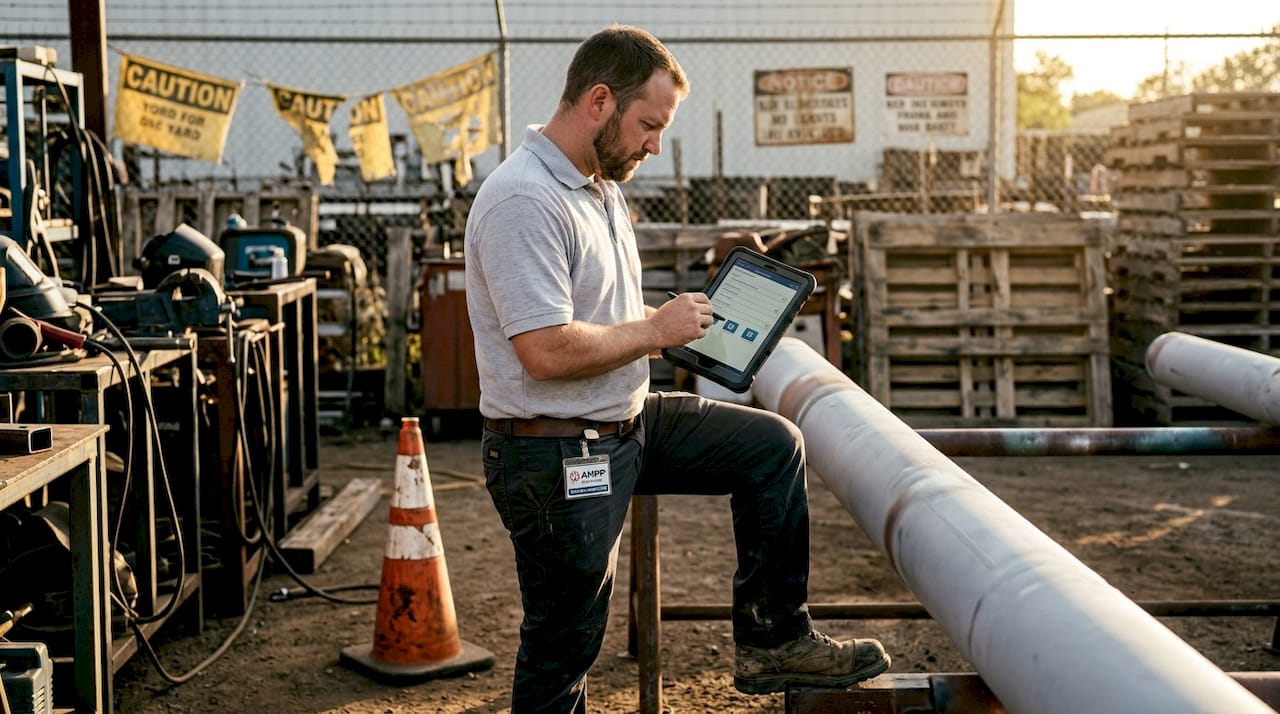
Quality assurance for coating work commonly includes documentation of ambient conditions, surface profile measurements, and batch and application controls. This means your QA file should contain more than just before-and-after photos. It should be a complete record that a third-party auditor or regulator could use to verify every critical step.
A practical QA and inspection workflow looks like this:
- Pre-application ambient check. Record air temperature, substrate temperature, dew point, and relative humidity at the start and every two hours during application. Use a calibrated psychrometer or digital environmental meter.
- Surface cleanliness verification. Before each coating application, visually confirm the substrate meets the specified blast cleanliness level. Photograph each inspection point.
- Wet film thickness measurement. During application, check wet film thickness using a wet film gauge at regular intervals across the work zone. Adjust spray pressure or pass speed as needed.
- Dry film thickness (DFT) measurement. After cure, measure DFT per SSPC-PA2 requirements using a calibrated magnetic or eddy-current gauge. Record readings per grid section and compare against spec minimums and maximums.
- Holiday detection. For immersion or underground service coatings, run a holiday detector (spark tester or wet sponge tester depending on film thickness) across the entire coated surface. Any pinhole detected must be repaired and retested.
- Adhesion testing. Conduct pull-off adhesion tests per ASTM D4541 on representative areas. Minimum adhesion values should be specified in the project documents.
- Final documentation package. Compile all ambient records, DFT readings, holiday test results, adhesion values, product batch numbers, and applicator certifications into a single project file before issuing final payment.
A project without complete documentation is a liability waiting to surface. If a coating fails two years from now and your records are incomplete, your options for cost recovery are severely limited.
Welds and hard-to-reach zones deserve their own inspection criteria. These areas are prone to inadequate film build, shadow effects during blasting, and pinholes at weld toes. Applying general blast-cleaning acceptance criteria to weld zones is insufficient. You need explicitly engineered acceptance criteria for these locations.
Pro Tip: Assign a dedicated third-party inspector credentialed through AMPP (formerly NACE) or SSPC on projects involving immersion service or public safety assets. The cost is small compared to the risk of an undocumented failure. Explore corrosion protection for water facilities if your scope includes water storage or distribution infrastructure.
Why “checklists” alone fail Florida infrastructure: our take
After two decades of working on city assets across Central Florida, we have seen a consistent pattern. Projects that rely entirely on standardized checklists without adapting to real conditions produce inconsistent results. The checklist says “check humidity before application.” But it does not tell you what to do when your only available access window falls in the middle of Florida’s afternoon thunderstorm season and your project deadline is fixed by a city council resolution.
Generic guidance was written in a climate-controlled environment. Florida is not climate-controlled. High ambient humidity does not just affect cure times. It compromises blast-cleaned steel within minutes. A surface that passes inspection at 7 a.m. can be contaminated by flash rust by 9 a.m. if your crew does not coat immediately after blasting. That is not covered in most standard checklists.
Population density adds another layer of complexity that generic guides ignore entirely. Working on a manhole in a downtown Orlando intersection is not the same as working on a remote pipeline. You are managing pedestrian detours, noise ordinances, business access, and sometimes local media attention simultaneously. Emergency utility work can shut down your prep zone without warning, forcing you to re-blast a surface you already cleaned.
What actually works in Florida is a combination of adaptive scheduling, test patches as a standard first step rather than an optional add-on, and real collaboration with the utility operators and city departments that control access to your work zones. The coating process best practices that we have refined over hundreds of Florida projects all share one trait: they are built around reality, not around what a vendor’s technical data sheet assumes.
Third-party inspectors are not a luxury. On any project where coating failure could mean regulatory non-compliance or public safety risk, they are a non-negotiable safeguard. We have seen contractors resist third-party oversight. We have also seen those same contractors return to redo work at their own expense. The inspection cost is always cheaper than the remediation cost.
The takeaway for Florida asset managers is this: use checklists as a starting point, then overlay your specific operational context, local weather patterns, access constraints, and stakeholder coordination requirements. A checklist that does not account for those factors is not a plan. It is a wish list.
Expert coating solutions for Florida municipalities
Managing city infrastructure coatings across Florida’s demanding climate requires more than the right product. It requires a contractor who understands the substrate, the environment, and the compliance requirements before mobilizing a single piece of equipment.
Southern Sandblasting & Painting LLC brings over 20 years of hands-on experience delivering industrial coatings for Florida infrastructure across water treatment facilities, bridges, utility structures, and municipal assets throughout Central Florida. We specialize in surface prep best practices that set every project up for maximum service life, and our coating application process is fully documented for compliance and accountability. If you are planning a coating project for a city asset and want a partner who treats your infrastructure the way it deserves to be treated, contact our team for a project consultation.
Frequently asked questions
What is the most common mistake in city infrastructure coating projects?
Treating all substrates the same and skipping surface profile verification often results in premature coating failures, especially on concrete where CSP requirements vary significantly by coating type.
How does Florida weather affect coating application?
High humidity and surprise rain events in Florida can cause coatings to fail if application timing is not strictly controlled, as weather and moisture constraints are a primary driver of adhesion and cure quality.
What quality checks are required for municipal coating work?
Daily logs, ambient readings, and surface profile measurements are minimum QA requirements, since coating quality assurance must document ambient conditions, batch controls, and application verification throughout every phase.
Can I use a trial area or test patch method on city assets?
Yes, trial patches are strongly recommended for comparing surface prep and coating options before full deployment, as test patches allow you to validate cleaning and coating methods under your actual site conditions before committing to a full-scale application.
What is special about coating over welds or hard-to-reach areas?
These zones require engineered inspection criteria rather than general surface prep assumptions, because coating over weld interfaces and hard-to-prepare areas benefits from explicitly developed acceptance criteria such as NACE SP0178 to ensure lasting performance.
Recommended
- Municipal infrastructure coating explained for durability
- Infrastructure painting: why asset longevity depends on it
- Coating Inspections: Key to Infrastructure Longevity
- Complete Guide to Asset Protection Coatings for Infrastructure
- Sandblasting Contractor Baldwin Park FL
- Sandblasting Services Oviedo FL


