
TL;DR:
- Choosing protective paints for Central Florida infrastructure requires consideration of climate challenges, compliance, and lifecycle economics. High-performance systems like epoxy novolac, cementitious urethane, and polysiloxane offer long-term durability suited to Florida’s humid, UV-rich, and salty environment. Proper surface preparation, system compatibility, and documented application practices are essential to maximizing coating lifespan and minimizing total lifecycle costs.
Choosing a protective paint for Central Florida infrastructure involves far more than picking a product off a shelf. Florida’s relentless humidity, intense UV radiation, salt air, and strict environmental codes mean that a paint system either performs under pressure or fails within a few years, costing your facility far more in downtime and rework than the upfront savings ever justified. This guide gives you nine proven examples of industrial-grade protective paints, a head-to-head comparison, and clear situational guidance so you can make defensible, budget-smart coating decisions for every asset your facility manages.
Table of Contents
- How to evaluate protective paints for infrastructure
- 9 top examples of protective paints for commercial and municipal use
- Head-to-head comparison: protective paint systems at a glance
- Situational recommendations and application tips
- What most facility managers overlook about protective paints
- Get expert help for your next protective painting project
- Frequently asked questions
Key Takeaways
| Point | Details |
|---|---|
| Evaluate by compliance | Florida code standards and testing are essential for legal, lasting protection. |
| Choose for lifecycle value | Higher initial investment in durable paints reduces rework and saves money long-term. |
| Surface prep is crucial | Correct preparation means protective paints truly last their intended lifespan. |
| Match paint to conditions | Not all paints perform equally—select based on your site’s exposure, use, and environment. |
| Expert help pays off | Partnering with certified contractors helps ensure compliance and asset longevity. |
How to evaluate protective paints for infrastructure
Before you evaluate any specific product, you need a framework grounded in Florida’s climate realities and code requirements. A paint system that earns top marks in Minnesota will behave very differently on a Central Florida wastewater structure exposed to heat, H2S gas, and near-constant moisture vapor.
Start with compliance. Florida Building Code mandates that exterior coatings meet ASTM D3274 moisture resistance, ASTM G154 UV stability, ASTM D3273 mildew resistance, a 25-year minimum warranty, VOC compliance, and salt spray resistance for coastal applications. Those are not optional benchmarks. They are the floor, not the ceiling.
Understand protective paint systems as a lifecycle investment. A two-part epoxy applied at $2 per square foot might look attractive against a cementitious urethane system at $12 per square foot. But if the epoxy fails at year four and the urethane performs for 15 years, the economics reverse quickly once you factor in surface re-prep, labor, facility downtime, and any regulatory penalties for non-compliant deteriorated coatings.
Surface preparation is not a line item to cut. It is the single biggest variable that determines whether a paint system hits its rated service life. A premium coating over contaminated or poorly profiled steel will delaminate just as fast as a budget coating over good prep. Plan for SSPC-SP10 near-white metal blast cleaning on steel assets, and acid etching or shot blasting for concrete, before you even open a product data sheet.
Regulatory note: VOC (volatile organic compound) limits in Florida apply to both architectural and industrial maintenance coatings. Exceeding them exposes your facility to EPA and state environmental enforcement. Always confirm product VOC values against current Florida DEP thresholds before spec approval.
Warranty language matters too. Check whether the coatings compliance standards your contractor references are manufacturer-only warranties or performance-backed warranties that cover both material and application. The difference can be hundreds of thousands of dollars on a large municipal project.
Finally, match your evaluation criteria to the substrate and exposure environment. Steel in a coastal municipality needs corrosion inhibitors and salt spray ratings. Concrete in a wastewater plant needs chemical resistance down to pH 1. Food-grade wet areas need NSF-approved systems. Build your criteria list before you request bids, not after.
9 top examples of protective paints for commercial and municipal use
Each example below reflects real industrial applications found across Central Florida’s infrastructure sectors, from water treatment plants and airports to municipal bridge structures and theme park utility areas.
1. Epoxy phenalkamine coatings. These cure at low temperatures and high humidity, making them well suited for Florida’s rainy season application windows. They offer excellent adhesion over marginally prepared surfaces and good chemical resistance. Common in wastewater wet wells and coastal pipe exteriors. Expected service life: 10 to 15 years with proper prep.
2. Epoxy novolac coatings. Designed for severe chemical exposure, epoxy novolac systems resist pH 1 to 12 and temperatures up to 300 degrees Fahrenheit. They are the go-to choice for chemical containment areas, secondary containment berms, and industrial floors in processing facilities. The tradeoff is brittleness under mechanical impact, so they work best on substrates that do not flex.
3. Cementitious urethane coatings. These hybrid systems bond mechanically to concrete and offer compressive strength over 8,000 psi, with a service life of 10 to 20 years. Installed cost runs $8 to $15 per square foot, but the lifecycle math beats thin epoxies decisively. Ideal for food processing plant floors, commercial kitchen areas, and water treatment structures that face thermal cycling from cleaning operations.
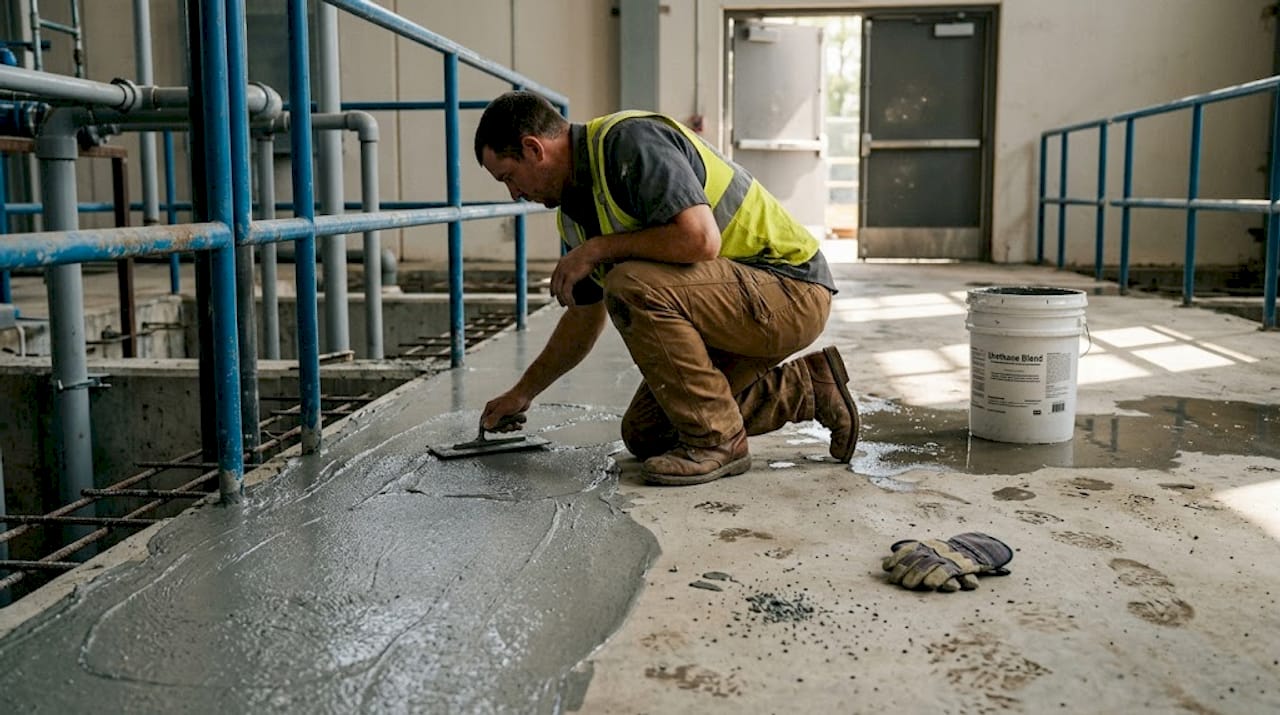
4. Polyurea coatings. Fast-cure, high-elongation systems with elongation at break exceeding 600%. Polyurea handles substrate movement, crack bridging, and impact far better than rigid epoxy systems. It is the preferred choice for secondary containment liners, bridge decks, and large concrete surfaces that experience temperature-driven expansion and contraction. Service life runs 15 to 25 years.
5. Zinc-rich epoxy primers. Cathodic protection in a paint. Zinc particles in the coating sacrifice themselves to protect underlying steel, just like a sacrificial anode. These primers are the foundation of virtually every high-performance steel coating system in corrosive environments and are required under UFGS standards for severe atmospheric service. They must be paired with a compatible intermediate and topcoat to reach rated performance.
6. Polyurethane topcoats. Applied over epoxy or zinc primer intermediates, polyurethane topcoats deliver UV stability, color retention, and gloss durability that epoxy topcoats cannot match. Solvent-borne polyurethanes often outperform waterborne versions in chemical resistance and cure speed, though both can comply with Florida VOC rules when properly formulated. Standard choice for exterior steel structures, bridge elements, and facility facades.
7. Polysiloxane topcoats. A generation ahead of conventional polyurethane in UV and weathering resistance, polysiloxane finishes maintain their gloss and color integrity for significantly longer periods in Central Florida’s sun-intense environment. They cost more but reduce refinishing frequency on high-visibility structures. Often specified for municipal water towers, airport structures, and coastal exterior piping.
8. Waterborne acrylic urethane systems. Lower VOC, easier cleanup, and increasingly competitive performance make waterborne systems attractive for interior industrial applications, LEED-oriented projects, and environments where solvent exposure must be minimized. They suit industrial-grade paint applications in occupied or semi-occupied facilities.
9. Active protection epoxy systems. An emerging category worth knowing. These coatings contain corrosion inhibitors that release in response to early-stage metal ion activity, providing a built-in warning mechanism before visible rust appears. They are particularly valuable on aging steel infrastructure where early corrosion detection reduces the cost and scope of repairs.
Pro Tip: When a project involves tight budget cycles, calculate the cost per year of service rather than the cost per square foot of installation. Durable systems almost always win that comparison by a wide margin, and that framing is far easier to defend to municipal procurement boards.
Head-to-head comparison: protective paint systems at a glance
The table below puts the most common systems side by side so you can match performance data to your specific infrastructure context.
| Paint system | Key application | Strength stat | Expected life | Compliance fit | Typical cost/sq ft |
|---|---|---|---|---|---|
| Epoxy phenalkamine | Wet wells, coastal pipe | High humidity cure | 10 to 15 years | Florida BC, VOC | $4 to $8 |
| Epoxy novolac | Chemical containment, process floors | pH 1 to 12, 300°F | 8 to 12 years | ASTM D3274 | $6 to $10 |
| Cementitious urethane | Food plants, water treatment | 8,000+ psi compressive | 10 to 20 years | Full Florida BC | $8 to $15 |
| Polyurea | Containment, bridge decks | 600%+ elongation | 15 to 25 years | ASTM G154, VOC | $10 to $18 |
| Zinc-rich epoxy primer | Steel structures (primer layer) | Cathodic protection | System dependent | UFGS, SSPC | $3 to $6 |
| Polyurethane topcoat | Exterior steel, facades | UV and gloss stable | 8 to 12 years | Florida BC, VOC | $3 to $7 |
| Polysiloxane | Water towers, coastal structures | Superior UV stability | 15 to 20 years | Full Florida BC | $8 to $14 |
| Waterborne acrylic urethane | Interior industrial, LEED projects | Low VOC | 7 to 12 years | VOC compliant | $3 to $6 |
| Active protection epoxy | Aging steel infrastructure | Early corrosion signal | 10 to 15 years | Emerging standard | $5 to $9 |
Key takeaway: Coating innovations data consistently shows that durable systems deliver two to five times the lifecycle value compared to the cheapest alternatives, once you account for re-preparation, recoating labor, and operational disruptions. On a 50,000 square foot municipal facility, that gap can represent millions of dollars over a 20-year asset management plan.
Situational recommendations and application tips
Having compared your options on paper, the real skill is matching the right system to your specific asset, environment, and regulatory requirements in Central Florida.
- Wastewater and water treatment plants. Use epoxy phenalkamine or epoxy novolac for submerged and splash zones. Apply polysiloxane over an epoxy intermediate for above-grade exterior steel exposed to H2S vapor and UV. Cementitious urethane is the strongest choice for concrete floors in pump stations and wet wells.
- Municipal steel structures and bridges. The proven three-coat system—zinc-rich epoxy primer, epoxy intermediate, polyurethane or polysiloxane topcoat—meets UFGS requirements for severe atmospheric exposure and is the minimum expected by most municipal procurement specs. Never shortcut the intermediate coat; it is what ties the primer to the topcoat and ensures intercoat adhesion.
- Coastal municipal facilities. Salt spray is relentless within five miles of Florida’s coasts. Polysiloxane topcoats with zinc-rich primers are your best defense. Inspect annually, address holidays (thin spots or pinholes in coatings) immediately, and document your maintenance for warranty compliance.
- Commercial and industrial floors. Cementitious urethane for areas with thermal cycling or heavy washdowns. Polyurea where floor crack bridging is needed or forklift impact is a daily reality. Epoxy novolac for chemical containment where floor integrity is a regulatory requirement.
- Food-grade and wet-area facilities. Confirm NSF 61 approval or equivalent before spec. Cementitious urethane dominates this sector because it resists both thermal shock from steam cleaning and the caustic and acidic cleaners used in food processing operations.
Pro Tip: Before any coating application, confirm that your contractor holds SSPC certification and can document compliance with surface prep best practices. A missed anchor profile or a substrate with residual chloride contamination will void your warranty faster than any product defect.
Surface preparation standards in Florida increasingly require third-party inspection reports as part of project closeout documentation. Build that requirement into your contract scope from day one, not as an afterthought when the inspector shows up during application.
One more critical point: verify system compatibility across all coating layers. Applying a polyurethane topcoat over an incompatible epoxy intermediate is a common field error that shows up as delamination within one to two years, well inside any reasonable lifecycle expectation for a quality system. Require the contractor to confirm compatibility with written manufacturer approval before application begins.
What most facility managers overlook about protective paints
After more than 20 years working on infrastructure assets across Central Florida, the pattern we see most consistently is not bad product selection. It is underinvestment in surface preparation combined with a fixation on the lowest bid number rather than the lowest total cost.
The math is not subtle. A facility that saves $1.50 per square foot by choosing a thin epoxy over a high-performance system on a 30,000 square foot floor saves $45,000 upfront. But if that floor requires re-blasting and recoating at year four instead of year fifteen, the repeat cost including production downtime can easily exceed $200,000. That is not a hypothetical. It is a pattern we have documented repeatedly on municipal and commercial projects throughout the region.
The Southeast’s climate is unforgiving in a way that facility managers from other regions often underestimate. Coastal salt air, standing humidity above 80% for months at a time, and UV index values that exceed most of North America all conspire to accelerate coating failure. The coatings that survive here are engineered for it, properly prepped, applied by contractors who understand Florida-specific failure modes, and maintained on documented cycles.
The guidance in coating application steps is not bureaucratic. Every step exists because field failures have taught the industry what goes wrong when those steps are skipped. Engaging a certified contractor, investing in blast prep to SSPC-SP10, specifying the right system for the actual exposure environment, and documenting everything for warranty purposes are not optional best practices for budget-strapped facilities. They are the difference between a ten-year coating and a three-year coating. The budget-strapped facility that skips them ends up spending more, not less.
Get expert help for your next protective painting project
Selecting and applying the right protective paint system for Florida infrastructure is a decision that plays out over decades, not just the project timeline.
Southern Sandblasting & Painting LLC brings more than 20 years of experience applying industrial coatings for Florida infrastructure to commercial facilities, municipal assets, water systems, airports, and utility structures across Central Florida. From professional sandblasting services in Orlando that achieve proper SSPC-SP10 profiles to expert guidance on how to apply protective coatings for your specific asset and compliance requirements, our team handles every phase of your project. Contact us to schedule a site evaluation and get a specification-grade recommendation before your next coating project goes to bid.
Frequently asked questions
What makes a paint “protective” for infrastructure?
Protective paints are engineered specifically for chemical, moisture, and UV resistance rather than aesthetics, and must meet standards such as ASTM D3274 and D3273 to legally safeguard commercial assets in Florida.
How long do industrial protective paints typically last?
High-performance systems like polyurea last 15 to 25 years and cementitious urethane 10 to 20 years, while standard thin epoxies typically require full recoating within 3 to 5 years under Central Florida conditions.
What is the most important factor for a long-lasting protective paint job?
Proper surface preparation following SSPC-SP10 standards is the single most critical variable, since even the best coating system will fail prematurely if applied over contaminated or poorly profiled substrates.
Which protective paint is best for humid and coastal Florida conditions?
Systems combining a zinc-rich epoxy primer with a polysiloxane or polyurethane topcoat, or using epoxy phenalkamine as a base in wet environments, provide the strongest resistance to salt spray, H2S, and extreme moisture typical of Florida’s coastal municipalities.
Recommended
- Industrial-Grade Paint: Lasting Protection for Infrastructure
- Top 8 Protective Paint Brands for Infrastructure in 2026
- Infrastructure painting: why asset longevity depends on it
- Why paint infrastructure: extend asset life and cut costs
- Sandblasting Contractor Baldwin Park FL
- Sandblasting Services Oviedo FL


