
TL;DR:
- Proper surface inspection in Florida’s harsh climate is crucial to prevent coating failures and ensure long-term asset durability.
- Using correct lighting, testing tools, and following standardized procedures help detect defects, contamination, and inadequate surface prep.
- Thorough documentation and skilled oversight are essential, as technology aids but does not replace human inspection and accountability.
A coating failure on a Florida water tank or municipal pipeline doesn’t announce itself. It shows up months later as rust bloom, delamination, or a regulatory citation that halts your entire project. Poor surface prep causes 90% of coating failures, costing billions globally every year. For contractors, facility managers, and municipal officials in Central Florida, a missed inspection step isn’t just a technical problem. It’s a budget problem, a compliance problem, and sometimes a public safety problem. This guide walks you through the exact inspection process to prevent all three.
Table of Contents
- Understanding the inspection objectives and standards
- How to gather the right tools and conditions for inspection
- Step-by-step: The industrial surface inspection process
- How to troubleshoot common inspection challenges
- How to ensure inspection results lead to lasting surface performance
- Why audits fail: The uncomfortable truths about surface inspection
- Get expert help for flawless industrial surface inspection
- FAQ**
Key Takeaways
| Point | Details |
|---|---|
| Follow established standards | Adhering to SSPC, ASTM, and ISO benchmarks assures inspection quality and regulatory compliance. |
| Use complete toolkits | Proper inspection requires calibrated tools, correct lighting, and validated reference guides every time. |
| Automation boosts, but doesn’t replace humans | AI and automated analysis can augment speed and accuracy, but manual inspection is still required for legal and quality reasons. |
| Document and communicate findings | Meticulous records and clear reporting ensure inspection outcomes translate into asset durability and lower costs. |
Understanding the inspection objectives and standards
Surface inspection isn’t a formality you pencil in before coating day. It’s the foundation that determines whether your coating system performs for five years or fifteen. In Florida’s aggressive climate, where high humidity, salt air, and UV exposure attack industrial assets year-round, the margin for error is razor thin. Understanding why you’re inspecting and what rules govern that inspection is the logical starting point.
Three standards anchor most Florida industrial projects:
- Surface cleanliness and inspection is regulated by inspection methodologies from inspect surface preparation longevity and the surface prep safety best practices outlined by your project specs.
- Why prep surfaces before painting is grounded in standards like inspection methodologies: cleanliness benchmarks, lighting levels, and documentation methodology.
- ISO 8502-6 governs salt contamination testing, a non-negotiable step on any coastal or marine-adjacent Florida project.
- Surface cleanliness baselines under inspection methodologies remain the legal compliance benchmark, even as AI and automation grow in use.
- inspect surface preparation longevity audits confirm your results hold up over time.
“The objective of every inspection cycle is threefold: detect defects in the substrate, verify surface profile meets coating spec requirements, and confirm contamination is absent before any coating is applied.”
Every inspection also has measurable end goals. You’re looking for surface defects such as pitting, mill scale, or corrosion. You’re measuring surface profile depth to confirm abrasive blasting hit the target anchor pattern. And you’re identifying contamination, whether oil, dust, or soluble salts, that would undermine adhesion. Missing any one of these objectives creates a gap the coating system cannot bridge.
How to gather the right tools and conditions for inspection
With your standards clear, the next step is assembling the right setup before any technician sets foot on the substrate. A well-prepared inspection kit removes guesswork and speeds up the process significantly.
Essential tools for industrial surface inspection:
- Industrial surface prep tools: inspection mirrors, flashlights, and magnifying loupes
- Digital lux meter: mandatory for verifying lighting levels on site
- Industrial inspection technology including replica tape (for profile measurement per inspection methodologies and surface prep safety tips)
- Industrial inspection technology such as the inspection methodologies: digital surface profile gauges, NDT instruments, and holiday detectors
- Industrial surface prep tools: reference coupons, contamination test kits (ISO 8502-6 compliant), and standardized inspection forms
| Tool | Standard / Method | What it measures** | Required condition | note |
|---|---|---|---|---|
| Digital lux meter | inspection methodologies | Light intensity at surface | 500 lux min.; 1000 lux for detail | |
| Industrial inspection technology replica tape | inspection methodologies | Surface profile depth | Must match coating spec anchor range | |
| NDT thickness gauge | inspection methodologies | Metal thickness | Within design tolerance | |
| Industrial inspection technology | ISO 8502-6 | Salt contamination | Below allowable threshold |
Lighting is where most crews underestimate the requirement. 500 to 1000 lux is necessary for reliable visual inspection; anything below that and inspectors simply miss defects that lead to early failure.
Pro tip: Always measure lux at the actual work surface, not at shoulder height. Florida’s shadowed tank interiors and confined pipeline sections can drop below 200 lux even with general area lighting active.
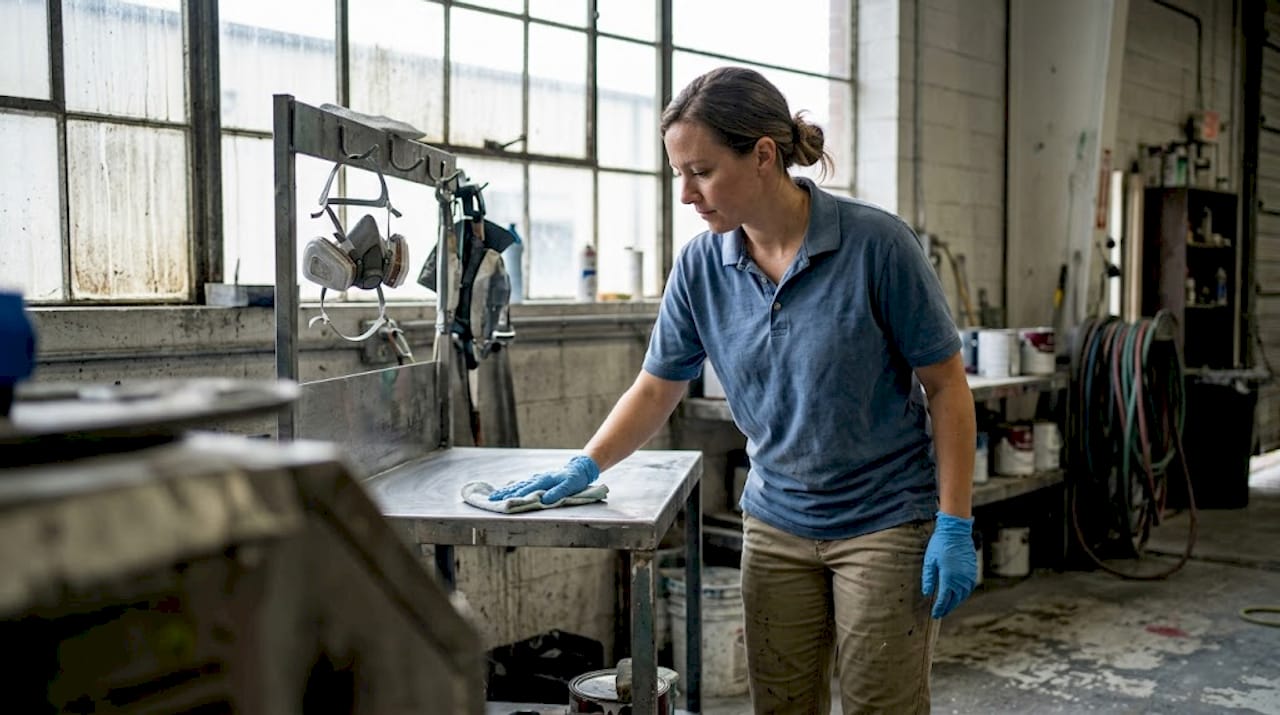
Your work area must be clean, dry, and free of active blasting or grinding operations during inspection. Wind and humidity must also be monitored: relative humidity above 85% or substrate temperatures within 3°F of dew point will compromise results.
Step-by-step: The industrial surface inspection process
Once your tools and conditions are confirmed, run through this sequence without skipping steps. Each phase feeds the next.
- Document baseline conditions. Record ambient temperature, humidity, dew point, substrate temperature, and lighting levels before anything else.
- Visual cleanliness evaluation. Compare the surface against your surface prep workflow reference standard and the applicable coating inspection methods to determine blast grade achieved.
- Surface profile measurement. Use replica tape and a digital micrometer or a profilometer to confirm anchor pattern depth.
- Salt and soluble contamination testing. Deploy the inspection methodologies test method on representative surface areas, especially in Florida coastal projects where chloride levels are elevated.
- Non-destructive testing (NDT). Use magnetic particle, ultrasonic, or eddy current instruments to detect subsurface defects not visible to the eye.
- Optional AI-assisted analysis. Where budgets and project specs allow, AI inspection systems can increase detection speed and achieve accuracy rates approaching 99%. These tools are valuable but don’t replace steps one through five.
| Method | Speed | Best use case | Human required? | AI-assisted option | note |
|---|---|---|---|---|---|
| Visual (manual) | inspection methodologies | All projects | Yes | Optional | |
| AI inspection systems | Fast | Large area scanning | Yes (oversight) | Yes | |
| NDT (ultrasonic) | inspection methodologies | Metal thickness | Yes | Optional | |
| Salt contamination | inspection methodologies | All Florida projects | Yes | No |
Visual inspection paired with automation can reach up to 99% detection accuracy, but manual expertise and documentation are still legally mandated under compliance frameworks.
Pro tip: Run your NDT pass before your contamination test, not after. NDT instruments can transfer residues that skew salt test results if the sequence is reversed.
How to troubleshoot common inspection challenges
Even a well-organized team runs into problems. Here’s where Florida industrial inspections most often break down and how to correct each issue fast.
Most common inspection errors and their fixes:
- Poor lighting. Use portable LED towers calibrated with your lux meter before starting. Never rely on general area fixtures alone.
- Surface contamination misread. Take at least three separate samples across the surface zone. One sample isn’t statistically valid on a large tank or pipe section.
- Documentation gaps. Use standardized forms for every inspection phase. A missed photo record or unsigned checklist can unravel your compliance case during a project audit.
- Technology miscalibration. AI cameras and sensors must be calibrated to the specific coating type, substrate, and defect profile of your project. Generic calibration causes missed defects.
“Human error remains substantial even as AI improves. The real risk isn’t that the technology fails; it’s that teams place too much trust in it and stop cross-checking.”
The role of coating inspectors on any project is to act as the final quality gate, not a rubber stamp. NDT and advanced inspection methods are powerful for metals, but sophisticated subsurface defects may still require optical or advanced analytical tools that a basic NDT kit won’t catch. Build redundancy into your process: use at least two measurement methods per inspection category, and require a second inspector sign-off on any non-conformance finding.
Poor surface preparation and inspection remain the leading cause of coating failure, and human error is still the primary driver, even on technology-assisted projects. Following painting safety compliance protocols during inspection also protects your crew from silica, fume, and chemical exposure that are real on-site risks in Florida industrial settings.
How to ensure inspection results lead to lasting surface performance
Completing the inspection is only half the job. The findings have to flow directly to your coating team in a form they can act on immediately.
Documentation essentials every Florida project needs:
- Environmental conditions log (temperature, humidity, dew point at each inspection phase)
- Surface cleanliness grade confirmed against the applicable standard
- Profile measurement records with tape or instrument readings attached
- Salt/contamination test results with sample locations marked on a site drawing
- Photo records with timestamps, locations, and inspector name
- Non-conformance reports for any areas that don’t meet spec, with corrective action required
Once your coating application workflow begins, your inspection documentation becomes the coating team’s operating manual. Any area flagged for re-blasting or spot treatment must be re-inspected before coating proceeds. This verification loop is not optional. It’s the step that converts a thorough inspection into a durable result.
Up to 90% of coating failures are preventable through proper surface inspection and preparation, but only when those findings are fully documented and communicated to the application team.
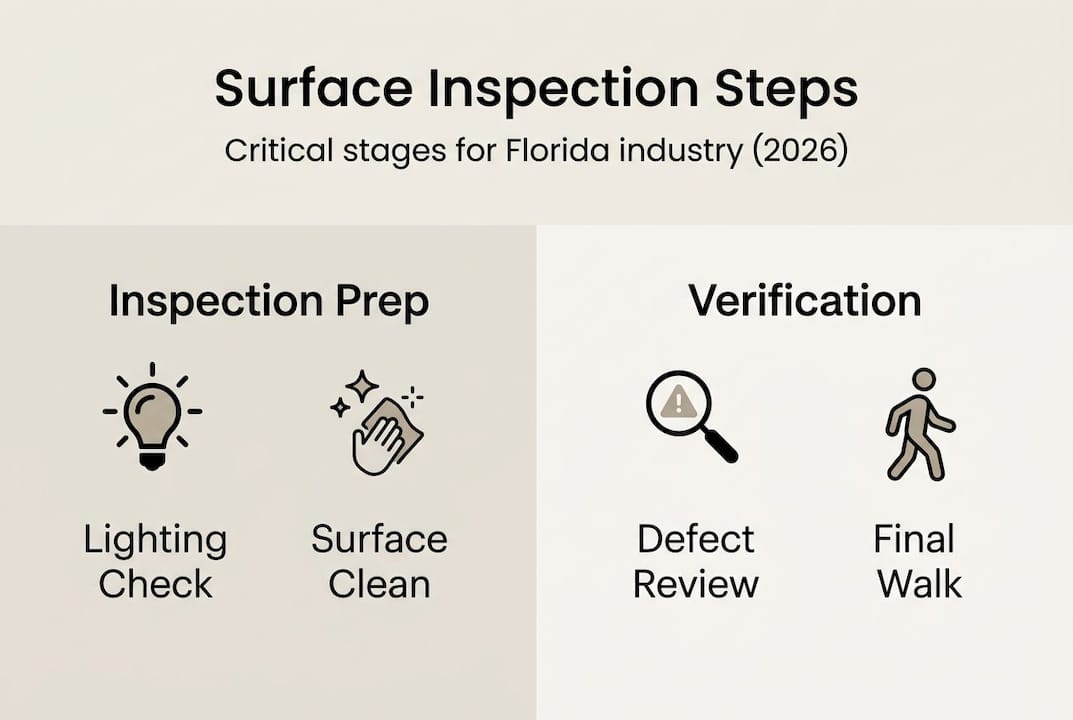
Verification also includes a final walk after priming and before topcoat. Pin hole detection, adhesion pulls, and dry film thickness (DFT) checks close the loop on surface prep importance and confirm the coating system was applied to a properly prepared surface. No amount of high-performance coating material rescues a surface that wasn’t properly inspected and documented.
Why audits fail: The uncomfortable truths about surface inspection
After 20 years of working on Florida infrastructure, we’ve seen projects with perfect checklists and technically correct procedures still result in premature coating failure. Here’s what the process guides don’t tell you.
Regulatory culture matters more than most teams admit. When inspection is treated as a box-checking exercise rather than a critical quality gate, documentation becomes a liability instead of a shield. Teams that invest in inspection compliance as a culture, not a task, consistently outperform those chasing technology shortcuts. AI achieves near-perfect detection, but legal compliance still requires adherence to baseline inspection methodologies under inspection methodologies. Technology is a force multiplier for a skilled team. It is not a replacement for one. The projects that perform best long term are the ones where inspectors take personal ownership of every finding, not where the software makes the call.
Get expert help for flawless industrial surface inspection
Getting surface inspection right the first time protects your project budget, your compliance standing, and the long-term integrity of Florida’s infrastructure. That requires more than good intentions.
At Southern sandblasting & painting LLC, our team has spent over 20 years delivering inspection-backed industrial coating application steps for water tanks, municipal pipelines, airports, and city infrastructure across Central Florida. From Orlando sandblasting services to full-service sandblasting and painting, we follow every standard required to keep your project on schedule and your assets performing. Contact us today to schedule a professional surface inspection consultation for your next industrial project.
FAQ**
Which inspection standards are mandatory for Florida industrial projects?
SSPC, inspection methodologies, and ISO 8502-6 are the core compliance frameworks for Florida industrial surface inspection projects. Project specifications and client contracts may also require additional standards depending on the asset type.
How important is lighting during industrial surface inspection?
500 to 1000 lux is the required range for reliable visual inspection, with the higher end needed for detailed defect assessment in confined spaces or critical structural areas.
Can AI-based inspection replace manual methods?
AI inspection systems improve speed and defect detection rates significantly, but manual methods and human sign-off remain legally required under current compliance standards.
What is the most common reason for coating failure in industry?
Up to 90% of failures trace directly to inadequate surface preparation and inspection, making the pre-coating process the single highest-leverage point for long-term asset protection.
Recommended
- Surface Contamination Standards & Methods for Florida Infrastructure
- Surface prep for contractors: expert guide for Florida 2026
- Surface Preparation Standards 2025: Raising Compliance in Florida
- Industrial corrosion prevention steps for Florida 2026
- 7 Essential Steps in a Commercial Flooring Trim Guide
- Sandblasting Contractor Baldwin Park FL
- Sandblasting Services Oviedo FL


