
TL;DR:
- Proper surface prep in Florida requires strict OSHA compliance, dust control, and worker safety measures.
- Choosing safer abrasive materials like glass or steel reduces airborne hazards and health risks.
- Continuous inspection, adaptive safety culture, and expert guidance ensure project safety and regulatory adherence.
Surface preparation failures don’t just ruin coatings. They shut down facilities, trigger OSHA fines, and put workers in the hospital. For municipal and industrial facility managers in Central Florida, the risks compound fast: intense heat, pop-up storms, aging infrastructure, and strict OSHA standards requiring specific PPE, dust controls, and health hazard evaluations in abrasive blasting. Getting surface prep right means addressing compliance, material selection, dust control, inspection, and worker culture all at once. This article gives you a practical, step-by-step framework covering each of those areas, including comparison tables, material trade-offs, and regulatory essentials specific to Florida operations.
Table of Contents
- Understand OSHA safety requirements for surface prep
- Choose safer abrasive materials for blasting
- Control dust and airborne hazards during surface prep
- Implement inspection, documentation, and emergency readiness
- Foster a safety-first culture with worker training and engagement
- Why most safety checklists fail: The truth from Florida job sites
- Get expert help for safer surface preparation in Florida
- Frequently asked questions
Key Takeaways
| Point | Details |
|---|---|
| Prioritize OSHA compliance | Meeting OSHA and Florida safety rules reduces accident risk and costly project delays. |
| Use safer abrasive materials | Choosing non-silica abrasives with documented hazards supports healthier job sites. |
| Control dust and monitor air | Effective dust suppression and real-time monitoring are vital for respiratory safety. |
| Document inspections and emergencies | Thorough records, regular inspections, and ready emergency plans build a stronger safety program. |
| Invest in culture and training | Continuous worker engagement helps adapt safety practices to Florida’s unique conditions. |
Understand OSHA safety requirements for surface prep
With the stakes set, the first step is understanding what OSHA and federal safety standards truly require. Surface preparation, especially abrasive blasting, is one of the most regulated activities in industrial maintenance. Skipping steps here doesn’t just risk worker health. It risks your entire project timeline.
OSHA 29 CFR 1910.94(a) governs abrasive blasting operations and sets clear requirements for respiratory protection, dermal PPE, and dust level controls. Here’s what you must have in place before any blasting begins:
- Supplied-air respirators for all workers in the blast zone
- Heavy-duty gloves, aprons, and safety shoes to protect against abrasive rebound
- Eye and face protection rated for high-velocity particle impact
- Continuous air monitoring to track dust and silica levels against permissible exposure limits (PELs)
- Engineering controls like blast enclosures and local exhaust ventilation
- Annual respirator fit-testing for every worker using tight-fitting respiratory equipment
Florida adds another layer. Heat illness prevention protocols, including mandatory water, shade, and rest schedules, are required under state construction safety rules. Hot work permits are also required for operations near flammable coatings or fuel storage. During hurricane season, you need a written weather emergency plan integrated into your safety program.
Pro Tip: The two most common compliance gaps we see on Florida job sites are expired respirator fit-test records and missing heat hazard assessments. Auditing both before mobilization saves significant headaches during inspections.
Failing to meet OSHA blasting standards exposes your facility to citations starting at $16,131 per violation, project shutdowns, and potential criminal liability if worker injuries result. The cost of compliance is always lower than the cost of enforcement.
For a solid foundation, review blasting terminology basics and painting safety compliance tips before drafting your site-specific safety plan.
Choose safer abrasive materials for blasting
Once legal requirements are met, material selection is the next crucial safety variable. The abrasive you choose directly determines the airborne hazard profile of your entire project. This decision deserves more attention than most managers give it.
NTP studies confirm that silica sand is highly toxic, while alternatives like crushed glass, slag, and hematite carry lower silica content but introduce their own risks. Here’s how the common options compare:
| Abrasive material | Free silica content | Primary health hazard | Key controls required |
|---|---|---|---|
| Silica sand | Very high (up to 99%) | Silicosis, lung cancer | Supplied-air respirators, wet suppression |
| Crushed glass | Negligible | Cuts, eye injury | Heavy gloves, face shield |
| Coal slag | Low to moderate | Arsenic, heavy metals | Air monitoring, disposal controls |
| Steel grit/shot | None | Noise, rebound injury | Hearing protection, enclosures |
| Hematite (iron ore) | Very low | Siderosis (iron dust) | Respirators, air monitoring |
When selecting your abrasive, evaluate these criteria before finalizing the spec:
- Toxicological profile: What are the airborne hazards at your site’s expected dust levels?
- Disposal requirements: Some slags are classified as hazardous waste under EPA rules
- Surface profile performance: Does it achieve the required anchor profile for your coating system?
- Recyclability: Steel media can be recycled, reducing both cost and waste volume
- Availability: Florida supply chains affect lead times, especially post-storm
Pro Tip: Rotate abrasive types based on real-time air monitoring results rather than sticking to one material by habit. What works safely in an enclosed shop may exceed PELs on an open outdoor tank in Central Florida’s wind conditions.
For a deeper look at how abrasive choice affects surface quality and coating adhesion, the abrasive material selection guide covers the technical trade-offs in detail.
Control dust and airborne hazards during surface prep
Material choice brings its own air hazard risks, requiring robust dust control solutions. Even the safest abrasive creates airborne particulates that can exceed OSHA’s permissible exposure limits without proper engineering controls in place.
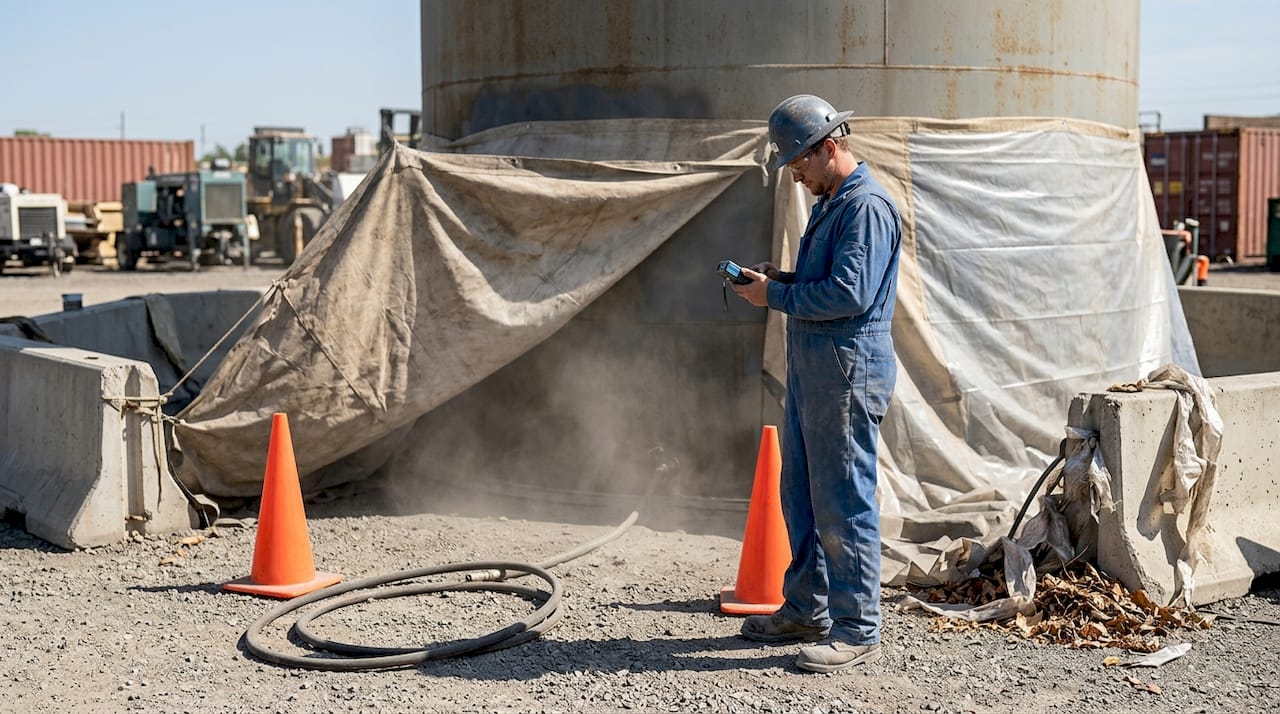
PELs set the legal ceiling for worker exposure. For respirable silica, OSHA’s PEL is 50 micrograms per cubic meter of air averaged over an 8-hour shift. Real-time air quality monitoring using calibrated sampling equipment is the only way to know whether your controls are actually working.
Wet blasting reduces dust more effectively than dry methods, but even wet substitutes produce lung hazards at high exposures. Wet blasting is not a complete solution. It’s one layer of a multi-control approach.
Here are the primary dust control methods ranked by effectiveness:
- Blast enclosures with negative pressure ventilation: Contain dust at the source and capture it before it reaches workers or bystanders
- Wet or vapor blasting: Suppress airborne dust by introducing water into the blast stream
- Local exhaust ventilation (LEV): Pull contaminated air away from the worker’s breathing zone
- Wind barriers and containment shrouds: Critical for outdoor Florida projects where wind disperses dust unpredictably
- Continuous real-time air monitoring: Detects exceedances before they become health events
| Surface prep method | Estimated dust reduction vs. dry open blasting | Notes |
|---|---|---|
| Dry open blasting | Baseline | Highest exposure risk |
| Dry blasting with enclosure | 60 to 80% reduction | Requires LEV system |
| Wet blasting | 70 to 90% reduction | Adds moisture management complexity |
| Vacuum blasting | Up to 99% reduction | Best for confined spaces |
“Substitution alone does not eliminate the hazard. Engineering controls must be layered with administrative controls and PPE to achieve acceptable exposure levels.”
Florida’s heat and humidity complicate every control method. High ambient temperatures accelerate worker fatigue, which leads to PPE removal. Humidity affects dust suppression chemistry. Outdoor projects near water bodies face environmental protection challenges that require containment plans approved before work begins.
Implement inspection, documentation, and emergency readiness
Air hazard controls are only effective if properly inspected and backed up with documentation and readiness. A safety program that exists only on paper is not a safety program. It’s a liability.
SSPC SP1-SP16 and VIS standards define surface cleanliness levels and provide visual inspection guides that help prevent coating failure. Over 70% of premature coating failures trace back to inadequate surface preparation, making formal inspection non-negotiable.
Your pre-job and in-progress inspection checklist should include:
- Visual surface inspection: Compare to SSPC VIS reference photos for cleanliness grade
- Salt contamination testing: Chloride levels above 3 micrograms per square centimeter cause early coating delamination
- Surface profile measurement: Verify anchor profile depth matches coating manufacturer specs
- Air monitoring log review: Confirm all readings are within PELs before each shift
- Equipment condition check: Blast hoses, nozzles, and pressure gauges must be inspected daily
- PPE inspection records: Document fit-test dates, equipment condition, and replacements
Pro Tip: Build hurricane and heat emergency protocols directly into your surface prep safety documentation. Florida’s weather can change a low-risk morning into a dangerous afternoon. Having a written stop-work trigger based on heat index thresholds and wind speed protects both workers and your project timeline.
Digital documentation platforms that provide real-time project updates make inspection records instantly accessible to project managers, inspectors, and clients. This reduces disputes and accelerates closeout. Pair digital logs with formal surface preparation inspections to build a defensible compliance record. Review current industry standards for coatings to ensure your documentation meets 2026 requirements.
Foster a safety-first culture with worker training and engagement
Safety programs succeed when every worker is trained, engaged, and able to flag problems early, especially in Florida’s high-risk climate. Rules posted on a trailer wall don’t prevent injuries. Engaged workers who understand why the rules exist do.
Heat amplifies PPE discomfort and creates real pressure for workers to cut corners. Worker engagement is essential for identifying real-world challenges before they become incidents. Your training program should cover:
- Hazard communication (HazCom): Workers must understand the Safety Data Sheets for every abrasive and coating material on site
- PPE selection and use: Not just how to wear it, but why each piece matters and how to inspect it
- Heat illness recognition and response: Symptoms of heat exhaustion and heat stroke, and the emergency response steps
- Dust and silica hazards: Plain-language explanation of what silicosis is and why it’s irreversible
- Emergency procedures: Evacuation routes, storm shelter locations, and first aid protocols
- Near-miss reporting: How to report and what happens when they do
Pre-task safety briefings every morning and weekly toolbox talks keep hazard awareness sharp without overwhelming workers. These don’t need to be long. Ten focused minutes before a shift is more effective than a quarterly safety marathon.
Pro Tip: Appoint a worker safety champion on each crew and reward near-miss reporting with positive recognition. Workers closest to the work see risks that supervisors miss. Creating a channel for that information to flow upward is one of the highest-value safety investments you can make.
For a full framework on managing blasting crews safely, the industrial sandblasting guidance resource covers crew management, training records, and site-specific risk controls.
Why most safety checklists fail: The truth from Florida job sites
After 20-plus years working surface prep projects across Central Florida, we’ve seen a consistent pattern. Facilities with the thickest safety binders often have the most incidents. The reason is straightforward: static checklists are written for average conditions, and Florida doesn’t do average.
A checklist written in January doesn’t account for a 98-degree July afternoon when a crew is three hours into a tank exterior blast and the heat index spikes. It doesn’t flag the pop-up thunderstorm that rolls in at 2 p.m. and turns a dry blast zone into a slip hazard in minutes. Rigid compliance with a document is not the same as actual safety.
What works is adaptive safety management. Train supervisors to read conditions, not just checklists. Empower workers to call a stop-work without fear. Build weather triggers and heat index thresholds into daily decision-making, not just written plans.
“The difference between a safe job site and an incident report is usually one conversation that didn’t happen.”
The facilities that consistently achieve zero incidents treat surface prep best practices as a living system, not a one-time compliance exercise. Culture, not paperwork, is what keeps workers safe when conditions change fast.
Get expert help for safer surface preparation in Florida
If managing OSHA compliance, abrasive selection, dust monitoring, and worker training simultaneously feels like a full-time job on top of your actual job, that’s because it is.
Southern Sandblasting & Painting LLC brings 20-plus years of hands-on experience to surface prep and industrial coating projects across Central Florida. Our crews are trained, equipped, and familiar with Florida’s unique regulatory and environmental demands. From water tanks to city infrastructure, we handle Orlando sandblasting services and industrial coatings expertise that meet SSPC, OSHA, and local requirements. If you want compliant, efficient, and genuinely safe surface prep without the guesswork, review our surface prep best practices or contact our team directly to discuss your project.
Frequently asked questions
What PPE does OSHA require for abrasive blasting in Florida?
OSHA 29 CFR 1910.94(a) mandates supplied-air respirators, heavy gloves, aprons, safety shoes, and eye and face protection for all abrasive blasting operations, regardless of abrasive type.
Is silica sand legal to use for blasting in Florida?
Silica sand is not outright banned but is strongly discouraged due to high toxicity risks, and many employers are required to demonstrate that safer alternatives were evaluated before using it.
How can I reduce worker heat stress during summer surface prep?
Provide shade, regular water breaks, and scheduled rest periods, and train all workers to recognize heat illness symptoms, as required under Florida construction safety regulations.
What inspection standards apply to surface preparation work?
SSPC SP1-SP16 and VIS 1-5 provide the visual and cleanliness benchmarks used to inspect industrial surface prep projects and verify readiness for coating application.
Recommended
- Surface Preparation Workflow for Industrial Projects
- 7 Essential Surface Preparation Tips 2025 for Infrastructure
- Painting safety tips 2026: best practices for compliance
- Surface Prep Best Practices for Long-Lasting Coatings
- Industrial Painting Services in Orlando, FL
- Sandblasting Services in Orlando, FL


