

TL;DR:
- Modern blasting systems provide precise surface profiling that directly influences coating adhesion and long-term asset protection. Selecting appropriate equipment based on substrate, scale, and environmental needs is vital, with technological innovations like CNC integration enhancing consistency and efficiency. Proper surface preparation through tailored blasting methods prevents premature coating failures, ensuring project success and regulatory compliance across industries.
Most construction and industrial professionals understand that blasting equipment removes rust, old coatings, and surface contaminants. What gets underestimated is how precisely modern blasting systems do it, and how much that precision affects everything downstream. The role of blasting equipment extends well beyond brute-force cleaning. When matched correctly to a substrate and project scope, it determines coating adhesion quality, long-term asset protection, operational efficiency, and regulatory compliance. This article breaks down how blasting equipment actually works, what separates one system from another, and how technology is shifting the standards your projects will be held to.
Table of Contents
- Key Takeaways
- The role of blasting equipment in surface preparation
- Types of blasting equipment and their applications
- Technology advancements shaping blasting in 2026
- Selecting and using blasting equipment effectively
- Real-world applications of blasting equipment
- My perspective on how blasting equipment shapes project outcomes
- Why Southernsandblastingandpainting should be your next call
- FAQ
Key Takeaways
| Point | Details |
|---|---|
| Blasting enables coating success | Proper surface profiling through blasting directly determines how long a protective coating will last on any substrate. |
| Equipment type drives results | Selecting the right blasting system for the substrate, scale, and environment prevents rework and controls costs. |
| Technology is raising the bar | CNC and Industry 4.0 integration are delivering more consistent results while reducing labor dependency and setup time. |
| Sizing matters more than power | Oversized equipment causes substrate damage and inefficiency; matching capacity to scope produces better outcomes. |
| Pressure must be measured at the nozzle | Compressor outlet readings are misleading; real surface profile consistency depends on nozzle pressure during active blasting. |
The role of blasting equipment in surface preparation
Surface preparation is not a preliminary step you get through before the real work starts. It is the real work. Any coating applied over a contaminated, poorly profiled, or chemically compromised surface will fail ahead of schedule, and 90% of coating failures trace back to inadequate surface preparation. Blasting equipment is the primary tool that prevents that outcome.
The physical process works by propelling abrasive media at high velocity against a target surface. That impact simultaneously strips contaminants and creates a microscopic anchor profile in the substrate. Coatings bond to that profile mechanically, and the depth and consistency of the profile directly determine bond strength. An inconsistent blast leaves high spots and low spots, which translates to uneven coating thickness and premature delamination.
Here is what blasting equipment addresses in a typical industrial or construction workflow:
- Rust and corrosion removal from structural steel, pipelines, and tanks
- Old coating removal, including lead-based paints that require controlled containment
- Mill scale removal from newly fabricated steel before primer application
- Contaminant removal, including oils, salts, and industrial residues that interfere with adhesion
- Surface profiling to the specific anchor depth required by coating specifications
Pro Tip: Always specify your target surface profile in mils before selecting abrasive media. The profile requirement from your coating manufacturer should drive media selection, not the other way around.
Blasting equipment in construction also plays a direct role in material processing efficiency. Proper fragmentation is not just about removing material. It is about optimizing the results of every downstream process that depends on surface condition, from coating application to structural inspection. That perspective changes how you spec a job.
Types of blasting equipment and their applications
Not all blasting systems are built for the same work. The four categories that matter most to construction and industrial professionals are sandblasting (abrasive pressure blasting), shot blasting, wet blasting, and CNC-integrated automated systems. Each operates on a different mechanism and suits a different set of project conditions.
| Equipment Type | Mechanism | Best Applications | Scale Suitability |
|---|---|---|---|
| Abrasive pressure blasting | Compressed air propels abrasive media through a nozzle | Structural steel, tanks, bridges, varied substrates | Small to large, portable |
| Shot blasting | Centrifugal wheel throws steel shot or grit | Flat surfaces, floors, fabricated steel, pipelines | Medium to high volume |
| Wet blasting | Water mixed with abrasive reduces dust at the nozzle | Sensitive environments, near occupied areas | Small to medium |
| CNC-integrated systems | Computer-controlled blast path and parameters | Precision manufacturing, aerospace, automated lines | High volume, industrial |
Portable abrasive pressure blasting is the workhorse for most construction-side projects. It handles irregular surfaces, vertical structures, and confined spaces in ways that fixed systems cannot. Shot blasting equipment excels on flat, high-volume surfaces like structural steel plate in fabrication yards, where the centrifugal wheel mechanism delivers consistent profiling without requiring constant nozzle operator control.
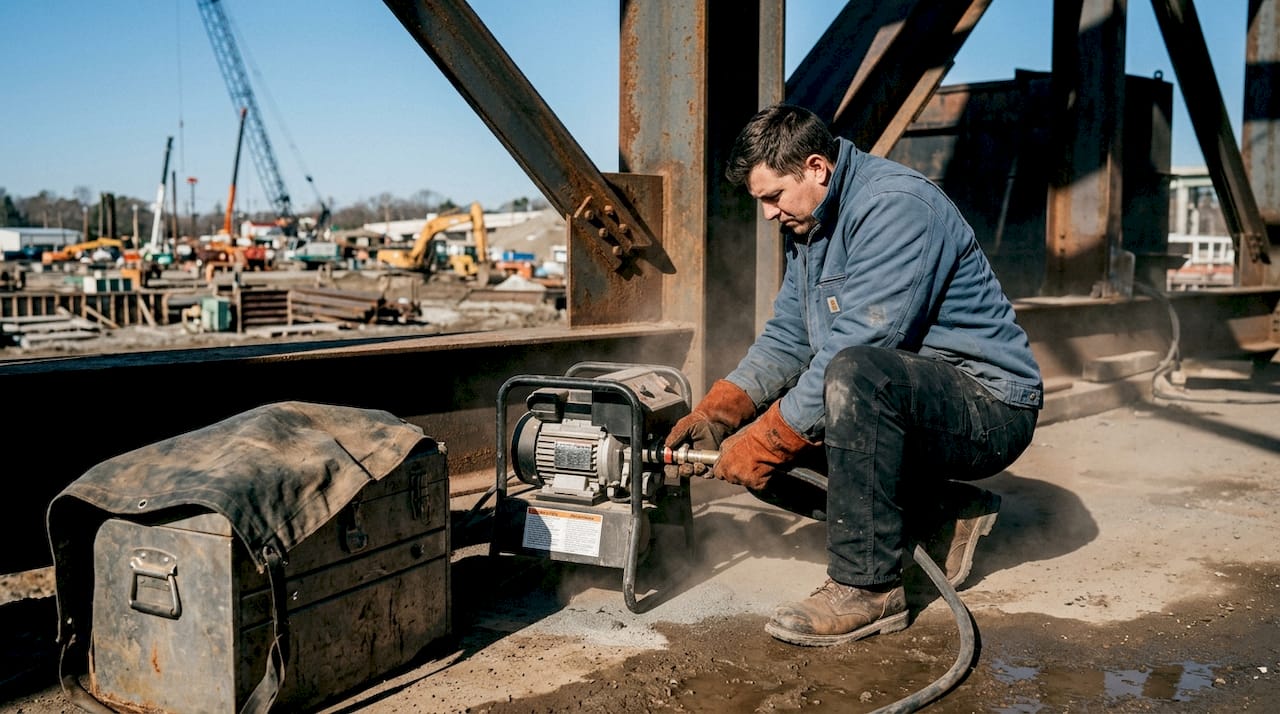
Wet blasting and dustless blasting are effective alternatives for controlling dust in environments near occupied buildings or sensitive ecosystems, though they can trade off some speed and surface profile control compared to dry abrasive methods. That trade-off is worth making when environmental compliance demands it.
The growth of CNC shot blasting machine technology has introduced computer-controlled blast paths, variable wheel speed, and integration with manufacturing execution systems that allow predictive maintenance and real-time quality tracking. That represents a significant shift in blasting equipment usage from manual craft to programmable process.
Pro Tip: For projects that require SSPC-SP10 or NACE No. 2 surface cleanliness standards, verify that your equipment selection can consistently deliver those results before mobilizing. Not every machine generates the abrasive velocity needed to meet near-white metal blast specifications.
Technology advancements shaping blasting in 2026
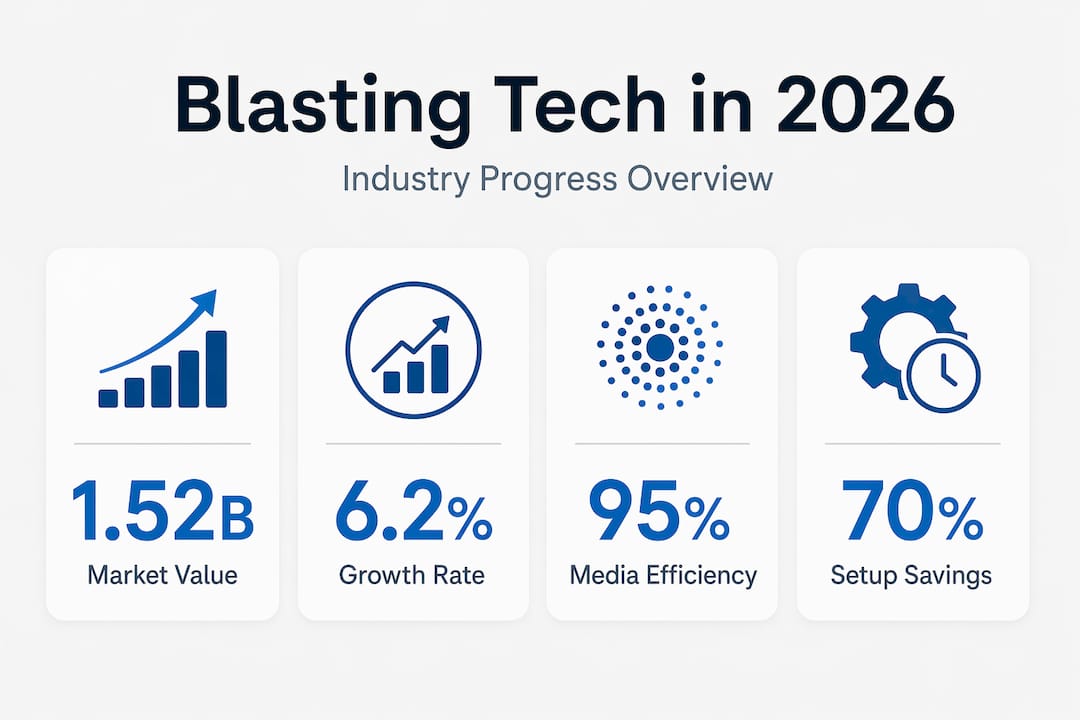
The global shot blasting machine market is valued at $1.52 billion in 2026, with a projected 6.2% CAGR. That growth signals where investment is flowing and why. Automotive, aerospace, and heavy infrastructure sectors are demanding higher surface quality and faster cycle times simultaneously, and manual blasting processes cannot keep pace.
Industry 4.0 integration is moving blasting equipment away from operator-dependent variables and toward programmable, repeatable parameters. CNC systems can be set to specific blast intensities, dwell times, and travel speeds, which eliminates the inconsistency that comes from operator fatigue or technique variation over a long shift.
The efficiency gains are substantial. CNC-integrated shot blasting can reduce setup times by up to 70% and push abrasive media recycling efficiency above 95%. That second number matters more than most operators realize. Abrasive media is one of the largest variable costs in a blasting operation. Recovering and reusing 95% of it changes your cost per square foot dramatically across a large-scale project.
“Modern CNC blasting machines connected to manufacturing execution systems are enabling predictive maintenance scheduling and consistent quality verification that were not possible with manually operated equipment.”
Environmental performance has also improved. Real-time dust monitoring, enclosed blast chambers, and intelligent media recirculation systems are reducing environmental impact and helping operations stay compliant with EPA and OSHA requirements without slowing production. Aerospace sector demand for precise, continuous shot blasting is driving further refinement of these technologies, with aircraft delivery volumes up 11% year over year pushing equipment manufacturers to increase capability and repeatability.
Selecting and using blasting equipment effectively
Getting equipment selection right before mobilizing is where experienced operators separate themselves from the rest. The most common expensive mistake is choosing too much machine for the project. Oversized blasting equipment leads to harder control, increased operational costs, and a higher risk of substrate damage. Matching capacity to actual project scope consistently produces better outcomes than defaulting to the most powerful available option.
Here is a practical sequence for selecting and deploying blasting equipment on a construction or industrial project:
- Define the surface specification first. Know your target cleanliness level (SSPC, NACE, ISO 8501) and anchor profile depth before you select equipment or media.
- Assess substrate condition and geometry. Complex curves, welds, and interior spaces require portable abrasive systems. Flat, high-volume surfaces favor shot blasting.
- Consider site constraints. Proximity to occupied spaces, waterways, or air-sensitive areas may require wet blasting or enclosed systems to manage dust and overspray.
- Size equipment to the project scope. Calculate the square footage to be treated, the target throughput rate you need, and the media volume required. Then select equipment whose capacity aligns with those numbers.
- Verify pressure at the nozzle during operation. Compressor outlet readings are not reliable indicators of blast performance. Nozzle pressure during active blasting is what determines surface profile consistency and prevents rework.
- Plan for dust control and media recovery. Establish a containment perimeter, identify media recovery method, and confirm compliance with local air quality requirements before the first blast.
Pro Tip: Check your nozzle bore diameter regularly during long blasting runs. A worn nozzle increases media consumption and drops nozzle pressure, which directly degrades surface profile quality without any obvious visual warning.
The industrial safety practices that govern blasting operations are not optional checkboxes. Respiratory protection, blast suit integrity, and air monitoring are operational requirements that affect crew health and project liability in equal measure.
Real-world applications of blasting equipment
The best way to understand blasting equipment usage across industries is to look at where it actually gets deployed and what it accomplishes in each context.
- Water tanks and storage vessels: Blasting removes existing coatings and corrosion before potable water-safe linings are applied. The surface profile specification for tank linings is typically tighter than structural steel, requiring consistent near-white metal blast across curved interior surfaces.
- Bridge and highway infrastructure: Large-scale abrasive pressure blasting removes decades of lead paint and mill scale from structural steel before recoating. The ability to work at height on irregular geometry makes portable blasting equipment the standard choice.
- Pipelines: Shot blasting equipment is used extensively in pipe fabrication facilities to profile exterior and interior surfaces before industrial coating application. Automated pipe blasting machines maintain consistent throughput across high-volume production runs.
- Airport and theme park infrastructure: Specialty substrates including aluminum, fiberglass, and composite materials require carefully controlled blast pressure and media selection to achieve the required profile without damaging the base material.
- Metal fabrication finishing: Blasting removes weld spatter, heat scale, and oxidation from fabricated assemblies before finishing. Efficient blasting techniques at this stage directly reduce labor time in the coating phase by eliminating surface defects before they reach the painter.
For a closer look at how these workflows connect to broader surface preparation methods across infrastructure types, that resource walks through each stage with practical sequencing detail.
My perspective on how blasting equipment shapes project outcomes
I’ve seen projects where a crew arrived with the right coating, the right primer, and the wrong blast equipment for the substrate, and the result was a coating failure within 18 months. That is not a coating problem. It is a blasting equipment selection problem that showed up late.
What I’ve learned after 20 years of surface preparation work is that the industry still undervalues the diagnostic step before equipment selection. The common instinct is to grab what is available rather than to spec what the surface actually requires. Blasting equipment is not interchangeable across applications the way people treat it.
My other observation is that technology adoption in blasting is slower than it should be. CNC-integrated systems and real-time monitoring are producing measurably better outcomes in manufacturing environments. But in construction and infrastructure work, manual portable blasting still dominates, partly from habit and partly from contractor familiarity. That gap will close. The cost-per-square-foot argument for automation gets more compelling every year as labor costs rise and quality documentation requirements tighten.
If you are managing surface preparation projects in 2026, build your equipment selection criteria around the surface spec, not the schedule pressure. The rework costs more than the extra day.
— Southernsandblastingandpainting
Why Southernsandblastingandpainting should be your next call
Southern Sandblasting and Painting has delivered surface preparation and industrial coating solutions across Central Florida for over 20 years, working on water tanks, pipelines, airport infrastructure, and municipal assets that demand verifiable results. If you are evaluating equipment options or planning a large-scale blasting project, their sandblasting equipment guide lays out what different systems protect and how to match equipment to asset type. For a full picture of service capabilities, the sandblasting and painting services page details everything from initial surface prep through final coating application. And if your project is in the Orlando area and you need boots on the ground quickly, the Orlando sandblasting services page gets you to the right contact directly.
FAQ
What is the role of blasting equipment in construction projects?
Blasting equipment prepares surfaces by removing rust, old coatings, and contaminants while creating an anchor profile that allows protective coatings to bond correctly. Without proper blasting, coating failures on structural steel and infrastructure are significantly more likely.
How does blasting equipment work in surface preparation?
Blasting equipment propels abrasive media at high velocity against a surface to strip contamination and create a textured profile. The media type, pressure, and nozzle distance are calibrated to match the substrate and the surface specification required by the coating system.
What blasting safety measures do operators need to follow?
Operators require appropriate respiratory protection, blast suits, and air monitoring during active blasting operations. Dust containment perimeters and media recovery systems are also required under OSHA and EPA regulations for most industrial blasting environments.
How do advancements in blasting technology improve results?
CNC-integrated blasting systems reduce setup times by up to 70% and push media recycling efficiency above 95%, delivering consistent surface profiles that manual blasting cannot reliably replicate at scale.
What factors determine which blasting equipment to use?
Surface geometry, substrate type, required cleanliness standard, project scale, and site environmental constraints all influence equipment selection. Oversizing equipment relative to project scope increases costs and the risk of substrate damage.


