
TL;DR:
- Sandblasting is a precise surface treatment process that uses high-velocity abrasive media to remove contaminants and create a textured profile for coating adhesion. Proper media selection, safety controls, and timing are essential for achieving lasting industrial coatings and preventing failures. It varies from heavy rust removal to decorative finishes, with environmental and health considerations paramount in operation planning.
Sandblasting is widely misunderstood as simple surface scrubbing. What is sandblasting, really? It’s a precision surface treatment process that propels abrasive media at high velocity using compressed air, stripping rust, old coatings, and contaminants while simultaneously creating a textured surface profile that allows industrial coatings to mechanically bond to the substrate. Without that profile, even the best coating will peel. For facility managers, municipal contractors, and anyone overseeing infrastructure work, understanding how sandblasting works, what it accomplishes, and how to do it safely is the difference between a coating that lasts 20 years and one that fails in two.
Table of Contents
- Key takeaways
- What is sandblasting and how the process works
- Sandblasting applications across industries
- Health, safety, and environmental considerations
- Advanced techniques for coating adhesion success
- What 20 years in the field actually teaches you about sandblasting
- Ready to put this knowledge to work on your next project?
- FAQ
Key takeaways
| Point | Details |
|---|---|
| Sandblasting builds surface profiles | Abrasive blasting creates anchor profiles that allow industrial coatings to bond mechanically and resist failure. |
| Media selection drives results | Choosing the right abrasive, from aluminum oxide to glass beads, determines surface finish quality and substrate safety. |
| Silica sand is outdated | Modern operations use engineered media to eliminate the serious respiratory risks associated with crystalline silica dust. |
| Safety requires layered controls | Noise can exceed 100 dB during blasting, requiring PPE, scheduling controls, and community communication on large projects. |
| Timing after blasting matters | In humid conditions, flash rust forms on freshly blasted metal within minutes, so coatings must be applied promptly. |
What is sandblasting and how the process works
At its core, the sandblasting process involves feeding abrasive media into a pressurized stream of compressed air and directing it through a nozzle at the target surface. The abrasive particles hit the surface at high speed, knocking off contaminants and simultaneously roughening the substrate at a microscopic level. The system typically operates at 60 to 150 PSI, with pressure adjusted depending on the substrate hardness and the finish required.
There are three main equipment configurations used in professional settings:
- Pressure blast systems use a sealed pressure vessel to feed media directly into the air stream. These are the workhorses of industrial sandblasting and produce the most consistent, high-velocity output.
- Suction (siphon) blast systems draw media up from a hopper using air-induced vacuum. They use less media but also produce less impact force, making them better suited for lighter work.
- Wet abrasive blasting systems mix water with the abrasive stream to suppress dust at the source. These are increasingly used where dust control regulations are strict.
Nozzle selection matters more than most people realize. A venturi-style nozzle accelerates the abrasive through a shaped chamber that amplifies velocity without increasing PSI. Wider bore nozzles cover more surface area per pass but wear faster. On large infrastructure projects like water tanks or pipelines, operators swap nozzles regularly to maintain consistent blast profiles.
Pro Tip: Run a blotter test before every blasting session. Hold a clean white card in the air stream for 60 seconds. Any oil staining means contaminated compressed air that will cause immediate coating failure. This two-minute check prevents expensive rework.
The modern shift away from silica sand is worth emphasizing here. Silica sand creates serious health risks through crystalline silica dust inhalation, which causes silicosis, an irreversible lung disease. Today’s professional operations use aluminum oxide, steel grit, crushed glass, or glass beads, each matched precisely to the substrate and target surface profile via grit charts and surface roughness measurements.
Sandblasting applications across industries
The range of sandblasting applications spans from delicate decorative work to heavy industrial surface stripping. Understanding which application fits your project determines your media choice, pressure settings, and finishing expectations.
Surface cleaning and rust removal
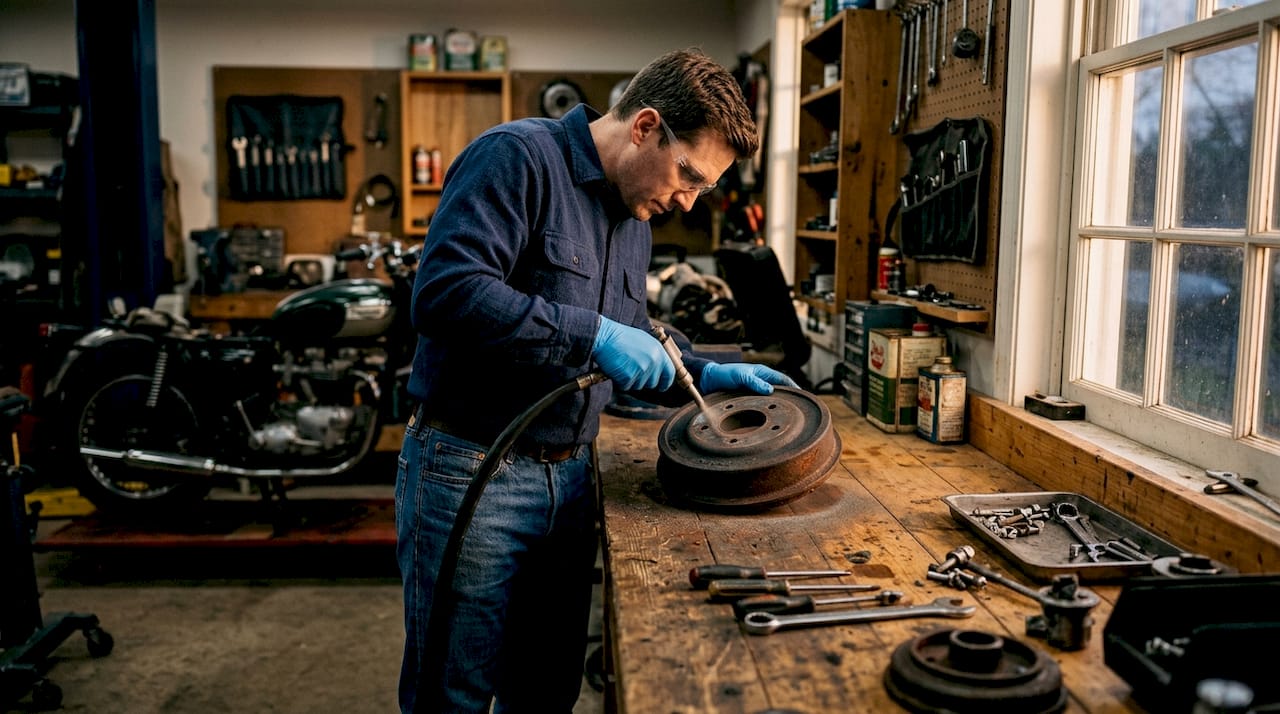
This is where most industrial clients start. Automotive sandblasting removes rust and oxidized paint quickly and completely, reaching into pitted areas that wire brushing or grinding would miss. For infrastructure assets like bridges, pipelines, and water tanks, full surface cleaning to a white metal standard (SSPC-SP5 or NACE No. 1) is often specified before protective coating application.
Creating anchor profiles for coatings
This is sandblasting’s most critical industrial function, and the one most often overlooked by clients who just want the surface “cleaned.” Improper surface profiles cause premature coating failure, leading to costly corrosion and rework cycles on critical infrastructure. A properly blasted surface has microscopic peaks and valleys that give coatings something to grip. Without that mechanical bond, adhesion depends solely on chemistry, which is far less reliable under thermal cycling, moisture exposure, and mechanical stress.
Decorative and precision finishing
On the finer end, glass bead blasting at 200 to 325 grit produces satin and matte finishes with surface roughness of 0.4 to 0.8 Ra microns. This is the range used for consumer electronics housings, architectural metal panels, and high-end automotive components where appearance matters as much as function.
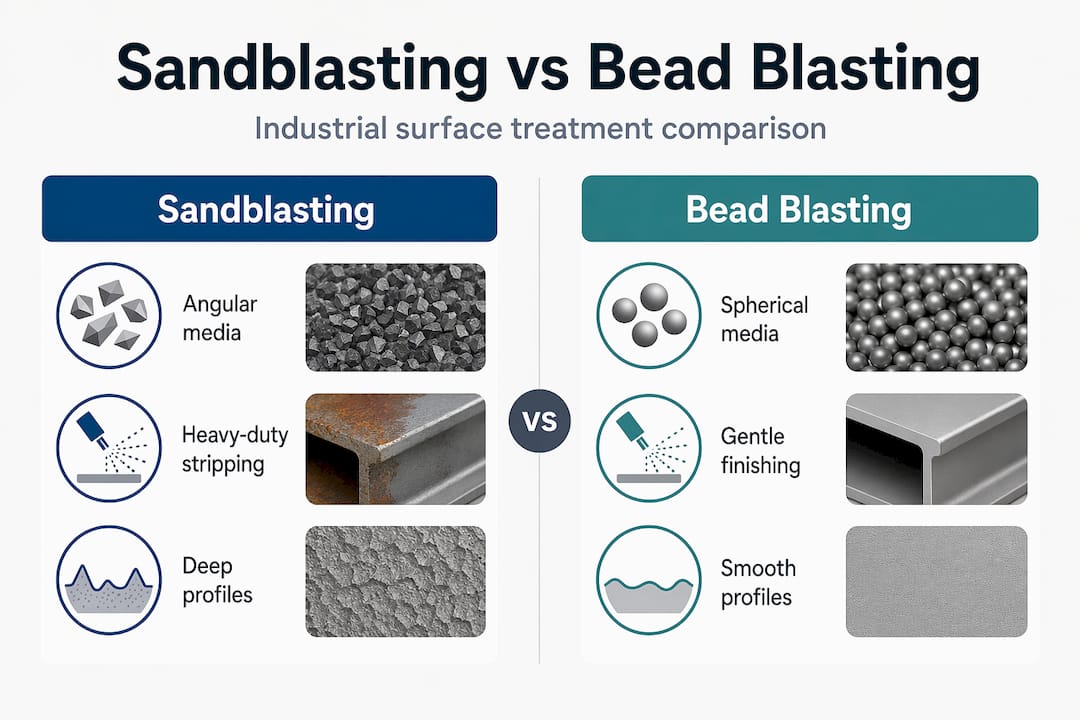
Sandblasting vs. bead blasting
These two methods are frequently confused. Here is a direct comparison:
| Feature | Sandblasting | Bead blasting |
|---|---|---|
| Media type | Angular abrasives (steel grit, aluminum oxide) | Spherical glass or ceramic beads |
| Surface action | Cuts and profiles the surface aggressively | Peens and smooths without deep profiling |
| Best for | Heavy rust removal, coating prep, infrastructure | Cosmetic finishing, light cleaning, delicate parts |
| Typical grit range | 16 to 80 grit for industrial work | 100 to 325 grit for finishing |
| Surface roughness | 2.0 to 3.5 mils profile depth | 0.4 to 0.8 Ra microns |
When a facility manager needs to prep a steel water tank for a 20-year epoxy lining, sandblasting with angular media is the right call. When an aerospace component needs a uniform matte finish without dimensional change, bead blasting wins. Knowing this distinction saves time and prevents surface damage from using the wrong tool.
Health, safety, and environmental considerations
Sandblasting is one of the louder industrial processes you will encounter on a job site. Noise levels during blasting frequently exceed 100 dB, well above OSHA’s 85 dB action limit. Sustained exposure at that level causes permanent hearing loss. This is not a soft risk. It requires hard controls.
Key safety requirements for any sandblasting operation include:
- Supplied air respirators for blasting operators. Air-purifying respirators are not sufficient when abrasive dust is present.
- Hearing protection rated for 25 to 30 dB noise reduction, worn by all personnel within the blast zone.
- Full body blast suits to protect skin from abrasive ricochets, which can cause serious lacerations.
- Blast containment systems such as tarps, shrouds, and negative pressure enclosures to prevent media and dust from migrating off-site.
- Continuous air monitoring downwind of the blast zone on large outdoor projects.
“Large-scale sandblasting operations require off-peak scheduling, 48-hour advance notice to neighboring properties, and designated noise monitoring points to manage community impact and maintain operational continuity.”
Environmental compliance adds another layer. Spent abrasive media and paint chips, especially from older structures that may contain lead paint, must be collected and disposed of as hazardous waste under EPA guidelines. Local air quality permits may be required for large open-air blasting operations in regulated areas. For projects in Florida, Southernsandblastingandpainting manages these compliance requirements as part of its standard project workflow, documented in detail in its safe sandblasting practices resource.
Pro Tip: Schedule exterior blasting projects for early morning hours when wind speeds are typically lower. This reduces dust migration and helps keep spent media contained within your site perimeter.
Advanced techniques for coating adhesion success
Getting the surface clean is table stakes. Getting the surface profile right is where experienced operators separate from beginners. For heavy industrial coating applications, the anchor profile depth needs to fall within a specific window. Too shallow and the coating has nothing to grip. Too deep and the peaks exceed coating thickness, creating uncoated high spots that rust immediately.
| Abrasive type | Grit range | Anchor profile depth | Recommended coating type |
|---|---|---|---|
| Steel grit | 25 to 40 | 3.0 to 5.0 mils | Thick-film epoxy, polyurethane |
| Aluminum oxide | 36 to 80 | 2.0 to 3.5 mils | Standard epoxy, zinc-rich primers |
| Crushed glass | 40 to 80 | 1.5 to 3.0 mils | Direct-to-metal coatings |
| Glass beads | 100 to 325 | 0.4 to 0.8 mils | Light topcoats, decorative finishes |
Moisture control is the other variable that trips up projects in Florida’s climate. Flash rust forms within minutes on freshly blasted steel in high humidity. The standard practice in humid conditions is to blast small sections and coat immediately, rather than blasting an entire structure and letting it sit. Some operators use desiccant dryers on compressor lines to keep moisture out of the air supply entirely.
Oil contamination in compressed air is an equally common hidden failure point. A blotter test confirms oil-free air before each session starts. Standard shop compressors without oil separators routinely introduce enough contamination to cause coating delamination within months.
Industrial sandblasting techniques also vary when moving between substrate types. Concrete requires different grit and pressure settings than structural steel. Aluminum and other soft metals need gentler media and lower PSI to avoid warping or excessive material removal. When working on infrastructure projects that mix substrate types, experienced operators switch media and pressure settings between zones rather than running a single setup across the whole structure.
Pro Tip: Always check the dew point before blasting bare metal outdoors. The substrate temperature should be at least 5°F above the dew point to prevent moisture condensation on freshly blasted surfaces.
What 20 years in the field actually teaches you about sandblasting
I’ve watched projects that looked perfect on paper fail because the surface was blasted the day before coating in August humidity. Florida’s climate is genuinely unforgiving for abrasive blasting work, and it forces you to develop habits that contractors in drier climates can afford to skip.
The biggest misconception I see from clients, even experienced facility managers, is treating sandblasting as a cleaning step rather than a fabrication step. When you blast a surface correctly, you are manufacturing a product. That surface profile is as engineered and intentional as the coating going over it. The moment you treat blasting as just prep work, you start cutting corners that show up as coating failures two years later.
The second thing that surprises people is how much the terminology has shifted. “Sandblasting” is still the term everyone uses, but the shift away from silica sand to engineered media means the word is more of a legacy label than a literal description. Knowing which media actually fits your substrate is the real conversation, and it is one worth having before equipment is even on site.
Smart project planning around noise and community relations is something I have come to value as much as technical precision. A technically perfect blast job that generates noise complaints and regulatory delays costs more in the end than one planned with a neighbor notification schedule and off-hours blasting windows.
— Southernsandblastingandpainting
Ready to put this knowledge to work on your next project?
If your project involves water tanks, pipelines, city infrastructure, or any heavy industrial asset in Central Florida, the technical details covered above translate directly into how Southern Sandblasting and Painting approaches every job. With over 20 years of experience handling complex surface preparation for municipal, commercial, and government clients, the team brings the media selection expertise, environmental compliance knowledge, and coating application precision that these projects demand.
Start with the sandblasting equipment guide to understand which tools and abrasive systems are appropriate for your specific substrate and coating requirements. If you are managing a municipal or infrastructure project and need guidance on workflow sequencing, the municipal sandblasting workflow resource walks through each stage in detail.
For clients ready to move from planning to execution, Southernsandblastingandpainting offers full-service sandblasting in Orlando with on-site project consultation, regulatory compliance handling, and integrated coating services. Whether your asset is a water tower scheduled for recoating or an airport structure requiring lead paint removal, the team has the equipment capacity and field experience to deliver results that protect your investment for the long term.
Contact Southernsandblastingandpainting directly to discuss your project requirements and get a tailored assessment of the surface preparation approach that fits your timeline, budget, and compliance obligations.
FAQ
What is sandblasting used for?
Sandblasting is used to remove rust, paint, and surface contaminants from metal, concrete, and other substrates, and to create surface profiles that allow industrial coatings to bond mechanically. Applications range from infrastructure maintenance to automotive restoration and decorative finishing.
What is the difference between sandblasting and bead blasting?
Sandblasting uses angular abrasive media that cuts aggressively into the surface, creating deep anchor profiles for industrial coatings. Bead blasting uses spherical glass beads to peen and smooth surfaces, producing satin finishes suited for cosmetic work on precision or delicate components.
Is silica sand still used in sandblasting?
No. Silica sand has been largely replaced by engineered abrasives like aluminum oxide, steel grit, and crushed glass due to serious respiratory health risks from crystalline silica dust exposure. Modern operations select media based on substrate hardness and required surface finish specifications.
How long after sandblasting should you apply a coating?
In humid conditions, coating should be applied within minutes of blasting to prevent flash rust forming on the freshly exposed metal surface. Florida’s climate makes this timing particularly tight, and experienced operators blast in sections to coat immediately rather than blasting entire structures at once.
What equipment is needed for industrial sandblasting?
Core sandblasting tools and equipment include a pressure blast vessel, an industrial air compressor with moisture separators, venturi nozzles sized for the work area, supplied-air respirators, hearing protection, and blast containment systems to manage dust and spent media on site.


