
Hire a specialist contractor who shows up with a written, project-specific safety plan, documented OSHA silica controls, and a willingness to run a test patch before finalizing any estimate. That is the short version. Before you sign anything, request two things on first contact: proof of silica compliance training and a current certificate of liability insurance. Everything else in the vetting process builds from there.
Immediate next steps when evaluating bidders:
- Request a 1 ft x 1 ft test patch before accepting any fixed-price quote — it is the industry standard for measuring real removal rates and media consumption.
- Ask for a written, project-specific controls plan covering engineering controls, containment, and ventilation before work begins.
- Get a mobilization and timeline estimate tied to actual production rates, not a generic per-square-foot number.
Table of Contents
- Why industrial facilities need a specialist, not a generalist
- How industrial sandblasting is priced — and what drives the cost
- What to demand from any contractor on safety and OSHA compliance
- Which abrasive media and methods fit your project?
- How to vet and choose the right contractor
- Southernsandblastingandpainting: a recommended provider for Central Florida
- Key Takeaways
- What the cheapest bid usually costs you
- Southern Sandblasting & Painting LLC is ready to quote your project
- Authoritative sources for procurement and safety decisions
Why industrial facilities need a specialist, not a generalist
The best industrial sandblasting services are not interchangeable with general contracting or pressure washing. The gap shows up fast when a coating fails six months after a job that looked fine on the surface.
Specialist contractors bring engineered containment, calibrated media selection, and equipment scaled to the substrate. A general contractor renting a blast pot for the weekend does not. The downstream cost of a failed surface profile — recoating, downtime, regulatory exposure — routinely exceeds the original job cost.
Operational reasons to hire a specialist:
- Engineered containment and dust mitigation matched to the site (enclosed shop vs. open field)
- Media selection based on substrate hardness, coating type, and required surface profile
- Equipment scaled for the job: industrial compressors, high-efficiency dust collectors, negative-pressure enclosures
- QC protocols including post-blast inspection and profile measurement before coating begins
Risk reasons the stakes are higher than they look:
- Silica exposure is a serious occupational hazard; OSHA’s silica standard requires employer-implemented engineering controls, not just respirators
- Regulatory enforcement can result in stacked citations across ventilation, respiratory protection, and exposure control standards simultaneously
- Incorrect surface preparation is the leading cause of premature coating failure on industrial assets
Pro Tip: Before any contractor sets foot on your site, require a documented project-specific controls plan in writing. A verbal assurance that they “follow OSHA rules” is not a plan.
How industrial sandblasting is priced — and what drives the cost
Industrial sandblasting pricing varies widely depending on media type, coating condition, surface complexity, and labor rate. That range is wide because the variables are real, not because contractors are guessing.
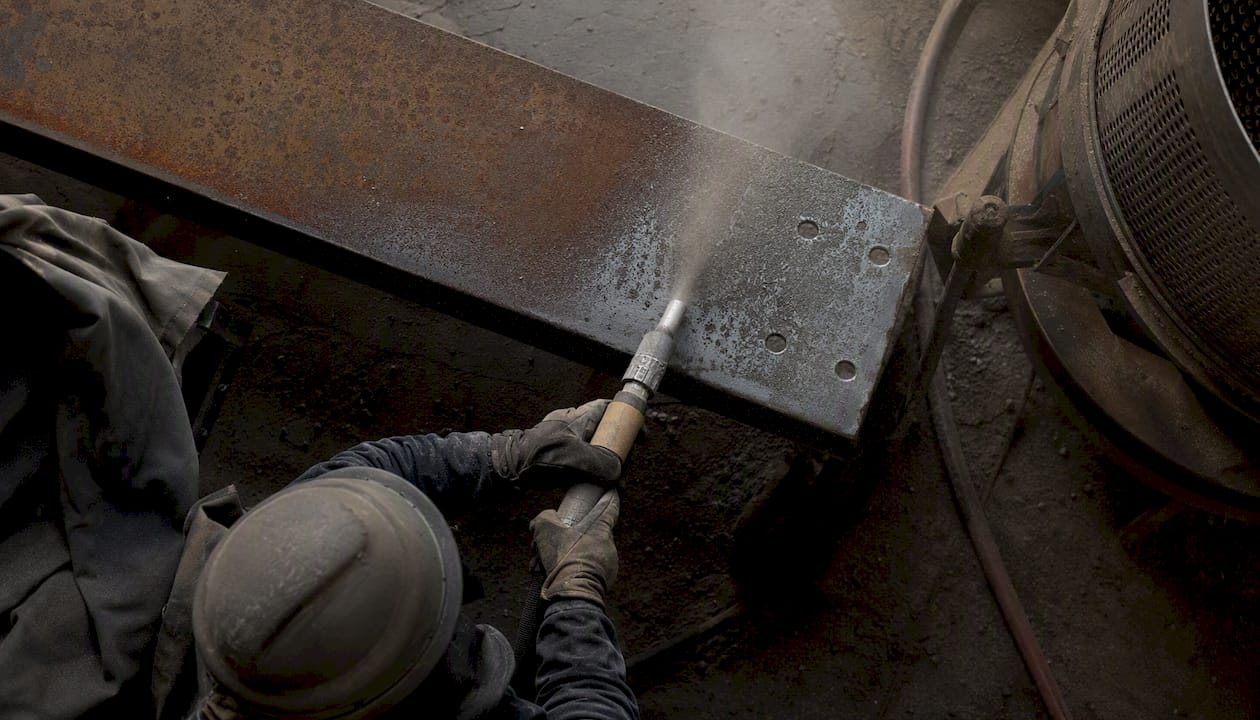
Field work costs 1.5× to 2× more than shop blasting for the same surface area. Containment, scaffolding, compressor transport, and lower operator productivity in the field drive that premium. Shop throughput can run at roughly double the pace of field operations, which is why shipping removable components to a shop is worth calculating before defaulting to on-site work.
Primary cost drivers:
- Coating type and thickness (mill scale vs. multiple paint layers vs. epoxy)
- Substrate geometry and access difficulty
- Containment requirements (enclosed shop vs. open-air field with draping)
- Media type and consumption rate
- Labor rate and mobilization distance
| Setting | Typical Range | Notes |
|---|---|---|
| Shop blasting | $2–$5 per sq ft | Higher throughput, lower containment cost |
| Field blasting | $4–$10+ per sq ft | Containment, logistics, lower productivity |
| Steel grit (closed-loop) | Lowest effective cost/m² | 100+ reuse cycles |
| Garnet | Moderate effective cost | 3–5 reuse cycles |
| Aluminum oxide | Mid-range effective cost | 15–20 reuse cycles |
Flat per-square-foot quotes without a site visit are a red flag. Abrasive media and labor each account for roughly 25–45% of total project cost, so any quote that ignores media consumption or site conditions is not a real estimate. Nozzle condition matters too: worn nozzles increase compressed-air draw significantly, and boron carbide nozzles lasting 1,000+ hours represent a real energy and cost advantage over ceramic alternatives.
Cost callout: Field blasting typically costs 1.5× to 2× more than shop blasting for the same surface area. When parts can be transported, shop work is almost always the smarter financial choice.
What to demand from any contractor on safety and OSHA compliance
OSHA’s hierarchy of controls places engineering controls — substitution, isolation, local exhaust ventilation — above respirators. Respirators are last-resort protection, not a compliance strategy. A contractor whose safety plan starts and ends with PPE is not compliant.
Documents to request before signing a contract:
- Written, project-specific exposure control plan (not a generic company policy)
- Silica compliance records and employee training documentation
- Respiratory protection program with fit-test records
- Containment and ventilation plan specific to your site
- Current certificate of liability insurance and workers’ compensation coverage
- MSDS/SDS sheets for all abrasive media to be used
- Waste disposal plan for spent media and debris
OSHA’s ventilation standard requires blast-cleaning enclosures to maintain continuous inward airflow at all openings during blasting, with exhaust discharged through dust-collecting equipment. That is a minimum, not a best practice. For field work on infrastructure assets, negative-pressure enclosures and HEPA-filtered collection are the standard you should expect.
Safety callout: A single OSHA inspection of a blasting operation can generate separate citations for inadequate ventilation, missing respiratory protection, no written exposure control plan, and insufficient training — each carrying its own penalty.
Pro Tip: Ask the contractor to show you the dust-control equipment they plan to use on your specific job. High-efficiency dust collectors and negative-pressure enclosures are not optional for enclosed or semi-enclosed field work.
For a deeper look at sandblasting safety essentials, including engineering controls and containment practices, that resource covers the documentation framework in detail.
Which abrasive media and methods fit your project?
Choose media for the job, not for the unit price. Silica sand alternatives exist and are widely used, but some substitutes have limited long-term health-effect study data — which means dust control remains non-negotiable regardless of media choice.
Common media and their best uses:
- Garnet: Excellent for steel and concrete; low dust, 3–5 reuse cycles, good surface profile
- Steel grit: Best for high-volume shop work; 100+ reuse cycles in closed-loop systems, lowest effective lifecycle cost
- Aluminum oxide: Hard, fast-cutting; 15–20 reuse cycles; good for precision work
- Coal slag: Low unit cost, widely available; limited reuse; releases some contaminants — review SDS carefully
- Glass bead: Smooth finish applications; not suited for heavy mill-scale removal
- Walnut shell / organic media: Soft substrates and delicate surfaces only; combustible, so automatic systems only per OSHA
Wet (dustless) blasting suppresses airborne dust and can cut abrasive consumption by roughly 50% in masonry and painted-wall applications. Dry blasting moves faster on heavy mill scale and is standard for most structural steel work. The right method for your substrate depends on coating type, contamination level, and environmental constraints at the site.
For high-volume industrial work, closed-loop steel grit reclamation lowers lifecycle media cost despite a higher unit price per pound. The math favors recyclable media on any job over roughly 5,000 square feet.
How to vet and choose the right contractor
The minimum qualifying package from any serious bidder is a test patch result, a project-specific safety plan, and a clear mobilization and production-rate estimate. Anything less is a guess dressed up as a quote.
Vendor vetting checklist:
- Documented OSHA silica compliance and training records
- Written project-specific controls plan (not a template)
- Proof of liability insurance and workers’ compensation
- References from comparable industrial or municipal projects
- Equipment list including compressor capacity, nozzle type, and dust-collection specs
- Test patch results with measured removal rate and media consumption
- Waste disposal method for spent media
Questions to ask on the first call:
- What media will you use, and why for this substrate?
- How will you contain dust and spent media on this site?
- What is your expected production rate in square feet per hour?
- What nozzle type and size do you plan to use?
- How do you handle lead paint or PCB-containing coatings if discovered?
- What are your insurance limits, and can you name us as additional insured?
- What is your mobilization timeline and estimated job duration?
- Can you provide a test patch before finalizing the estimate?
Red flags to walk away from:
- Flat per-square-foot quote with no site visit
- Refusal to provide a test patch
- No written silica compliance documentation
- Vague or verbal-only safety assurances
- No references from industrial or municipal clients
A typical 5,000 sq ft industrial job on structural steel runs 3–5 days for field blasting, depending on coating condition, access, and containment setup. Shop work on the same area moves faster. The surface preparation workflow for industrial projects outlines what a proper pre-coating inspection looks like after blasting is complete.
Southernsandblastingandpainting: a recommended provider for Central Florida
Southern Sandblasting & Painting LLC brings 20+ years of documented experience on industrial, municipal, and infrastructure projects across Central Florida. That track record matters when you are evaluating a contractor for water tanks, airport infrastructure, pipelines, or city assets where a coating failure is not a cosmetic problem.
Services that map directly to the vetting checklist:
- Industrial sandblasting (shop and field) with documented containment and dust control
- Surface preparation for metal, concrete, and infrastructure substrates
- Protective coatings and industrial painting following post-blast inspection
- Test patches available before estimate finalization
- Municipal and government project references on request
- Industrial sandblasting services in Orlando, FL with mobilization across Central Florida
For project examples and before/after documentation, sandblasting project examples show the scope and substrate types the team has handled.
Pro Tip: When contacting Southernsandblastingandpainting, ask specifically for a written project-specific safety plan and a test patch as part of the initial estimate process. A contractor who offers both without hesitation is the one worth hiring.
Key Takeaways
The single most reliable way to hire a qualified industrial sandblasting contractor is to require a test patch, a written project-specific safety plan, and documented OSHA silica compliance before any work begins.
| Point | Details |
|---|---|
| Test patch first | A 1 ft x 1 ft test patch is the industry standard for accurate removal-rate and media-consumption estimates. |
| Field vs. shop cost | Field blasting costs 1.5× to 2× more than shop work; ship removable parts when possible. |
| Media lifecycle cost | Steel grit in closed-loop systems offers the lowest effective cost per area across 100+ reuse cycles. |
| Safety documentation | Require a written project-specific controls plan, silica compliance records, and insurance before signing. |
| Southernsandblastingandpainting | A 20+ year Central Florida provider offering industrial sandblasting, surface prep, and protective coatings with documented safety controls. |
What the cheapest bid usually costs you
The conventional wisdom in industrial procurement is to get three bids and take the middle one. That heuristic fails badly in abrasive blasting, and here is why: the variables that separate a $3/sq ft quote from a $7/sq ft quote are almost never visible in the bid document itself. They live in containment quality, media consumption accuracy, nozzle condition, and whether the operator actually measured the substrate before pricing it.
Paying a premium makes sense when the job involves hazardous coatings (lead, PCBs), remote or difficult-access field sites, or a tight schedule where a redo is not an option. In those cases, the documented controls and measured production rates that a qualified specialist provides are not overhead. They are the product.
The one-sentence heuristic for shop vs. field: if the component can be transported without structural risk, get a shop quote first, because the cost difference alone usually justifies the logistics.
Southern Sandblasting & Painting LLC is ready to quote your project
Twenty-plus years of industrial surface preparation work across Central Florida means Southernsandblastingandpainting has handled the substrate types, coating conditions, and containment challenges that trip up less experienced contractors. For facility managers who want to move from evaluation to a signed contract without surprises, the qualifying package is straightforward: a test patch, a written project-specific safety plan, a sample SDS for the proposed media, and a mobilization timeline tied to real production rates.
Contact Southern Sandblasting and Painting to request that package for your project. The sandblasting services page covers service scope and contact options, and the equipment and capabilities guide details the specific equipment used on industrial jobs. Reach out with your project specs and ask for a test patch as part of the estimate process.
Authoritative sources for procurement and safety decisions
- OSHA Respirable Crystalline Silica Standard (1926.1153): The governing federal standard for silica exposure in construction blasting operations; save this for your compliance file.
- OSHA Ventilation Standard (1910.94): Specifies exhaust ventilation requirements for blast-cleaning enclosures; use when reviewing a contractor’s containment plan.
- OSHA Controlling Silica Exposure in Construction (Publication 3697): Plain-language hierarchy-of-controls guidance; the clearest explanation of why engineering controls come before respirators.
- EPA AP-42 Abrasive Blasting Emissions Guide: Media types, emissions data, and control efficiency benchmarks; useful for environmental permit review.
- Compressed Air Best Practices: Sandblasting Operational Costs: Nozzle wear, energy cost drivers, and boron carbide nozzle performance data; reference when asking contractors about equipment.
- NCBI: Health Effects of Abrasive Blasting Media: Research review on silica substitutes and their health profiles; use when evaluating media SDS documentation.
This article provides general procurement and safety information for facility managers. Confirm current OSHA requirements and applicable regulations with a qualified safety professional or legal counsel for your specific project and jurisdiction.


