
TL;DR:
- Proper equipment configuration is crucial for optimal surface quality and coating adhesion.
- Equipment wear and incorrect setup can lead to early coating failure and regulatory issues.
- Automation benefits large-scale projects by ensuring consistency and reducing operator exposure.
Sandblasting equipment guide: results that protect assets
Most facility managers and procurement officers assume that the type of abrasive media determines sandblasting quality. It’s a reasonable assumption, but it’s wrong. The real make-or-break factor in any sandblasting project is equipment configuration and condition. Choose the wrong compressor size, run a worn nozzle, or skip proper dust collection, and you will get a surface that fails coating adhesion tests, triggers compliance violations, or forces costly rework. This guide walks you through the core equipment involved, how each component directly shapes surface quality and coating performance, the role of dust control in safety and regulatory compliance, and when automation changes the game for large municipal and industrial projects.
Table of Contents
- Sandblasting essentials: The core equipment breakdown
- How equipment design shapes surface quality and coating success
- Blast pot and dust control: Efficiency, safety, and compliance factors
- Automation in sandblasting: Robotic vs. manual equipment
- What most decision-makers overlook when choosing sandblasting equipment
- Connect with expert sandblasting and asset protection solutions
- Frequently asked questions
Key Takeaways
| Point | Details |
|---|---|
| Equipment drives results | The right sandblasting equipment setup is the biggest factor in achieving consistent, high-quality outcomes. |
| Surface profile matters | Properly selected and maintained equipment ensures the surface roughness needed for long-lasting coating adhesion. |
| Automation boosts efficiency | Robotic systems reduce fatigue, improve consistency, and excel in challenging environments. |
| Safety and compliance rely on dust control | Effective dust collection keeps operations safe and meets environmental standards for Florida projects. |
| Smart choices save costs | Aligning equipment selection with project needs minimizes downtime and avoids costly mistakes. |
Sandblasting essentials: The core equipment breakdown
Before you can evaluate a contractor or specify a sandblasting scope of work, you need a solid grasp of what the equipment actually does. Sandblasting is not a single tool. It is a system, and every component in that system carries real consequences for outcome and cost.
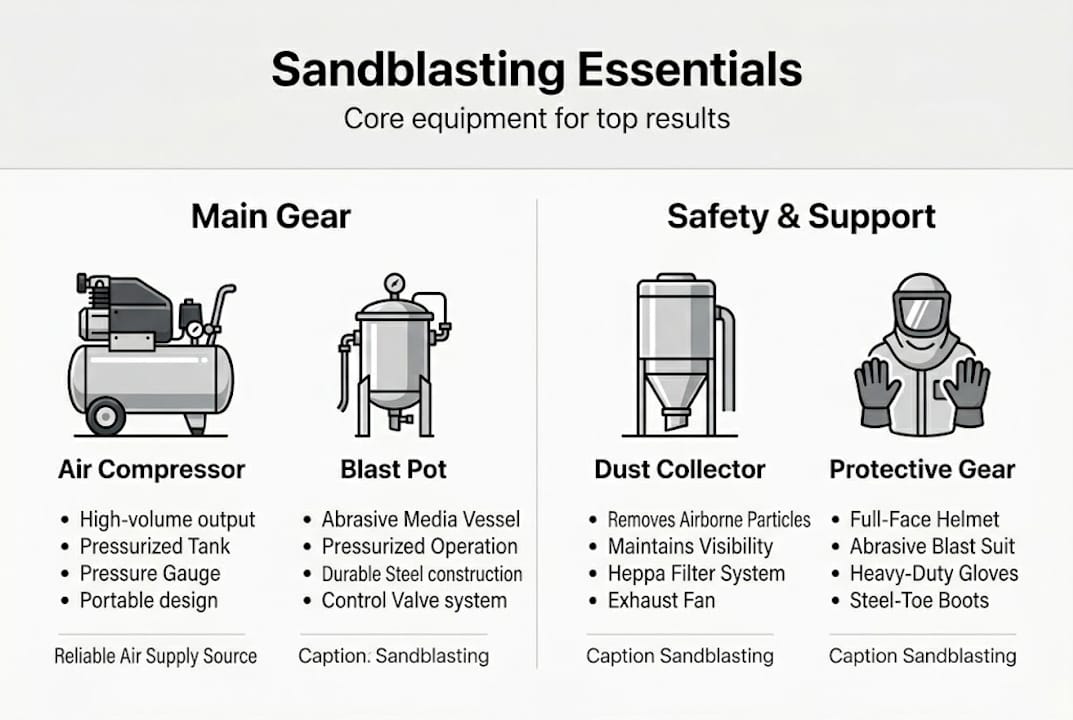
Core sandblasting equipment includes an air compressor, blast pot or pressure vessel, blast hose, nozzle, and dust collection or recovery systems. Each of these components must be matched to the scale and nature of your project. Undersizing any one element creates a bottleneck. Oversizing without purpose wastes budget.
Here is a quick breakdown of what each component does:
- Air compressor: Generates the compressed air that powers the entire system. Output is measured in CFM (cubic feet per minute) and PSI (pounds per square inch). Industrial sandblasting typically requires 150 to 375 CFM or more depending on nozzle size.
- Blast pot (pressure vessel): Holds the abrasive media and delivers it into the air stream. Pressurized pots allow for continuous blasting cycles with less interruption.
- Blast hose: Carries the abrasive-air mixture from the pot to the nozzle. Hose diameter affects velocity and wear rate. Larger diameter hoses reduce friction loss over longer runs.
- Nozzle: Shapes and accelerates the abrasive stream. This is one of the most performance-sensitive parts of the whole system. Worn nozzles alone can drop efficiency by 30% or more.
- Dust collection and recovery systems: Capture spent abrasive and airborne particulate. These systems protect worker health, improve visibility at the work face, and keep you on the right side of environmental regulations.
The table below gives you a quick reference for the core specs and roles:
| Equipment | Primary function | Key spec to review |
|---|---|---|
| Air compressor | Powers the system | CFM and PSI rating |
| Blast pot | Feeds abrasive media | Capacity and pressure rating |
| Blast hose | Transfers abrasive-air mix | Diameter and length |
| Nozzle | Controls blast pattern | Orifice size and material |
| Dust collection | Captures particulate | CFM capacity and filter rating |
Pro Tip: For most municipal and industrial projects in Florida involving water tanks, bridges, or large structural steel, you want a compressor rated for at least 185 to 250 CFM per blast pot. Review the facility manager’s sandblasting guide for project-specific sizing recommendations, and take a look at key surface prep tools to see how they support each phase of preparation.
Getting this equipment mix right is not a technical exercise for its own sake. It is the foundation for every result that follows, including surface profile, coating adhesion, and asset lifespan.
How equipment design shapes surface quality and coating success
Surface quality is not just about cleanliness. It is about profile, the microscopic texture of peaks and valleys on a metal surface that allows coatings to bond mechanically. Get the profile wrong, and even the best industrial coating will fail early.
Equipment creates surface roughness through micro-indentations measured in mils, which are thousandths of an inch. These peaks and valleys are what coating adhesion depends on. Air pressure, nozzle orifice size, and the angle of the blast stream all control the depth and uniformity of that profile.
Here is the practical impact:
- Air pressure too low: Produces shallow, inconsistent profile. Coatings lack mechanical grip and may delaminate under thermal cycling or moisture exposure common in Florida’s climate.
- Air pressure too high: Creates excessive profile depth that can trap air under the coating, leading to pinholes and early corrosion points.
- Worn nozzle: As a nozzle’s orifice enlarges with wear, blast velocity drops and the pattern becomes inconsistent. A worn nozzle forces the compressor to work harder while producing inferior results.
- Wrong nozzle type: Straight bore nozzles work for close-range or small-area work, but venturi nozzles dramatically outperform them in productivity. Venturi nozzles can boost abrasive velocity and cleaning speed by 30 to 40% over straight bore types.
Here is a comparison of typical equipment configurations and their surface outcomes:
| Equipment configuration | Surface profile (mils) | Coating adhesion quality |
|---|---|---|
| Worn nozzle, low pressure | 0.5 to 1.0 | Poor: risk of delamination |
| Straight bore, correct pressure | 1.5 to 2.5 | Acceptable for light-duty coatings |
| Venturi nozzle, calibrated pressure | 2.0 to 4.0 | Excellent: ideal for epoxy and urethane |
Surface profile reference: Most industrial coating manufacturers specify a surface profile between 1.5 and 4.0 mils for proper adhesion. Always cross-reference the coating manufacturer’s data sheet with the blast profile your equipment delivers.
Mis-selected or worn gear is one of the leading causes of early coating failure on infrastructure assets. If you want to understand how proper equipment choices help with preventing coating failures, the connection starts here at the equipment level, not at the coating selection stage. The benefits of sandblasting only materialize when the equipment is matched to the job.
For Florida facility managers overseeing assets exposed to salt air, high humidity, and UV radiation, surface profile precision is not optional. It is the difference between a coating system that lasts 15 years and one that needs recoating in five.
Blast pot and dust control: Efficiency, safety, and compliance factors
The blast pot and dust collection system are where efficiency and regulatory compliance intersect. Choosing the wrong pot type for your project or skipping adequate dust control does not just slow you down. It can expose your organization to OSHA violations, environmental complaints, and worker compensation claims.
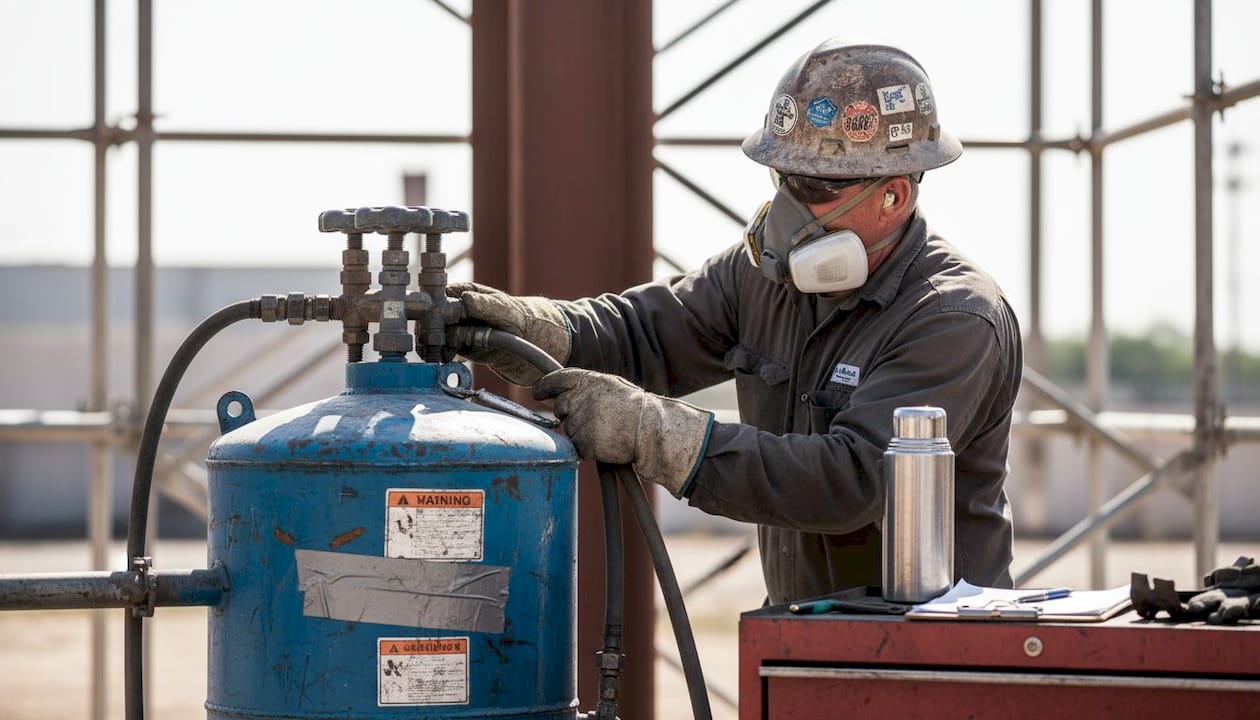
Blast pot types break down into three main categories: suction-feed, pressure-feed, and wet blast systems. Each serves a different operational context.
Suction-feed systems use a venturi effect to pull abrasive into the air stream. They operate at lower overall pressures and are best for lighter applications, touchup work, or situations where portability matters more than throughput. They are not ideal for large-scale municipal infrastructure work because their output rate is simply too low.
Pressure-feed systems are the workhorses of industrial and municipal sandblasting. The abrasive is pressurized directly in the blast pot and pushed into the air stream, delivering significantly higher velocity and throughput. These systems can run continuously with properly sized equipment and are appropriate for water tanks, bridges, pipelines, and similar large assets.
Wet blast systems mix water with the abrasive stream, which dramatically reduces airborne dust at the point of generation. They are particularly useful in populated or sensitive environments where standard dry blasting would trigger air quality concerns. The tradeoff is more complex cleanup and slightly modified surface profile characteristics.
For dust control specifically, here are the key steps to effective management and regulatory compliance:
- Assess the environment: Determine whether you are working in a contained space, open air, or near populated areas. Each scenario dictates a different control strategy.
- Select the right collection system: Industrial vacuum recovery systems should be rated to capture at least 99% of particulate above 0.3 microns for work involving potentially hazardous materials like lead-based paint.
- Establish containment barriers: Use shrouding, curtains, and negative-pressure enclosures to prevent fugitive dust from migrating beyond the work zone.
- Monitor air quality in real time: Continuous particulate monitoring at the work perimeter ensures you stay within permitted limits and provides documentation if compliance questions arise.
- Dispose of spent abrasive properly: Depending on what was on the surface being blasted, spent media may be classified as hazardous waste and require licensed disposal.
Pro Tip: Schedule your blast pot inspections on the same cycle as your compressor service intervals. Worn pot valves and clogged metering systems are among the most common hidden causes of project delays on Florida infrastructure contracts. For more on managing this safely, see our sandblasting safety essentials resource.
Compliance is not just a checkbox for government contracts. It directly affects project timelines, liability exposure, and your organization’s reputation with oversight agencies.
Automation in sandblasting: Robotic vs. manual equipment
For most of sandblasting’s history, the work was done entirely by hand. Operators pointed nozzles, moved across surfaces, and relied on personal skill and endurance to deliver consistent results. That model still exists and still works in many contexts. But for large-scale, continuous, or hazardous operations, automation is changing the math significantly.
Robotic sandblasting reduces operator fatigue and inconsistency, making it far better suited to continuous operations and hostile environments. In practical terms, this means robotic systems can run longer shifts, maintain exact standoff distance and blast angle, and produce a statistically more uniform surface profile than manual blasting over the same square footage.
The key benefits of robotic and semi-automated sandblasting systems include:
- Consistent surface profile: Automated systems maintain precise standoff distance and traverse speed, eliminating the variation that comes from human fatigue over long shifts.
- Reduced operator exposure: Workers are removed from direct exposure to high-velocity abrasive, noise, vibration, and potentially hazardous dust streams.
- Higher throughput on large surfaces: Robotic units can process significantly more square footage per shift on open, regular surfaces like tank exteriors or bridge decks.
- Better data capture: Many modern robotic systems log blast parameters in real time, giving you documentation for quality control and contract compliance.
- Lower long-term labor cost: On multi-week projects, reduced fatigue-related slowdowns and rework translate into real cost savings.
That said, manual blasting is still the right choice in many Florida infrastructure situations. Complex geometries like pipe joints, valve clusters, structural steel connections, and areas with restricted access often require a skilled operator who can adapt instantly. Robotic systems need relatively regular surfaces to deliver their advantages. Deploying robotic equipment in a confined space or on a heavily corrugated surface can actually slow the project down.
Cost and mobilization are also real factors. Robotic systems carry higher day rates and require setup time and skilled technicians for deployment. For smaller projects or those with highly variable surface geometry, manual blasting by experienced operators remains the more cost-effective option. Review asset longevity examples for context on when each method delivers the best lifecycle value, and look at the municipal sandblasting workflow to see how these decisions integrate into a complete project plan.
The smart move is not to choose one model over the other categorically. It is to match the method to the surface, the environment, and the project timeline.
What most decision-makers overlook when choosing sandblasting equipment
Here is something worth saying plainly: over-specifying equipment is just as damaging to a project as under-specifying it. Facility managers often push for the largest compressor and highest-capacity blast pot available, assuming more power means better results. In practice, running a massive compressor on a small or geometrically complex job creates pressure management problems, wastes fuel, and can actually damage thinner substrates by delivering too aggressive a profile.
The other gap we see consistently is lifecycle cost thinking. Most procurement decisions focus on day rates or bid totals without factoring in what worn equipment costs over time. A contractor running nozzles past their service life or delaying blast pot valve replacements is effectively transferring those costs to your project through lost efficiency, rework, and schedule overruns.
For Florida specifically, humidity and salt air accelerate equipment wear in ways that affect inland operations far less. A contractor whose equipment is sized and maintained for Central Florida conditions, not just for generic industrial work, will outperform one that brings generic specifications to every job. When choosing sandblasting methods and contractors, ask about equipment age, maintenance cycles, and nozzle replacement frequency. Those answers tell you more about project risk than any bid price. Also review the how-to guide for Florida infrastructure for a framework that accounts for local environmental conditions from the start of project planning.
Connect with expert sandblasting and asset protection solutions
Putting this knowledge into practice means partnering with a team that actually runs calibrated, well-maintained equipment and understands Florida’s environmental and regulatory conditions at the project level.
Southern Sandblasting & Painting LLC brings over 20 years of experience to municipal, industrial, and commercial surface preparation across Central Florida. From water tanks and pipelines to airport infrastructure and city assets, we match equipment to the job, maintain tight compliance standards, and back every blast with proper coating application to lock in lasting protection. Explore our full Orlando sandblasting services or learn more about the importance of industrial coatings for Florida infrastructure. Contact us to discuss your project requirements.
Frequently asked questions
What equipment is absolutely required for professional sandblasting?
A professional sandblasting setup always includes an air compressor, blast pot or pressure vessel, blast hose, nozzle, and a dust collection or recovery system. Each component must be properly matched to the project scale to deliver consistent surface quality and regulatory compliance.
How does nozzle type affect sandblasting efficiency?
Nozzle selection has a direct impact on cleaning speed and surface profile consistency. Venturi nozzles increase abrasive velocity and cleaning output by 30 to 40% compared to straight bore types, making them the standard choice for large industrial projects.
Why is dust collection important in sandblasting?
Effective dust collection protects workers from hazardous airborne particulate, maintains visibility at the work face, and ensures compliance with OSHA and environmental permit requirements. Proper dust collection is a non-negotiable element of any professional sandblasting operation, not an optional add-on.
Which projects benefit most from robotic sandblasting?
Robotic sandblasting delivers its strongest advantages on large, continuous, or hazardous surfaces where minimizing operator fatigue and maintaining profile uniformity are critical. Robotic systems reduce inconsistency and perform better than manual methods in sustained, hostile operating environments.


