
Even Florida’s NASA launch pads rely on zinc-rich coatings for decades of corrosion resistance, contradicting the belief that paint alone can protect against harsh coastal conditions. Most asset managers underestimate the risks of corrosion in Florida’s climate, where humidity, salt spray, and hurricanes accelerate metal degradation. Zinc-rich coatings aren’t just theoretical—they’re proven on high-stakes projects like NASA. This guide explains what zinc-rich coatings are, how they protect, best practices, and how you can leverage their benefits for your infrastructure.
Table of Contents
- What is a zinc-rich coating?
- Zinc-rich coatings in Florida infrastructure: Where and why
- Types of zinc-rich coatings: Organic vs. inorganic
- Standards and compliance: What asset managers must know
- Best practices: Application, maintenance, and inspection for long-term performance
- Get expert help: Zinc-rich coating solutions for your Florida assets
- Frequently asked questions
Key Takeaways
| Point | Details |
|---|---|
| Powerful corrosion barrier | Zinc-rich coatings provide unmatched steel protection through both a physical barrier and galvanic action. |
| Proven Florida performance | NASA and DOT assets prove zinc-rich coatings last under Florida’s toughest conditions. |
| Choose the right type | Select organic or inorganic zinc coatings based on your specific asset, location, and prep standards. |
| Compliance is critical | Following standards like AASHTO M-300 and SSPC-Paint 20 ensures regulatory and warranty coverage. |
| Expert help pays off | Working with professionals ensures proper application and decades of asset protection. |
What is a zinc-rich coating?
Now that you know why coatings matter in Florida, let’s clearly define what makes a coating ‘zinc-rich’ and how it works. A zinc-rich coating is a paint containing 77-95% metallic zinc dust by weight in the dry film. This high concentration isn’t arbitrary—it’s the threshold needed to create both a physical barrier and galvanic protection, meaning zinc sacrifices itself to protect steel underneath.
When you review product technical data sheets, you’ll find this percentage clearly listed. The primary function goes beyond simple coverage. While conventional paints merely block moisture and oxygen, zinc-rich coatings actively prevent rust through electrochemical action. If the coating gets scratched or damaged, the surrounding zinc continues protecting exposed steel by corroding preferentially.
Zinc content ranges and applications:
| Zinc Content | Coating Type | Primary Use |
|---|---|---|
| 77-85% | Organic zinc-rich | Field applications, impact-prone areas |
| 85-95% | Inorganic zinc-rich | Severe marine exposure, bridges |
| 65-75% | Zinc-rich primer | Multi-coat systems, topcoat compatibility |
The main benefits include:
- Prevents rust through dual protection mechanisms
- Extends asset life by decades in harsh environments
- Proven performance in severe coastal and industrial settings
- Reduces long-term maintenance costs significantly
- Meets stringent infrastructure standards for critical projects
Understanding zinc coatings explained helps you make informed decisions about which formulation suits your specific Florida infrastructure needs.
Zinc-rich coatings in Florida infrastructure: Where and why
With an understanding of the chemistry, let’s turn to real-life projects across Florida where zinc-rich coatings prove their value. Florida’s infrastructure faces unique threats that make zinc-rich coatings essential rather than optional. Humidity averages 74% year-round, salt spray reaches miles inland from both coasts, and hurricane-force winds carry corrosive particles that accelerate metal degradation.
NASA’s Kennedy Space Center provides compelling evidence. Structures exposed to beachside conditions for decades show minimal degradation when protected with properly applied zinc-rich coatings. Florida Department of Transportation bridges demonstrate similar longevity, with some installations exceeding 30 years of service without major recoating.
Florida infrastructure performance data:
| Asset Type | Exposure Level | Years in Service | Performance Notes |
|---|---|---|---|
| Coastal bridges | Severe marine | 25-35 years | Minimal touch-up required |
| Water tanks | Moderate humidity | 20-30 years | Excellent adhesion maintained |
| Pipeline supports | Industrial/coastal | 15-25 years | No substrate corrosion |
| NASA structures | Extreme beachside | 30+ years | Ongoing protection verified |
“Florida beachside test sites demonstrate that zinc-rich coatings maintain structural integrity and corrosion resistance even under the most aggressive atmospheric conditions, validating their use for critical infrastructure investments.”
Typical infrastructure assets that benefit most from zinc-rich coatings include:
- Highway and pedestrian bridges in coastal counties
- Municipal water storage tanks and treatment facilities
- Industrial piping systems and support structures
- Coastal communication towers and utility infrastructure
- Theme park ride structures and architectural steel
- Port facilities and marine terminal equipment
The role of coatings in longevity becomes clear when you compare protected versus unprotected assets in identical environments. Protected structures maintain structural integrity while unprotected steel shows significant section loss within five to seven years.
Types of zinc-rich coatings: Organic vs. inorganic
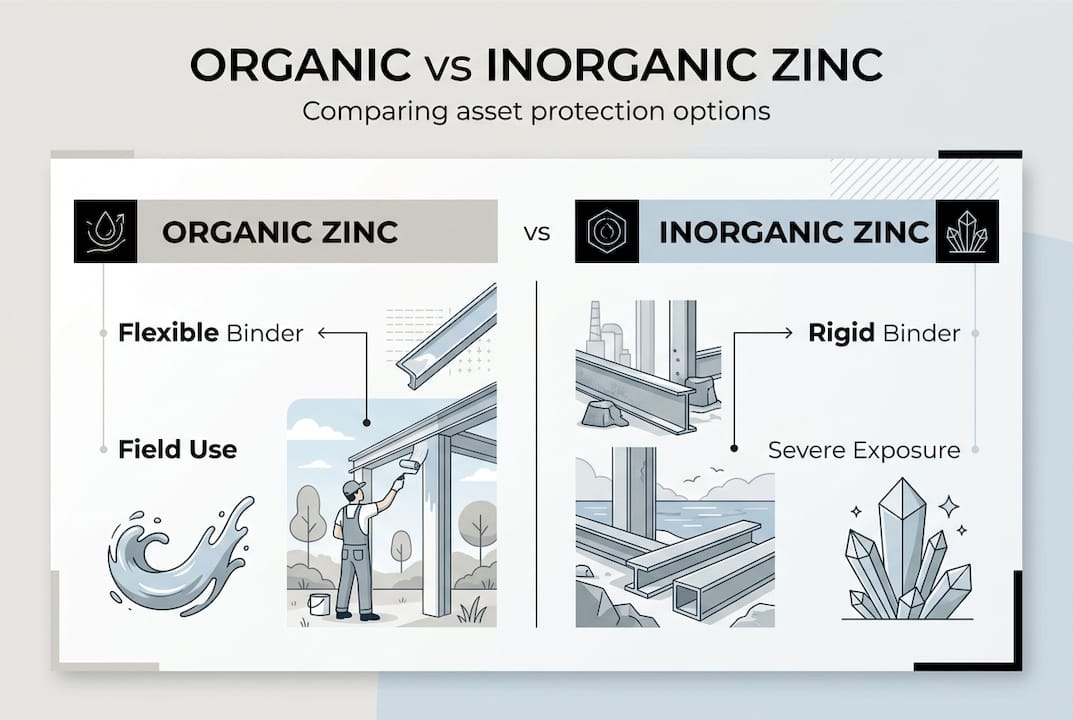
Having established where zinc-rich coatings succeed, it’s important to understand there isn’t just one kind—in Florida, choosing the right type is crucial. The fundamental difference lies in the binder system that holds zinc particles together. Organic zinc-rich coatings use epoxy or urethane resins, while inorganic versions rely on silicate chemistry similar to glass.
Organic vs. inorganic zinc-rich coating comparison:
| Feature | Organic Zinc-Rich | Inorganic Zinc-Rich |
|---|---|---|
| Binder type | Epoxy/urethane resin | Alkyl silicate |
| Field application | Easier, more forgiving | Demanding, strict controls |
| Impact resistance | Excellent flexibility | Brittle, prone to cracking |
| Durability | Very good (20-25 years) | Exceptional (30+ years) |
| Surface prep required | SSPC-SP6 or SP10 | SSPC-SP10 (near-white) |
| Humidity sensitivity | Moderate tolerance | Very sensitive |
| Best applications | Structural steel, field work | Bridges, severe marine |
| Topcoat compatibility | Excellent | Requires specific primers |
Organic zinc-rich coatings excel in field applications with impact risk, while inorganic performs best in severe exposures but demands top-notch surface preparation and environmental controls. This distinction matters enormously in Florida’s climate.

Pro Tip: When working on projects where surface preparation conditions can’t be perfectly controlled—such as bridge repairs during humid summer months—organic zinc-rich coatings offer better application tolerance. Save inorganic formulations for new construction or controlled shop environments where you can achieve ideal surface cleanliness and manage humidity below 85%.
Florida’s humidity presents specific challenges for inorganic coatings. If moisture contaminates the surface between blasting and coating application, adhesion fails catastrophically. Organic formulations tolerate brief exposure to humidity better, though neither type should be applied in rain or when relative humidity exceeds manufacturer specifications.
Understanding the differences between organic and inorganic zinc coatings helps you specify the right product for your project’s specific exposure conditions and application constraints.
Standards and compliance: What asset managers must know
The choice between organic and inorganic zinc coatings should always be grounded in recognized standards—here’s what you need to watch for. Two primary standards govern zinc-rich coating use in Florida infrastructure: AASHTO M-300 and SSPC-Paint 20. These aren’t bureaucratic formalities—they represent decades of field performance data translated into minimum requirements.
AASHTO M-300 specifically addresses zinc-rich coatings for highway structures, establishing zinc content minimums, application procedures, and performance criteria. SSPC-Paint 20 provides detailed specifications for both organic and inorganic zinc-rich primers, including surface preparation requirements and film thickness ranges. For coastal and infrastructure projects, these standards ensure your coating investment delivers expected service life.
How to verify compliance on your projects:
- Review construction specifications to confirm they reference current AASHTO M-300 or SSPC-Paint 20 standards by number and year
- Require contractors to submit product technical data sheets showing compliance certification before procurement
- Verify surface preparation meets SSPC-SP10 (near-white metal blast) for inorganic coatings or minimum SSPC-SP6 for organic types
- Conduct field inspections to measure dry film thickness using calibrated gauges at specified intervals
- Document environmental conditions during application, including temperature, humidity, and dew point measurements
- Retain batch numbers and application records for warranty claims and future maintenance planning
Pro Tip: Always require surface prep to SSPC-SP10 (near-white metal blast) when specifying inorganics for contract success. This single specification prevents more coating failures than any other factor. The cost difference between SP6 and SP10 surface preparation is minimal compared to the expense of premature coating failure and reapplication.
Florida municipalities and facility managers should also verify that coating applicators hold current SSPC certifications. Proper training ensures field crews understand the critical relationship between surface preparation quality and coating performance. The coating standards and compliance framework protects your investment by establishing clear accountability.
Best practices: Application, maintenance, and inspection for long-term performance
To maximize the longevity and ROI of your assets, following proven best practices can make the difference between decades of protection and premature failure. Empirical data shows zinc-rich coatings can last decades with proper surface prep, application, and maintenance. The key lies in systematic execution of each phase.
Step-by-step application protocol:
- Surface preparation: Abrasive blast to specified cleanliness (SSPC-SP10 for inorganic, minimum SP6 for organic) and achieve 2-3 mil anchor profile
- Environmental control: Verify substrate temperature is minimum 5°F above dew point and relative humidity is below 85% before coating
- Material mixing: Follow manufacturer’s induction time requirements precisely—zinc particles must be uniformly suspended before application
- Application technique: Apply to specified dry film thickness (typically 3-5 mils) using plural component spray equipment for inorganics or conventional spray for organics
- Quality verification: Measure wet film thickness during application and dry film thickness after cure using calibrated gauges
- Cure monitoring: Allow full cure time before topcoat application or service exposure—rushing this step compromises performance
Critical maintenance points focus on early detection. Establish routine inspection schedules based on exposure severity—annually for severe marine environments, every two to three years for moderate exposures. Look for chalking, color change, or localized coating breakdown as early warning signs.
Common signs of early wear include:
- White zinc corrosion products (zinc rust) appearing on the surface
- Coating chalking or powdering when rubbed
- Edge creep or coating disbondment at welds and corners
- Localized blistering indicating moisture infiltration
- Color fading or gloss loss beyond normal weathering
Top errors to avoid:
- Insufficient surface preparation—the single largest cause of premature coating failure
- Inconsistent film thickness creating weak points in protection
- Ignoring weather and humidity conditions during application
- Applying topcoats before zinc-rich primer fully cures
- Using incompatible topcoat systems over inorganic zinc primers
- Failing to document batch numbers and application conditions
For detailed guidance, explore [surface prep best practices](https://southernsandblastingandpainting.com/surface prep best practices coatings) that address Florida’s specific climate challenges. Ongoing success requires understanding [maintaining zinc-rich coatings](https://southernsandblastingandpainting.com/how to maintain coatings for protection) through systematic inspection programs. Professional [inspecting applied coatings](https://southernsandblastingandpainting.com/coating inspections infrastructure longevity) services provide objective verification that your assets receive the protection you’re paying for.
Get expert help: Zinc-rich coating solutions for your Florida assets
If you want confidence that your assets will withstand Florida’s tough conditions, a trusted local professional can make all the difference. Zinc-rich coatings deliver exceptional value, but only when applied by experienced contractors who understand both the chemistry and the climate challenges specific to Central Florida.
Local experts ensure your zinc-rich coating projects meet Florida’s unique climate demands and compliance requirements from the start. They know when humidity will interfere with inorganic applications and can schedule work during optimal weather windows. They understand which formulations perform best on specific asset types and can recommend cost-effective solutions that balance initial investment with lifecycle costs.
Professional surface preparation makes the difference between decades of protection and premature failure. Experienced contractors maintain calibrated blasting equipment, source appropriate abrasives for Florida’s climate, and employ certified inspectors who verify surface cleanliness before coating application. This attention to detail protects your investment and ensures warranty coverage remains valid.
Ongoing coating inspection services provide peace of mind that your infrastructure maintains its protective barrier. Regular assessments catch minor issues before they become major problems, extending service life and reducing total cost of ownership. For comprehensive protection, explore industrial coatings for Florida infrastructure solutions tailored to municipal and commercial needs. Professional industrial painting services ensure proper application techniques and quality control throughout your project. Expert sandblasting services deliver the surface preparation quality that zinc-rich coatings require for optimal performance.
Frequently asked questions
How does a zinc-rich coating protect steel in Florida’s humid climate?
The high zinc content forms a sacrificial barrier, so zinc corrodes instead of the steel—even in hot, humid, or salty air. This galvanic protection continues working even if the coating gets scratched or damaged.
What is the difference between zinc-rich coatings and regular paint?
Zinc-rich coatings contain 77-95% zinc dust by weight, which offers long-term galvanic protection. Regular paints provide only barrier protection without the electrochemical corrosion prevention that zinc delivers.
Do zinc-rich coatings require special surface preparation?
Yes, especially inorganic types require SSPC-SP10 near-white metal blast to ensure adhesion and performance. Organic zinc-rich coatings tolerate slightly less aggressive preparation but still need minimum SSPC-SP6 commercial blast cleaning.
How long can a zinc-rich coating last in Florida?
NASA and DOT projects show well-applied coatings last decades with proper maintenance and environmental controls. Some Florida bridge installations exceed 30 years of service without major recoating when properly maintained.
Can zinc-rich coatings be applied over existing paint?
No, zinc-rich coatings require direct contact with bare steel substrate to provide galvanic protection. Existing paint must be completely removed through abrasive blasting before zinc-rich coating application for the system to function properly.


