
Industrial surfaces endure constant exposure to moisture, chemicals, and environmental stress, leading to corrosion and coating failures that compromise structural integrity. Sandblasting removes contaminants and rust, preparing surfaces for coatings that extend asset life. This comprehensive guide walks you through everything facility managers need to know about industrial sandblasting, from equipment selection and safety protocols to execution techniques and quality verification, empowering you to make informed decisions about surface preparation projects.
Table of Contents
- Key takeaways
- Understanding industrial sandblasting and its importance
- Preparation: equipment, materials, and safety requirements
- Executing industrial sandblasting: step-by-step process
- Post-blasting verification and maintenance tips
- Get professional industrial sandblasting services in Central Florida
- Frequently asked questions
Key Takeaways
| Point | Details |
|---|---|
| Importance of prep | Proper surface preparation accounts for eighty percent of coating system performance and prevents premature failures. |
| Equipment and media choice | Selecting the right blast pots, air compressors, hoses, nozzles, and abrasive materials directly affects project outcomes and total costs. |
| Safety and compliance | Following safety protocols minimizes risks and helps ensure regulatory compliance on site. |
| Post blasting inspection | A thorough post blasting inspection confirms surface cleanliness and suitable profile before applying coatings. |
Understanding industrial sandblasting and its importance
Industrial sandblasting is a surface preparation method that uses abrasive materials propelled at high velocity to clean, profile, and prepare surfaces for protective coatings. This process effectively strips away rust, old paint, mill scale, and other contaminants that prevent proper coating adhesion. The technique creates an anchor profile on the surface, providing mechanical grip for subsequent coating layers.
The benefits of sandblasting extend across multiple operational dimensions. First, it completely removes surface contaminants that cause premature coating failure. Second, it creates the optimal surface profile for maximum coating adhesion, directly impacting the longevity of protective systems. Third, properly prepared surfaces resist corrosion more effectively, reducing maintenance cycles and extending asset lifespan by decades. Fourth, sandblasting ensures compliance with industry standards like SSPC and NACE, which many municipal and government contracts require.
Facility managers in municipal infrastructure commonly use sandblasting for water tanks, bridges, wastewater treatment equipment, and structural steel. Commercial properties apply it to parking structures, building facades, and mechanical equipment. Manufacturing facilities rely on sandblasting to maintain production equipment, storage tanks, and material handling systems.
Pro Tip: Match your abrasive media to both surface type and project goals. Softer materials like walnut shells work for delicate aluminum surfaces, while steel grit handles heavy rust on structural steel. Garnet provides excellent profile on concrete without excessive dust generation.
“Proper surface preparation through industrial sandblasting accounts for 80% of coating system performance. Skipping or rushing this step guarantees premature coating failure, regardless of coating quality.” — NACE International Surface Preparation Standards
The investment in professional sandblasting pays dividends through reduced maintenance costs, extended asset life, and improved safety compliance. Facilities that implement systematic surface preparation programs report 40% lower long-term maintenance expenses compared to reactive repair approaches.
Preparation: equipment, materials, and safety requirements
Successful sandblasting projects begin with proper equipment selection and site preparation. Proper equipment choice and safety protocols are critical for successful and compliant sandblasting. The primary equipment includes blast pots that hold and meter abrasive material, air compressors providing sufficient CFM and PSI, blast hoses rated for abrasive flow, and nozzles sized for the project scope.
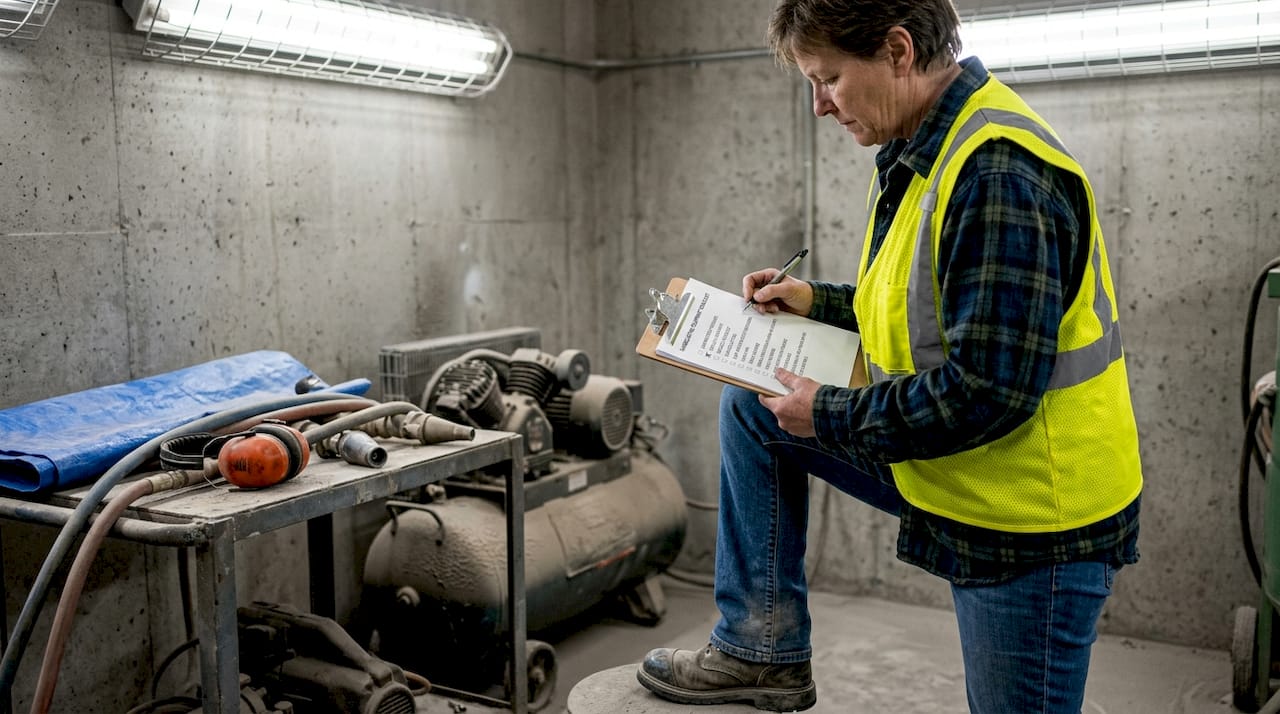
Abrasive selection significantly impacts project outcomes and costs. Silica sand, though traditional, faces regulatory restrictions due to silicosis risks and is being phased out in many jurisdictions. Garnet offers excellent cutting power with lower dust generation, making it ideal for enclosed spaces. Steel grit and shot provide aggressive cutting for heavy rust and mill scale, with recyclability reducing material costs. Aluminum oxide works well for precise profiling on specialty metals. Coal slag delivers cost-effective performance for large structural projects.
Equipment and Material Selection Guide
| Equipment/Material | Common Applications | Key Considerations |
|---|---|---|
| Pressure blast pot | Heavy rust removal, large surfaces | Requires 185+ CFM compressor, faster than siphon systems |
| Garnet abrasive | General steel preparation, confined spaces | Low dust, recyclable 3-5 times, meets environmental standards |
| Steel grit | Structural steel, heavy corrosion | Recyclable 100+ times, creates aggressive profile |
| Respirator with supplied air | All blasting operations | NIOSH approved, mandatory for silica exposure |
| Containment systems | Outdoor projects, environmental compliance | Controls dust migration, required in populated areas |
Site preparation involves establishing containment barriers to control dust and abrasive spread. Tarps, scaffolding enclosures, or permanent blast rooms contain debris depending on project scale. Environmental controls include dust collectors, water misting systems for suppression, and proper drainage to prevent contaminated runoff. Surface preparation tips emphasize thorough site assessment before equipment mobilization.
Safety gear requirements are non-negotiable. Operators must wear NIOSH-approved respirators with supplied air systems, never relying on dust masks. Abrasive-resistant blast suits protect skin from high-velocity particle impact. Hearing protection rated for 100+ decibel environments prevents permanent damage. Impact-resistant face shields and safety glasses provide eye protection. Leather gloves rated for abrasive handling complete personal protective equipment.
Pro Tip: Calculate your compressor requirements before equipment rental. Multiply nozzle orifice size by 300 to determine minimum CFM needed. A 3/8-inch nozzle requires 112 CFM minimum, but 150+ CFM ensures consistent performance and faster completion.
Additional preparation steps include identifying and marking utilities, establishing clear communication protocols between operators and support staff, setting up decontamination stations for equipment and personnel, and creating emergency response plans for equipment failures or injuries. Proper preparation reduces project delays and safety incidents by over 60%.
Executing industrial sandblasting: step-by-step process
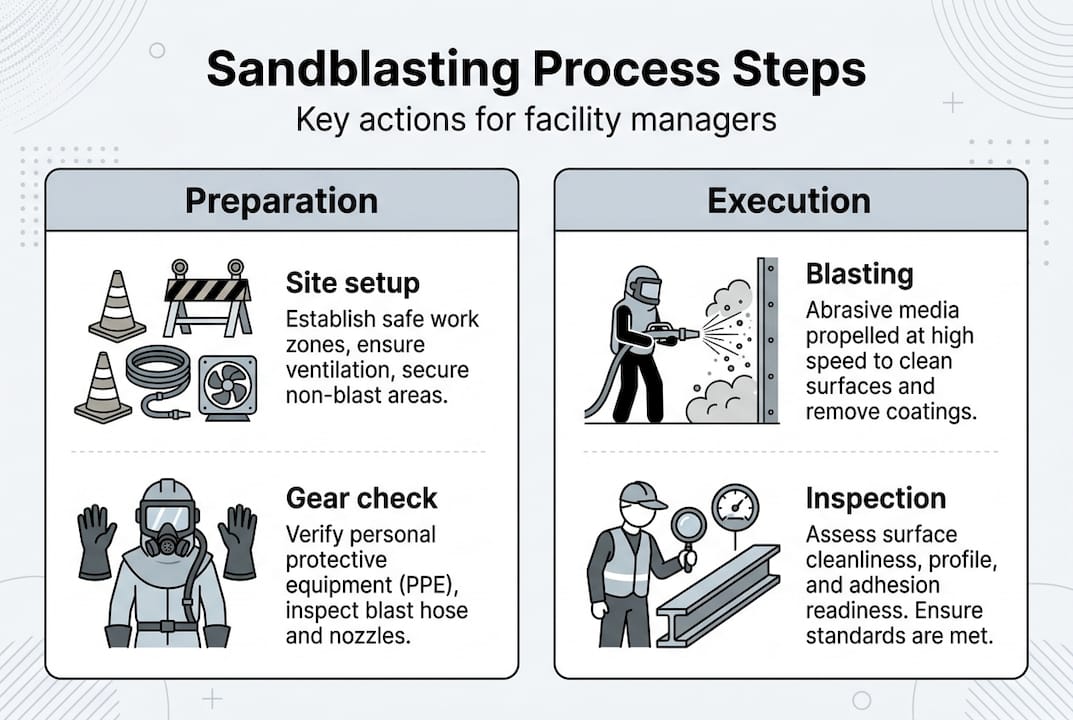
Following a structured sandblasting workflow prevents defects and enhances coating adhesion. The operational process requires systematic execution to achieve specification-grade results.
Step-by-step execution process:
- Equipment setup and testing: Connect air compressor to blast pot, verify pressure settings match abrasive type and surface requirements, test nozzle spray pattern on sample area, confirm all safety systems function properly.
- Surface assessment: Document existing conditions with photographs, identify areas requiring special attention like deep pitting or previous coating failures, mark boundaries for different surface treatments.
- Initial blasting pass: Maintain 12 to 18-inch standoff distance from surface, hold nozzle at 45 to 90-degree angle depending on contaminant type, use overlapping passes to ensure complete coverage, monitor abrasive consumption rates.
- Surface monitoring: Inspect cleaned areas for remaining contaminants, verify profile depth meets coating manufacturer specifications, document progress and any anomalies discovered.
- Final cleaning: Remove dust and abrasive residue with compressed air or vacuum systems, wipe surfaces with clean rags to verify cleanliness, protect prepared surfaces from contamination until coating application.
- Quality verification: Measure surface profile with replica tape or digital gauges, confirm cleanliness meets SSPC-SP10 or specified standard, photograph completed work for documentation.
Common mistakes to avoid:
- Holding nozzle too close, causing surface damage and excessive abrasive consumption
- Using inconsistent pressure, creating uneven profile depths across the surface
- Inadequate masking of adjacent areas, leading to unwanted abrasive damage
- Failing to rotate nozzles regularly, resulting in uneven spray patterns
- Blasting damp surfaces, which prevents proper cleaning and profiling
- Insufficient overlap between passes, leaving untreated spots
Choosing sandblasting methods depends on project-specific factors including surface type, environmental constraints, and performance requirements.
Dry vs wet sandblasting comparison
| Method | Advantages | Disadvantages | Best Applications |
|---|---|---|---|
| Dry blasting | Faster material removal, creates deeper anchor profile, lower equipment costs | Generates significant dust, requires extensive containment, higher silica exposure risk | Open outdoor projects, structural steel, heavy rust removal |
| Wet blasting | Eliminates dust, reduces abrasive consumption, gentler on delicate surfaces | Slower process, requires water supply and drainage, potential flash rusting on steel | Confined spaces, populated areas, aluminum and stainless surfaces |
| Vapor blasting | Superior surface finish, minimal material waste, excellent for precision work | Higher equipment investment, limited to smaller components | Aerospace parts, decorative metals, restoration projects |
Pro Tip: Track abrasive consumption rates throughout the project. Calculate square footage cleaned per pound of abrasive to identify inefficiencies. Rates declining by more than 20% indicate nozzle wear, improper technique, or moisture contamination requiring immediate correction.
Operators should maintain consistent movement speed, typically 12 to 18 inches per second, to achieve uniform profile depth. Varying speed creates high and low spots that compromise coating performance. Regular breaks prevent operator fatigue, which directly correlates with technique consistency and quality outcomes.
Post-blasting verification and maintenance tips
Quality assurance begins immediately after blasting completion. Inspection of surface cleanliness and profile is essential to ensure quality standards are met before coating application. White metal cleanliness, defined by SSPC-SP5 standards, requires complete removal of all visible contaminants, rust, and mill scale. Commercial blast cleaning (SSPC-SP6) permits light shadows of staining but removes all loose material.
Surface profile measurement uses replica tape pressed into the blasted surface, then measured with a micrometer to determine peak-to-valley depth. Most industrial coatings require 2 to 4 mil profile depth for optimal adhesion. Profiles too shallow fail to provide mechanical grip, while excessive depth creates voids under coating films. Digital profile gauges offer faster measurement but require calibration verification.
Visual inspection identifies several quality indicators. Uniform gray or white appearance across the entire surface confirms complete cleaning. Consistent texture without smooth spots indicates proper profile creation. Sharp, angular profile peaks, not rounded edges, provide maximum coating grip. Absence of flash rusting, oil residue, or dust contamination ensures coating compatibility.
Maintenance tips for coated surfaces:
- Schedule annual visual inspections to identify early coating degradation before substrate damage occurs
- Address coating failures within 30 days to prevent accelerated corrosion spread
- Clean surfaces quarterly to remove contaminants that degrade coating integrity
- Document all inspections with photographs and written reports for trend analysis
- Maintain spare coating materials for touch-up repairs matching original specifications
- Establish humidity and temperature monitoring for indoor assets to prevent condensation damage
Pro Tip: Create detailed documentation packages for each sandblasting project including abrasive type and consumption rates, equipment settings and nozzle sizes, environmental conditions during blasting, profile depth measurements, and cleanliness verification photos. This data ensures consistency across future maintenance cycles and provides valuable troubleshooting information if coating problems develop.
Compliance verification compares completed work against contract specifications and industry standards. SSPC standards define cleanliness levels, while NACE standards address corrosion control systems. Municipal contracts often reference both, requiring strict adherence for payment approval. Sandblasting inspection and outcomes demonstrate the long-term value of specification-grade surface preparation.
Red flags indicating failed preparation include visible rust or mill scale remaining after blasting, smooth or glossy surface areas lacking proper profile, oil or grease contamination evidenced by water beading, flash rusting appearing within hours of blasting, and dust or abrasive residue not removed before coating. Any of these conditions require corrective action before coating application proceeds.
Successful projects establish clear acceptance criteria before work begins, conduct inspections at defined intervals during execution, document all measurements and observations, and obtain written approval before advancing to coating phases. This systematic approach reduces disputes and ensures coating system performance meets design expectations.
Get professional industrial sandblasting services in Central Florida
Implementing the techniques and standards outlined in this guide requires specialized equipment, trained personnel, and extensive project experience. Southern Sandblasting & Painting delivers expert sandblasting services in Orlando and throughout Central Florida, bringing over 20 years of industrial surface preparation expertise to municipal infrastructure, commercial properties, and manufacturing facilities.
Our certified professionals understand the unique challenges Central Florida’s climate presents, from humidity-driven flash rusting to salt air corrosion in coastal areas. We match abrasive media and techniques to your specific surface conditions and performance requirements, ensuring optimal preparation for long-lasting protective coatings. Our comprehensive sandblasting and painting services cover everything from initial surface assessment through final coating application, providing single-source accountability for your project success.
When you partner with Southern Sandblasting & Painting, you gain access to industrial-grade equipment, proven industrial coating application steps, and a team committed to meeting specifications and deadlines. Contact us today to discuss your surface preparation needs and discover how professional sandblasting protects your infrastructure investments for decades.
Frequently asked questions
What is industrial sandblasting used for?
Industrial sandblasting removes rust, paint, mill scale, and contaminants from metal and concrete surfaces to prepare them for protective coating application in municipal infrastructure and manufacturing environments. It creates the anchor profile necessary for coating adhesion, directly impacting system longevity. Typical applications include water storage tanks, structural steel, bridges, wastewater equipment, and production machinery where surface preparation quality determines coating performance and asset lifespan.
How do I choose the right abrasive material?
Abrasive selection depends on substrate material, desired surface profile depth, environmental regulations, and budget constraints. Garnet works well for general steel preparation with lower dust generation, while steel grit handles heavy corrosion on structural components. Softer media like walnut shells suit aluminum and delicate surfaces. Consider recyclability for cost management on large projects, and always verify compliance with local air quality regulations regarding silica content.
What safety precautions are critical during sandblasting?
Operators must wear NIOSH-approved respirators with supplied air systems, abrasive-resistant blast suits, hearing protection rated for 100+ decibels, and impact-resistant eye protection. Site containment prevents dust migration into occupied areas, while proper ventilation controls airborne particle concentrations. Establish clear communication protocols, mark utility locations, and create emergency response plans before starting work. Regular equipment inspections and operator training reduce incident risks by over 70%.
How can I verify the quality of sandblasting work?
Inspect surface cleanliness against specified standards like SSPC-SP10 for white metal or SSPC-SP6 for commercial blast cleaning, confirming complete contaminant removal. Measure surface profile depth using replica tape or digital gauges to verify it meets coating manufacturer requirements, typically 2 to 4 mils for industrial coatings. Check for uniform texture, absence of flash rusting, and complete dust removal. Document findings with photographs and written reports before authorizing coating application to ensure specification compliance and long-term performance.


