
TL;DR:
- Long-lasting coating systems protect assets from environmental damage over extended periods. Choosing the right system based on performance data reduces maintenance and extends asset life. Premium coatings like fluoropolymers and polyurea offer long durability, but proper surface preparation is crucial for success.
Long-lasting coating systems are specialized protective layers engineered to shield industrial and commercial assets from UV radiation, chemical exposure, abrasion, and corrosion over extended service periods. For facilities managers and decision-makers, selecting the right system from a credible long-lasting coating systems list is the single most direct way to reduce maintenance frequency and extend asset lifespan. Technologies like fluoropolymers, polysiloxanes, polyureas, and intumescent coatings each serve distinct environments and budget profiles. Manufacturers including Sherwin-Williams, PPG, AkzoNobel, Jotun, and BASF lead the global protective coatings market with documented performance data across industrial, municipal, and commercial applications.
Top long-lasting coating systems list: types and core benefits
The coating types below represent the most widely specified high-performance systems in industrial and municipal projects. Each entry includes typical lifespan, primary strengths, and known limitations so you can match the system to your asset and environment.
1. Fluoropolymer coatings
Fluoropolymer coatings are the longest-lasting option in most industrial specifications, exceeding 20 years in harsh environments. That lifespan makes them the preferred choice for exterior steel structures, bridges, and high-rise facades exposed to constant UV and acid rain.
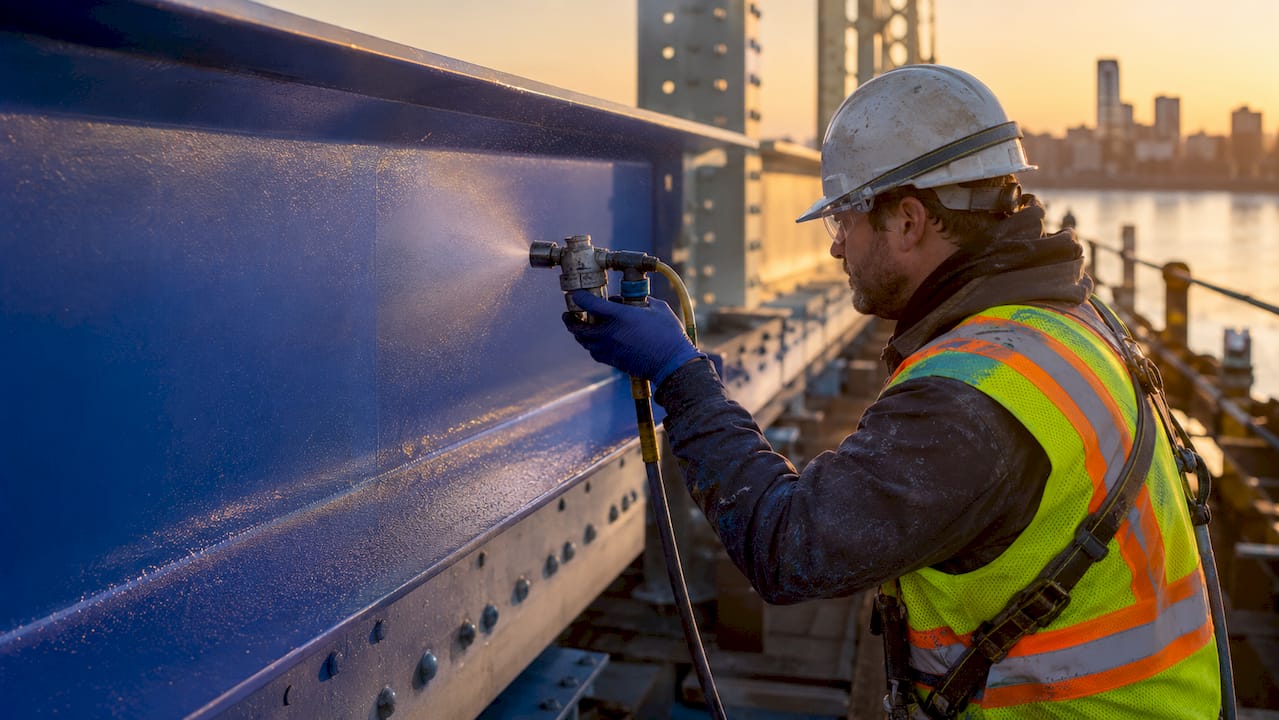
Strengths: Exceptional UV resistance, chemical inertness, color retention, and low maintenance frequency.
Limitations: Installation costs run $6–$12 per square foot, placing them at the top of the budget range. Application requires trained specialists and controlled conditions.
Best for: Bridges, exterior structural steel, airport infrastructure, and coastal facilities.
Pro Tip: Fluoropolymer systems from brands like Daikin and Kynar 500 require specific primer systems. Confirm primer compatibility before specifying to avoid adhesion failures.
2. Polysiloxane coatings
Polysiloxane coatings combine the weather resistance of silicone with the adhesion properties of epoxy, delivering 15–20 year service life in corrosive and UV-intense environments. They are a strong mid-tier choice when fluoropolymer budgets are not available but long-term performance is still required.
Strengths: Superior gloss retention, corrosion resistance, and resistance to thermal cycling.
Limitations: Higher upfront cost than standard polyurethanes. Pot life is short, which demands experienced applicators.
Best for: Offshore structures, chemical plant exteriors, and municipal water treatment facilities.
3. Ceramic-based coatings
Ceramic coatings deliver 10–20 years of service life and are the top choice where heat resistance is the primary concern. They form a hard, thermally stable barrier that resists temperatures standard organic coatings cannot handle.
Strengths: Extreme heat resistance, low thermal conductivity, and resistance to scaling.
Limitations: Brittleness under mechanical impact. Requires careful surface prep and controlled application temperature.
Best for: Boilers, exhaust systems, industrial ovens, and high-temperature pipelines.
4. Polyurea coatings
Polyurea is the fastest-curing system on this list. Polyurea cures within hours rather than days, which directly reduces downtime for critical facilities. That speed, combined with a 15–25 year lifespan and high flexibility, makes polyurea the go-to system for secondary containment, water tanks, and high-traffic floors.
Strengths: Rapid return to service, abrasion resistance, flexibility, and waterproofing capability.
Limitations: Sensitive to moisture during application. Requires plural-component spray equipment and trained crews.
Best for: Secondary containment, municipal water tanks, parking decks, and wastewater infrastructure.
Pro Tip: Some polyurea formulations are engineered for cold-cure or chemical-specific resistance, including hydrogen sulfide environments. Always verify the product data sheet against your site’s specific chemical exposure conditions.
5. Epoxy coatings
Epoxy coatings are the most widely used industrial coating system because they balance corrosion resistance with affordability. Installation costs run $3–$6 per square foot, and lifespan ranges from 5–15 years depending on exposure and maintenance. Epoxy is rarely the final answer on its own. It performs best as a primer or intermediate coat beneath a UV-stable topcoat.
Strengths: Strong adhesion, chemical resistance, and cost-effectiveness.
Limitations: Chalks under UV exposure. Shorter standalone lifespan than premium systems.
Best for: Interior steel, concrete floors, tank linings, and as a primer layer in multi-coat systems.
6. Intumescent coatings
Intumescent coatings are passive fire protection systems that expand under heat to insulate structural steel. Their service life runs 15–30 years, making them one of the longest-lasting systems on a per-year cost basis. Installation costs fall in the $4–$8 per square foot range.
Strengths: Fire resistance, long service life, and compliance with building codes for structural steel protection.
Limitations: Not designed for corrosion or UV protection as a standalone system. Requires a compatible topcoat in exterior applications.
Best for: Structural steel in commercial buildings, warehouses, airports, and municipal facilities.
7. Zinc-rich primers and coatings
Zinc-rich systems provide galvanic protection, meaning the zinc sacrifices itself to protect the underlying steel. They are specified at $3–$7 per square foot and serve as the foundation layer in most heavy-duty three-coat systems on bridges, tanks, and marine structures.
Strengths: Galvanic corrosion protection, long track record, and compatibility with most topcoat systems.
Limitations: Requires thorough surface preparation to near-white metal. Not a standalone finish coat.
Best for: Marine structures, bridges, water tanks, and any steel asset in high-humidity or salt-spray environments.
How to compare durable coating systems: lifespan, cost, and maintenance
The right way to evaluate any coating system is cost per year of service, not cost per square foot at installation. A fluoropolymer system at $10 per square foot lasting 25 years costs $0.40 per square foot per year. An epoxy system at $4 per square foot lasting 8 years costs $0.50 per square foot per year, and that figure excludes reapplication labor and downtime.
| Coating system | Typical lifespan | Install cost (per sq ft) | Maintenance interval | Best application |
|---|---|---|---|---|
| Fluoropolymer | 20+ years | $6–$12 | 15–20 years | Bridges, exterior steel |
| Polysiloxane | 15–20 years | $5–$9 | 12–18 years | Offshore, chemical plants |
| Polyurea | 15–25 years | $4–$8 | 10–20 years | Water tanks, containment |
| Intumescent | 15–30 years | $4–$8 | 15–25 years | Structural steel, airports |
| Ceramic | 10–20 years | $5–$10 | 10–15 years | High-heat equipment |
| Epoxy | 5–15 years | $3–$6 | 5–10 years | Interior steel, floors |
| Zinc-rich | 10–20 years | $3–$7 | 10–15 years | Marine, bridges, tanks |
Higher-investment coatings often enable 15–20 year maintenance gaps. That gap matters enormously for municipal water systems, airports, and industrial plants where recoating means shutting down operations.
Critical factors that determine coating durability
Longevity is a system result, not a material property. The combination of primer, intermediate coat, and topcoat must be engineered together for the specific environmental stressors at your site. Specifying a premium topcoat over an incompatible primer is one of the most common and costly mistakes in facilities maintenance.
The factors that most directly affect achieved lifespan are:
- Surface preparation: Surface prep accounts for 70–80% of coating project success. Poor substrate profiling causes premature adhesion failure regardless of coating quality.
- Environmental stressors: UV intensity, salt spray, chemical splash, abrasion, and thermal cycling each degrade coatings differently. Match the system to the dominant stressor at your site.
- System compatibility: Primer, intermediate, and topcoat must be specified from compatible product families. Mixing manufacturers without documented compatibility testing is a documented failure point.
- Application conditions: Temperature, humidity, and dew point at the time of application directly affect cure quality and adhesion.
- Maintenance inspection schedule: Even the best systems require periodic inspection. Catching early failures at the primer level prevents full recoating cycles.
Pro Tip: Request documented performance data, not just manufacturer claims. Ask for third-party test results or field performance records from comparable projects before finalizing your specification.
You can review coating durability factors in more detail to build a complete site-specific specification.
Situational recommendations: matching systems to your facility type
The best protective coating for your asset depends on where it sits and what it faces daily. The table below maps common facility types to the most appropriate systems.
| Facility or asset type | Recommended coating system | Key reason |
|---|---|---|
| Municipal water tanks | Polyurea or epoxy lining | NSF-compliant, waterproof, fast return to service |
| Offshore or marine structures | Zinc-rich primer + polysiloxane topcoat | Galvanic protection + salt spray resistance |
| Industrial plant exteriors | Fluoropolymer or polysiloxane | UV and chemical resistance over 20+ years |
| Structural steel (fire code) | Intumescent + compatible topcoat | Code compliance and long service life |
| High-traffic concrete floors | Polyurea or polyaspartic | Abrasion resistance and rapid cure |
| Airport infrastructure | Fluoropolymer or polysiloxane | Color retention, UV stability, long maintenance cycle |
| Pipelines and secondary containment | Polyurea | Chemical resistance, flexibility, fast cure |
For municipal water tanks and pipelines specifically, asset coating benefits go beyond corrosion protection. The right system prevents contamination, extends inspection intervals, and reduces the total cost of compliance.
Facilities that cannot afford extended downtime should prioritize polyurea or polyaspartic systems. Rapid-cure coatings return assets to service within hours, a critical advantage for airports, water treatment plants, and high-traffic commercial facilities.
Key takeaways
The most cost-effective coating decision combines the right material technology with proper surface preparation and a system designed for your site’s specific environmental stressors.
| Point | Details |
|---|---|
| Lifespan varies by system | Fluoropolymers last 20+ years; epoxies last 5–15 years depending on exposure and prep quality. |
| Cost per year beats cost per square foot | Higher upfront investment in premium systems typically delivers lower total lifecycle cost. |
| Surface prep drives success | Poor preparation causes premature failure even with premium coatings; prep accounts for 70–80% of project outcome. |
| Match system to environment | UV, chemical, heat, and abrasion stressors each require different coating chemistries and layer configurations. |
| Downtime is a hidden cost | Fast-curing systems like polyurea reduce operational disruption and lower the true cost of recoating. |
What I’ve learned after 20 years of coating industrial assets in Florida
The single most common mistake I see facilities managers make is selecting a coating based on the lowest installation quote. That decision almost always costs more over a 10-year horizon. A facility that recoats every 7 years instead of every 20 years is not saving money. It is paying for labor, downtime, and disposal three times over.
Florida’s environment makes this worse than most places. The combination of UV intensity, humidity, salt air near the coast, and temperature swings means that a coating system that performs well in the Midwest may fail in 5 years here. I have seen epoxy systems on water tanks in Central Florida chalk and delaminate well before their rated lifespan because the specification ignored UV exposure.
The other lesson is that surface preparation is not a line item to cut. Every coating failure I have investigated in 20 years traces back to inadequate prep, incompatible primers, or application in the wrong conditions. The coating itself is rarely the problem. The process is. Partnering with a contractor who treats prep as seriously as the topcoat is the most reliable way to get the lifespan the manufacturer promises.
— Southernsandblastingandpainting
How Southernsandblastingandpainting protects your assets from the ground up
The coating system you specify is only as good as the surface it goes on. Southern Sandblasting and Painting brings 20+ years of industrial surface preparation and coating application experience to commercial, municipal, and government projects across Central Florida.
From professional sandblasting that achieves the correct substrate profile to applying fluoropolymer, polyurea, and intumescent systems on water tanks, airports, and city infrastructure, the team delivers the preparation quality that makes coatings last. Review the sandblasting equipment guide to understand how proper prep equipment directly affects coating adhesion and lifespan. For a full overview of available sandblasting and painting services, contact Southernsandblastingandpainting to discuss your next project.
FAQ
What is the longest-lasting industrial coating system?
Fluoropolymer coatings deliver the longest documented service life, exceeding 20 years in harsh environments. Intumescent coatings can reach 15–30 years, but they serve a fire protection function rather than general corrosion resistance.
How does surface preparation affect coating lifespan?
Surface preparation accounts for 70–80% of coating project success. Even premium coating systems fail prematurely when applied over poorly prepared or contaminated substrates.
Which coating system is best for municipal water tanks?
Polyurea and NSF-compliant epoxy lining systems are the standard choice for municipal water tanks. Polyurea offers the added advantage of curing within hours, minimizing service interruption.
What is the most cost-effective way to evaluate coating systems?
Calculate cost per year of service rather than cost per square foot at installation. A higher-cost system with a 20-year lifespan consistently outperforms a lower-cost system requiring recoating every 7 years when total labor and downtime are included.
Are there eco-friendly options in high-performance coatings?
Yes. Water-based epoxy and polyurethane systems from manufacturers like Sherwin-Williams and AkzoNobel reduce VOC emissions significantly compared to solvent-based alternatives while still delivering competitive corrosion resistance in commercial and light industrial applications.


