
TL;DR:
- Proper surface preparation prevents 78% of coating failures in municipal infrastructure.
- Selecting the correct prep method and documenting all steps are critical for compliance and durability.
- Experienced, certified contractors following standardized workflows ensure long-lasting, inspection-ready coatings.
Surface preparation failures are responsible for 80% of coating defects across public works projects, yet it remains the most underfunded and rushed phase on many municipal job sites. For infrastructure managers in Central Florida, the consequences go beyond peeling paint. You are looking at asset degradation, failed inspections, and costly re-work that strains already tight budgets. This guide walks you through the standards, methods, field workflow, and compliance checkpoints you need to deliver durable, inspection-ready results. Whether you manage water treatment facilities, bridges, or city-owned steel structures, the principles here apply directly to your work.
Table of Contents
- Understand the role of surface preparation in municipal projects
- Survey the main surface preparation methods for concrete and steel
- Specify step-by-step workflow: Assess, prepare, test, and document
- Tackle common pitfalls, compliance challenges, and safety concerns
- What most managers overlook about surface prep (and why it matters in Florida)
- Get expert help for surface preparation and coatings in Central Florida
- Frequently asked questions
Key Takeaways
| Point | Details |
|---|---|
| Surface prep prevents failures | Proper preparation stops most municipal coating problems before they start. |
| Standard compliance is critical | Meeting national and local standards ensures both durability and passing inspection. |
| Choose the right method | Select prep techniques that match both material type and project environment for best results. |
| Test and document every step | Systematic testing and record-keeping reduce risk and speed up regulatory approval. |
| Address hazards upfront | Spot and manage lead, dust, and moisture issues early to avoid big cost overruns. |
Understand the role of surface preparation in municipal projects
Most coating defects are not a product failure. They are a preparation failure. When a coating system breaks down prematurely, the root cause is almost always what happened before the first coat was applied. Proper epoxy surface prep prevents 78% of coating failures in Florida municipal projects, which means the investment in preparation pays for itself many times over in avoided re-work.
For municipal managers, the stakes are especially high. Public assets like water tanks, stormwater infrastructure, and roadway bridges must meet multiple layers of compliance simultaneously. You are balancing FDOT specifications, ECUA requirements, ASTM testing standards, SSPC surface cleanliness grades, and ICRI concrete surface profile guidelines. Missing any one of these can trigger a failed inspection or a warranty dispute with your contractor.
Here is a quick look at how substrate type maps to the applicable standard:
| Substrate | Governing standard | Key metric |
|---|---|---|
| Concrete | ICRI 310.2R | CSP profile 1-10 |
| Steel (general) | SSPC SP 6 / NACE 3 | Visual cleanliness |
| Steel (critical) | SSPC SP 10 / NACE 2 | Near-white blast |
| Steel (immersion) | SSPC SP 5 / NACE 1 | White metal blast |
| Concrete (tensile) | ASTM D4541 / C1583 | Min. 200 psi |
The factors that most often undermine prep quality in Florida include substrate moisture from humidity and groundwater infiltration, delaminated or soft spots in aging concrete, chloride contamination near coastal sites, and existing coatings that contain lead or other hazardous materials. Each one requires a specific response before any coating goes down.
Key compliance considerations for Central Florida municipal projects:
- Verify substrate soundness before specifying a prep method
- Confirm CSP profile matches the coating manufacturer’s requirements
- Document all test results for audit readiness
- Align prep specifications with municipal surface prep examples from comparable local projects
- Cross-reference your coating spec with the coating durability guide for your asset type
“The single most impactful decision on any coating project is how thoroughly the surface is prepared. Everything else is secondary.”
The 80/20 rule here is not an abstraction. It is a budget reality. Skipping or shortcutting prep to save time on the front end almost always produces a failure that costs far more to fix than the original project.
Survey the main surface preparation methods for concrete and steel
Not every prep method works for every situation. Selecting the wrong one can leave you with a surface profile that is either too shallow to hold a coating or so aggressive it damages the substrate. Understanding your options makes specification writing much more precise.
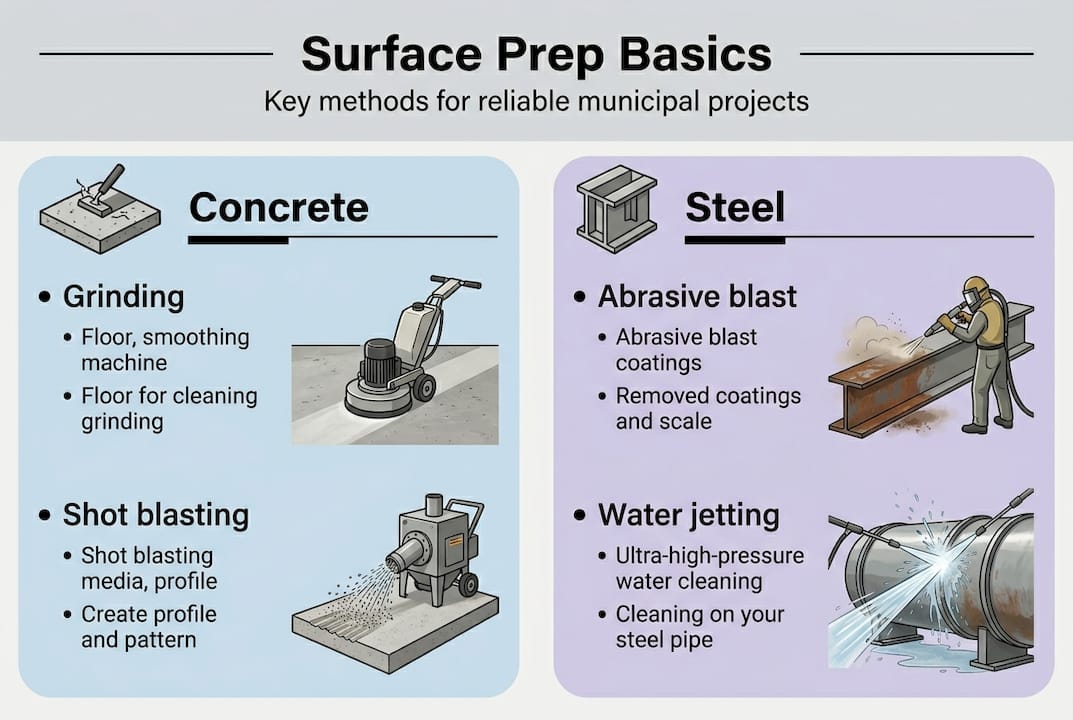
Concrete surface preparation methods are governed by ICRI 310.2R standards, which define Concrete Surface Profile (CSP) levels from 1 to 10. Here is how the main methods compare:
| Method | CSP range | Best use case |
|---|---|---|
| Diamond grinding | CSP 1-4 | Thin coatings, traffic decks |
| Shot blasting | CSP 3-9 | Thick coatings, large flat areas |
| Scarifying | CSP 4-8 | Heavy coating removal, overlays |
| Hydrodemolition | CSP 5-10 | Deteriorated concrete, bridge decks |
Steel surface preparation follows SSPC and NACE standards. For Florida municipal projects near the coast or in marine environments, abrasive blasting SSPC SP10 and water jetting are the preferred methods because they remove chloride contamination that mechanical cleaning alone cannot address.
Here is a step-by-step approach to selecting the right method:
- Identify the substrate: concrete, steel, or composite
- Determine the coating system being applied and its required CSP or cleanliness grade
- Assess site constraints: urban setting, confined space, proximity to water or sensitive areas
- Evaluate existing coating condition and hazardous material risk
- Select the method that meets the spec while fitting site logistics
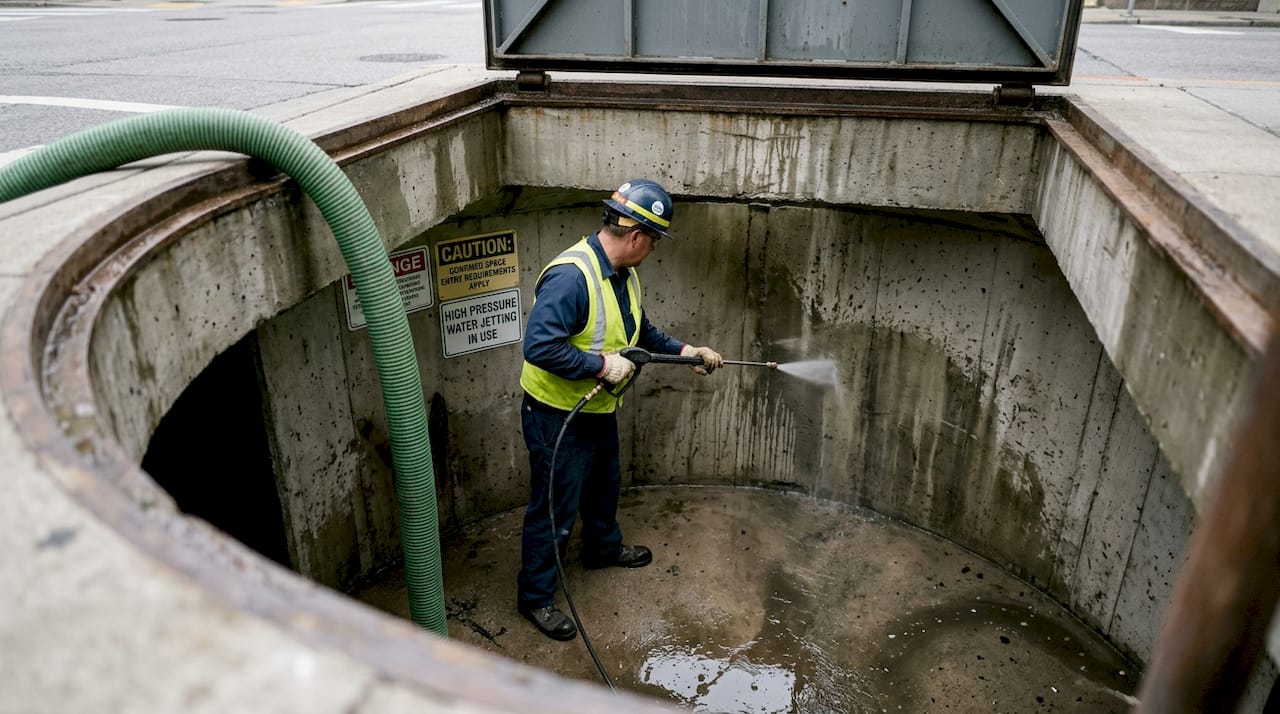
Pro Tip: In dense urban areas or near water bodies, water jetting is often the smarter choice over dry abrasive blasting because it dramatically reduces airborne dust and containment costs. The surface treatment process for urban infrastructure projects frequently defaults to wet methods for exactly this reason.
Mechanical methods consistently outperform chemical etching for municipal work. Acid etching leaves residue in the pores of concrete that interferes with coating adhesion and can cause osmotic blistering over time. Mechanical prep creates a clean, open profile that gives the coating a true mechanical bond. For more on selecting the right approach, the surface prep tips resource covers current best practices for 2026 infrastructure projects.
Specify step-by-step workflow: Assess, prepare, test, and document
A solid prep workflow is what separates a project that passes inspection from one that fails at the worst possible time. Here is a field-ready sequence any municipal manager can use to structure contractor requirements and on-site oversight.
- Assess substrate condition. Walk the entire surface area before any equipment is mobilized. Look for delaminations, soft spots, cracks, standing moisture, efflorescence, and oil contamination. Mark problem areas for targeted remediation.
- Test moisture content. Florida’s humidity makes this non-negotiable. Use a calcium chloride test or relative humidity probe per ASTM F2170. Moisture above the coating manufacturer’s threshold causes adhesion failure and osmotic blistering.
- Remove contaminants. Degrease oil-contaminated areas, remove loose material, and address any biological growth. On steel, remove all mill scale, rust, and existing coating per the specified SSPC grade.
- Profile the surface. Apply the selected mechanical prep method to achieve the target CSP or cleanliness level. Verify the profile using a replica tape or profilometer per ASTM D4417.
- Test tensile strength. Minimum substrate tensile strength of 200 psi per ASTM D4541 or C1583 is the benchmark for a durable coating bond. Pull-off tests must be conducted and recorded.
- Inspect and verify. Have a qualified inspector confirm the surface meets all specification requirements before any coating is applied.
- Document everything. Record test results, photos, inspector sign-offs, and any deviations from spec. This documentation is your protection during audits and warranty claims.
Pro Tip: Build documentation requirements directly into your contractor scope of work. Require daily field reports, test logs, and photo documentation as deliverables. A surface prep checklist built around your project spec makes this process consistent across crews and shifts.
Statistic to keep in mind: ECUA compaction and density specs for trench backfill emphasize the same principle that governs surface prep: the quality of what you cannot see after the job is done determines how long the asset lasts. The same logic applies to coating adhesion. Review your coating compliance for city facilities requirements before finalizing any prep specification.
Tackle common pitfalls, compliance challenges, and safety concerns
Even well-planned projects run into field realities that can blow up your timeline and budget. Knowing where the traps are lets you build contingencies before they become emergencies.
The most common and expensive pitfalls in Florida municipal prep work include:
- Skipping moisture testing: Applying coatings over wet concrete is one of the top causes of premature failure. Florida’s climate means moisture is almost always present.
- Using acid etching on concrete: It seems faster, but acid leaves behind residue that actively undermines adhesion. Mechanical prep is the only reliable option for compliant municipal work.
- Under-documenting prep activities: If it is not recorded, it did not happen. Inspectors and auditors will ask for test logs, and missing records can void warranties or trigger non-compliance findings.
- Ignoring existing coating history: On structures built before 1980, existing coatings may contain lead or asbestos. Pre-1980 coatings can trigger OSHA 1926.62 and 1926.1101, which require specialized abatement procedures that increase project costs by 3 to 5 times.
- Choosing the wrong containment method: Dry blasting in urban or waterfront sites without proper containment creates regulatory exposure and community relations problems.
“The most expensive mistake in surface prep is not the one you make on-site. It is the one you failed to plan for in the specification.”
When you encounter older structures, the first step is a hazardous materials survey before any mechanical work begins. This is not optional. OSHA enforcement in Florida is active, and the cost of a violation far exceeds the cost of proper testing upfront.
For sites near water or in confined spaces, water jetting minimizes airborne hazards and reduces containment complexity. It is also effective at removing chloride contamination that dry methods leave behind. Pair water jetting with proper drainage planning to stay compliant with stormwater regulations. Review coating best practices for a full breakdown of method selection by site type.
What most managers overlook about surface prep (and why it matters in Florida)
After more than 20 years working on municipal infrastructure across Central Florida, the pattern we see most often is this: managers focus on methods and miss the process. They specify shot blasting or SSPC SP10 and assume the work is covered. But the real differentiator between a coating that lasts 20 years and one that fails in five is whether the crew follows a repeatable, documented process every single time.
Too many procurement decisions in Florida are driven by the lowest bid. That approach ignores the credentials that actually predict performance. Contractors certified in AMPP and ICRI standards bring the technical discipline to meet FDOT and ECUA compliance requirements and extend asset life in ways that uncertified crews simply cannot replicate.
The managers who get the best long-term outcomes are the ones who require standardized reporting, verify contractor credentials before award, and treat documentation as a deliverable equal in importance to the coating itself. That discipline pays off during audits, warranty claims, and the next budget cycle when your assets are still performing. The coating process guide is a practical starting point for building that kind of rigor into your standard operating procedures.
Get expert help for surface preparation and coatings in Central Florida
Applying these standards consistently requires more than a good specification. It requires a contractor with the credentials, equipment, and local knowledge to execute them in Florida’s demanding environment.
Southern Sandblasting & Painting LLC has delivered compliant, durable surface prep and coating solutions for municipal clients across Central Florida for over 20 years. Our crews are certified, our processes are documented, and our work is built to pass the inspections that matter. From sandblasting services in Orlando to full-scale industrial coatings for Florida infrastructure, we handle the complexity so your assets stay protected. Explore our best practices for coating prep or contact us to discuss your next project.
Frequently asked questions
What surface preparation standards must Florida municipalities follow?
You must follow ICRI 310.2R for concrete and SSPC SP10/NACE2 for steel, along with AMPP, ASTM, FDOT, and ECUA requirements to pass compliance checks and protect coating warranties.
How do managers confirm municipal surfaces are ready for coating?
Test for soundness, moisture content, and surface profile, and verify that tensile strength meets 200 psi per ASTM D4541 or C1583 before any coating is applied.
Which prep method is best for steel in a marine Florida setting?
Water jetting and SSPC SP10 abrasive blasting are the preferred methods because they remove chloride contamination that mechanical cleaning alone cannot fully address in marine or corrosive environments.
What safety issues can raise prep costs?
Hidden lead or asbestos in pre-1980 coatings can trigger OSHA 1926.62 and 1926.1101 requirements, raising total project costs by 3 to 5 times due to specialized abatement and containment requirements.
Is acid etching acceptable for concrete surface prep?
No. Acid etching leaves residue in concrete pores that undermines coating adhesion. Mechanical methods like shot blasting or diamond grinding are the compliant and reliable choice for municipal projects.
Recommended
- 7 Essential Surface Preparation Tips 2025 for Infrastructure
- 7 Step Surface Preparation Checklist for City Projects
- Surface Prep Cuts Florida Infrastructure Costs 50%
- Surface Treatment Process for Durable Infrastructure Results
- Industrial Painting Services in Orlando, FL
- Sandblasting Services in Orlando, FL


