
TL;DR:
- Proper application of industrial primers is essential for ensuring long-lasting, durable coatings on municipal infrastructure. Selecting the correct primer type and thoroughly preparing surfaces can prevent costly failures, especially in harsh Florida climates. Integrating primer and surface prep into a system-level approach maximizes asset lifespan and minimizes maintenance costs.
Coating failures at municipal facilities are rarely random. Most trace back to a single decision made early in the project: skipping primer, or using the wrong one. Understanding why use industrial primers correctly is the difference between a coating that lasts 15 years and one that starts peeling inside 18 months. For facility managers overseeing water tanks, pipelines, bridges, or city infrastructure in Central Florida’s punishing humidity, that distinction has a direct dollar value. This guide breaks down exactly how industrial primers work, how to choose them, and why cutting corners here always costs more in the end.
Table of Contents
- What industrial primers do: the foundation for durable coatings
- Choosing the right primer for metal and concrete surfaces
- Surface preparation’s critical role before primer application
- When and why primers are essential versus alternatives
- Balancing primer benefits with practical facility management
- Why thinking beyond primer as a product is the key to facility success
- Get expert industrial primer and surface preparation services in Central Florida
- Frequently asked questions
Key Takeaways
| Point | Details |
|---|---|
| Primers prevent coating failure | Primers create strong adhesion and seal surfaces, stopping peeling, blistering, and corrosion beneath coatings. |
| Proper surface prep is essential | Removing oils and contaminants before primer application ensures durable adhesion and coating performance. |
| Select primers by substrate | Zinc-rich primers are ideal for protecting metal in humid areas, while masonry primers suit concrete and porous surfaces. |
| Primers extend asset life | Using quality primers reduces maintenance costs by preventing corrosion and premature coating failures. |
| Think system durability | Primer effectiveness depends on testing, compatibility, surface prep, and workflow integration, not just product choice. |
What industrial primers do: the foundation for durable coatings
Think of an industrial primer as the layer that makes every other coating decision matter. Without it, you are painting on a surface that may look clean but won’t hold. The industrial primers role in a coating system is not decorative. It is structural.
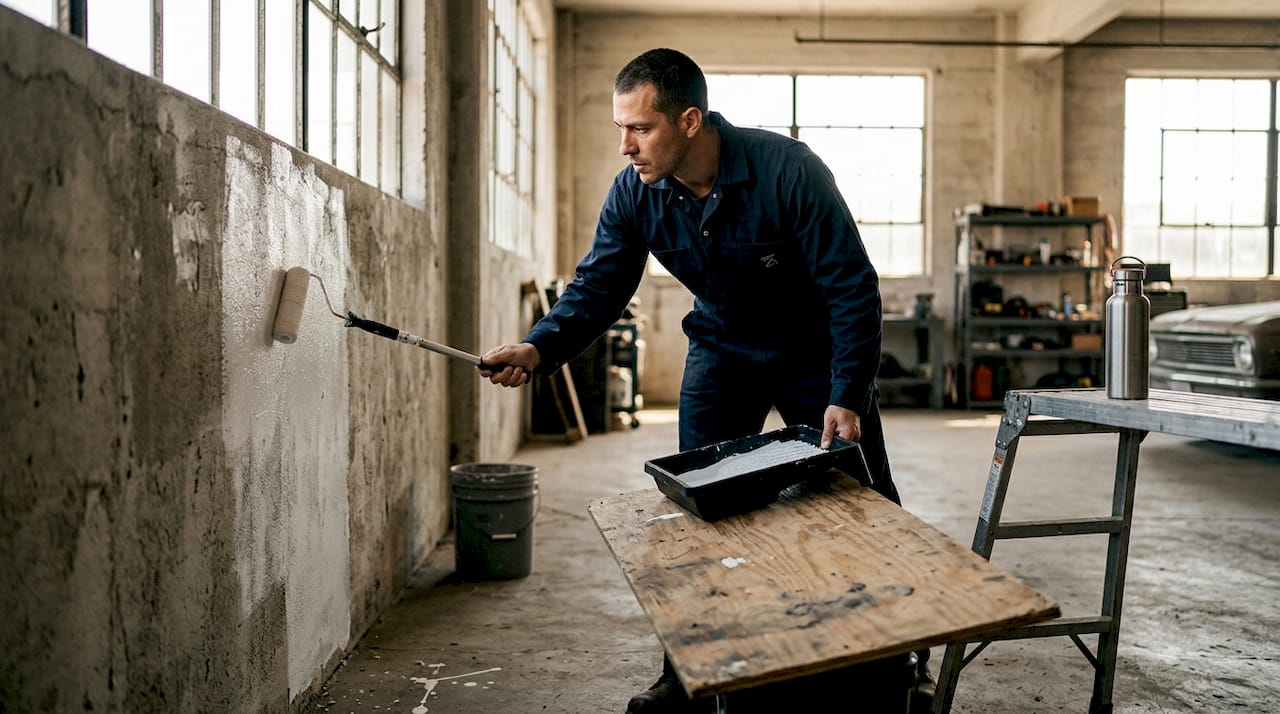
Primers bond to the substrate at a molecular level, giving the topcoat something to grip. On smooth steel, that bond is what prevents delamination. On concrete, primers seal micropores and irregular surfaces that would otherwise absorb topcoat unevenly, creating weak spots. Primer prevents topcoat failure such as peeling and flaking over time, especially on porous or smooth substrates like concrete and steel.
Here is what properly selected industrial primers actually do in practice:
- Improve adhesion between the substrate and topcoat, reducing the risk of delamination under mechanical stress or thermal cycling
- Seal porous materials like concrete and masonry so topcoat film thickness stays consistent across the surface
- Create a moisture barrier that prevents water ingress, a critical function in Central Florida’s year-round humidity
- Inhibit corrosion by chemically reacting with the metal surface or physically blocking oxygen and moisture from reaching it
- Improve topcoat coverage by creating a uniform base that requires fewer coats to achieve proper film build
The industrial paint primer benefits go beyond performance. A properly primed surface is also easier to inspect, easier to recoat during maintenance cycles, and more predictable in long-term behavior. Skipping primer doesn’t save time. It front-loads future repair costs.
Choosing the right primer for metal and concrete surfaces
Not all primers are the same, and choosing the wrong formulation for your substrate is nearly as bad as skipping primer altogether. For municipal facilities, the two most common substrate types are steel and concrete, and each requires a different approach.
For steel surfaces, zinc-rich primers are the standard in aggressive environments. These primers contain zinc particles that act as a sacrificial anode, corroding preferentially before the steel does. Zinc-rich primers extend asset life by delivering corrosion protection, improved edge coverage, enhanced adhesion, and increased film build. For water treatment facilities, pump stations, or any steel exposed to moisture and chlorides in Florida’s coastal and inland environments, zinc-rich is not optional. It is the spec baseline.
For concrete and masonry, penetrating or block-filler primers are the right tool. These seal pores and protect concrete and masonry surfaces from moisture, improving coating durability. Without them, moisture migrating through the slab will blister topcoats from the inside out, particularly in Florida where groundwater pressure and temperature swings are constant factors.
Here is a side-by-side comparison of primer types for the most common municipal substrates:
| Substrate | Recommended primer type | Key benefit | Typical application |
|---|---|---|---|
| Carbon steel | Zinc-rich epoxy | Sacrificial corrosion protection | Water tanks, structural steel, pipelines |
| Galvanized steel | Wash primer or epoxy | Adhesion to zinc coating | Fencing, conduit, utility hardware |
| Concrete and masonry | Penetrating or block-filler | Seals pores, prevents moisture ingress | Floors, walls, drainage structures |
| Cast iron | Alkyd or epoxy mastic | Rust inhibition and adhesion | Valves, fittings, older infrastructure |
Additional factors that influence primer selection include:
- Film thickness requirements based on expected service life
- Chemical exposure such as fuel, solvents, or wastewater
- Temperature range the coated surface will experience
- Recoat window compatibility with the specified topcoat
Explore zinc-rich primers benefits and the primer application steps for greater detail on matching formulations to specifications.
Pro Tip: Always require laboratory test data including salt spray resistance hours when specifying primers for municipal infrastructure. A product data sheet without test results is marketing, not a specification.
Surface preparation’s critical role before primer application
Here is something most project managers don’t realize until it’s too late: a premium primer applied to a poorly prepared surface will fail just as fast as no primer at all. Surface preparation is not a preliminary step. It is a quality event with its own inspection criteria and hold points.
The most common and most overlooked contamination type is invisible. Oils from handling, soluble salts from environmental exposure, and residual grinding compounds don’t show up on a visual inspection. They sit on the surface and break the primer bond from underneath.
The standard procedure before any mechanical cleaning is SSPC-SP 1 solvent cleaning, which removes oils, greases, dirt, and soluble contaminants to prevent coating adhesion failures. Skipping this step because the surface “looks clean” is one of the most common causes of coating failures that don’t appear until 18 to 24 months after installation.
Follow this sequence every time, without exception:
- Degrease with SSPC-SP 1 compliant solvents to remove all oil, grease, and soluble salt contamination before any abrasive work begins
- Conduct a water-break test on the cleaned surface. Water beading indicates residual oil contamination that will defeat primer adhesion
- Test for chloride contamination using a Bresle patch kit or equivalent. Levels above 3 to 5 micrograms per square centimeter require re-cleaning
- Apply mechanical cleaning (abrasive blast, power tool, or hand tool) to achieve the specified surface profile for the primer
- Verify surface profile with a testex tape measurement to confirm anchor depth matches the primer’s requirements
- Document and sign off each step as a quality hold point before primer application begins
“Surface preparation is the single largest variable in coating system performance. Every hour spent on proper cleaning multiplies the return on every dollar spent on primer.”
Review the surface preparation process and best surface prep practices to build this sequence into your facility’s standard workflow.
Pro Tip: Make solvent cleaning a formal, documented hold point in your quality plan. Require a sign-off before any mechanical prep begins. This single practice eliminates the most common root cause of premature coating failures.
When and why primers are essential versus alternatives
The straightforward answer is: for most municipal infrastructure applications, primers are non-negotiable. But understanding the exceptions makes facility managers sharper at evaluating specifications and vendor claims.
Primers are introduced when tests show insufficient bond strength for the product’s expected lifetime. Alternatives include selecting substrates or adhesives that don’t require primers. In industrial facility contexts, that typically means engineered composite materials or factory-applied coatings, not field-applied systems on aged infrastructure. For anything involving existing steel or concrete that has seen service life, eliminating primer is a risk that almost never pays off in the field.
There are genuine cases where primer needs are reduced or replaced:
- Factory powder-coated components where the coating is applied in controlled conditions to clean, pretreated metal may not need a field primer if not damaged during installation
- Plasma surface treatment used in controlled manufacturing environments can improve adhesion without traditional primers, but has no practical application in field-applied municipal coatings
- Self-priming topcoats exist for low-exposure applications, but they carry a shorter service life and are typically not appropriate for infrastructure with 20-plus-year maintenance cycles
- Compatible adhesive selection in bonding applications can sometimes replace a primer coat, but only when bond strength is verified by testing
The benefits of industrial primers become most clear when you price out a failure. A missed hold point, wrong primer selection, or contaminated surface can result in full coating removal and reapplication on a structure like a water storage tank that can cost six figures per event.
Pro Tip: Bring your coating contractor into spec discussions early, before procurement locks in materials. A contractor who understands industrial painting best practices can identify primer needs and alternatives before the project starts, not during troubleshooting afterward.
Balancing primer benefits with practical facility management
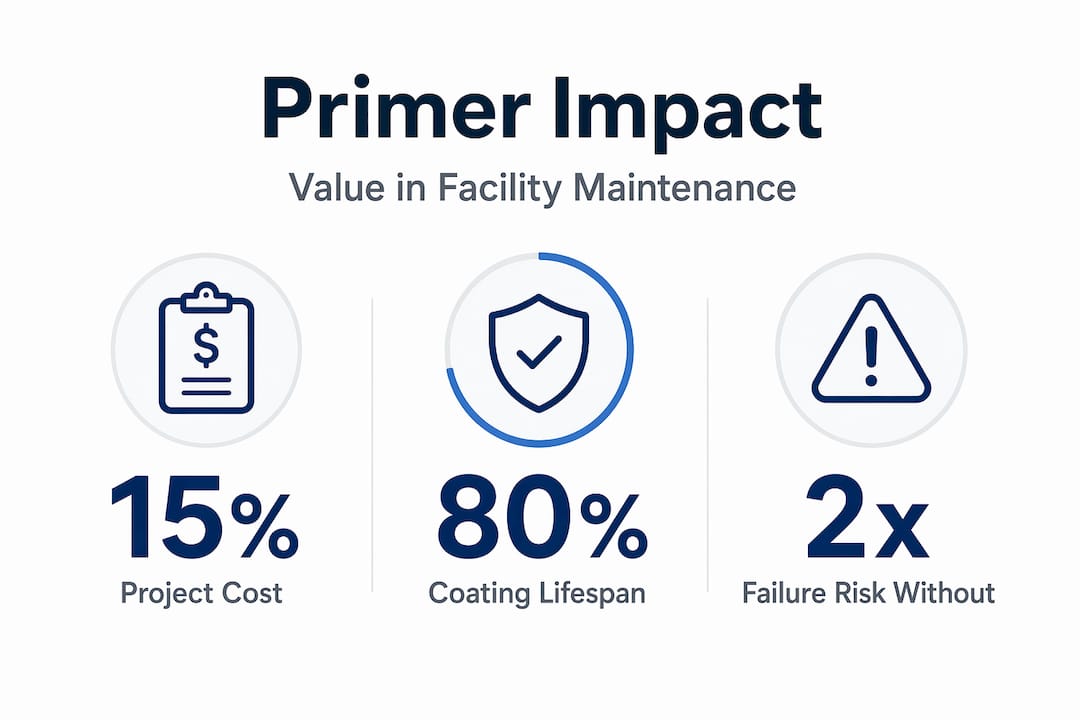
The importance of industrial primers becomes especially clear when you look at the numbers in your maintenance budget. The upfront cost of primer is small relative to total project spend, but it has an outsized effect on how long every dollar of that investment performs.
Primer cost is less than 15% of project expense but determines 80% of paint job longevity. Skipping primer causes early failures costing far more in repairs. That ratio explains why experienced facility managers treat primer selection as a specification priority, not a cost-cutting opportunity.
The practical calculus for municipal and commercial facilities:
- A typical industrial topcoat applied without primer on steel in Florida will show visible failure, blistering, rust staining, or delamination in as little as 6 to 18 months under normal environmental exposure
- Recoating a failed system costs 2 to 4 times more than applying it correctly the first time due to removal, surface prep, and downtime
- Climate conditions in Central Florida, including high humidity, UV intensity, thermal cycling, and proximity to salt air in coastal areas, accelerate every failure mode that proper priming prevents
- Chemical exposure at water treatment plants, wastewater facilities, and fuel storage sites further shortens the lifespan of unprimed or under-specified coating systems
- A well-specified primer, correctly applied over properly prepared surfaces, can push maintenance intervals from 5 years to 15 years or longer on steel infrastructure
Key stat: Primer costs under 15% of total project budget but accounts for 80% of coating lifespan. That is the most straightforward ROI calculation in facility maintenance.
Use the industrial coatings checklist to build primer selection and verification into your pre-project approval process.
Why thinking beyond primer as a product is the key to facility success
After 20-plus years in industrial surface preparation and coating application across Central Florida, the most consistent pattern we see in failed projects is not wrong product selection. It is treating primer as an isolated product decision rather than as part of an integrated coating system.
Primer value is tied to system-level durability, including corrosion protection, edge coverage, adhesion, and film build that extend asset lifespan. That means the primer needs to be compatible with the surface prep method, the topcoat chemistry, the application environment, and the facility’s expected service conditions simultaneously.
Facility managers who get this right don’t just ask “which primer should I use?” They ask “how does this primer perform within this specific coating system, on this substrate, under these service conditions?” That’s a different question, and it leads to better procurement decisions.
The most overlooked factor is field verification. Lab test data tells you what a primer can do under ideal conditions. Field verification tells you whether your crew is delivering the right surface profile, the right application thickness, and the right cure time before topcoat. Both matter. Without coating system performance documentation at the project level, you’re relying on hope rather than evidence.
Procurement specs that require product test data, compatibility sheets, and application verification checkpoints are not bureaucratic overhead. They are the controls that protect your maintenance budget. If a contractor cannot produce salt spray test hours and a compatibility statement for the proposed system, that is a warning sign, not a specification gap.
Pro Tip: Prioritize procurement specs that require product test data, system compatibility documentation, and field inspection checkpoints. These requirements cost nothing to add to a spec and routinely prevent the failures that cost the most to fix.
Get expert industrial primer and surface preparation services in Central Florida
Protecting your municipal infrastructure starts with the right primer, applied over a properly prepared surface, by a team that knows exactly what Central Florida’s climate demands from every coating system.
At Southern Sandblasting & Painting LLC, we’ve spent 20-plus years preparing and coating critical infrastructure across Orlando and Central Florida, from water tanks and pipelines to city facilities and commercial properties. Our professional sandblasting services meet SSPC-SP 1 and full blast standards before any primer touches your structure. We provide expert coating application with documented hold points and system-level specifications built for durability. If you’re responsible for infrastructure that needs to last, explore our Florida industrial coatings expertise or contact us directly to discuss your next project.
Frequently asked questions
Why is using a primer important before applying industrial coatings?
Primers create a strong bond between the substrate and topcoat while protecting against moisture and corrosion, which is what prevents topcoat peeling and extends coating lifespan well beyond what topcoat alone can deliver.
What makes zinc-rich primers suitable for protecting metal surfaces in Florida?
Zinc-rich primers act as a sacrificial anode, corroding before the steel does and providing protection even at cut edges or scratches. Zinc-rich epoxy primers offer exceptional corrosion resistance ideal for Florida’s humid and coastal environments.
How important is surface preparation before primer application?
It’s arguably more important than primer selection itself. SSPC-SP 1 solvent cleaning removes the invisible oils, salts, and contaminants that cause adhesion failures from beneath the coating, even when the surface looks clean.
Can primers be avoided in some industrial coating projects?
In limited cases, yes. Primers can be avoided when testing confirms that bond strength meets lifetime requirements through compatible adhesives or surface treatments, but for field-applied systems on aged municipal infrastructure, this is rarely a sound decision.
How does primer choice impact long-term maintenance costs?
Significantly. Primer determines 80% of a coating system’s service life despite representing less than 15% of project cost, making it the highest-leverage investment in any facility maintenance coating program.


