
Protective coatings and surface preparation are the most cost-effective asset-management investment most facility budgets consistently underfund. A single well-specified coating system can extend a bridge’s service life by 25–45 years, while unprotected structural steel can lose roughly 1 mm of thickness in five years under harsh exposure. Treating coatings as an infrastructure asset-longevity decision rather than a maintenance line item changes how you fund them, spec them, and schedule them. Your immediate next step: commission a condition survey on your highest-risk assets before the next budget cycle.
- Protective coatings reduce lifecycle cost by deferring capital replacement and cutting unplanned downtime.
- AMPP (formerly NACE/SSPC) and ASTM surface-preparation standards govern adhesion quality and are the baseline for any defensible spec.
- San Mateo Bridge coatings extended service life by an estimated 25–45 years — a concrete benchmark for executive buy-in conversations.
Key Takeaways
Protective coatings are an asset-management investment that reduces lifecycle cost, defers capital replacement, and mitigates regulatory risk when specified and applied correctly.
| Point | Details |
|---|---|
| Lifecycle cost beats first cost | A premium system with notably higher first cost can deliver a significantly lower 10-year total cost of ownership once downtime and recoating are included. |
| Surface prep determines performance | SSPC-SP 10 near-white blast is the baseline for immersion service; inadequate prep voids the value of any coating system. |
| Polyurea for high-movement assets | Systems like VersaFlex elongate up to 400% and bridge cracks up to 1/8 inch, making them the right choice for concrete structures with thermal movement. |
| Regulatory risk is a funding argument | Coating failures on wastewater assets can trigger NPDES violations and consent decrees — frame the program as compliance spend, not maintenance. |
| Southernsandblastingandpainting | Provides the full workflow: abrasive blasting, coating application, QA testing, and handover documentation for municipal and industrial projects. |
Table of Contents
- Why invest in asset protection coatings?
- How do coatings and surface preparation actually extend asset life?
- When does monitoring become a funded coatings program?
- How do you estimate costs and ROI for a coatings program?
- What does a successful coatings project actually require?
- How do you select and contract a coatings contractor?
- The real reason most asset protection programs underperform
- Southernsandblastingandpainting delivers on the full asset protection checklist
- Sources
Why invest in asset protection coatings?
The core reason is financial control. Coating failures rarely stay isolated — they cascade into unplanned downtime, inspection requirements, and potential regulatory actions that dwarf the original repair cost. A coating program treated as an engineered, lifecycle-managed system reduces total cost of ownership across 5–20 year horizons in ways that reactive maintenance never can.
The operational benefits are concrete:
- Reduced maintenance frequency: Polyurea rehabilitation programs report measurable reductions in cleaning burden and avoided emergency repairs; field reports indicate clarifier cleaning hours can fall by roughly two-thirds after polyurea application.
- Lower corrosion rates: Barrier coatings cut the electrochemical and microbiologically induced corrosion (MIC) that degrades steel and concrete in wastewater, marine, and industrial environments.
- Reduced infiltration and exfiltration: Properly applied linings in sewer and water systems cut inflow/infiltration (I/I), reducing treatment load and regulatory exposure.
- Fewer recoat cycles: A premium system applied correctly over a properly prepared surface lasts significantly longer than a budget system applied over marginal prep.
On the financial side, the 10-year TCO model is the most persuasive tool you have. Downtime avoidance alone often closes the gap between a budget bid and a premium system.
Regulatory and safety benefits are equally real. Coating failures on wastewater assets create contamination risks, sanitary sewer overflow (SSO) events, and NPDES permit violations. Environmental containment failures carry liability that no maintenance budget can absorb after the fact. Coatings also reduce worker exposure to corroded surfaces and confined-space hazards during recurring inspections.
How do coatings and surface preparation actually extend asset life?
The mechanism is straightforward: a coating creates a physical and chemical barrier between the substrate and the environment. What varies is how well that barrier holds under real operating conditions.
Surface preparation is where most projects succeed or fail. Abrasive blasting removes mill scale, rust, and contaminants that would otherwise prevent adhesion. Without a clean, profiled surface meeting SSPC-SP 6 (commercial blast) at minimum, or SSPC-SP 10 (near-white blast) for immersion service, even a premium coating system will delaminate prematurely. Profile depth, measured in mils, must match the coating’s specification.
Key performance attributes to evaluate when specifying a system:
- Elongation: How much the cured film can stretch before cracking. Polyurea systems can elongate up to 400%, bridging cracks up to 1/8 inch — critical for concrete structures subject to thermal movement.
- Tensile strength: Resistance to mechanical stress and abrasion, relevant for clarifiers, pipe interiors, and tank floors.
- Permeability: How readily corrosive agents (hydrogen sulfide, chlorides, moisture) pass through the film. In wastewater applications, permeability and chemical resistance are the primary selection criteria — not peak tensile strength.
- Cure temperature range: Polyurea cures rapidly across wide temperature ranges, reducing weather-window constraints and plant downtime.
- Abrasion resistance: Relevant for pipe inverts, tank floors, and any surface with flow or mechanical contact.
The table below compares the four main material categories for infrastructure applications:
| System | Elongation | Cure Speed | Best Use Cases | Key Limitation |
|---|---|---|---|---|
| Polyurea (e.g., VersaFlex) | Up to 400% | Very fast (seconds to minutes) | Wastewater structures, manholes, tanks, bridges | Requires plural-component spray equipment; moisture-sensitive mixing |
| Polyurethane | Moderate | Moderate | Pipe interiors, secondary containment | Slower cure than polyurea; less elongation |
| Epoxy | Low | Slow to moderate | Steel tanks, immersion service, chemical resistance | Brittle at low film builds; poor crack-bridging |
| Cementitious lining | Minimal | Slow | Large-diameter pipe, concrete rehabilitation | Heavy; limited to non-flexing substrates |
VersaFlex polyurea systems are a well-documented example of advanced spray-applied technology: rapid set, high elongation, and field-proven service life in wastewater applications spanning multiple decades. For pipeline-specific coating approaches, the selection logic shifts toward chemical resistance and cathodic disbondment resistance, where corrosion prevention methods for buried pipe systems add another layer of specification complexity.
When does monitoring become a funded coatings program?
Condition triggers are the clearest signal. If you are seeing any of the following, the decision to fund has already been delayed:
- Visible cracking, spalling, or delamination in existing coatings or concrete
- Active exfiltration or infiltration in sewer or water assets
- Measurable steel section loss confirmed by ultrasonic thickness testing
- Spot repairs recurring on the same asset within a 12-month window
- Cleaning cycles increasing in frequency without a change in operating conditions
Performance triggers follow: warranty expiration on an existing system, recurring noncompliance events tied to asset condition, or documented increases in downtime cost per quarter.
Regulatory triggers are the hardest to ignore. Consent decrees, NPDES permit limits tied to SSO events, and sanitary sewer overflow risk all create legal exposure that a funded coating program directly mitigates. Documenting these triggers in a capital request converts a maintenance ask into a risk-management decision.
Pro Tip: Schedule coating projects to coincide with planned outages, permit renewals, or capital improvement program cycles. Aligning with an already-approved shutdown eliminates the disruption cost from your ROI calculation entirely.
How do you estimate costs and ROI for a coatings program?
Start with a complete lifecycle cost inventory, not just the application quote:
- Initial application cost (material, labor, mobilization, plural-component equipment)
- Surface preparation cost (abrasive blasting, containment, waste disposal)
- Disruption and downtime cost (lost production, bypass pumping, temporary service)
- Inspection and QA cost (adhesion testing, DFT measurement, holiday detection)
- Preventive maintenance (annual inspections, spot touch-ups)
- Eventual recoat (at end of system service life, typically 15–25 years for premium systems)
For a simple ROI narrative, run three scenarios against a do-nothing baseline:
- Optimistic: Premium system, full surface prep, 20-year service life, zero emergency repairs.
- Baseline: Mid-grade system, standard prep, 12-year service life, two spot-repair cycles.
- Pessimistic: Budget system, minimal prep, 6-year service life, one full recoat at year 7.
Polyurea manhole and structure applications typically run $8–$18 per square foot depending on surface prep complexity and project scale. Plug that range into your three scenarios alongside your facility’s documented downtime cost per day, and the premium system’s higher first cost usually closes within the first recoat cycle avoided. Lifecycle-cost modeling consistently favors higher-performance systems for critical assets once disruption costs are included.
What does a successful coatings project actually require?
A project that performs starts with a written specification, not a verbal scope. Here is the implementation sequence:
- Write a system spec covering: coating system layers, minimum dry-film thickness (DFT) per coat, accepted surface-prep standard (SSPC-SP 10 or SSPC-SP 6 as appropriate), substrate moisture limits, and cure temperature range.
- Execute surface preparation per spec: abrasive blast to target cleanliness, measure anchor profile in mils using a replica tape or profilometer, verify with a soluble-salt test before coating.
- Apply coating under controlled conditions: monitor ambient temperature, dew point, and relative humidity; document batch numbers and mix ratios for plural-component systems.
- Conduct QA testing: wet-film thickness checks during application, DFT measurement after cure, adhesion pull-off test per ASTM D4541, and holiday (pinhole) detection per NACE SP0188 for immersion service.
- Document everything: test logs, batch records, inspector sign-offs, and a maintenance schedule form the warranty-support package.
Pro Tip: Require surface prep verification reports before any coating is applied. A signed anchor-profile and cleanliness record protects both the owner and the contractor if adhesion is ever disputed.
Safety callouts: confined-space entry protocols are mandatory for tank and manhole work; abrasive containment and waste disposal must comply with local environmental regulations; ventilation requirements for solvent-borne systems must be documented in the site-specific method statement.
How do you select and contract a coatings contractor?
Prequalification separates capable contractors from low-bid risk. Ask for:
- Documented experience with municipal or industrial assets of comparable type and scale
- References from owners (not just general contractors) on similar projects
- Current insurance certificates: general liability, workers’ compensation, and pollution liability
- Safety record: EMR (Experience Modification Rate) below 1.0 is a reasonable threshold
- Equipment capability: plural-component spray rigs for polyurea, abrasive blasting equipment matched to the substrate
Red flags to watch for:
- Specs that reference only “industrial coating” with no system name, DFT, or prep standard
- No adhesion verification in the scope
- Bids that omit surface preparation as a line item
- Missing confined-space or environmental compliance documentation
Required handover documents:
- As-built coating system record (product names, batch numbers, DFT readings by zone)
- Surface-prep verification report (cleanliness grade, anchor profile, salt test results)
- QA test logs (adhesion, holiday, DFT)
- Manufacturer’s warranty certificate
- Recommended maintenance schedule
For project examples across infrastructure types, reviewing a contractor’s documented project history gives you a faster read on capability than any prequalification questionnaire alone.
The real reason most asset protection programs underperform
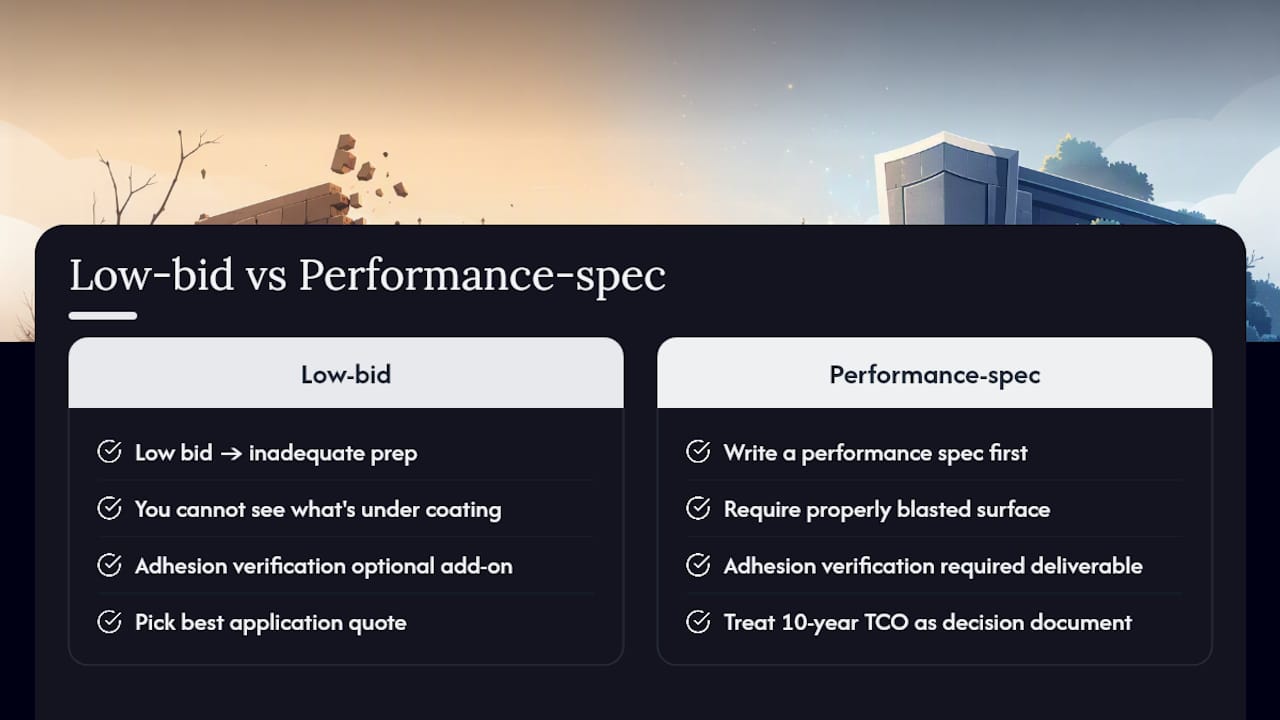
The conventional advice is to “get three bids and pick the best value.” That framing is the problem. When surface preparation is the largest cost driver and the hardest item to verify after the fact, a low bid almost always means inadequate prep. You cannot see what is under a coating once it is applied, which means the entire risk of a bad prep decision lands on the owner at year three when delamination starts.
The more defensible approach: write a performance spec first, then bid against it. Require adhesion verification as a contract deliverable, not an optional add-on. And treat the 10-year TCO model as the decision document, not the application quote. A premium polyurea system over a properly blasted surface will outlast two cycles of a budget system over marginal prep, and the math is not close once downtime is included.
What most facility managers underestimate is the regulatory dimension. A coating failure on a wastewater asset is not just a maintenance event — it is a potential consent decree trigger. Framing a coating program as compliance risk mitigation rather than maintenance spend changes who approves it and how fast.
Southernsandblastingandpainting delivers on the full asset protection checklist
Twenty-plus years of municipal and industrial project experience means Southern Sandblasting and Painting has worked through the exact scenarios this article describes: aging wastewater structures, corroded steel tanks, bridge coatings, and pipeline rehabilitation. The service scope covers the complete workflow — abrasive blasting to SSPC standards, plural-component coating application, QA testing, and documentation packages that satisfy municipal procurement requirements.
For facility managers and public-works officials who need a contractor that shows up with the right equipment, carries the right insurance, and delivers the test logs and warranty documentation at handover, Southernsandblastingandpainting is a practical next step. Request a site survey or project proposal through the services page — or review the industrial coating types guide to sharpen your spec before the conversation starts.
Sources
Use these sources to build a specification, develop a business case, or brief a procurement team:
- Polyurea Saves the Day for Aging Wastewater Treatment Infrastructure — American Coatings Association
- The Ultimate Guide to Industrial Coatings: Corrosion Protection, Compliance, and Asset Longevity – Schmidt Industrial Services
- How Polyurea Coatings Extend Wastewater Infrastructure Lifespan and Reduce Maintenance Costs – Wastewater Coatings
- Preserving Wastewater Infrastructure: Choosing the Right Protective Coatings and Linings – Sauereisen
- The power of coatings: infrastructure coatings — American Coatings Association


