

TL;DR:
- Preventive coatings programs are structured systems that protect infrastructure assets from corrosion through surface prep, coating application, and scheduled inspections. They offer significant cost savings over the asset’s lifetime by preventing emergency repairs and reducing indirect operational costs. Investing upfront in quality coating systems and maintaining regular inspections results in long-term economic and operational benefits.
Preventive coatings programs are defined as structured systems of surface preparation, protective coating application, and scheduled inspection designed to stop corrosion before it damages infrastructure assets. Corrosion costs the U.S. economy more than $276 billion annually, and industry research confirms that 15%–35% of those costs are preventable through best practices. For infrastructure managers and municipal decision-makers, the question of why fund preventive coatings programs is not philosophical. It is a financial and operational imperative backed by life-cycle data, regulatory pressure, and decades of field evidence. The industry term for this discipline is corrosion management, and it belongs in every capital planning conversation.
Why fund preventive coatings programs: the core economic case
Corrosion is a predictable operational threat, not a random event. That distinction matters because predictable threats can be priced, planned for, and mitigated at a fraction of the cost of emergency response.
The most cited figure in corrosion management is the 1-to-20 ratio. The City of Toronto demonstrated that investing $1 in preventive mitigation prevents $20 in future replacement and emergency maintenance costs. That ratio holds across asset classes from dry pipe fire suppression systems to municipal water infrastructure.
Life-cycle cost analysis for concrete reinforcement tells the same story with hard numbers. Epoxy-coated reinforcing steel carries a 75-year life-cycle cost of $237 per square yard, compared to $444 per square yard for uncoated steel. That is a 47% reduction in total cost over the asset’s service life, achieved by spending more upfront on a proven coating system.
The economic argument for preventive coatings is not about spending less today. It is about spending far less over the full life of the asset.
What are preventive coatings programs and how do they protect assets?
A preventive coatings program is a managed process, not a one-time paint job. It combines four core components: surface preparation, coating system selection, application quality control, and scheduled inspection and maintenance.

Surface preparation is the most critical step. Contaminants, mill scale, rust, and existing coating failures must be removed before any new coating is applied. Abrasive blasting to standards such as SSPC-SP 6 or SSPC-SP 10 creates the surface profile that allows coatings to bond correctly. Without proper prep, even the most expensive coating system will fail early.
Coating system selection depends on the environment and asset type. Epoxy primers, polyurethane topcoats, and zinc-rich primers each address different corrosion mechanisms. Lined manhole systems, for example, use factory-applied coatings that save up to 65% in lifetime costs compared to field-applied coatings that require reapplication every 7–10 years.
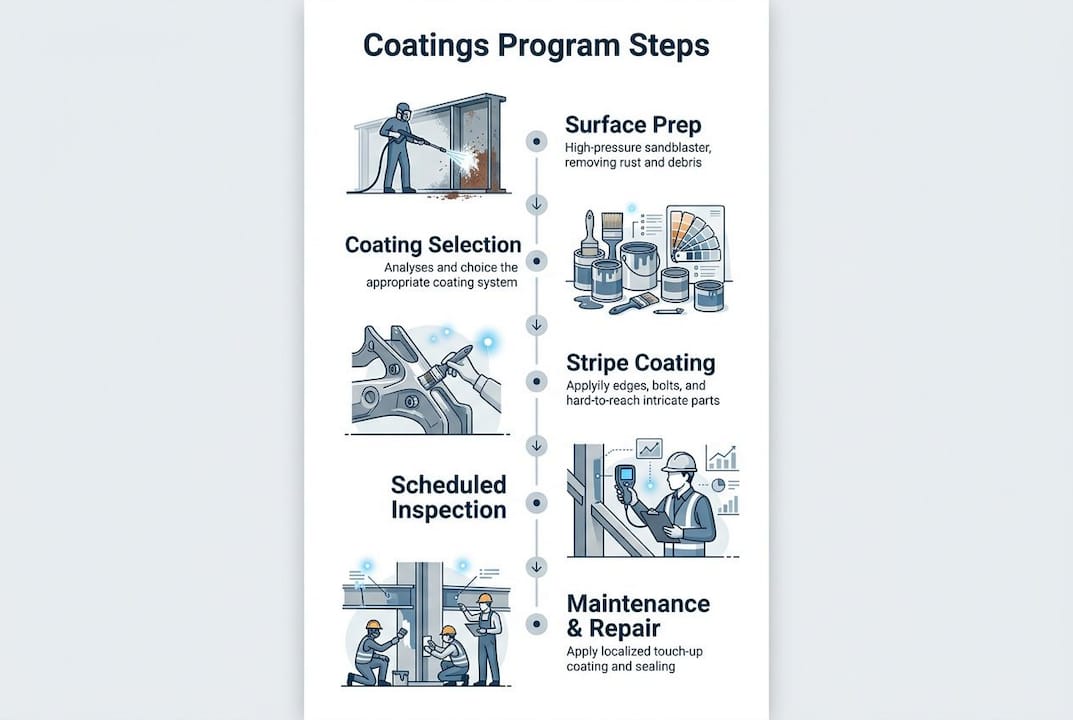
One technical detail that separates professional programs from ad hoc maintenance is stripe coating. Stripe coats at edges, welds, bolts, and crevices are critical to preventing premature failure. These are the points where coating film thickness drops and corrosion attacks first. Skipping stripe coats undermines the entire system regardless of product quality.
Pro Tip: Specify stripe coating as a separate line item in your contract documents. Inspectors who verify it as a distinct step catch failures that general coating inspections miss.
A complete program also includes scheduled inspections at defined intervals, documented condition ratings, and trigger points for maintenance recoating before corrosion initiates. This is what separates a program from a project.
How does preventive coating save money over an asset’s life cycle?
The cost savings from preventive maintenance coatings come from two sources: direct material and labor savings, and indirect cost avoidance. Most budget analyses capture the first category and ignore the second. That is where the real money is.
Indirect operational costs such as traffic control, bypass pumping, and service downtime frequently exceed the direct cost of paint and labor in corrosion maintenance projects. A water main repair that costs $50,000 in materials and labor can generate $200,000 in traffic management, emergency contracting, and service interruption costs. Preventive coatings eliminate most of those events.
“Economic justification for corrosion-resistant materials depends more on whole-life maintenance and user disruption costs than on initial price. Higher-CAPEX protective solutions consistently save total costs when maintenance, disruption, and risk are factored over a 75-year service horizon.”
Probabilistic life cycle cost research, 2026
The table below compares life-cycle cost outcomes across three common infrastructure scenarios.
| Asset type | Unprotected or field-coated cost | Preventive coatings cost | Estimated savings |
|---|---|---|---|
| Concrete reinforcement (75-year) | $444/yd² | $237/yd² | ~47% |
| Manhole system (full life cycle) | Baseline with 7–10 yr recoating | Lined system | Up to 65% |
| Municipal pipe system (City of Toronto) | $20 in reactive costs | $1 in preventive spend | 20x return |
The pattern is consistent. Assets protected by structured coatings programs cost significantly less to maintain over their service lives than assets managed reactively.
Pro Tip: When building a budget case, calculate the indirect cost of your last three emergency corrosion repairs. That number almost always exceeds the annual cost of a preventive program and makes the case for funding faster than any technical argument.
Phosphate corrosion control in municipal water systems adds another dimension. Optimized phosphate treatment reduced lead concentrations by up to 90% within 12 months at targeted sampling locations. That result demonstrates how preventive coating and chemical protection programs deliver measurable public health outcomes alongside cost savings.
What operational and risk management advantages come from preventive coatings funding?
Preventive coatings programs reduce operational risk in ways that go beyond cost. They reduce the frequency of emergency maintenance events, protect structural integrity, and support regulatory compliance.
The EPA mandates corrosion-resistant materials in sewer infrastructure under Clean Water Act requirements. Municipalities that fund structured coatings programs stay ahead of compliance requirements rather than reacting to enforcement actions. That distinction matters when federal funding eligibility depends on demonstrated asset management practices.
For bridge infrastructure, whole-life maintenance and user disruption costs drive the economic ranking of material and protection choices more than initial price. A bridge that requires lane closures for emergency corrosion repairs generates public disruption costs that dwarf the price difference between a standard coating and a high-performance system.
The operational advantages of funded preventive programs include:
- Reduced emergency callouts. Scheduled maintenance replaces reactive repairs, which are always more expensive and disruptive.
- Extended service intervals. Properly coated assets require less frequent intervention, freeing maintenance budgets for other priorities.
- Regulatory compliance. Documented inspection and maintenance records satisfy EPA and state agency requirements for corrosion management.
- Structural integrity protection. Coatings prevent section loss in steel and concrete, maintaining load-bearing capacity over time.
- Improved safety outcomes. Assets in documented good condition reduce liability exposure for municipalities and facility operators.
Inspection and maintenance after application are equally important. Coating failure at vulnerable points like welds and bolts often goes undetected until corrosion has progressed significantly. Structured programs with defined inspection intervals catch these failures early, when repair costs are low. The importance of coating investments in maintaining structural reliability is well documented across bridge, pipeline, and water infrastructure sectors.
What challenges and misconceptions hinder funding for coating programs?
The most common barrier to funding preventive coatings programs is the upfront cost objection. Decision-makers see a higher line item for a quality coating system and compare it only to the immediate cost of a cheaper alternative. They do not see the recoating cycles, emergency repairs, and indirect costs that follow.
Short-term budget cycles favor cheaper field-applied coatings because they minimize current-year spending. The problem is that field coatings require reapplication every 7–10 years, and each reapplication carries the same indirect costs as the original project. The total cost over 30 years consistently exceeds the cost of a durable system applied once.
Common misconceptions that block funding decisions include:
- “We can’t afford the upfront cost.” The correct comparison is total cost of ownership, not first-year spend. Epoxy-coated systems cost 47% less over 75 years.
- “We’ll address it when it fails.” Reactive maintenance costs 20 times more per dollar than preventive mitigation, as the City of Toronto data shows.
- “Our assets are not that exposed.” Corrosion affects all steel and concrete infrastructure. Humidity, chlorides, and biological activity accelerate degradation in ways that are invisible until structural damage occurs.
- “Maintenance is the contractor’s problem.” Post-application inspection and maintenance are the owner’s responsibility. Without them, even the best coating system fails prematurely.
Pro Tip: Present your funding case using a 20-year total cost model, not a single-year budget comparison. Include three indirect cost categories: emergency repair labor, service disruption, and regulatory risk. That framing shifts the conversation from expense to investment.
Communicating the value of preventive coatings to budget committees requires translating technical outcomes into financial language. Corrosion prevention guides for engineers provide the technical foundation, but the budget case must speak in dollars, risk ratings, and service continuity metrics. Explore corrosion prevention strategies that translate directly into budget justification language.
Key Takeaways
Preventive coatings programs reduce infrastructure life-cycle costs by 47%–65% compared to reactive maintenance, making them the most cost-effective asset protection strategy available to municipal and commercial decision-makers.
| Point | Details |
|---|---|
| Life-cycle cost advantage | Epoxy-coated steel costs $237/yd² vs. $444/yd² for uncoated steel over 75 years. |
| Return on prevention | Every $1 spent on preventive mitigation avoids $20 in future emergency and replacement costs. |
| Indirect costs dominate | Traffic control, bypass pumping, and downtime frequently exceed direct paint and labor costs. |
| Stripe coating is non-negotiable | Coating failure at edges, welds, and bolts undermines the entire system if stripe coats are skipped. |
| Budget framing matters | A 20-year total cost model, including indirect costs, makes the funding case more effectively than first-year comparisons. |
The case for proactive investment is stronger than most budgets reflect
The infrastructure managers I respect most share one trait: they stopped thinking about coatings as maintenance and started treating them as capital protection. That shift in framing changes every budget conversation.
What I have seen repeatedly in the field is that the assets with the worst corrosion damage are rarely the ones in the harshest environments. They are the ones where inspection was deferred, stripe coats were skipped to save time, or the recoating cycle was stretched past its limit because the budget was tight. The damage that results is always more expensive than the prevention would have been.
The 2026 data on whole-life cost modeling for bridges confirms what experienced practitioners already know: user disruption and risk consequences matter more than initial price when you are evaluating protection systems. That insight should be in every capital planning document for assets with a 30-year or longer service horizon.
The technology side of coatings has improved significantly. High-build epoxies, moisture-tolerant primers, and factory-lined systems now deliver performance that was not achievable 15 years ago. But technology only works when programs are funded, inspections are completed, and maintenance is treated as a commitment rather than an option. The pitfall is assuming that a better product eliminates the need for program discipline. It does not.
Proactive investment in coatings is not a luxury for well-funded municipalities. It is the lowest-cost path to asset reliability for any organization managing infrastructure at scale.
— Results
Southernsandblastingandpainting: professional coatings programs for critical infrastructure
Southernsandblastingandpainting brings more than 20 years of experience in surface preparation and protective coating application to municipal and commercial infrastructure projects across Central Florida.

Surface preparation quality determines whether a coating system lasts 5 years or 25 years. Southern Sandblasting and Painting applies abrasive blasting techniques that meet SSPC standards, followed by industrial-grade coating systems selected for the specific environment and asset type. The team supports water tanks, pipelines, bridges, airports, and city infrastructure with documented inspection and quality control at every stage. For decision-makers building the case for a funded preventive program, Southernsandblastingandpainting provides the technical execution that makes the investment pay off. Review the full range of industrial coating services or explore the surface prep best practices that underpin every durable coating program.
FAQ
Why do preventive coatings programs cost less over time?
Preventive coatings programs eliminate the recurring recoating cycles and emergency repair costs that reactive maintenance generates. Life-cycle data shows coated systems cost 47%–65% less than unprotected or field-coated alternatives over a full service horizon.
What is the most important step in a preventive coatings program?
Surface preparation is the most critical step. Coatings applied to improperly prepared surfaces fail prematurely regardless of product quality, making abrasive blasting to SSPC standards the foundation of any durable program.
How do indirect costs affect the funding decision for coatings programs?
Indirect costs such as traffic control, bypass pumping, and service downtime frequently exceed direct material and labor costs in corrosion maintenance. Including these costs in a total cost model consistently justifies higher upfront investment in quality coating systems.
What does the City of Toronto example show about preventive coatings?
The City of Toronto demonstrated that $1 invested in preventive corrosion mitigation prevents $20 in future replacement and emergency maintenance costs. That 20-to-1 return makes preventive coatings one of the highest-ROI strategies in infrastructure asset management.
How often do preventive coatings programs require maintenance?
Maintenance intervals depend on the coating system and environment, but factory-lined and high-performance epoxy systems typically extend service intervals well beyond the 7–10 year recoating cycles required by standard field-applied coatings.
Recommended
- Complete Guide to Asset Protection Coatings for Infrastructure
- Role of Protective Coatings in Critical Infrastructure
- Infrastructure painting: why asset longevity depends on it
- Coating Inspections: Key to Infrastructure Longevity
- Fire Alarm System Services in Bellaire, TX
- Sandblasting Contractor Baldwin Park FL


