
TL;DR:
- Fire-resistant coatings protect structural steel by delaying heat transfer and maintaining structural integrity during a fire. Intumescent coatings expand into an insulating char at high temperatures, reducing steel heating and preventing early collapse. Proper application, inspection, and maintenance are essential to ensure these systems meet code requirements and provide life safety.
Fire-resistant coatings are passive fire protection materials applied directly to structural steel and other building components to delay heat transfer during a fire. The role of coatings in fire protection is not cosmetic. These systems preserve structural integrity long enough for occupants to evacuate and for fire suppression to take effect. Standards like ASTM E119 and UL 263 govern how these coatings are tested and certified. Contractors, building officials, and property managers who understand how these systems work, and what the code requires, make better decisions on every project.
How do fire-resistant coatings protect structural steel?
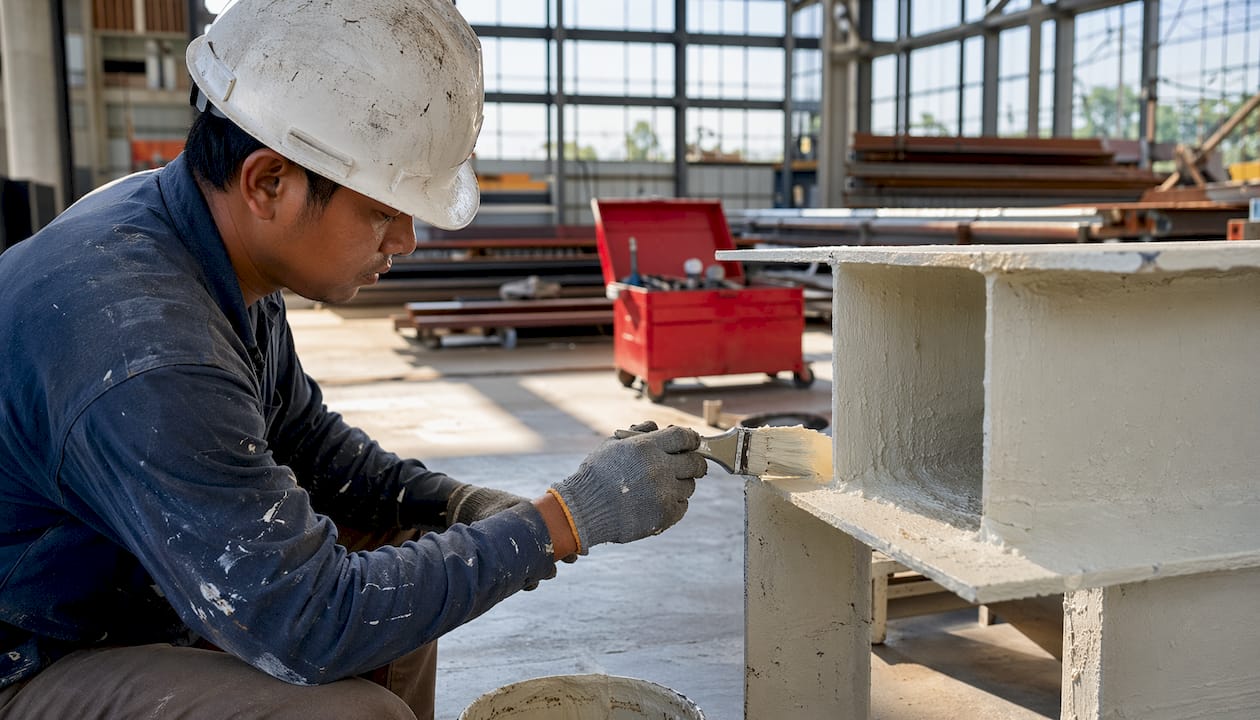
Passive fire protection with coatings delays steel temperature rise, preserving building integrity and giving occupants time to evacuate safely. Steel loses roughly half its yield strength at temperatures above 1,100°F. Without a fire protection layer, uncoated structural steel can reach that threshold in as little as 10 minutes under a standard fire exposure.
Intumescent coatings are the most widely specified solution for exposed structural steel. When surface temperature reaches 250°F to 400°F, the coating undergoes a chemical reaction. It expands 20 to 50 times its original thickness, forming a low-density insulating char layer between the fire and the steel. That expansion ratio is what makes intumescent systems so effective at slowing heat transfer.
The char layer acts as a thermal barrier. It dramatically reduces the rate at which the steel beneath it heats up. Advanced water-borne intumescent coatings can retain over 95% of steel’s yield strength after exposure to 500°C when applied at listed thicknesses. That performance level is the difference between a building that stays standing long enough for evacuation and one that collapses prematurely.
Key performance factors for intumescent coatings include:
- Activation temperature: Typically 250°F to 400°F, triggering the expansion reaction
- Expansion ratio: 20 to 50 times original thickness, forming the insulating char
- Dry film thickness (DFT): Must match the tested assembly exactly to achieve the rated fire resistance
- Fire resistance rating: Typically 1, 2, or 3 hours depending on the assembly and occupancy requirements
What building codes and testing standards govern fire protection coatings?
The 2021 International Building Code (IBC) mandates fire resistance ratings for structural steel assemblies. Those ratings must be established through testing per ASTM E119 or UL 263, which the IBC treats as functionally equivalent standards. Both test entire assemblies under standard cellulosic fire curves in restrained and unrestrained conditions, evaluating realistic structural configurations.
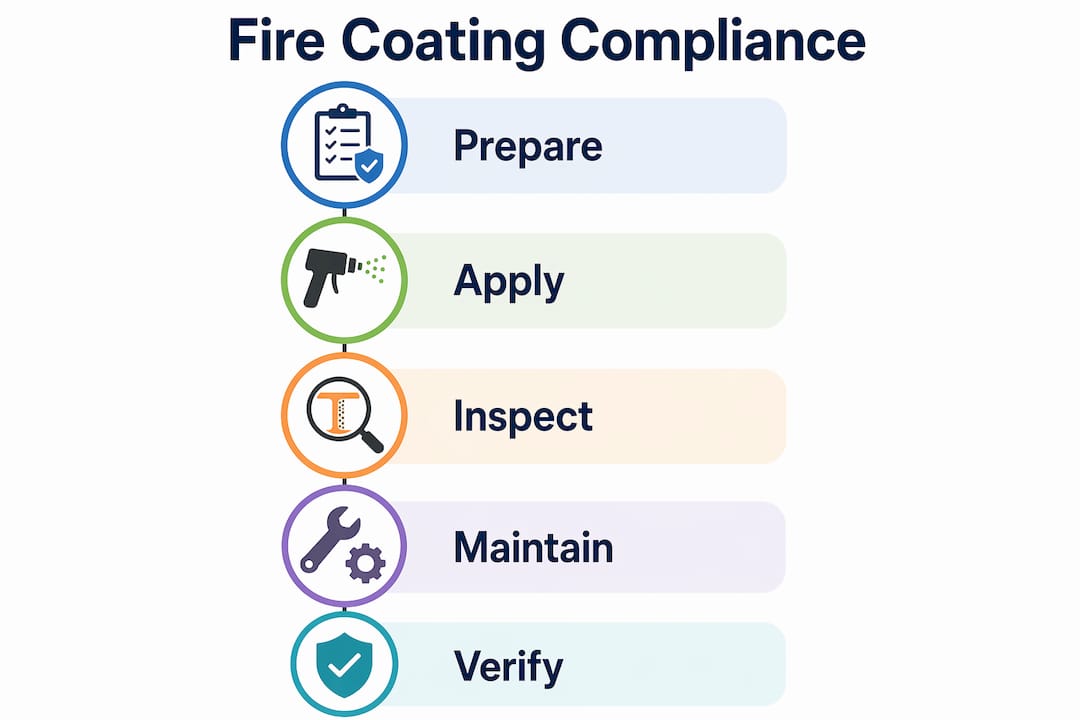
The compliance process follows a clear sequence:
- Select a listed assembly. The coating manufacturer publishes tested assemblies with specific primers, topcoats, and DFT ranges. The assembly number is the compliance anchor.
- Verify the fire resistance rating. The assembly must meet the rating required by the IBC for the occupancy type and structural element being protected.
- Confirm the evaluation report. Code officials rely on ICC Evaluation Service (ICC-ES) reports or UL listings to verify that a product meets code requirements.
- Schedule special inspections. IBC Section 1705.16 mandates special inspections specifically for intumescent coatings. These inspections verify critical application parameters and are required to avoid construction delays.
- Document everything. Inspection records, product data sheets, and DFT measurements must be retained for the authority having jurisdiction (AHJ).
Pro Tip: Request the manufacturer’s listed assembly documentation before the project specification is finalized. Changing the primer or topcoat after the fact is a code violation, not a field substitution.
Special inspections for intumescent coatings differ from those for cementitious fireproofing. The inspector must verify DFT at multiple locations, confirm primer compatibility, and check topcoat condition. These are not routine paint inspections. Contractors who treat them as such create compliance risk for the entire project.
What types of fire protection coatings are available?
Intumescent coatings come in three chemistry families: water-based, solvent-based, and epoxy. Each serves different project conditions. Water-based systems are lower in VOCs and easier to apply in occupied buildings. Solvent-based systems cure faster in cold or humid conditions. Epoxy intumescents offer the highest durability and are preferred in harsh industrial environments.
Cementitious fireproofing is less expensive but leaves a rough, textured surface. It is well suited for concealed structural steel in mechanical rooms, parking structures, and above-ceiling spaces where appearance is not a factor. Intumescent coatings produce a smooth finish and are the standard choice for exposed steel in lobbies, atriums, and open-plan commercial spaces.
Ablative coatings are a third category, used primarily in high-heat industrial applications like petrochemical facilities. They work by absorbing heat through a controlled burn-off process rather than expansion. Ablative systems are not common in standard commercial construction but are specified where jet fire or hydrocarbon fire exposure is a design scenario.
| Coating type | Finish | Best use case | Cost relative to others |
|---|---|---|---|
| Water-based intumescent | Smooth | Exposed steel, occupied buildings | Moderate |
| Solvent-based intumescent | Smooth | Cold or humid environments | Moderate to high |
| Epoxy intumescent | Smooth | Harsh industrial environments | High |
| Cementitious | Rough | Concealed steel, budget projects | Low |
| Ablative | Variable | Petrochemical, hydrocarbon fire risk | High |
DFT ranges vary significantly by coating type and required fire rating. A 1-hour rating on a standard wide-flange beam may require 30–60 mils DFT for a water-based intumescent system. A 2-hour rating on the same section could require 80–120 mils or more. These numbers come directly from the listed assembly. No field adjustment is acceptable without a new tested assembly to support it.
Pro Tip: Always cross-reference the W/D ratio (weight per unit length divided by heated perimeter) of the steel section against the manufacturer’s published DFT tables. The same coating at the same thickness performs differently on a heavy column versus a light beam.
What are the best practices for applying and maintaining fire coatings?
Surface preparation is the foundation of every effective coating application. Steel must be cleaned to the profile specified in the listed assembly, typically SSPC-SP 6 (Commercial Blast) at minimum, and often SSPC-SP 10 (Near-White Blast) for epoxy intumescent systems. Applying any fire-resistant coating over mill scale, rust, or contamination guarantees adhesion failure and voids the fire rating.
Proper compliance requires that fireproofing coatings be installed as exact matches to tested assemblies. Substituting primers, changing topcoat brands, or applying at a different DFT than specified constitutes a code violation. The fire rating belongs to the assembly, not the individual product. That distinction matters enormously when an AHJ reviews the project.
Critical application checkpoints every contractor must follow:
- Confirm primer compatibility with the intumescent mid-coat before application begins
- Measure DFT at every inspection point using a calibrated wet film gauge and dry film gauge
- Protect fresh coatings from rain, freezing temperatures, and direct sunlight during cure
- Document batch numbers for all products used, tied to the specific assembly being installed
- Inspect penetrations and connections where coating is often missed or damaged during steel erection
Maintenance is not optional after installation. Topcoat failures are the most common cause of intumescent coating degradation. Moisture intrusion through a damaged topcoat softens the intumescent layer and reduces its expansion capacity. Property managers should schedule visual inspections annually and after any renovation work that affects coated steel. Damaged areas must be repaired using the original listed assembly products, not generic coatings.
The role of coating contractors in maintaining fire protection systems extends beyond initial application. Contractors who understand assembly documentation, DFT verification, and inspection protocols protect their clients from costly compliance failures during certificate of occupancy reviews.
Key Takeaways
Fire-resistant coatings are life-safety systems that must be installed and maintained as tested assemblies to preserve their code-required fire resistance ratings.
| Point | Details |
|---|---|
| Intumescent expansion is the core mechanism | Coatings expand 20–50 times at 250°F–400°F, forming insulating char that slows steel heating. |
| Tested assemblies are legally binding | Substituting any component, primer, topcoat, or DFT voids the fire rating and violates the IBC. |
| Special inspections are mandatory | IBC Section 1705.16 requires documented inspections for intumescent coatings on every project. |
| Coating type selection depends on exposure | Intumescent suits exposed steel; cementitious suits concealed steel; epoxy suits harsh environments. |
| Maintenance preserves the fire rating | Annual topcoat inspections and prompt repairs prevent moisture intrusion and rating degradation. |
Why fire coatings deserve more respect than they get
Fire-resistant coatings are consistently underspecified and under-inspected on commercial projects. The pattern is predictable. A project team selects a coating product based on price, the contractor applies it without verifying the listed assembly, and the special inspector signs off without measuring DFT at enough locations. Nobody notices until the building department flags it during a certificate of occupancy review, or worse, until a fire reveals the gap.
The uncomfortable truth is that most coating failures in fire protection are not material failures. They are process failures. The product worked fine in the tested assembly. The problem is that the field installation did not match that assembly. A different primer was used because the specified one was backordered. The DFT was light in the corners because the applicator was rushing. The topcoat was skipped on a section of steel that “nobody would see.” Each of those decisions erodes the fire resistance rating that the building’s occupants are depending on.
Balancing aesthetics, cost, and safety is a real challenge. Intumescent coatings cost more than cementitious systems. That cost difference is real, and it matters on a tight budget. But the right way to manage that cost is to specify cementitious where it is code-compliant and appropriate, not to cut corners on the intumescent system where it is required. The industrial coating types available today give specifiers enough options to hit budget targets without compromising life safety.
Documentation is the other undervalued discipline. Batch numbers, DFT readings, inspection reports, and assembly references should be organized and retained for the life of the building. When a renovation contractor drills through a coated beam 15 years from now, that documentation tells them exactly what system to restore. Without it, they are guessing, and guessing with fire protection is not acceptable.
— Results
Southernsandblastingandpainting: fire protection coating services in Orlando
Southernsandblastingandpainting brings 20+ years of industrial surface preparation and coating experience to fire protection projects across Central Florida. The team applies fire-resistant coatings following tested assembly specifications, with documented DFT verification and full compliance support for building officials and contractors.
Surface preparation is where fire protection coating performance starts. Southern Sandblasting and Painting’s sandblasting services deliver the steel profile that listed assemblies require, from commercial blast for standard intumescent systems to near-white blast for epoxy-grade applications. Every project is supported by the documentation that AHJs and property managers need. Contact Southernsandblastingandpainting to discuss your fire protection coating requirements and get a project-specific consultation from a team that knows what compliance actually looks like in the field.
FAQ
What is the role of coatings in fire protection?
Fire-resistant coatings are passive fire protection materials that delay heat transfer to structural steel, preserving yield strength and structural integrity during a fire. They give occupants more time to evacuate and reduce the risk of catastrophic collapse.
How do intumescent coatings work?
Intumescent coatings expand 20 to 50 times their original thickness when exposed to temperatures between 250°F and 400°F, forming an insulating char layer that slows heat transfer to the steel beneath.
What standards govern fire protection coatings in the US?
The 2021 International Building Code requires fire resistance ratings established through ASTM E119 or UL 263 testing. Both standards test complete assemblies under standard fire exposure conditions and are considered functionally equivalent.
Can you substitute products within a listed fire protection assembly?
No. Substituting any component, including the primer, topcoat, or changing the DFT, voids the fire resistance rating and constitutes a code violation under the IBC.
How often should fire-resistant coatings be inspected?
Property managers should conduct visual inspections annually and after any renovation work that affects coated steel. Topcoat damage is the leading cause of intumescent coating degradation and must be repaired using the original listed assembly products.


