
TL;DR:
- Proper surface preparation accounts for 60 to 80 percent of coating durability, making it the most critical factor.
- Matching coating systems to environmental corrosivity and controlling application conditions significantly extend service life.
When a coating fails ahead of schedule on a water tank, pipeline, or airport structure, the cost goes far beyond repainting. Understanding the industrial coating durability factors that drive performance is what separates facility managers who react to failures from those who prevent them. ISO 12944 defines durability as the expected time to first major maintenance, with ratings spanning from 2 to over 25 years depending on system design and environmental conditions. This article breaks down the seven factors that most directly control how long a coating system performs before it needs attention.
Table of Contents
- Key takeaways
- 1. Surface preparation: the single biggest industrial coating durability factor
- 2. Environmental conditions and corrosivity categories
- 3. Coating system design: primers, film thickness, and layer architecture
- 4. Application conditions: temperature, humidity, and dew point
- 5. Operator skill and application execution
- 6. Real-world vs laboratory testing: closing the expectation gap
- 7. Maintenance practices and inspection frequency
- My perspective on durability as a management framework
- How Southernsandblastingandpainting supports coating durability goals
- FAQ
Key takeaways
| Point | Details |
|---|---|
| Surface prep is the foundation | Poor preparation accounts for most premature failures; target Sa 2½ blast cleaning as the baseline. |
| Environment category drives system selection | Match your coating chemistry and film thickness to the specific corrosivity category of your asset’s environment. |
| Durability is a system attribute | Primer choice and layer architecture matter more than topcoat selection alone. |
| Application conditions must be controlled | Steel surface temperature must be at least 3°C above dew point at time of application. |
| Lab tests don’t tell the full story | Interpret accelerated test data critically; real-world degradation mechanisms often differ significantly. |
1. Surface preparation: the single biggest industrial coating durability factor
No other variable controls coating performance the way surface preparation does. Surface prep accounts for 60 to 80% of long-term coating system performance, which means the coating itself is almost secondary if the substrate isn’t ready.
The target for most industrial steel applications is Sa 2½ blast cleaning per ISO 8501-1. This removes mill scale, rust, and contaminants down to a near-white metal surface with defined anchor profile. Degreasing before blasting, and verification after, are non-negotiable steps in this process.
What happens when prep falls short? Adhesion failure, early delamination, and corrosion creep under the coating film. You can apply the most technically advanced epoxy system available and still watch it fail in two years if the steel underneath wasn’t properly cleaned. Review the surface preparation workflow before specifying any coating system on critical infrastructure.
Key preparation best practices:
- Remove all grease and oil with approved solvents before abrasive blasting
- Verify blast profile using replica tape and compare to system specification
- Check for soluble salt contamination using Bresle patch testing
- Apply coating within the specified overcoat window after blasting to prevent flash rust
Pro Tip: Always document the blast profile depth and surface cleanliness grade with photographs and formal inspection reports. This protects you contractually and gives future maintenance teams accurate baseline data.
2. Environmental conditions and corrosivity categories
Not all environments are equally aggressive. ISO 12944 classifies atmospheric corrosivity in six categories from C1 (very low, typical of heated indoor spaces) to CX (extreme, as found in offshore or industrial chemical environments). Immersion environments have their own classification. Matching your coating system to the correct category is one of the most direct factors affecting coating durability.
UV radiation is particularly destructive to polymer-based topcoats. UV exposure induces polymer chain scission and embrittlement over time, which is why polyurethane and fluoropolymer topcoats are specified for exterior applications rather than standard epoxies that chalk and degrade rapidly outdoors.
Moisture is the other persistent threat. Condensation on steel surfaces, especially in coastal or high-humidity environments like Central Florida, drives osmotic blistering and accelerates corrosion under intact-looking coatings. Chemical exposure from industrial pollutants, chlorides, and acids requires specific barrier coat chemistries rather than general-purpose products.
Here’s how environmental factors stack up by impact:
- Chloride exposure (marine and coastal): Accelerates under-film corrosion; requires high-build zinc-rich primers
- UV radiation (exterior, direct sun): Degrades topcoat polymers; requires UV-stable urethane or fluoropolymer finishes
- Temperature cycling: Thermal expansion mismatch creates shear stress at the coating-substrate interface
- Chemical immersion: Requires epoxy or vinyl ester systems with specialized resistance ratings
Understanding the weather and coating durability relationship for your specific location is a prerequisite to intelligent system selection, not an afterthought.
3. Coating system design: primers, film thickness, and layer architecture
Durability is a system attribute, not a topcoat characteristic. This is the most consistently misunderstood aspect of factors affecting coating performance in industrial settings.
Zinc-rich primers, epoxy intermediates, and polyurethane topcoats work together to deliver corrosion protection at multiple levels: galvanic protection at the primer, barrier resistance through the intermediate, and UV and weathering resistance at the topcoat. Remove or downgrade any layer and you compromise the entire stack.
Total dry film thickness (NDFT) is directly tied to durability class. ISO 12944-5 is explicit on this point.
| Environment Category | Durability Level | Typical NDFT | Typical System |
|---|---|---|---|
| C3 (medium) | Medium (M) | 160–200 µm | Epoxy primer + polyurethane topcoat |
| C4 (high) | High (H) | 240–320 µm | Zinc-rich primer + epoxy MIO + PU topcoat |
| C5 (very high) | High (H) | 320–500 µm | Zinc-rich epoxy primer + epoxy intermediate + PU topcoat |
| CX (extreme) | Very high (VH) | 400–600+ µm | Multi-coat zinc-rich + high-build epoxy + specialty topcoat |
Understanding how primer vs topcoat selection shifts maintenance schedules is critical for lifecycle cost planning. A thicker, more aggressive system costs more upfront but can extend time to first maintenance from 5 years to over 15 years on the same asset.
Pro Tip: When specifying systems for hard-to-access assets like elevated water tanks or bridge girders, move up one durability class from what the environment strictly requires. The cost premium is minor compared to the mobilization cost of an unscheduled recoat.
4. Application conditions: temperature, humidity, and dew point
You can select the right system and prepare the surface correctly, then lose everything on application day if ambient conditions are wrong. This is where many industrial coating failures originate, and it’s one of the most controllable factors affecting coating longevity.
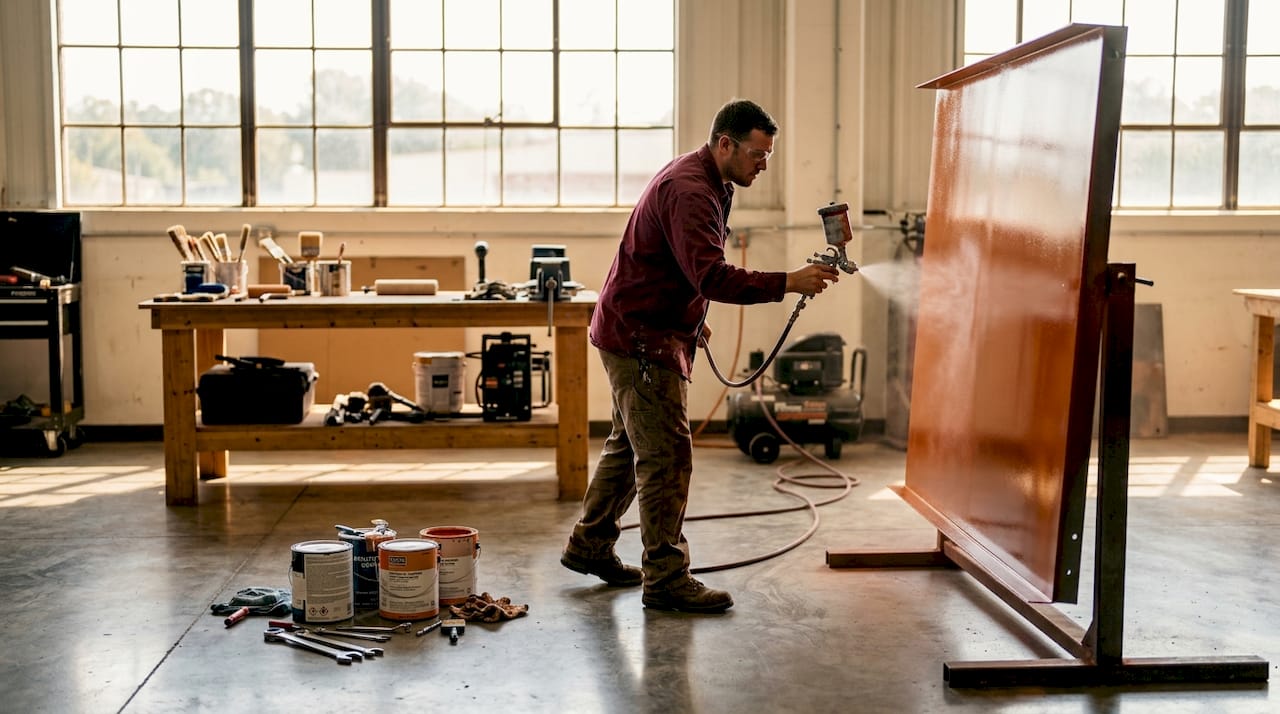
Steel surface temperature must be at least 3°C above dew point at time of application. When this isn’t met, invisible condensation forms on the steel surface and the coating bonds to water rather than metal. The result looks fine initially but fails within months as adhesion breaks down.
Equally important: dew point controls and steel surface temperature logging during application aren’t just good practice, they’re quality assurance requirements on any project meeting ISO 12944 specifications.
Daily monitoring requirements for application conditions:
- Measure and record ambient temperature, relative humidity, and dew point before each shift
- Verify steel substrate temperature with a contact or infrared thermometer
- Confirm coatings are applied within manufacturer’s specified temperature range (typically 5°C to 35°C)
- Check recoat windows between coats. Applying topcoat too early or too late affects intercoat adhesion
Pro Tip: Require contractors to submit a daily ambient conditions log as a formal project deliverable. If conditions fall outside spec, coating must stop. This one requirement prevents the majority of application-related failures.
5. Operator skill and application execution
Even with perfect conditions and the right system, application execution matters enormously. Spray technique, wet film thickness consistency, and timing between coats all affect the final cured film quality in ways that are largely invisible until failure occurs.
Inconsistent film thickness is a common issue. Areas of insufficient thickness underperform the system specification. Runs and sags create stress concentrations. Holidays (pinholes and uncoated spots) allow direct moisture and ion ingress to the substrate.
The difference between a coating system that reaches its designed durability class and one that fails early often comes down to the crew applying it. This is why Southernsandblastingandpainting emphasizes applicator training and supervision on every project, not just material specification compliance.
6. Real-world vs laboratory testing: closing the expectation gap
Accelerated lab tests are useful for screening and comparison, but they don’t always predict real-world performance accurately. This has direct implications for how you interpret coating data sheets and manufacturer durability claims.
Water-borne polyurethane coatings show near-equivalent outdoor durability to solvent-borne formulations on steel bridges, despite performing differently in accelerated tests. If you were making a selection based purely on cyclic corrosion test results, you might overweight the solvent-borne option and pay more without gaining real-world benefit.
The dominant failure mechanisms also differ between lab and field. In-service coating failure is driven by inhibitor leaching and polymer degradation through hydrolysis and thermo-oxidation. Many accelerated tests don’t replicate these mechanisms with the right intensity or sequence. Coating failure often begins as microscopic moisture ingress through the barrier film long before visible degradation appears, which means performance-based inspection is more reliable than visual checks alone.
The practical takeaway: treat lab data as directional, not definitive. Ask suppliers for field exposure data from environments that actually match your asset’s conditions.
7. Maintenance practices and inspection frequency
Even the best-specified and applied coating system degrades. How you monitor and respond to that degradation is one of the most underappreciated factors affecting coating longevity in operational facilities.
Coating longevity depends on controlling heat load, moisture penetration, and substrate movement over time. Regular inspection intervals catch early-stage degradation before it becomes a recoat event. Edge corrosion, chalking topcoats, blistering at welds, and rust creep at scribes are all indicators that tell you where you are in the coating lifecycle.
Industrial coatings maintenance tips that actually extend asset life center on one discipline: inspection before deterioration becomes structural. A documented inspection schedule tied to the ISO 12944 durability class of each asset gives you a defensible, proactive maintenance program rather than a reactive one. For high-criticality assets in corrosive environments, annual or biannual inspection is not excessive.
My perspective on durability as a management framework
I’ve worked around industrial coating projects long enough to see a consistent pattern. The facilities that get the most life out of their coatings aren’t necessarily the ones that specify the most expensive systems. They’re the ones that treat durability as a management discipline, not just a materials question.
When I think about what actually drives failure, it almost always traces back to one of three things: a surface prep shortcut, an application day where conditions were borderline and no one stopped work, or a maintenance cycle that slipped because the coating still looked okay visually. Primer selection has an outsized impact on durability compared to topcoat metrics alone, but in practice, facility managers often focus exclusively on the topcoat spec and ignore what’s underneath.
Thermal and moisture stress are the silent accelerants most planning documents don’t adequately address. In hot, humid environments, a coating system is under mechanical and chemical stress every single day. Building that reality into your inspection frequency and system selection is what separates a 15-year maintenance cycle from a 7-year one on the same asset class.
— Southernsandblastingandpainting
How Southernsandblastingandpainting supports coating durability goals
If the factors covered in this article feel like a lot to manage, that’s because they are. Getting coating durability right requires coordinating surface preparation, system selection, application conditions, and ongoing inspection into a single quality-controlled process.
Southern Sandblasting and Painting brings over 20 years of experience doing exactly that for municipalities, airports, water utilities, and industrial facilities across Central Florida. The team handles professional Sa 2½ sandblasting and surface prep through to ISO 12944-aligned coating application, with daily ambient condition logging and formal QA documentation as standard practice. Whether you’re specifying a new coating system for a water tank or planning a maintenance recoat on city infrastructure, start with the surface prep best practices resource or reach out directly for a project consultation.
FAQ
What is the most important factor in industrial coating durability?
Surface preparation is the single most important factor, accounting for 60 to 80% of long-term coating system performance according to ISO 12944. A properly blasted, cleaned, and inspected substrate is the foundation everything else depends on.
How does ISO 12944 define coating durability?
ISO 12944 defines durability as the expected time to first major maintenance, with classifications ranging from low (2 to 5 years) through medium, high, and very high (over 25 years) depending on environment and system design.
Why do coatings fail even when the right product is specified?
Most premature failures trace back to application conditions rather than product selection. Steel surface temperature below 3°C above dew point, or application outside manufacturer temperature limits, creates adhesion defects that are invisible at installation but cause early failure.
How do you improve coating durability in aggressive environments?
To improve coating durability in high-corrosivity categories (C4, C5, or CX), use zinc-rich primers, increase total dry film thickness per ISO 12944-5 guidelines, specify UV-stable topcoats, and implement a documented inspection program tied to the system’s durability class.
Are water-borne coatings as durable as solvent-borne on steel structures?
Field evidence shows water-borne polyurethanes approach solvent-borne durability on steel bridges in real-world exposure, despite differences in accelerated test results. System design, surface prep, and application conditions matter more than solvent type in most cases.
Recommended
- Industrial Coating Terminology: Keys for Asset Longevity
- Role of Coatings in Longevity – Extending Asset Lifespans
- Industrial Coating Application Steps for Lasting Protection
- How to Apply Protective Coatings for Lasting Asset Durability
- Sandblasting Contractor Baldwin Park FL
- Sandblasting Services Oviedo FL


