
TL;DR:
- Florida facilities require region-specific maintenance checklists focused on storm readiness, humidity, and coastal corrosion.
- Proper documentation and regular review are critical for compliance and effective asset protection in Florida’s environment.
- Proactive surface preparation and coating inspections save costs by preventing hidden damage from humidity and salt air.
Skipping one item on your maintenance checklist can cascade into a $50,000 emergency repair, a failed compliance audit, or a full facility shutdown. Florida’s unique combination of extreme humidity, hurricane seasons, and strict municipal regulations makes this risk even higher than in most other states. For facility managers and contractors across Central Florida’s commercial and municipal sectors, a structured, locally adapted checklist is not optional. It is the difference between proactive asset protection and reactive crisis management. This article walks you through a practical, evidence-based approach to building and executing a maintenance checklist that works in Florida conditions.
Table of Contents
- Setting maintenance priorities in industrial facilities
- Core facility maintenance checklist items
- Compliance and documentation best practices
- Optimizing your checklist for Florida-specific risks
- Why most checklists fail: Lessons from Florida facility audits
- How Southern Sandblasting & Painting streamlines facility maintenance
- Frequently asked questions
Key Takeaways
| Point | Details |
|---|---|
| Prioritize safety and compliance | Always focus maintenance resources on critical areas to prevent costly disruptions or regulatory penalties. |
| Adapt for Florida climate | Customize your checklist for humidity, storms, and coastal risks to keep assets resilient. |
| Document every action | Maintain thorough inspection and repair records to streamline audits and meet legal requirements. |
| Review and update regularly | Update your checklist at least quarterly to address new regulations and local risks. |
| Expert support adds value | Using specialized sandblasting and painting services strengthens your maintenance outcomes. |
Setting maintenance priorities in industrial facilities
Before you build your checklist, you need a clear system for ranking what gets done first. Not all maintenance tasks carry equal weight. Some protect lives, others protect budgets, and some protect your legal standing. The smartest facility managers treat these three categories separately and schedule accordingly.
Start with safety and compliance. Safety and compliance priorities are central to any facility maintenance program, and skipping them exposes you to OSHA violations, insurance gaps, and liability claims. These are always your first priority, no debate.
Next, protect your most expensive assets. In Florida, that means paying close attention to anything exposed to the elements. Humidity averaging above 70% year-round accelerates corrosion on structural steel, electrical conduits, and mechanical systems. Salt air along coastal facilities adds another layer of degradation. Following maintenance best practices built around Florida’s environment will extend asset life by years.
Here is a framework for categorizing your tasks:
- Safety-critical: Fire suppression, emergency lighting, fall protection, hazardous material containment
- Compliance-driven: HVAC inspections, environmental reporting, coating condition reviews, permit renewals
- Asset-protective: Structural surface inspections, coating inspections, corrosion monitoring, drainage maintenance
- Operational continuity: Generator testing, backup system checks, utility inspections
Florida’s hurricane season runs June through November. That window should anchor your annual scheduling. Complete your most intensive inspections and surface repairs before June so your facility enters storm season in peak condition.
Pro Tip: Schedule your heavy maintenance work between January and April. You avoid peak storm risk, contractor availability is better, and you get time to address findings before summer heat pushes humidity to its worst levels.
One compliance point that many managers overlook: auditors want documentation, not just completion. As one industrial compliance officer noted, “A facility that passes every inspection but has no paperwork to prove it is treated the same as one that never ran the inspection at all.” Build documentation into every task from day one.
Core facility maintenance checklist items
With your priorities established, the next step is building the actual checklist. This is where specificity matters. Generic checklists miss Florida-specific failure points that cost managers time and money every year.
Routine maintenance tasks ensure safe and operational facilities, but the sequence and frequency of those tasks determine how much value you actually get from them. Here is a numbered checklist of the core items every Florida industrial or municipal facility should include:
- Fire suppression systems: Monthly visual checks, quarterly pressure tests, annual full inspections
- HVAC systems: Monthly filter replacements, quarterly coil cleaning, biannual refrigerant checks
- Plumbing and drainage: Monthly visual checks, quarterly backflow preventer testing, annual drain line inspections
- Electrical panels and conduit: Monthly visual checks for corrosion, annual thermographic scanning
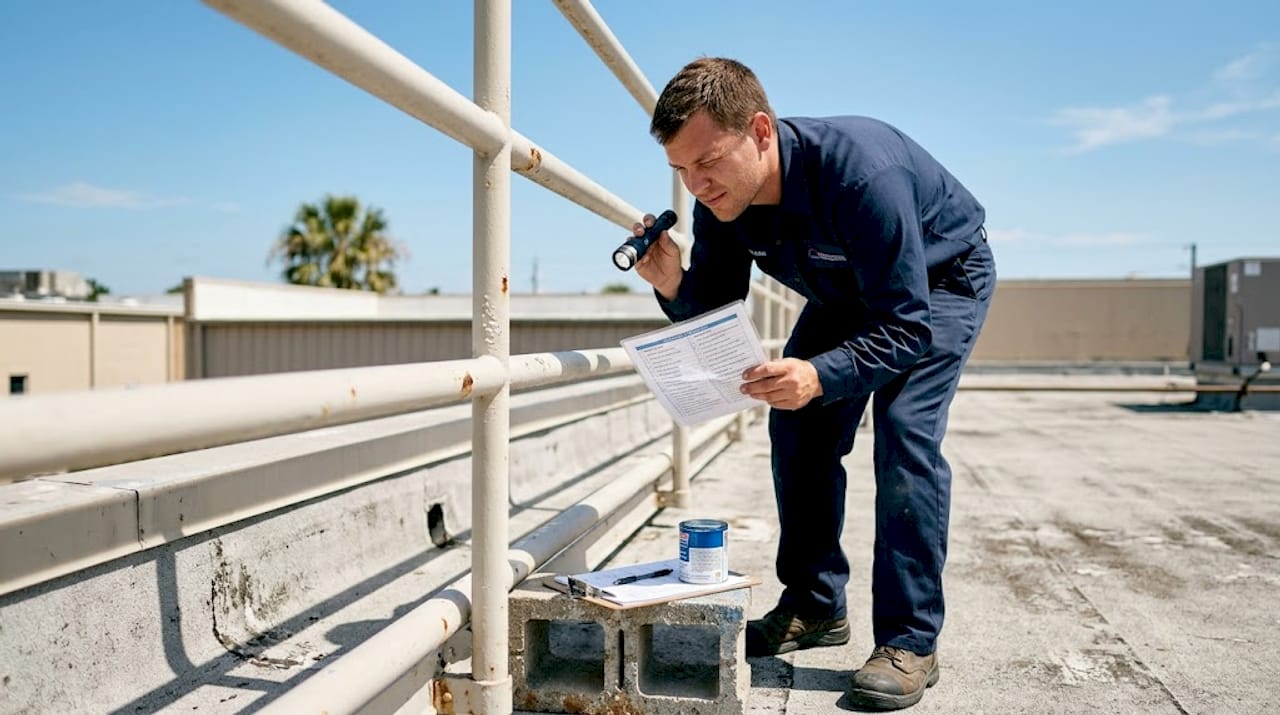
- Structural surfaces: Quarterly inspection for rust, coating failure, or impact damage
- Surface prep and painting touch points: Review your painting checklist for Florida to time recoating cycles correctly
- Emergency backup power: Monthly generator testing, quarterly load bank tests
- Alarm and detection systems: Monthly sensor tests, annual third-party verification
Use the table below to organize your inspection schedule at a glance:
| Task | Frequency | Method |
|---|---|---|
| Fire suppression check | Monthly / Annual | Visual + pressure test |
| HVAC filter change | Monthly | Physical replacement |
| Electrical corrosion scan | Monthly / Annual | Visual + thermographic |
| Structural surface inspection | Quarterly | Visual + coating gauge |
| Generator load test | Quarterly | Automatic transfer switch test |
| Full facility compliance review | Annual | Third-party audit |
For anything involving paint durability and compliance, note that Florida’s UV intensity and humidity can shorten coating lifespans by 30% compared to drier northern climates. Build recoating cycles into your checklist proactively, not reactively.
Compliance and documentation best practices
A checklist you cannot prove you ran is worth nothing during an audit. Florida facilities face oversight from OSHA, the Florida Department of Environmental Protection, local fire marshals, and municipal code enforcement. Each agency wants records. Giving them clean, organized documentation is the fastest way to pass any inspection.
Documentation is key for compliance and audit readiness, and the format you choose matters almost as much as the content. Here is a comparison of your two main options:
| Feature | Digital documentation | Paper documentation |
|---|---|---|
| Search and retrieval | Instant keyword search | Manual file search |
| Audit sharing | Email or portal upload | Physical copies required |
| Version control | Automatic timestamps | Manual dating |
| Backup and recovery | Cloud redundancy | Fire or flood risk |
| Cost | Software subscription | Printing and storage |
The case for going digital is strong. But many Florida facilities, especially older municipal buildings, still rely on paper. If that is your situation, at minimum scan completed checklists monthly and store them in a secure cloud location.
Recommended record-keeping practices for Florida facilities:
- Log every inspection with date, inspector name, and outcome
- Keep contractor invoices and reports attached to the related inspection record
- Photograph any defects found and document repairs made
- Track permit expiration dates alongside your maintenance calendar
- Review industrial safety best practices when updating your records protocol
- Cross-reference coating inspections in Florida results with your annual surface maintenance log
“Facilities that conduct quarterly internal audits cut their average compliance violation rate by more than half compared to those relying only on annual third-party reviews.” This is a pattern seen consistently across Central Florida municipal clients.
Build a retention policy too. Most Florida regulations require maintenance records to be kept for a minimum of three years, with some environmental compliance records extending to seven years. Know which rules apply to your facility type before you set up your filing system.
Optimizing your checklist for Florida-specific risks
A generic checklist built for a warehouse in Ohio will leave dangerous gaps when applied to a waterfront municipal facility in Tampa or an industrial plant near Orlando. Florida’s environment demands specific additions.
Surface preparation is critical for facilities exposed to Florida’s climate, especially when you factor in the combination of UV radiation, salt air, and humidity cycles that stress coatings far faster here than in other regions. Ignoring these risks until a coating fails is the most expensive maintenance decision you can make.
For hurricane and storm readiness, add these tasks to your checklist before June:
- Inspect and secure roof attachments, skylights, and overhead doors
- Clear storm drains and retention ponds of debris
- Test sump pumps and emergency water removal equipment
- Verify backup generator fuel reserves and transfer switch operation
- Document the pre-storm condition of all exterior surfaces
For humidity and corrosion prevention, which applies year-round in Florida:
- Apply moisture-barrier coatings to exposed structural steel on schedule
- Inspect pipe insulation monthly for condensation-related deterioration
- Check expansion joints on concrete for water infiltration
- Keep dehumidification systems calibrated in enclosed mechanical spaces
For asset protection in Florida in coastal locations, salt air demands an accelerated inspection cycle. Facilities within five miles of the coast should double the frequency of all surface and coating inspections.
Pro Tip: Do not wait for visible rust before scheduling surface prep. By the time rust is visible on a coated surface, the metal underneath has already lost significant structural integrity. Proactive recoating costs a fraction of structural repair.
Adding a regional risk column to your checklist table helps. Tag each task with its primary risk driver: hurricane, humidity, UV, or salt. This makes it immediately clear which tasks need acceleration when seasonal conditions peak.
Why most checklists fail: Lessons from Florida facility audits
After working with municipal clients and commercial facilities across Central Florida for over 20 years, we have seen a clear pattern. Most checklist failures are not about effort. They are about design.
The biggest mistake managers make is downloading a generic industry template and assuming it covers their facility. It almost never does. A checklist built for a climate-controlled manufacturing plant in Atlanta will miss every Florida-specific corrosion and storm risk that our region demands. Following maintenance best practices insights specific to your facility type is where compliance actually starts.
The second failure point is not reviewing and updating the checklist. Regulations change. Equipment ages. New assets are added. A checklist that worked in 2023 may miss three critical items by 2026. Build a formal quarterly review of your checklist into your calendar, not just a review of your inspections.
Finally, ownership matters. Assign a named responsible party to each checklist item. When everyone is responsible, no one is responsible. Facilities that tie individual tasks to specific staff members catch deficiencies faster and close them more consistently.
How Southern Sandblasting & Painting streamlines facility maintenance
If your checklist has identified gaps in surface condition, coating failures, or storm damage repair, professional implementation support makes the difference between a plan and a result.

Southern Sandblasting & Painting LLC brings over 20 years of experience working directly with Florida municipalities, contractors, and commercial facility managers. Our team specializes in the coating application steps that protect your assets through Florida’s toughest seasons, from industrial sandblasting to compliance-ready coatings. Whether you need targeted surface prep on a specific asset or a facility-wide protective coating program, our Orlando sandblasting services are built for Florida conditions. Explore our full range of sandblasting and painting services to find the right solution for your maintenance program.
Frequently asked questions
What should a facility maintenance checklist include for Florida environments?
Your checklist should cover safety inspections, storm readiness, corrosion prevention, and compliance documentation adapted to Florida’s climate. A strong starting point is reviewing the surface preparation checklist used for city projects to see what task categories apply to your facility.
How often should facility maintenance checks be performed?
Critical systems should be checked monthly, with full facility reviews at least quarterly and before hurricane season. Inspection routines at regular intervals are a baseline requirement for compliance, not just best practice.
How does humidity impact maintenance checklists in Florida?
High humidity accelerates corrosion and coating failure, making regular surface treatment a non-negotiable checklist item. Facilities that follow surface preparation tips tailored to Florida’s climate consistently see longer asset lifespans.
What documentation helps most during compliance audits?
Detailed records of inspections, repairs, and contractor services in digital format give auditors what they need quickly. Applying best practices for compliance to your documentation system means you are prepared well before an auditor arrives.


