
TL;DR:
- Premature coating failure on city infrastructure leads to significant costs and compromised asset longevity. Proper surface preparation, environmental checks, and staged inspections based on industry standards are critical to ensuring coating durability in harsh climates like Florida’s. Adhering to systematic, standards-driven processes prevents costly rework and extends infrastructure lifespan.
Premature coating failure on city infrastructure isn’t just an eyesore. It’s a budget disaster that can cost municipalities two to five times the original project price when you factor in emergency recoating, traffic disruptions, and accelerated asset degradation. In Central Florida’s relentless combination of UV exposure, saltwater humidity, and seasonal temperature swings, improperly sequenced painting steps can cause a coating that should last 15 years to fail in under three. This guide gives city project managers and commercial property owners a structured, standard-referenced approach to getting it right the first time.
Table of Contents
- What you need before starting: tools, standards, and environmental checks
- Step-by-step: proven painting process for city infrastructure
- Common mistakes and edge cases: avoiding costly failures
- Inspection and quality assurance: verifying each step
- Why city painting success is about systems, not shortcuts
- Get expert help for your next city painting project
- Frequently asked questions
Key Takeaways
| Point | Details |
|---|---|
| Prioritize surface standards | Following AMPP/SSPC-NACE surface prep standards is essential for long-lasting coatings on city infrastructure. |
| Control dust and moisture | Proper cleaning and curing times are critical, especially in humid regions like Central Florida. |
| Inspect every step | Ongoing inspections prevent mistakes and ensure compliance, reducing costly failures or rework. |
| Adapt for materials | Steel, stucco, and concrete each have unique preparation and moisture management needs. |
What you need before starting: tools, standards, and environmental checks
With the stakes set, you need to ensure all materials and site conditions meet exacting standards before the first abrasive hits the surface. This is where most city projects quietly go wrong. Teams show up with the right intent but miss critical prerequisites, and by the time the failure appears, the prep crew is long gone and the warranty is void.
Setting the standard baseline
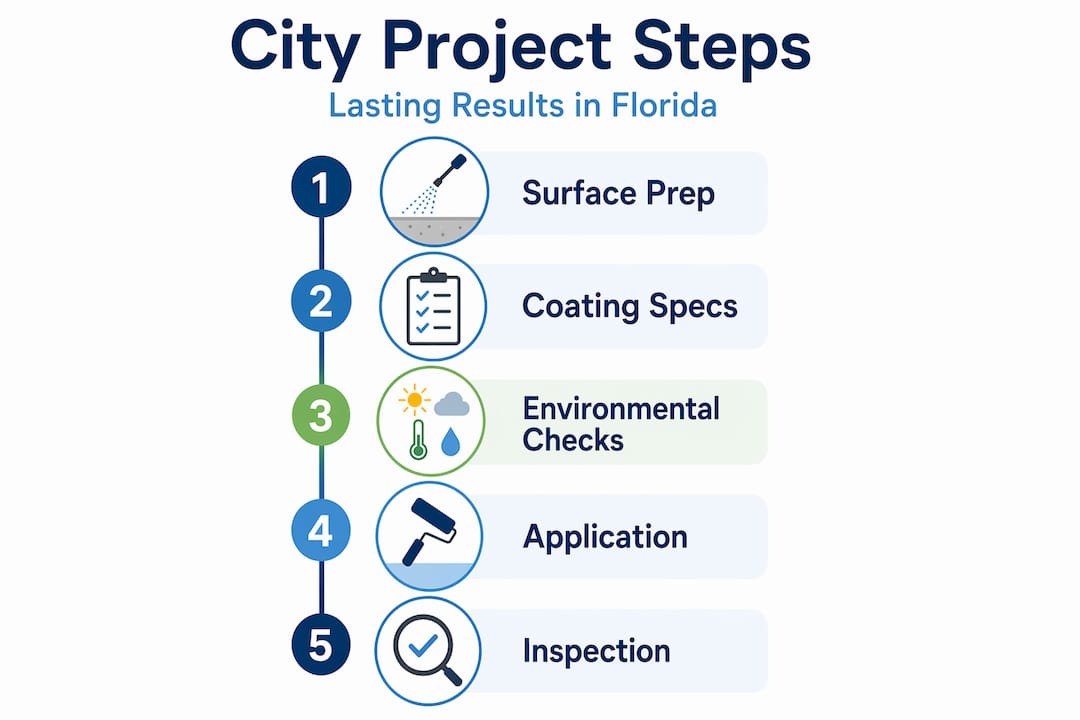
Every city painting project should be governed by AMPP/SSPC-NACE surface preparation standards. These are the industry benchmarks developed jointly by the Association for Materials Protection and Performance (AMPP) and the National Association of Corrosion Engineers (NACE). The Coating Inspector Program from AMPP exists precisely because coating work on city infrastructure must be verified through documented inspections, not just followed as a generic checklist. If your contract documents don’t reference a specific SSPC/NACE prep standard by number, that’s your first red flag.
You’ll also want to specify the right coating systems for city projects before mobilizing. The coating type dictates the required surface profile, which in turn determines the blast media and equipment you need on site.
Essential tools and equipment checklist
Before work begins, verify you have all of the following on site and in working condition:
- Abrasive blast equipment (pressure pots, nozzles, media appropriate to the substrate)
- High-pressure water jetting equipment if recoating existing steel
- Dust control systems including vacuums rated for industrial abrasive dust
- Moisture meters (digital, calibrated to the substrate type)
- Psychrometer or digital hygrometer for ambient humidity readings
- Surface profile comparators (NACE/AMPP replica tape or Testex Press-O-Film)
- Holiday detector for post-application pinhole testing
- PPE including supplied-air respirators, blast hoods, gloves, and anti-static suits
- Containment systems to prevent environmental contamination
Pro Tip: In Central Florida, schedule your blast and coat operations for early morning when relative humidity is lowest. By mid-afternoon in summer, humidity regularly climbs above 80%, which can prevent proper adhesion and cause flash rusting on bare steel within minutes of blasting.
Environmental prerequisites specific to Florida
Florida’s climate isn’t forgiving. The state averages over 230 sunny days per year, but those sunny days bring intense UV and surface temperatures that can spike 20 to 30 degrees above ambient air temperature on steel and dark concrete. Before starting any coating application, confirm:
| Environmental factor | Acceptable range | Florida risk level |
|---|---|---|
| Relative humidity | Below 85% | High (seasonal) |
| Surface temp vs. dew point | Min. 5°F above dew point | Very high in summer |
| Wind speed | 5 to 20 mph | Moderate |
| Ambient temperature | Per coating TDS | Moderate |
| Surface moisture | 0% for most coatings | High near coast |
Skipping these checks isn’t a minor oversight. It’s a setup for adhesion failure and premature delamination that no coating manufacturer will cover under warranty.
Step-by-step: proven painting process for city infrastructure
Once you have assembled the right resources and checked conditions, you can move systematically through each painting step. The sequence matters as much as the individual steps. Rushing or reordering even one phase can compromise the entire system.
The complete process, in order
- Remove loose material and existing coatings. Use scraping and wire brushing to remove any flaking paint, heavy rust scale, or loose debris. This prepares the surface for more effective mechanical abrasion.
- Degrease and clean. Apply a solvent wash or detergent solution to remove oils, grease, and biological growth. Rinse thoroughly. Any oil left on the surface will prevent bonding at every subsequent step.
- Select and execute abrasive blast cleaning. For new steel and most bridge or water tank rehabilitation work, SP10/NACE No. 2 (Near-White Metal Blast) is the standard minimum. This removes at least 95% of all mill scale, rust, and foreign matter. For less critical steel or recoating scenarios, SP6/NACE No. 3 (Commercial Blast) may be acceptable, but verify this with the coating manufacturer.
- Apply high-pressure water jetting where specified. When abrasive blasting is restricted by site conditions or environmental regulations, SSPC-SP12/NACE 5 governs the use of high-pressure water jetting as an approved alternative for steel and other hard materials prior to recoating. This is increasingly common on bridge rehabilitation projects in urban areas.
- Inspect weld zones on steel structures. Municipal steelwork, particularly bridges and water treatment structures, contains welds that require specific pre-coating attention. Sharp weld peaks, spatter, and undercut areas create thin film points and stress concentrations. The coating inspection of welds must confirm that weld zones are ground smooth, free of spatter, and blasted to the same profile as the adjacent base metal before coating proceeds.
- Verify surface profile and cleanliness. Use replica tape to confirm the achieved anchor profile matches the coating system requirements. Profiles that are too shallow reduce adhesion; profiles too deep cause thin spots at peaks.
- Allow proper flash time before priming. Bare steel begins to oxidize within minutes in Florida’s humid air. Prime within the window specified by the coating manufacturer, typically two to four hours after blasting, and never allow overnight exposure without reblasting.
- Apply primer coat. Use a brush, roller, or airless spray as specified. Stripe coat all edges, welds, bolts, and rivets with a brush before the full coat to ensure adequate film build in these vulnerable zones.
- Inspect primer dry film thickness (DFT). Use a calibrated DFT gauge to verify the primer coat meets the minimum thickness specified in the coating system data sheet.
- Apply intermediate and topcoats per the coating schedule. Each coat needs to cure to the recoat window. Apply the next coat too soon and you trap solvents; apply too late and you break the intercoat bond.
- Final inspection and documentation. Record all readings, weather logs, batch numbers, and inspector sign-offs. This documentation protects the municipality if the coating fails prematurely.
Pro Tip: For stucco and concrete substrates (common in Florida municipal buildings), you must allow a full 28-day cure before coating new concrete. Stucco needs a pH test prior to coating because fresh stucco is highly alkaline and will destroy most coatings from beneath.
Substrate comparison: what changes based on material
| Substrate | Blast standard | Key prep concern | Cure requirement |
|---|---|---|---|
| Structural steel | SP10/NACE No. 2 | Weld zones, mill scale | Prime within 2 to 4 hours |
| Bridge steel (recoat) | SP12/NACE 5 (WJ) | Existing coating removal | Same day priming |
| Concrete | ICRI CSP 3 to 5 | Moisture content, pH | Min. 28-day cure |
| Stucco | ICRI CSP 2 to 3 | Alkalinity, cracks | Min. 28-day cure |
Refer to the full coating process guide for substrate-specific coating system recommendations.
Common mistakes and edge cases: avoiding costly failures
Even with a solid plan, pitfalls are everywhere. Most failures in city coatings are avoidable but rarely obvious at first. The damage typically shows up six to eighteen months after project closeout, which makes accountability difficult and makes the municipality foot the bill for corrective work.
The failures that show up most often
- Dust residues after abrasion. This is the single most overlooked failure point. After blast cleaning, abrasive particles and steel dust settle back onto the prepared surface. If not removed with clean compressed air and a vacuum, these particles become contamination layers under the primer.
- Insufficient moisture management on stucco and concrete. As common coating failures confirm, inadequate dust control after abrasion and failure to manage moisture before coating are two of the most frequent causes of premature breakdown on stucco and concrete surfaces. Moisture trapped beneath a coating doesn’t just cause blistering; it feeds mold, accelerates substrate deterioration, and can cause full delamination within a single rainy season.
- Recoating too soon. In Florida’s heat, crews often assume faster surface drying means faster cure. It doesn’t. Solvent entrapment in a topcoat applied too soon is a common cause of wrinkling and intercoat adhesion failures.
- Coating over contamination. Chloride contamination near coastal Central Florida sites is real. Salt crystals invisible to the eye accelerate osmotic blistering at an alarming rate once sealed under a coating.
“The most expensive coating failures we’ve seen in Florida weren’t caused by the wrong product. They were caused by the right product applied over the wrong surface condition.” This is a field reality that every city project manager needs to internalize.
Moisture as the primary enemy
A quality moisture meter isn’t optional equipment. On moisture-related coating failures, the pattern is consistent: sites that skipped moisture verification before coating application account for the majority of warranty claims and early failures on Florida municipal projects. For concrete and stucco, the substrate moisture content should be below 5% before coating. For steel, the surface temperature must remain at least 5°F above the dew point throughout the application window.
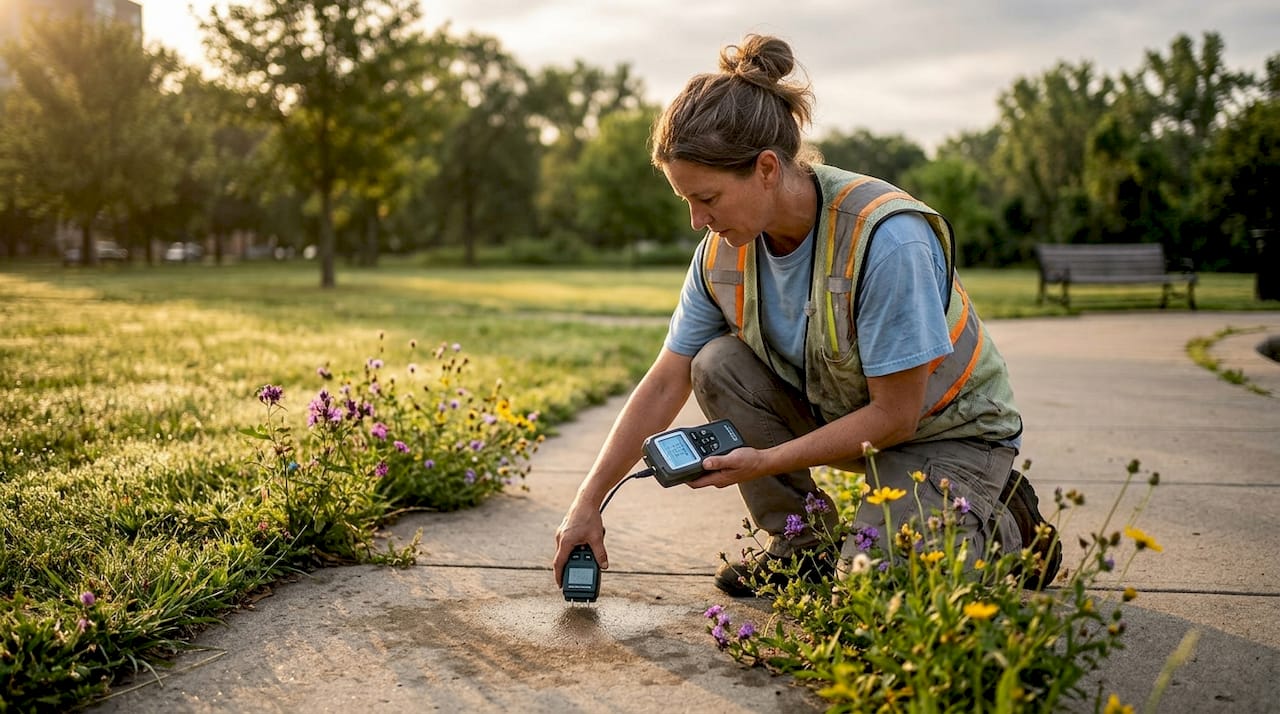
Studies of coating lifecycle performance on infrastructure in high-humidity climates show that moisture-related failures account for over 60% of coating system rejections on municipal projects. That’s a staggering number, and it’s almost entirely preventable with proper pre-application checks and the right surface prep best practices.
Inspection and quality assurance: verifying each step
To eliminate surprises and early failures, inspections aren’t a final step. They must punctuate the entire process, from pre-blast checks all the way through final topcoat application. A single uninspected stage can undermine an otherwise compliant project.
What to inspect at each stage
- Pre-blast: Confirm surface temperature, dew point differential, ambient humidity, and substrate condition (existing coating adhesion, visible contamination, weld condition)
- Post-blast: Verify blast profile using replica tape, check for residual dust and abrasive, confirm no visible rust bloom or recontamination
- Pre-prime: Recheck moisture content and ambient conditions, confirm the blast profile is still intact and uncontaminated
- During primer application: Monitor wet film thickness (WFT) using a wet film gauge, confirm spray parameters and overlap
- Post-primer: Measure dry film thickness at multiple points per SSPC-PA 1 requirements, document batch numbers and weather data
- During intermediate and topcoat: Repeat WFT and DFT checks, verify intercoat adhesion windows, inspect for runs, sags, or holidays
- Final inspection: Holiday detection using appropriate voltage for the coating type, final DFT readings, full documentation package
The AMPP Coating Inspector Program certifies inspectors specifically to perform this level of structured, standard-driven field verification. Requiring a CIP-certified inspector on city painting contracts is one of the single most effective ways to protect public infrastructure investment.
Pro Tip: Don’t rely on visual inspection alone for DFT verification. A coat can look perfect and still be below minimum thickness in localized areas, especially around complex geometry. Use a Type 2 electronic gauge with calibration verified at the start of each shift.
To verify coating compliance on your next project, build the inspection checkpoints directly into the project schedule as milestones. No inspection sign-off means the next phase doesn’t start. This simple rule prevents contractors from pulling ahead and then trying to retroactively document what should have been verified in real time.
Why city painting success is about systems, not shortcuts
After more than two decades working on infrastructure projects across Central Florida, the clearest pattern we’ve seen isn’t technical. It’s behavioral. Projects fail not because contractors don’t know the steps, but because they treat those steps as a checklist to complete rather than a system to execute with discipline.
Mechanical adherence to steps, where a crew goes through the motions without understanding why each step exists, produces work that passes a casual visual review but fails within two Florida wet seasons. The contractor who knows that post-blast dust removal matters because of adhesion physics, not because it’s item 4 on the spec sheet, is the contractor whose work is still intact a decade later.
Standards like SSPC and AMPP don’t exist to create paperwork. They encode decades of failure analysis into field-applicable requirements. When a spec calls for SP10/NACE No. 2 on a water treatment tank, it’s because every deviation from near-white metal on submerged steel surfaces has a documented failure rate. Treating these requirements as negotiable is how municipalities end up repainting bridges every four years instead of every fifteen.
The hardest lesson from Florida projects specifically is humidity management. Florida’s climate is hostile to coating work in a way that is easy to underestimate if your experience comes from drier states. We’ve seen projects in the Orlando metro area where every step was technically correct but the team applied primer at 3 PM in August when the surface dew point differential had dropped to 2°F. The coating looked fine for eight months. Then blistering started under the topcoat. The entire project had to be reblasted and recoated at the city’s expense.
The best practices for city coatings that actually work in this climate require treating the coating system as an engineered solution with defined environmental tolerances, not a product you apply and walk away from. When your team builds that mindset into the project culture, the checklist stops being a burden and starts being a quality assurance engine.
Get expert help for your next city painting project
For city managers and property owners who want to eliminate guesswork and risk, here’s where to turn.
Southern Sandblasting & Painting LLC has delivered standard-compliant surface preparation and industrial coating services across Central Florida for over 20 years, working with municipalities, water authorities, airports, and commercial facility managers on exactly the types of projects described in this guide. We understand Florida’s climate because we work in it every day.
When your project involves structural steel, water infrastructure, or large-scale concrete or stucco surfaces, the margin for error is too small for generalist contractors. Our team brings certified inspectors, compliant blast equipment, and field-proven coating systems together under one roof. Explore our full coating application steps guide for a deeper look at our process, or review our surface prep best practices to benchmark your current approach. When you’re ready to talk project specifics, we’re ready to put our experience to work for your infrastructure.
Frequently asked questions
What standards govern city infrastructure painting projects?
City infrastructure painting should reference AMPP/SSPC-NACE surface preparation standards by specific designation number, and all work should be verified through documented inspections at defined project milestones to maintain compliance and protect warranty coverage.
Why does painting on city projects often fail in Florida?
Most failures trace back to moisture mismanagement and skipped prep steps, particularly inadequate dust removal after abrasion blasting and coating applied before stucco or concrete surfaces have reached acceptable moisture content.
What is the role of inspection at each stage of city painting?
Stage-by-stage inspections enforce AMPP/SSPC-NACE standards at each critical hold point, preventing out-of-sequence work and catching surface deficiencies before they get sealed under a coating layer where they can cause premature failure.
What is high-pressure water jetting and when is it used?
High-pressure water jetting is an approved surface cleaning method for recoating steel and other hard materials, governed by SSPC-SP12/NACE 5, and is commonly used in urban infrastructure projects where dry abrasive blasting is restricted by environmental or site access constraints.
Recommended
- Maintain painted surfaces in Florida for lasting protection
- Infrastructure painting checklist for Florida 2026
- Role of painting contractors in Florida projects 2026
- commercial painting orlando fl – Resources – Southern Sandblasting & Painting LLC
- Sandblasting Contractor Baldwin Park FL
- Sandblasting Services Oviedo FL


