
TL;DR:
- Hydroblasting uses high-pressure water jets to remove rust, coatings, and contaminants from industrial surfaces without abrasives.
- It offers a safer, environmentally friendly cleaning method that preserves substrate integrity when pressure and nozzle type are properly calibrated.
Hydroblasting is defined as a high-pressure water jet cleaning process that removes rust, coatings, scale, and contaminants from industrial surfaces without abrasive media. The industry standard term is “water jetting,” though hydroblasting and hydro blasting are the widely accepted field terms. Operating at pressures from 5,000 to 40,000 PSI, the process delivers cleaning efficiency six times greater than traditional mechanical methods. That performance gap explains why municipalities, pipeline operators, and facility managers across infrastructure sectors have adopted it as the preferred surface cleaning method for critical assets.
What is hydroblasting and how does it work?
Hydroblasting works by forcing water through specialized nozzles at high velocity, creating a jet that physically strips contaminants from surfaces. Water accelerated to supersonic speeds breaks molecular bonds between coatings, scale, and base materials without introducing foreign abrasive particles. The result is a clean surface with no media residue to contain or dispose of afterward.
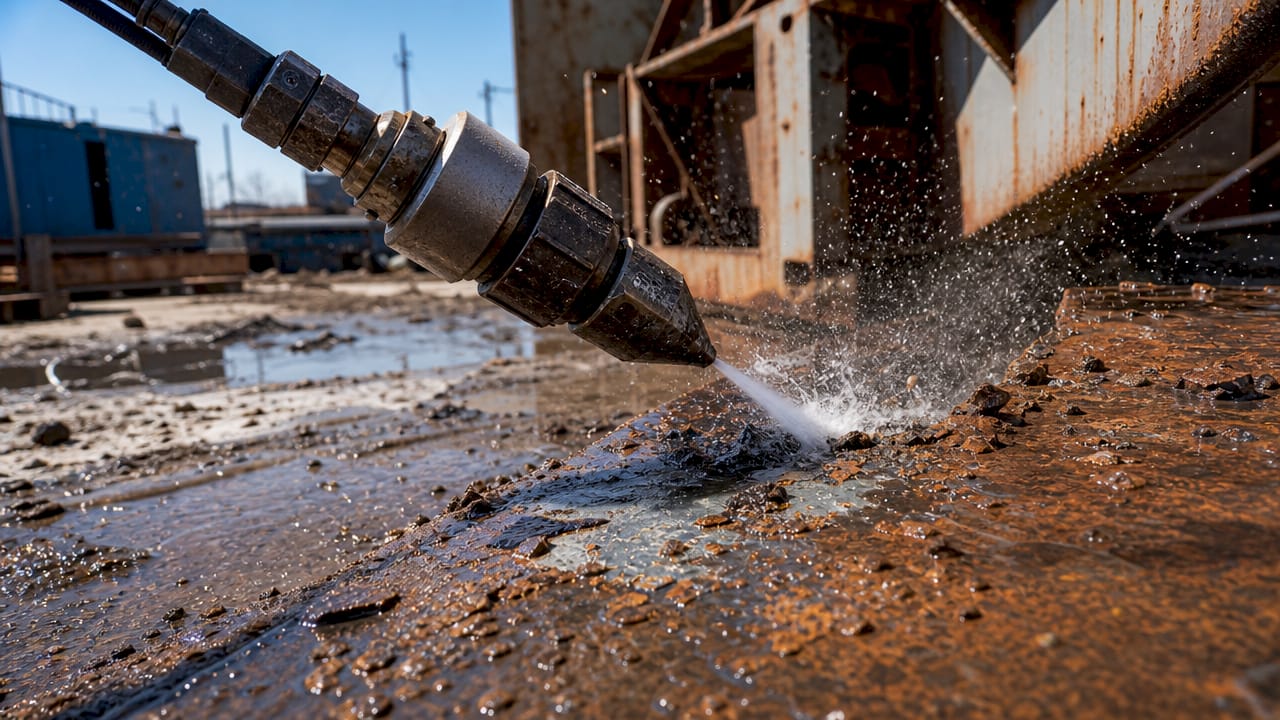
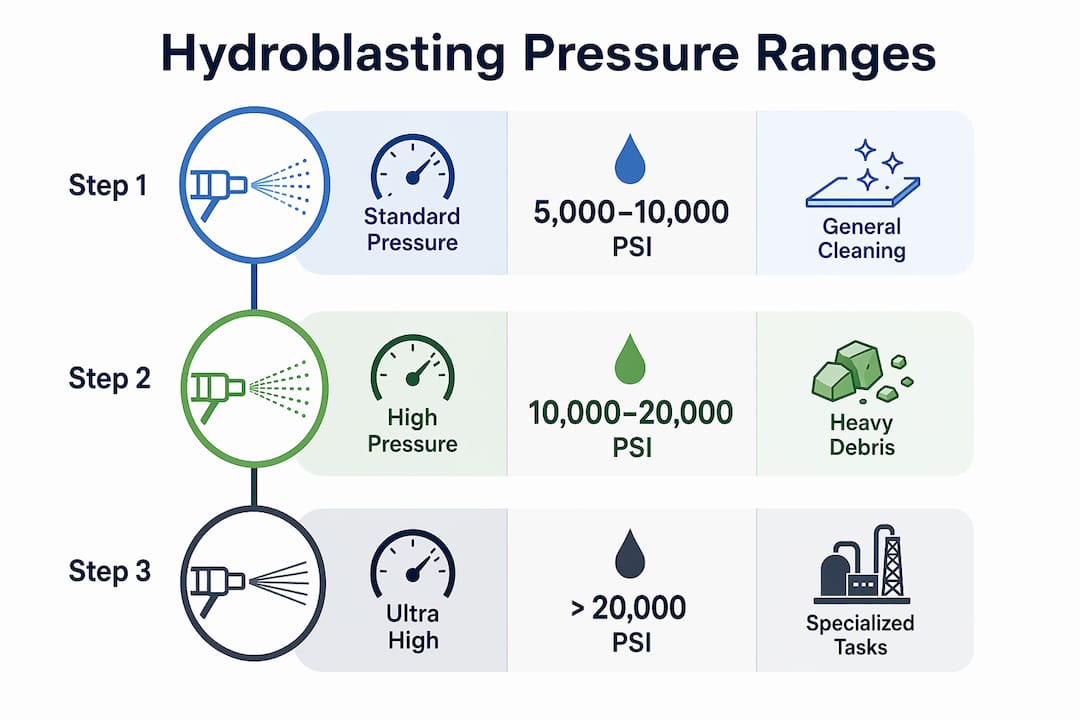
The hydroblasting process divides into two main pressure categories. Standard high-pressure water blasting operates between 5,000 and 10,000 PSI. Ultra-High-Pressure (UHP) hydroblasting starts at 10,000 PSI and can exceed 40,000 PSI for cutting bonded materials and removing thick coatings from steel or concrete. UHP is the category used on bridge decks, water tanks, and pipeline interiors where surface profile preservation matters.
Nozzle selection determines the outcome as much as pressure does. Rotating nozzles spread impact across a wider area for general cleaning. Fixed-orifice nozzles concentrate force for precise material removal. Correct nozzle and pressure balance is not optional. The wrong combination either damages the substrate or fails to remove the target material.
Pressure ranges and typical applications
| Pressure Range | Classification | Typical Application |
|---|---|---|
| 5,000–10,000 PSI | High Pressure | General surface cleaning, paint removal |
| 10,000–25,000 PSI | Ultra-High Pressure (UHP) | Industrial tank cleaning, pipeline descaling |
| 25,000–40,000 PSI+ | Extreme UHP | Concrete hydrodemolition, bonded coating removal |
Pro Tip: Match pressure to the substrate hardness, not just the contaminant. Running 40,000 PSI on a thin-walled pipe to remove light scale will cause more damage than the original contamination.
What are the safety requirements for hydroblasting?
Hydroblasting at high pressure carries serious injury risk. Water jets above 10,000 PSI can penetrate skin and cause internal injuries before an operator feels pain. A structured safety protocol is not optional. It is the difference between a productive job and a fatality.
Personal protective equipment requirements scale with pressure level:
- Face shield and safety glasses rated for high-pressure water impact
- Waterproof gloves and boots with cut-resistant outer layers
- Full-body waterproof suit for UHP operations above 10,000 PSI
- Hearing protection rated for sustained high-decibel pump noise
- Steel-toed footwear with slip-resistant soles on wet surfaces
Equipment safety features are equally non-negotiable. Anti-reversal devices sized to pipe diameters prevent nozzle backlash injuries during pipe cleaning. The device must be 1.5 times the pipe diameter, or 3 times the diameter when a T-junction is present. That sizing rule exists because an undersized device fails to stop a recoiling nozzle from exiting the pipe at full pressure.
Foot-operated dump valves give the operator immediate pressure release if control is lost. The technician controlling the lance must also control the dump valve. Separating those two functions creates a response lag that can cause serious injury.
Pre-job safety analysis with signed checklists is mandatory for all operations at 3,500 PSI or greater. The checklist verifies equipment integrity, hose condition, fitting torque, and operator readiness before water flows. Skipping this step is the leading cause of catastrophic equipment failures on hydroblasting sites. For a broader look at crew safety practices, sandblasting safety protocols follow similar pre-job verification logic.
Pro Tip: Conduct a dry run of the dump valve before pressurizing the system. A valve that sticks at 500 PSI will also stick at 20,000 PSI, and the consequences are not comparable.
What are the environmental and operational benefits of hydroblasting?
Hydroblasting is the industry gold standard for environmental compliance in surface cleaning. The process uses no chemical solvents and introduces no abrasive media into the work environment. That single fact reduces three separate cost categories: chemical procurement, hazardous waste disposal, and airborne particle containment.
The environmental advantages are concrete:
- No chemical solvents means no hazardous waste classification for cleaning residue
- Runoff capture and water recycling reduce total water consumption on large projects
- Lower airborne particulates compared to abrasive blasting protect workers and surrounding areas
- Reduced waste disposal fees from chemical-free cleaning and recyclable water streams
Operational efficiency gains are equally significant. Hydroblasting removes contaminants without profiling or damaging base materials when pressure is correctly calibrated. That means a steel tank cleaned by water jetting retains its original wall thickness. The same tank cleaned repeatedly by abrasive blasting loses measurable material with each cycle. Over a 20-year asset life, that difference in substrate preservation translates directly to extended service intervals and lower replacement costs.
Regulatory compliance is another operational driver. Environmental agencies increasingly restrict abrasive blasting near waterways, populated areas, and sensitive ecosystems. Hydroblasting generates no airborne silica, no spent abrasive media, and no chemical runoff, making it the compliant choice for projects near water infrastructure or urban environments. Understanding the full surface preparation workflow helps facility managers select the right method for each project phase.
What industries and applications use hydroblasting?
Hydroblasting applies across a wider range of industries than most facility managers realize. The adjustable pressure range is what makes it versatile. The same equipment that cleans a food processing floor at 5,000 PSI can remove a bonded epoxy coating from a bridge deck at 35,000 PSI.
The most common applications by industry include:
- Pipeline maintenance: Internal pipe cleaning removes scale, biofilm, and mineral deposits without scratching pipe walls or leaving abrasive residue that could contaminate product flow.
- Tank cleaning: Storage tanks for water, fuel, and chemicals require periodic cleaning to remove sludge, scale, and coating failures. Hydroblasting reaches confined spaces where mechanical tools cannot.
- Concrete hydrodemolition: UHP water jetting selectively removes deteriorated concrete from bridge decks and parking structures while leaving sound concrete intact. This is a precision application that abrasive methods cannot replicate.
- Paint and rust removal: Water jetting strips failed coatings and surface rust from steel structures, preparing them for new protective coatings without the silica dust hazard of dry abrasive blasting.
- Heat exchanger and boiler cleaning: Industrial heat transfer equipment accumulates scale that reduces efficiency. Hydroblasting restores tube surfaces to near-original condition without chemical descalers.
- Airport and municipal infrastructure: Runways, drainage systems, and water treatment facilities use hydroblasting for periodic maintenance cleaning where chemical use is restricted.
- Mining and manufacturing: Conveyor systems, processing equipment, and structural steel in heavy industrial environments require regular cleaning to prevent corrosion and maintain safety compliance.
Pressure adjustment is what tailors the process to each task. A facility manager specifying hydroblasting for a water treatment tank needs a different pressure profile than a contractor removing deteriorated concrete from a highway overpass. The top blasting techniques for infrastructure vary significantly by substrate and contamination type.
Key Takeaways
Hydroblasting is the most efficient and environmentally compliant method for industrial surface cleaning, combining pressure-calibrated water jets with zero abrasive media to remove contaminants without damaging base materials.
| Point | Details |
|---|---|
| Pressure determines application | Standard (5,000–10,000 PSI) handles general cleaning; UHP (above 10,000 PSI) handles bonded coatings and concrete. |
| Safety protocols are mandatory | Pre-job checklists, anti-reversal devices, and dump valves are required at 3,500 PSI and above. |
| Environmental compliance is built in | No solvents, no abrasive media, and recyclable water streams reduce waste disposal costs and regulatory risk. |
| Substrate preservation extends asset life | Correctly calibrated hydroblasting removes contaminants without thinning or profiling the base material. |
| Nozzle selection is as critical as pressure | Wrong nozzle configuration either damages the substrate or fails to remove the target contamination. |
Why hydroblasting deserves more respect than it gets
Most facility managers treat hydroblasting as a commodity service. They specify pressure and move on. That is the wrong approach, and I have seen the results: damaged pipe walls, failed coating adhesion, and safety incidents that a proper pre-job analysis would have prevented.
The technology has advanced significantly. Robotic hydroblasting systems now handle confined-space tank cleaning and pipeline interiors without putting operators in direct contact with high-pressure jets. Remote monitoring allows supervisors to track pressure, flow rate, and nozzle position in real time. These are not minor upgrades. They represent a fundamental shift in how the industry manages risk on complex projects.
The environmental argument for hydroblasting is also stronger than most contractors communicate to clients. When a municipality chooses hydroblasting for water tank maintenance, they are not just picking a cleaning method. They are avoiding hazardous waste classification, reducing containment costs, and staying ahead of tightening environmental regulations. That is a compliance decision as much as a technical one.
The operators who get the best results treat hydroblasting as a precision process, not a pressure wash. They calibrate nozzle type, standoff distance, and traverse speed for each surface condition. That level of attention separates a clean substrate ready for coating from one that looks clean but will fail adhesion testing within six months.
— Results
Surface preparation services that complement hydroblasting
Hydroblasting cleans the surface. What happens next determines how long the asset lasts.

Southern Sandblasting and Painting has delivered industrial surface preparation and protective coating services across Central Florida for over 20 years, working on water tanks, pipelines, airports, and municipal infrastructure. After hydroblasting removes scale and failed coatings, the substrate still needs proper profiling and a correctly specified coating system to achieve long-term protection. Southernsandblastingandpainting’s sandblasting equipment guide covers the preparation methods that follow water jetting and protect assets for decades. For projects requiring full-service surface prep and industrial coatings in the Orlando area, the sandblasting and painting services page details available capabilities and project types.
FAQ
What is hydroblasting used for in industrial settings?
Hydroblasting is used for pipeline cleaning, tank maintenance, concrete hydrodemolition, paint and rust removal, and heat exchanger descaling. Pressure settings are adjusted for each application, ranging from 5,000 PSI for general cleaning to over 40,000 PSI for bonded material removal.
How does hydroblasting differ from sandblasting?
Hydroblasting uses pressurized water with no abrasive media, while sandblasting propels abrasive particles to profile and clean surfaces. Hydroblasting preserves substrate thickness and produces no airborne silica, making it the preferred method where environmental compliance or substrate preservation is required.
What PPE is required for hydroblasting operations?
Operators require a face shield, waterproof cut-resistant gloves, full-body waterproof suit, hearing protection, and steel-toed slip-resistant boots. PPE requirements increase with pressure level, with full UHP suits mandatory above 10,000 PSI.
Is a pre-job safety checklist required for hydroblasting?
Pre-job safety analysis with signed checklists is mandatory for all hydroblasting at 3,500 PSI or greater. The checklist verifies hose condition, fitting integrity, equipment readiness, and operator qualifications before pressurizing the system.
Can hydroblasting damage the surface being cleaned?
Hydroblasting removes contaminants without damaging base materials when pressure is correctly calibrated for the substrate. Incorrect pressure settings or nozzle selection can cause surface damage, which is why operator training and pre-job specification are critical to every project.
Recommended
- What Is Shot Blasting? Industrial Guide for Professionals
- What Is Sandblasting? a Guide for Industrial Projects
- Industrial sandblasting guide for facility managers
- Industrial blasting terms demystified: a facility leader’s guide
- Sandblasting Contractor Baldwin Park FL
- Sandblasting Services Oviedo FL


