
An abrasion-resistant coating is an engineered surface layer that slows mechanical wear by combining hardness, toughness, and adhesion into a system matched to the specific wear environment. The single most important selection rule: match the coating family to your service environment and evaluate total lifecycle cost, not just the installed price. Three credibility anchors belong in every specification you write: ASTM D4060 (Taber abrasion test), SSPC/NACE surface-preparation grades, and a lifecycle cost comparison that accounts for downtime, not just materials.
Table of Contents
- What properties actually produce abrasion resistance?
- Which coating families do engineers actually use?
- Where are abrasion-resistant coatings applied in practice?
- How do you select the right coating and brief a contractor?
- Why surface preparation controls long-term performance
- Which tests and standards should you request from vendors?
- What service life and maintenance intervals should you plan for?
- Key Takeaways
- The spec detail most facility managers overlook
- How Southernsandblastingandpainting can help you specify and apply the right system
- Authoritative sources for further reading
What properties actually produce abrasion resistance?
Hardness, toughness, and adhesion work together. Pull any one of them out of balance and the system fails faster than a cheaper alternative would have.
Hardness resists micro-cutting, the mode where sharp particles plow grooves into the surface. Toughness absorbs impact energy without cracking. Adhesion keeps the film bonded to the substrate so neither mode can undercut it. Porosity matters too: a porous coating lets corrosive media reach the substrate, turning a wear problem into a corrosion-plus-wear problem. Film uniformity and thickness control how long the coating lasts before wear-through exposes bare metal.
The hardness-versus-toughness trade-off is the one engineers most often get wrong. A coating that is too hard becomes brittle under repeated impact and spalls off in chunks. One that is too soft lets angular particles cut right through it. For mixed-service environments, where you have both sliding abrasion and intermittent impact, the right answer is usually a mid-hardness polymer or a composite system, not the hardest coating on the datasheet.
Statistic callout: About 80% of machine component damage is attributed to wear, with global economic losses from wear exceeding $100 billion annually. That figure is why lifecycle cost, not first cost, is the correct frame for any specification decision.
Key properties to evaluate before shortlisting a coating:
- Hardness (scratch and micro-cutting resistance): measured on Vickers, Rockwell, or Shore scales depending on coating type
- Toughness (impact and fatigue resistance): a brittle coating fails under cyclic load even when hardness is high
- Adhesion to the substrate: hardness alone does not guarantee durability without strong interfacial bonding
- Porosity: pore-free coatings prevent corrosive undercut; porous ones accelerate substrate degradation
- Film thickness and uniformity: thicker builds extend service life, but only when applied uniformly
Which coating families do engineers actually use?
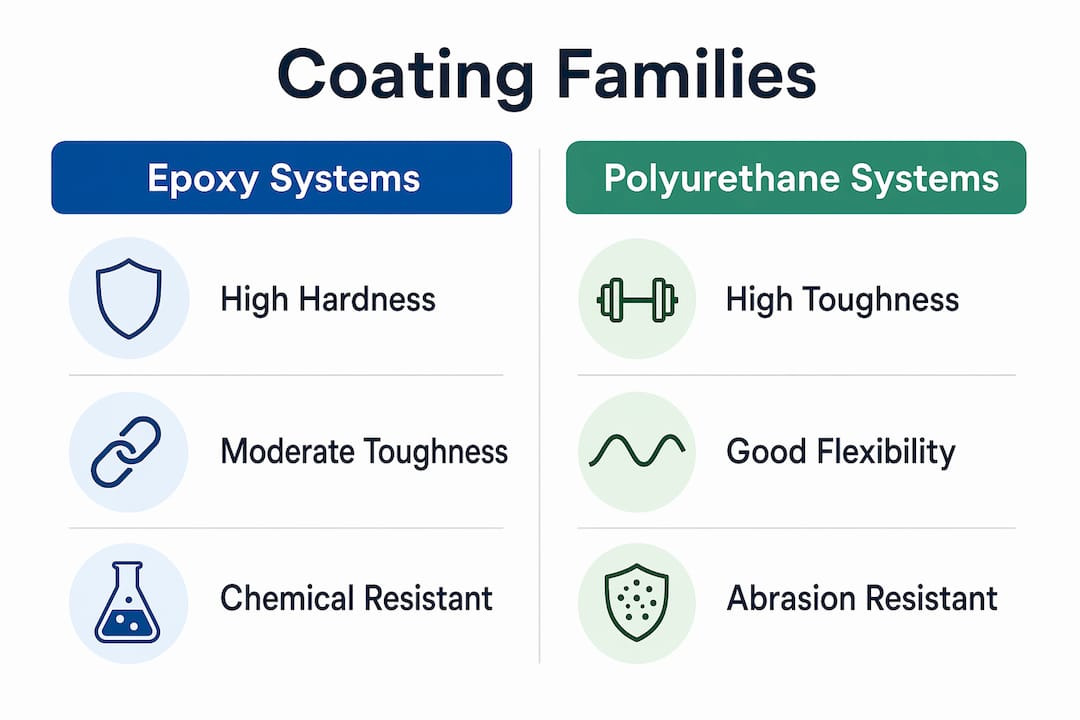
The table below covers the families you will encounter on industrial projects. Use it to shortlist two or three candidates before pulling full technical datasheets.
| Coating family | Best for / typical use case | Hardness vs. toughness | Typical film build | Cure / downtime | Chemical & temp resistance | Relative installed cost |
|---|---|---|---|---|---|---|
| Filled epoxy (high-build) | Concrete floors, tank linings, structural steel | Medium hardness / medium toughness | 250 µm | 72 hrs; moderate downtime | Good chemical resistance; limited above 120°C | Low–medium |
| Polyurethane | Exterior surfaces, conveyors, chutes, HVAC exteriors | Medium hardness / high toughness | 75 µm | 1 hr; low downtime | Good UV and weather resistance; moderate chemical | Medium |
| Polyurea | High-impact liners, secondary containment, pipe interiors | Low–medium hardness / very high toughness | 500 µm | Minutes to 1 hr; very low downtime | Good chemical resistance; moderate temp | Medium–high |
| Thermal spray / HVOF (WC-Co) | Pump shafts, wear plates, external cylinder surfaces | Very high hardness / medium toughness | 100 µm | Immediate; minimal downtime | Excellent; limited on complex geometries | High |
| CVD tungsten carbide | Internal valve bodies, pump internals, complex geometries | Very high hardness / good ductility | — | Process-dependent; off-site | Pore-free, uniform on internal geometries | High |
| Ceramic hard coatings | Cutting tools, high-temp wear surfaces | Extremely high hardness / low toughness | 2–20 µm | Process-dependent | Excellent high-temp; brittle under impact | High |
| Polymer fluoropolymers (ETFE/PVDF) | Chemical exposure, low-friction, exterior architectural | Low hardness / high flexibility | 100 µm | Varies | Superior chemical resistance and outdoor stability | Medium–high |
Recent research points toward composite coatings and nanocoatings as the next generation, with laser cladding and improved gas-phase deposition methods extending service life under complex combined loads. Worth tracking for future specifications, though the families above cover the vast majority of current industrial projects.
For multi-layer systems, epoxy primers paired with polyurethane topcoats are the most common approach to combining strong substrate adhesion and chemical resistance with surface toughness and UV stability. That pairing covers a wide range of exterior and semi-exposed industrial applications.
Where are abrasion-resistant coatings applied in practice?
The coating family that performs best depends on three variables: particle type (angular vs. rounded), impact energy, and chemical or temperature exposure. Here is how those variables map to common equipment.
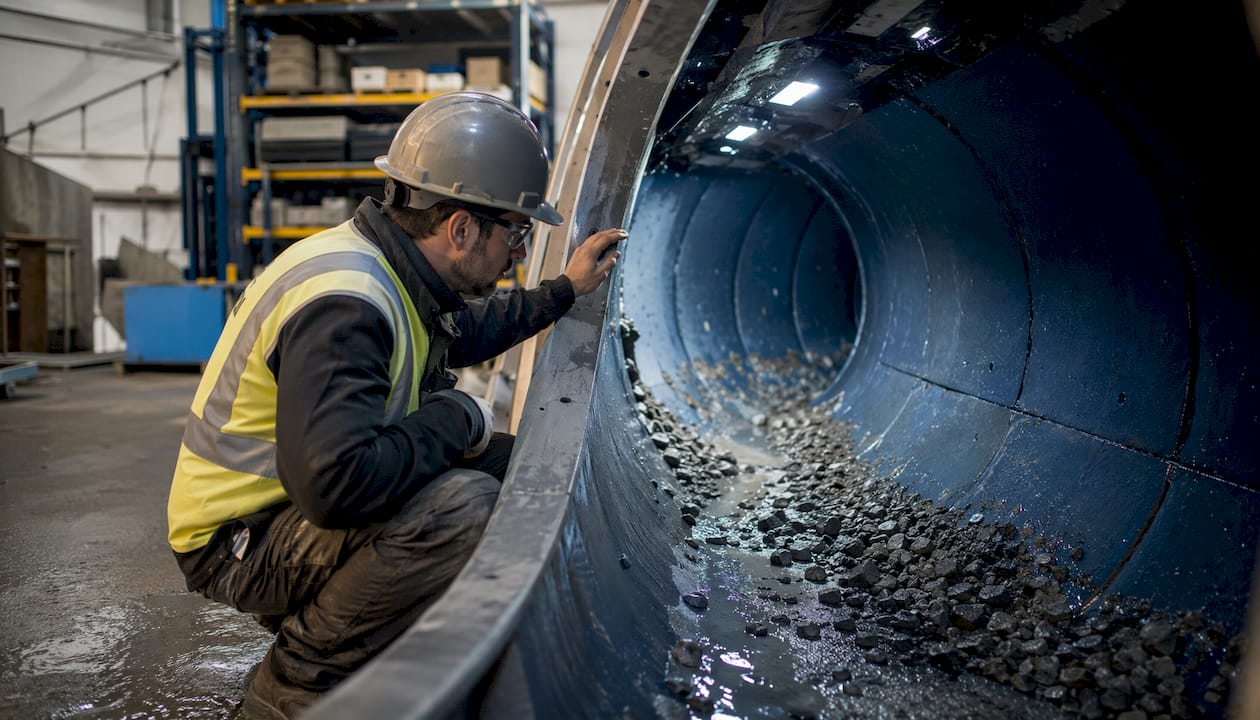
Grit chambers and slurry lines see angular particles at moderate velocity. Tough polyurethane or polyurea liners handle the combined abrasion and impact well. For internal pipe surfaces carrying abrasive slurry at higher velocities, thermal spray (HVOF) with tungsten carbide in a cobalt binder is the standard metallurgical choice.
Pump internals and valve bodies present a geometry problem. HVOF struggles to coat internal passages uniformly, and porosity in those tight spaces accelerates corrosion. CVD tungsten carbide solves this: its gas-phase deposition achieves a dense, pore-free layer on complex internal geometries where line-of-sight spray methods cannot reach.
Conveyors, chutes, and hoppers carrying bulk solids are classic polyurethane territory. The high toughness absorbs repeated impact from falling material, and the film builds thick enough to provide meaningful wear life between maintenance cycles.
HVAC exteriors and structural steel in corrosive or UV-exposed environments typically get a high-build epoxy primer followed by a polyurethane topcoat. For coastal or chemical plant environments, ETFE or PVDF fluoropolymers are worth specifying where long-term color stability and chemical resistance outweigh abrasion performance.
Water tanks and infrastructure assets often require NSF-compliant epoxy systems that balance abrasion resistance with potable water contact approval. Temperature matters here: standard epoxies soften above roughly 120°C, so high-temperature services need ceramic or thermal spray alternatives.
How do you select the right coating and brief a contractor?
Work through this checklist before you write a specification or send an RFP.
- Define the dominant wear mechanism. Is it micro-cutting (sliding abrasion), gouging (large angular particles), erosion (high-velocity particle impact), or fatigue (cyclic contact)? The answer drives the hardness-vs.-toughness balance.
- Characterize the particles. Angular particles cut harder than rounded ones. Particle size and hardness relative to the coating determine how fast wear progresses.
- Specify environmental constraints. Document operating temperature range, chemical exposure (acids, alkalis, solvents), UV exposure, and immersion versus splash service.
- Set acceptable downtime for curing. Fast-cure polyurea returns to service in under an hour. High-build epoxy may need 72 hours. That difference can determine the coating family before you look at anything else.
- Determine your target service interval and TCO threshold. A higher installed cost is often justified when it cuts shutdown frequency. Specialized systems reduce maintenance shutdown frequency, which is usually the largest component of total ownership cost.
- Assess geometry and inspection access. Internal passages, blind cavities, and complex shapes may rule out line-of-sight methods entirely.
- Select required test metrics. Specify ASTM D4060 (Taber) for sliding abrasion, ASTM G65 for dry sand/rubber wheel erosion, and ASTM D4541 for adhesion pull-off strength.
Vendor questions to include in your RFP:
- Provide Taber (ASTM D4060) or ASTM G65 test data for this formulation at the specified film thickness.
- What surface-prep profile and cleanliness grade do you require, and how do you verify it?
- What is the minimum and maximum recoat window, and what happens if it is exceeded?
- Describe your QA inspection steps: wet film gauge, dry film gauge, holiday detection, adhesion pull-off.
- What is the expected service life under the wear conditions described, and what is your repair protocol when wear-through occurs?
- Are there substrate compatibility limitations (galvanized steel, aluminum, concrete)?
Why surface preparation controls long-term performance
Inadequate anchor profile after abrasive blasting is the most common root cause of premature coating failure. The coating may look perfect on day one and delaminate within months because the substrate was not properly prepared.
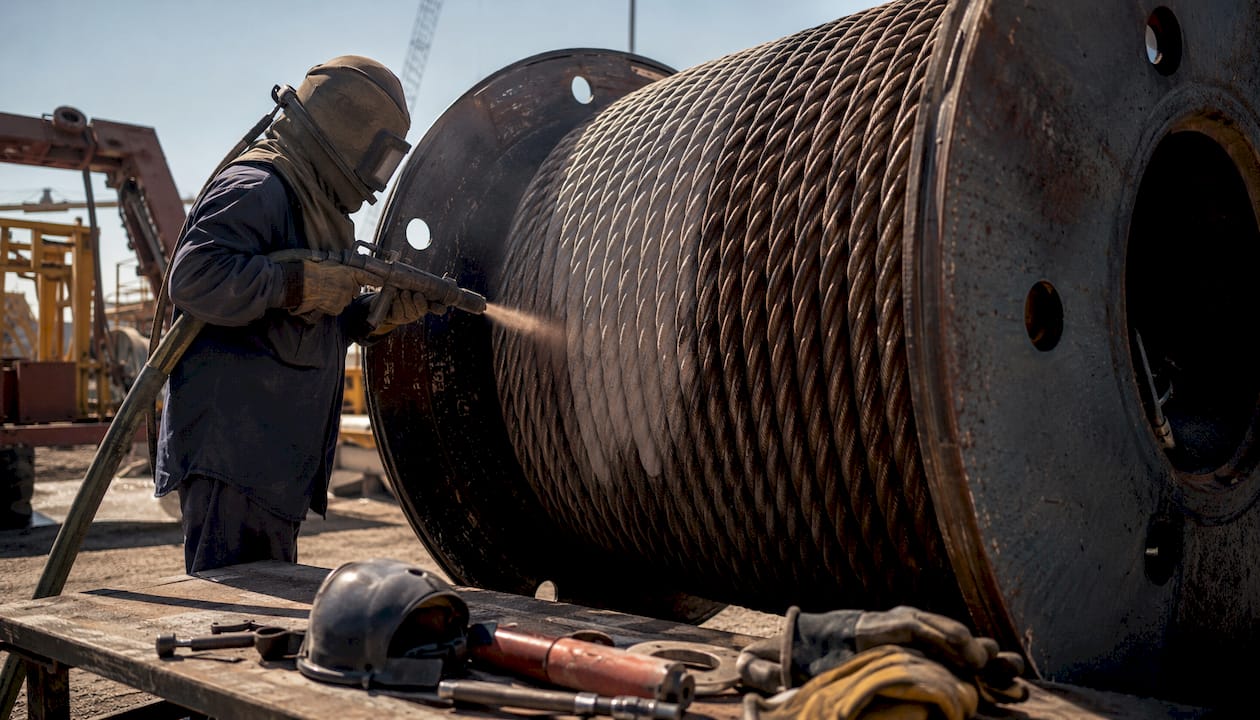
The mechanism is straightforward. Abrasive blasting removes mill scale, rust, salts, and old coatings, then creates a microscopic surface profile that gives the coating mechanical purchase. Without that profile, adhesion depends entirely on chemical bonding, which is insufficient for industrial wear environments. SSPC-SP 6 (Commercial Blast) is a common minimum for protective coatings; SSPC-SP 10 (Near-White Blast) is the standard for immersion service and high-performance systems. NACE equivalents (NACE No. 3 and NACE No. 2, respectively) are interchangeable in most specifications.
For a standard exterior system, an epoxy primer applied immediately after blasting captures the clean, profiled surface before flash rust forms. The polyurethane topcoat goes on after the primer reaches its recoat window. Thickness control at each stage matters: use a wet film gauge during application and a calibrated dry film gauge after cure. For immersion or chemical service, holiday (pinhole) detection with a low-voltage wet sponge or high-voltage spark tester catches defects before the asset goes back into service.
Pro Tip: Specify the target anchor profile in your contract documents, not just the blast grade. A target of 50–75 µm Rz (roughly SSPC-SP 10 with a medium-grit abrasive) gives the contractor a measurable acceptance criterion. Also require chloride testing on the blasted surface before coating application, particularly for assets near the coast or in chemical plant environments. Chloride contamination under a coating drives osmotic blistering faster than almost any other failure mode.
For complex internal geometries, surface-prep best practices must account for access limitations. Rotary blast nozzles, wet abrasive blasting, and power-tool preparation to SSPC-SP 11 are alternatives when full open-blast access is not possible.
Which tests and standards should you request from vendors?
Datasheets are not specifications. Require actual test data, not just a reference to a standard.
- ASTM D4060 (Taber abrasion): Reports mass loss (mg) per 1,000 cycles under a specified wheel load. Lower mass loss equals better abrasion resistance. Useful for comparing polymer coatings under sliding wear.
- ASTM G65 (dry sand/rubber wheel): Better suited to erosive wear and harder coatings. Reports volume loss; use it when particles are the dominant wear agent.
- ASTM D4541 (pull-off adhesion): Measures interfacial bond strength in psi or MPa. Minimum acceptable values vary by service, but 1,500 psi is a common threshold for industrial immersion systems.
- Vickers Hardness (HV) or Rockwell (HRC): Relevant for metallurgical coatings (HVOF, CVD). Compare HV values across competing systems at the same film thickness.
- SSPC/NACE surface-prep documentation: Require written inspection records showing blast grade achieved, anchor profile measurement (Testex Press-O-Film or Elcometer profilometer), and chloride test results.
Taber numbers alone do not predict field life under impact or particle erosion. A coating that scores well on D4060 may fail quickly in a high-velocity slurry line because the wear mode is erosion, not sliding abrasion. Always match the test method to the dominant wear mechanism in your application. Ask vendors to explain which test best represents your service conditions and why.
The AMPP (formerly NACE International) publishes surface-preparation and inspection standards that are the recognized authority for industrial coating work in the United States. Request that contractors reference specific AMPP/SSPC standards in their work procedures and inspection reports.
What service life and maintenance intervals should you plan for?
Service life varies widely by coating family, wear severity, and how well the substrate was prepared. Polymer systems (polyurethane, polyurea) on moderate-wear equipment typically deliver 5–10 years before significant wear-through. High-build epoxy floor coatings in light-to-moderate industrial traffic last 3–7 years. Metallurgical coatings (HVOF, CVD) on pump components and valve internals can exceed 10 years in severe abrasive service, which is why their higher installed cost often wins on TCO.
| Coating family | Typical service life (moderate wear) | Common failure modes | Early warning signs |
|---|---|---|---|
| High-build epoxy | 3–7 years | Delamination, undercutting corrosion | Edge lifting, blistering |
| Polyurethane | 5–10 years | Abrasion-through, UV chalking | Surface thinning, color fade |
| Polyurea | Several years | Cracking at stress concentrations | Hairline cracks at joints |
| HVOF (WC-Co) | Several years | Porosity-driven corrosion, edge chipping | Rust staining at coating edges |
| CVD tungsten carbide | 10–20 years | Fatigue cracking under extreme impact | Micro-spalling at impact zones |
The three factors that shorten service life most reliably are: improper surface preparation (the root cause in the majority of early failures), operating conditions that exceed the coating’s design envelope (temperature spikes, unexpected chemical exposure), and deferred maintenance that allows small defects to grow into full delamination.
A practical inspection schedule for most industrial assets: visual inspection every 6 months, dry film thickness spot-checks annually, adhesion pull-off test at the 3-year mark or after any process upset. When wear-through reaches 20% of the original film thickness in a localized area, plan a spot repair before the next scheduled outage. Waiting for full failure costs significantly more in substrate remediation and emergency downtime than a planned repair does. For guidance on managing total ownership cost versus initial investment, the principle applies directly: the higher-cost system that eliminates one unplanned shutdown typically pays back within the first maintenance cycle.
Key Takeaways
Abrasion-resistant coatings protect assets by combining hardness, toughness, and adhesion into a system matched to the dominant wear mode, surface-prep standard, and total lifecycle cost of the application.
| Point | Details |
|---|---|
| Match coating to wear mode | Identify micro-cutting, erosion, or impact as the dominant mechanism before shortlisting coating families. |
| Require test data, not just standards | Ask vendors for ASTM D4060 or G65 results at the specified film thickness, not a generic datasheet reference. |
| Surface prep determines adhesion | Specify SSPC/NACE blast grade, target anchor profile (50–75 µm Rz), and chloride limits in every contract. |
| Lifecycle cost beats first cost | Higher installed cost for HVOF or CVD is often justified when it eliminates one unplanned shutdown per cycle. |
| Southernsandblastingandpainting | Provides industrial sandblasting, surface preparation, and protective coating application for commercial and municipal assets in Central Florida. |
The spec detail most facility managers overlook
The coating family matters less than most engineers think. Spend an hour on a project post-mortem and the failure almost always traces back to one of two things: the surface was not prepared to the specified profile, or the coating was applied outside its temperature or humidity window. The product itself is rarely the problem.
That insight has a practical implication for how you write specifications. The most valuable line in any coating spec is not the product name. It is the acceptance criterion for surface preparation, the inspection hold point before the first coat goes on, and the documented cure conditions. Without those, you can specify the most expensive CVD system on the market and still get a failure inside two years.
There is also a tendency to over-specify hardness. Engineers see a high Vickers number and assume it means durability. But a coating that scores 1,500 HV and has poor toughness will spall under the first significant impact event. The right question is not “what is the hardest coating available?” It is “what combination of hardness, toughness, and adhesion survives this specific service environment for the target interval?” That reframe changes the shortlist almost every time.
Finally, the lifecycle cost argument is not theoretical. The downtime cost of an unplanned shutdown on a water treatment grit chamber or a pipeline pump station typically dwarfs the cost difference between a standard epoxy system and a premium polyurea or HVOF system. Run the numbers before the specification is locked, not after the first failure.
How Southernsandblastingandpainting can help you specify and apply the right system
Getting the coating right starts well before the first coat is applied. Southern Sandblasting and Painting brings 20+ years of industrial surface preparation and coating application experience to commercial, municipal, and infrastructure projects across Central Florida, covering everything from water tanks and pipelines to airport assets and city infrastructure.
Services relevant to abrasion-resistant coating projects include professional abrasive blasting to SSPC/NACE standards, anchor profile verification, industrial painting and protective coating application, and system selection support for facility managers who need to brief an estimator quickly. When you are ready to scope a project, send your estimator these four data points: surface area and substrate type, dominant wear mode and particle description, access constraints and acceptable downtime, and target service interval. That information is enough to get a meaningful estimate and a coating system recommendation.
Request an estimate or review available services to start a conversation about your next project. For projects where surface preparation is the primary concern, the sandblasting services page covers capabilities and project scope in detail.
Authoritative sources for further reading
Use these standards and references when reviewing vendor datasheets or writing specifications.
- ASTM D4060 (Taber Abrasion Test): the baseline lab test for polymer coating wear resistance; request mass-loss data at your specified film thickness.
- ASTM G65 (Dry Sand/Rubber Wheel Abrasion): better suited to erosive wear and metallurgical coatings; ask for volume-loss results.
- ASTM D4541 (Pull-Off Adhesion): the standard method for measuring coating bond strength; specify a minimum acceptable value in your RFP.
- AMPP (formerly NACE/SSPC) surface-preparation standards: SSPC-SP 6, SP 10, and SP 11 are the most commonly referenced grades for industrial coating work; require written inspection records referencing these standards.
- ASM International: technical reference for thermal spray and metallurgical coating properties, including HVOF and CVD performance data.
- Lubricants (MDPI) — Abrasive Resistant Coatings Review: peer-reviewed survey of composite coatings, nanocoatings, and advanced deposition methods; useful for understanding where the technology is heading.
- MDPI Metals — Wear-Resistant Coatings for Steel Substrates: covers wear mechanisms, coating families, and the economic context for industrial wear protection.


