
When professionals reference “NACE certification” today, they mean credentials issued by AMPP (Association for Materials Protection and Performance), the organization formed when NACE International and SSPC merged. The flagship credential is the AMPP Coatings Inspector Program (CIP): Level 1 covers supervised basic inspection, Level 2 certifies independent intermediate inspectors, and Level 3 designates senior inspectors who lead programs and pass a peer-review oral exam. If you need official program details, exam prep guides, or to manage an existing credential, start at AMPP Certification Resources and log into My Certification Portal.
Key Takeaways
AMPP credentials are the current industry standard for coatings inspection, replacing legacy NACE CIP and SSPC PCI designations, and specifying the correct level and accreditation type is the single most effective way to protect asset quality and reduce project risk.
| Point | Details |
|---|---|
| AMPP replaced NACE/SSPC | Legacy NACE CIP and SSPC PCI credentials now map to the AMPP Coatings Inspector Program; update spec language accordingly. |
| Three CIP levels, distinct scope | Level 1 requires supervision; Level 2 works independently; Level 3 leads programs and passes an oral peer-review exam. |
| Individual vs. contractor credential | AMPP CIP certifies a person’s competency; NIICAP accredits a company’s QA systems. Requiring both closes the most common risk gap. |
| Verify before award | Confirm credential number, level, and expiration in My Certification Portal before mobilizing any inspector. |
| Renewal every three years | PDHs, ethics training, and portal submission keep credentials active; lapsed credentials are not valid on-site. |
Table of Contents
- Why does NACE certification matter for corrosion control?
- What are the AMPP Coatings Inspector Program levels?
- How do you get AMPP certified step by step?
- Individual inspector certification vs. contractor accreditation: which do you need?
- How do you maintain and verify AMPP credentials?
- Why Southernsandblastingandpainting takes certification seriously
- Sources
Why does NACE certification matter for corrosion control?
NACE International and SSPC consolidated into AMPP, and with that merger came a unified Coatings Inspector Program that replaced both the legacy NACE CIP and the SSPC Protective Coatings Inspector (PCI) credentials. Existing cardholders were migrated into the new AMPP program and needed to accept updated terms through My Certification Portal to finalize the transition. Contracts and specifications written before the merger that reference “NACE CIP” or “SSPC PCI” now map directly to the AMPP Coatings Inspector Program levels, so the credentials are recognized as equivalent.
The practical value of these certifications goes beyond a credential on a badge. Certified inspectors apply standardized inspection methods, produce repeatable documentation, and give owners a defensible record of conformance. That consistency matters in regulated industries where a failed coating on a water tank, pipeline, or bridge carries real liability. Industry analysis shows certified inspectors reduce failure-related costs, extend asset service life, and improve regulatory compliance outcomes.
Key reasons owners and specifiers require AMPP credentials:
- Standardized methods: Inspectors trained to AMPP standards use the same test protocols, instruments, and acceptance criteria regardless of project location.
- Repeatable documentation: Inspection reports follow consistent formats, which simplifies dispute resolution and warranty claims.
- Contracting leverage: Many government and municipal contracts now require certified inspectors by name, and some procurement programs require contractor-level accreditation as well.
- Risk reduction: A NACE-certified contractor demonstrates adherence to current standards, which reduces operational risk and increases stakeholder confidence.
AMPP is also aligning its personnel certification practices toward ISO 17024-style accreditation, a global standard for personnel certification bodies. That shift increases the international credibility of AMPP credentials and matters for contractors working on multinational projects or bidding to owners who specify globally recognized standards.
What are the AMPP Coatings Inspector Program levels?
The AMPP CIP runs three levels, each building on the last. Here is how they compare:
A few points worth noting about the supervision model: Level 1 inspectors require direct or indirect oversight from a Level 2 or Level 3 inspector. That supervision can be remote with periodic field audits, which affects how you staff and cost a project. Level 3 holders can run inspection programs independently and are the credential to specify when you need someone accountable for the entire inspection scope.
Beyond the three CIP levels, AMPP offers specialty credentials and courses that frequently appear in project specifications:
- Corrosion Specialist: Advanced credential for engineers and scientists managing corrosion programs.
- Protective Coating Specialist (PCS): Focuses on coating selection, specification writing, and quality assurance.
- MR0175 Certified User: Covers NACE MR0175/ISO 15156 materials requirements for sour-service environments.
- Pipeline specialty: Inspection of external and internal pipeline coatings.
- Bridge specialty: Inspection of structural steel coatings on bridge structures.
- Nuclear specialty: Inspection in nuclear power plant environments.
- Thermal spray and CUI (Corrosion Under Insulation) specialties: Targeted at specific failure modes and application methods.
Specifiers should reference the AMPP Coatings Inspector Program by its current name in contracts, not the legacy NACE CIP or SSPC PCI designations. The industry is still mid-transition, and using the current program name avoids ambiguity when evaluating bids.
How do you get AMPP certified step by step?
The path to each CIP level follows the same general sequence, with the complexity and time investment scaling upward at each level.
- Identify the target credential. Confirm which CIP level or specialty your employer, contract, or career plan requires. Check the AMPP coatings inspection offerings page for current course schedules and prerequisites.
- Complete the required coursework. Each level has a corresponding AMPP course with classroom instruction and hands-on lab work. Labs cover instruments, surface cleanliness standards, dry film thickness measurement, holiday detection, and related skills. These are typically multi-day in-person sessions.
- Satisfy work-experience prerequisites. Level 1 has no prior inspection experience requirement. Level 2 requires documented field experience after Level 1. Level 3 requires five years of corrosion-related work experience plus prior completion of both Level 1 and Level 2 courses.
- Schedule and pass the required exams. Theory exams are computer-based and can be delivered through Pearson VUE testing centers or via remote proctoring. Practical exams take place in a lab setting during or after the course. Level 3 adds an oral peer-review exam where a panel of senior practitioners evaluates the candidate’s readiness to lead inspection programs.
- Submit your application through My Certification Portal. Upload experience documentation, course completion records, and any required verifications. The portal tracks your application status and issues your digital credential once approved.
- Receive your digital badge. AMPP issues digital badges that credential holders can share with employers and clients. Owners and specifiers can verify badge status directly.
Pro Tip: Document your field experience as you go, not at application time. Keep a log with project name, asset type, substrate, coating system, inspection tasks performed, and the name and credential number of any supervising inspector. Auditors and reviewers look for specifics, and a vague log entry (“performed inspections on various projects”) will slow your application.
Cost drivers to plan for:
- Course tuition varies by level and delivery format; multi-day in-person courses carry travel and lodging costs.
- Exam fees are separate from course fees and vary by exam type.
- Level 3 candidates should budget for travel to an oral peer-review session, which is not available remotely.
- Renewal every three years requires documented PDHs, which may involve additional training costs.
Individual inspector certification vs. contractor accreditation: which do you need?
These two credential types answer different questions. AMPP CIP certifies that a person has the technical competency to inspect coatings. NIICAP (National Industrial and Commercial Coatings Accreditation Program) accredits that a company has the quality assurance systems, production processes, and management support to meet owner-specified quality requirements.
| Dimension | AMPP CIP (Individual) | NIICAP (Contractor) |
|---|---|---|
| Who is audited | Individual inspector | Contracting company |
| What is assessed | Technical inspection competency | QA systems, management processes, production capability |
| Typical contracting context | Required when a spec names a certified inspector for on-site conformance verification | Required by government, municipal, or industrial owners vetting contractors in low-bid environments |
| Risk allocation | Assigns inspection accountability to a named individual | Assigns quality system accountability to the contractor organization |
| Verification method | Digital badge via My Certification Portal | NIICAP audit certificate |
Facility owners frequently specify both: an accredited contractor (NIICAP) to ensure company-level QA and a certified inspector (CIP Level 2 or 3) to verify on-site conformance. Requiring both reduces risk and clarifies responsibility in contract acceptance criteria. Specifying only one leaves a gap. An accredited contractor without a certified inspector on-site may have excellent systems but no independent verification of day-to-day conformance. A certified inspector working for a contractor with no formal QA program has limited authority to enforce corrective action.
A practical spec clause might read: “The contractor shall hold current NIICAP accreditation. A minimum of one AMPP Certified Coatings Inspector (CIP Level 2 or higher) shall be present on-site during all surface preparation and coating application operations.”
Pro Tip: When evaluating bids, ask for the AMPP credential number and expiration date for every named inspector, then verify status in My Certification Portal before award. A lapsed credential is not a valid credential, and catching it before mobilization is far less expensive than catching it during a project audit. For contractor accreditation, request the NIICAP certificate and confirm the accreditation scope covers the work type in your contract.
For more on how to write coating compliance requirements for municipal projects, the coating compliance guide for city facilities covers spec language and verification steps in detail.
How do you maintain and verify AMPP credentials?
Renewal happens on a three-year cycle. The steps are straightforward, but missing a deadline means the credential lapses and the holder may need to retest.
To renew an AMPP CIP credential:
- Log into My Certification Portal and confirm your renewal window is open.
- Accumulate the required Professional Development Hours (PDHs) through AMPP-approved training, conferences, or other qualifying activities. AMPP is an IACET-accredited training provider, so its courses count toward CEU requirements.
- Complete the ethics training requirement, which AMPP mandates as part of each renewal cycle.
- Submit renewal documentation and pay the renewal fee through the portal.
- Download your updated digital badge once renewal is approved.
AMPP’s move toward ISO 17024-style accreditation means the renewal and documentation requirements are becoming more rigorous over time. Holders who stay current with AMPP’s published renewal procedures will be better positioned as those requirements tighten.
Verification checklist for owners and specifiers receiving credentials from bidders:
- Request the inspector’s full name, AMPP credential number, credential level, and expiration date in writing.
- Log into My Certification Portal and search by credential number to confirm active status.
- Confirm the credential level matches what the specification requires (Level 1 is not a substitute for Level 2 or 3).
- For specialty credentials (pipeline, bridge, nuclear), verify the specialty appears on the credential record, not just the base CIP level.
- For contractor accreditation, request the NIICAP certificate and verify the accreditation scope and expiration date directly with NIICAP.
The role of coating inspectors in asset longevity is worth reviewing for teams that want a clearer picture of what a certified inspector actually does on-site and how that work connects to long-term asset performance.
Why Southernsandblastingandpainting takes certification seriously
At Southern Sandblasting and Painting, we have spent more than 20 years working on industrial surface preparation and protective coating projects across Central Florida, from water tanks and pipelines to municipal infrastructure and airport facilities. That experience has given us a clear view of what separates projects that hold up from projects that fail prematurely.
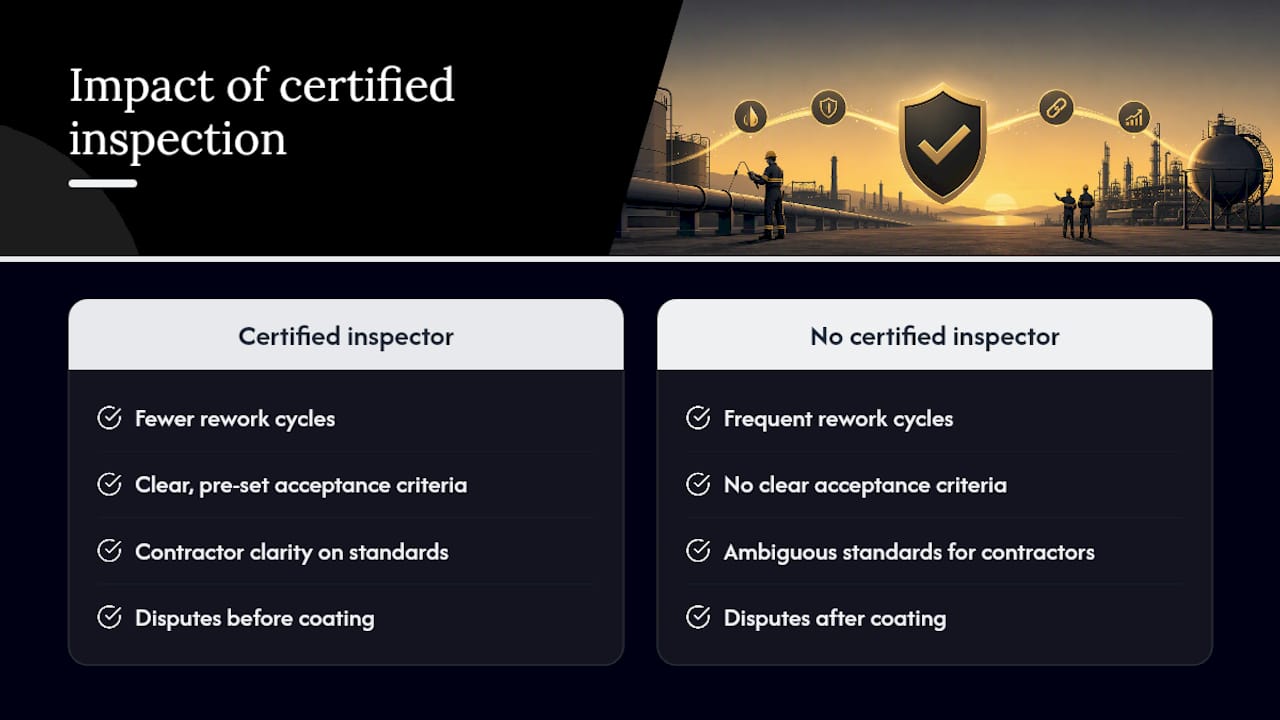
Certified inspectors change the outcome in ways that are measurable. When a project has a credentialed inspector setting acceptance criteria before work begins, the number of rework cycles drops. Contractors know the standard they are being held to, and there is no ambiguity about what “acceptable surface cleanliness” or “correct dry film thickness” means. When there is no certified inspector and no clear acceptance criteria, disputes over quality tend to surface after the coating has been applied, which is the worst possible time to have that conversation.
The coating inspection and infrastructure longevity connection is direct: consistent, documented inspection is what converts a good coating application into a 20-year service life instead of a 7-year one. Southernsandblastingandpainting works with facility managers and municipal clients who want that outcome, and we support projects where certified inspection is part of the specification. If you are preparing to specify or hire for a coated-asset project in Central Florida, our sandblasting and painting services page covers our full capability set.

Sources
These are the primary resources for program details, exam preparation, and credential verification:


