
TL;DR:
- Protective coatings in chemical plants act as engineered barriers to prevent corrosion, chemical attack, and moisture damage on critical equipment. Proper material selection, surface preparation, and scheduled inspections are essential to maximize coating performance and long-term asset protection. Treating coatings as a strategic, engineered system rather than a commodity reduces unplanned shutdowns and extends service life significantly.
Protective coatings in chemical plants are defined as engineered barrier systems that isolate structural steel, concrete, and process equipment from corrosive chemicals, moisture, and mechanical wear. Corrosion costs 3.1% to 3.4% of GDP in major economies, translating to an estimated $2.5 trillion in annual global losses. That figure makes the role of coatings in chemical plants one of the most financially consequential decisions a facility manager makes. The industry term for these systems is “protective coating systems,” and they cover everything from epoxy tank linings to zinc-rich primers on structural steel. Getting them right means fewer shutdowns, lower repair bills, and a safer plant.
How do protective coatings prevent corrosion and chemical damage?
Corrosion in chemical plants is not a single mechanism. It takes several forms, and each one demands a different coating response.
The most common threat is electrochemical corrosion, where moisture and oxygen drive oxidation on bare metal. Chemical plants add a second layer of complexity: process fluids, acids, solvents, and alkalis attack coatings directly, softening binders or causing blistering. A third threat is often overlooked. Microbiologically induced corrosion (MIC) causes 10–20% of corrosion incidents in industrial plants, driven by anaerobic bacteria living in biofilms on pipe and vessel surfaces. MIC is underreported, which means many facilities discover it only after significant damage has occurred.
Coating systems counter these threats by forming a physical barrier that blocks ionic transfer between the substrate and the environment. Zinc-rich primers add a second line of defense through galvanic protection, sacrificing the zinc to protect the steel beneath. Epoxy coatings provide dense, chemically resistant films suited to immersion service in tanks and vessels. Polyurethane topcoats add UV resistance and surface hardness for exposed structural steel. Ceramic-filled coatings handle high-temperature service and abrasion in reactors and heat exchangers.
Qualification testing confirms that a coating system actually performs under plant-specific conditions. ISO 2812 and NACE TM0185 objectively measure adhesion, blistering, softening, and resistance to process fluids. Relying on a product data sheet alone is not enough. The test must reflect the actual chemical stressors and temperatures at your facility.
- Epoxy coatings: Best for immersion service, chemical tanks, and secondary containment areas
- Zinc-rich primers: Galvanic protection for structural steel in aggressive atmospheres
- Polyurethane topcoats: UV stability and abrasion resistance on exposed surfaces
- Ceramic-filled systems: High-temperature and erosion-resistant service in reactors
- Polysiloxane finishes: Long-term color and gloss retention in C5 industrial environments
Pro Tip: Always specify coating qualification tests by the actual chemicals present at your plant, not generic “chemical resistance” claims from a product brochure. A coating that passes ISO 2812 for sulfuric acid may fail immediately in a chloride-rich environment.
What coating materials work best for chemical plant assets?
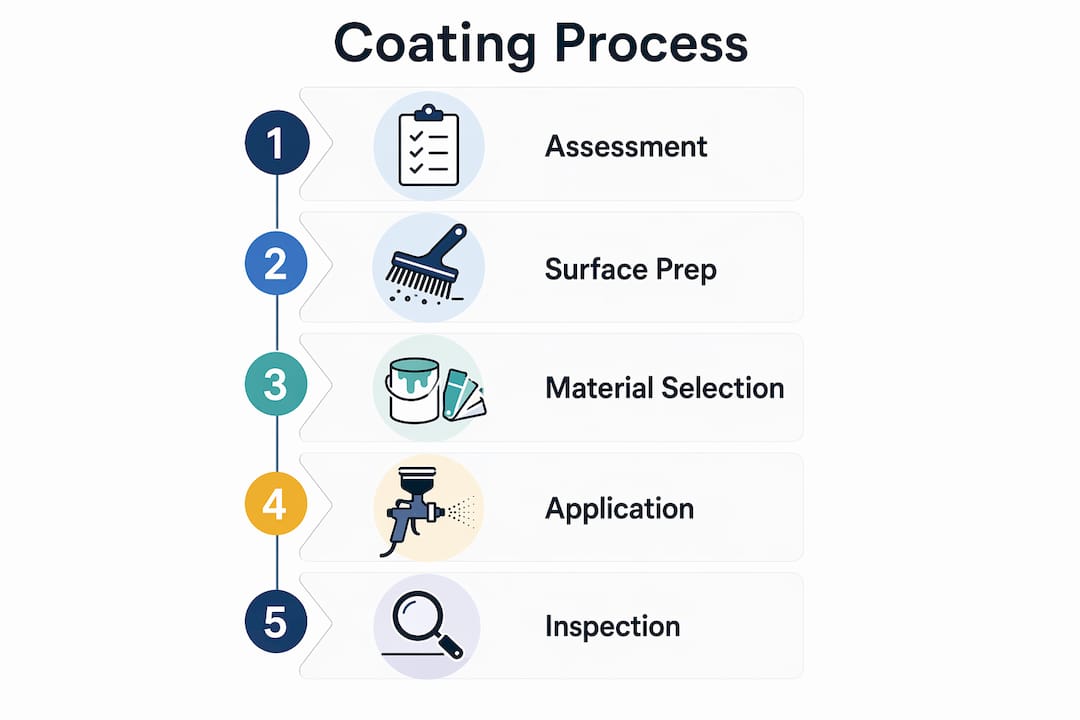
The right coating material depends on the asset type, the chemical exposure, and the operating temperature. No single system covers every application in a chemical plant.

Process vessels and storage tanks in chemical service typically use multi-coat epoxy systems, often with a zinc-rich primer, an epoxy intermediate coat, and a chemical-resistant epoxy or vinyl ester topcoat. Pipe racks and structural steel in petrochemical environments benefit from C5-rated high-durability systems that can deliver 15–20 years of service life with proper inspection and repair. That service life assumes zero corrosion under insulation (CUI) and a disciplined maintenance schedule. Concrete floors in chemical processing areas require coatings with high chemical resistance and low permeability, typically novolac epoxy or polyurethane systems.
Advanced systems add further protection for specific risks. Thermal spray metallizing applies zinc or aluminum directly to steel at high velocity, producing a coating with no organic binder and exceptional adhesion. Intumescent fireproofing coatings expand under heat to insulate structural steel during a hydrocarbon fire. These systems require compatible primers. Incompatible primers cause hidden delamination in fireproofing systems, which compromises fire resistance exactly when it matters most.
| Coating type | Chemical resistance | Typical use | Durability |
|---|---|---|---|
| Zinc-rich epoxy primer | Moderate | Structural steel, pipe racks | High with topcoat |
| Novolac epoxy | Very high | Tank linings, chemical containment | High |
| Polyurethane topcoat | Moderate | Exposed structural steel | High UV resistance |
| Polysiloxane | Moderate | Exterior finishes, C5 environments | Very high |
| Intumescent fireproofing | Low (fire protection) | Structural steel fireproofing | Requires compatible primer |
| Thermal spray zinc/aluminum | High | Critical steel, offshore-grade assets | Very high |
Pro Tip: For assets under insulation, specify coatings rated for the actual temperature zone. Systems for areas below 120°C differ significantly from those used in higher-temperature zones, and using the wrong system causes CUI failures that are nearly impossible to detect without removing insulation.
Facility managers can review key industrial coating types to match system selection to specific asset categories before specifying a project.
How does surface preparation affect coating performance?
Surface preparation is the single greatest variable in coating performance. A premium coating applied to a poorly prepared surface will fail faster than a basic coating applied correctly.
Surface contamination before coating application causes catastrophic delamination regardless of coating quality. Oils, process fluids, mill scale, and chloride salts all prevent adhesion. The coating may look intact for weeks before blistering and peeling reveal the failure underneath. Abrasive blasting to SSPC-SP 6 (commercial blast) is the minimum standard for most industrial coatings. Near-white blast cleaning to SSPC-SP 10 is required for immersion service and chemical tank linings. The anchor profile created by blasting also matters. Too shallow and the coating has nothing to grip. Too deep and the peaks of the profile pierce through thin coats.
Common application failures in chemical plants include:
- Applying coatings outside the specified temperature and humidity window, causing solvent entrapment or poor cure
- Exceeding the maximum recoat window, which prevents intercoat adhesion between layers
- Applying coats too thick in a single pass, trapping solvents and causing internal stress
- Skipping the primer on complex geometries like welds, bolts, and edges where coating thickness is naturally thinner
- Failing to verify dry film thickness with a calibrated gauge after each coat
Coating inspection by a certified inspector, such as those qualified under NACE CIP Level 2, catches these errors before they become field failures. Inspection at each stage, including surface prep, primer application, and final topcoat, is far cheaper than recoating a failed system during an unplanned shutdown.
Pro Tip: Stripe coat all welds, edges, and bolt heads with a brush-applied coat before rolling or spraying the full coat. These areas lose film thickness during application and are the first places corrosion initiates.
For a detailed breakdown of preparation methods, the surface prep best practices guide covers the standards and sequences that protect coatings over the long term.
What maintenance and inspection strategies keep coatings performing?
A coating system is not a one-time investment. It requires a structured inspection and maintenance program to deliver its full service life.
Synchronized inspection and maintenance during planned shutdowns allows coatings to last beyond 15 years without emergency recoating. The key is integrating coating inspection results into the turnaround schedule, not treating them as an afterthought. Facility managers who integrate inspection into turnaround schedules prevent the costly emergency repairs that result from deferred maintenance. Assets are prioritized by corrosion severity, so the worst-condition equipment gets attention first.
A practical maintenance program covers these priorities:
- Annual visual inspection of all coated surfaces, with photographic records to track progression
- Dry film thickness checks on high-risk assets like tank exteriors and pipe rack steel
- Holiday testing on tank linings and immersion-service coatings to detect pinholes
- CUI monitoring on insulated piping using thermal imaging or periodic insulation removal at high-risk locations
- MIC assessment in areas with standing water, biofilm, or anaerobic conditions, particularly in cooling water systems and buried piping
Corrosion under insulation deserves special attention. CUI develops invisibly, and by the time it is visible externally, the steel underneath may already be deeply pitted. Thermal spray coatings and high-build epoxy systems rated for the specific temperature zone reduce CUI risk significantly. Coating systems for insulated areas must also withstand thermal cycling and moisture ingress without cracking or delaminating.
Pro Tip: Build a coating register for every major asset in the plant. Record the coating system specified, the application date, the inspector’s name, and the dry film thickness readings. That register becomes the baseline for every future inspection and repair decision.
Detailed guidance on coating inspection routines explains how to structure these programs for maximum asset life.
Key Takeaways
Protective coating systems are the primary defense against corrosion, chemical attack, and safety failures in chemical plants, and their performance depends entirely on material selection, surface preparation, and disciplined inspection.
| Point | Details |
|---|---|
| Coatings prevent multiple failure modes | Electrochemical corrosion, chemical attack, and MIC each require specific coating responses. |
| Material selection must match the asset | Epoxy, polysiloxane, zinc-rich, and intumescent systems serve different assets and exposures. |
| Surface prep determines coating life | Contamination before application causes delamination regardless of coating quality. |
| Inspection must be structured and scheduled | Synchronized turnaround maintenance allows coatings to exceed 15 years of service life. |
| Primer compatibility is a safety issue | Incompatible primers under fireproofing systems compromise fire resistance during emergencies. |
Why I stopped treating coatings as a line item
After working with chemical plant facilities for years, the pattern is consistent: the plants with the worst corrosion problems are not the ones with the smallest budgets. They are the ones that treat coatings as a commodity purchase rather than an engineered system.
The misconception is understandable. A coat of paint looks like a coat of paint. The difference between a $4-per-square-foot epoxy and a $12-per-square-foot novolac epoxy is invisible until the tank lining fails at year three instead of year fifteen. The real cost is never the coating. It is the unplanned shutdown, the contaminated product, and the regulatory inspection that follows.
What I have found actually works is treating the coating specification the same way you treat a mechanical specification. Define the chemical exposure. Specify the qualification test. Require certified inspection at every stage. Coating qualification must match actual plant stressors, not generic product data sheet claims. That discipline separates facilities that recoat every five years from those that go fifteen or more years between major coating campaigns.
The other shift that matters is involving coating specialists early in capital projects. A coating engineer consulted during the design phase can specify the right primer for a fireproofing system before the steel is erected. That conversation costs almost nothing. Fixing a delaminated fireproofing system on erected structural steel costs a great deal more. Coatings are strategic assets that support operational continuity. Budget for them accordingly.
— Results
Southernsandblastingandpainting: surface preparation and coating services for chemical plants
Chemical plant assets demand surface preparation and coating application that meets industrial standards, not general commercial practice.

Southern Sandblasting and Painting brings 20+ years of experience in abrasive blasting, industrial painting, and protective coating application for critical infrastructure across Central Florida. The team handles the full sequence from surface prep through final inspection, applying coating systems suited to chemical exposure, structural steel, and process equipment. Facility managers can start with the sandblasting equipment guide to understand the preparation methods that determine coating adhesion and longevity. For a full picture of coating options by asset type, the industrial coating types guide covers system selection for chemical plant applications. Contact Southernsandblastingandpainting to discuss your facility’s coating requirements.
FAQ
What is the primary role of coatings in chemical plants?
Protective coatings in chemical plants function as engineered barriers that prevent corrosion, chemical attack, and moisture intrusion on structural steel, concrete, and process equipment. They extend asset life and reduce unplanned downtime.
How long do industrial coatings last in chemical plant environments?
C5-rated coating systems on structural steel can last 15–20 years in petrochemical environments when applied correctly and maintained through scheduled inspections. Service life drops significantly without regular maintenance.
What causes most coating failures in chemical plants?
Surface contamination before application is the leading cause of coating failure, producing delamination that appears weeks or months after application. Poor primer compatibility with fireproofing systems is the second most critical failure mode.
How often should coatings be inspected in a chemical plant?
Annual visual inspections are the minimum standard, with dry film thickness checks and holiday testing on immersion-service assets. Coating inspection results should feed directly into the plant’s turnaround maintenance schedule.
What coating system works best for chemical tank linings?
Novolac epoxy systems provide the highest chemical resistance for tank linings in aggressive chemical service. They require near-white blast cleaning to SSPC-SP 10 and certified inspection at each coat stage to perform as specified.


