
TL;DR:
- Properly specified coatings protect process equipment from corrosion and extend service life by up to 25 years. Surface preparation, application quality, and scheduled maintenance are critical to prevent early failure and reduce long-term costs. Systematic inspection and repair at early signs of damage support asset longevity and cost-effective operation.
Industrial coatings are defined as engineered protective systems applied to process equipment surfaces to prevent corrosion, chemical degradation, abrasion, and environmental damage. The role of coating in process equipment goes far beyond aesthetics. Corrosion alone costs the global economy an estimated 3.4% of GDP annually, a figure that puts the financial stakes of coating decisions in sharp focus. Properly specified and applied coatings extend maintenance-free service life by 15–25 years. The wrong choice, or poor application, produces failure in as few as 3–5 years. For engineers and facility managers, coating selection is an asset management decision, not a procurement afterthought.
How do coatings protect process equipment from corrosion and wear?
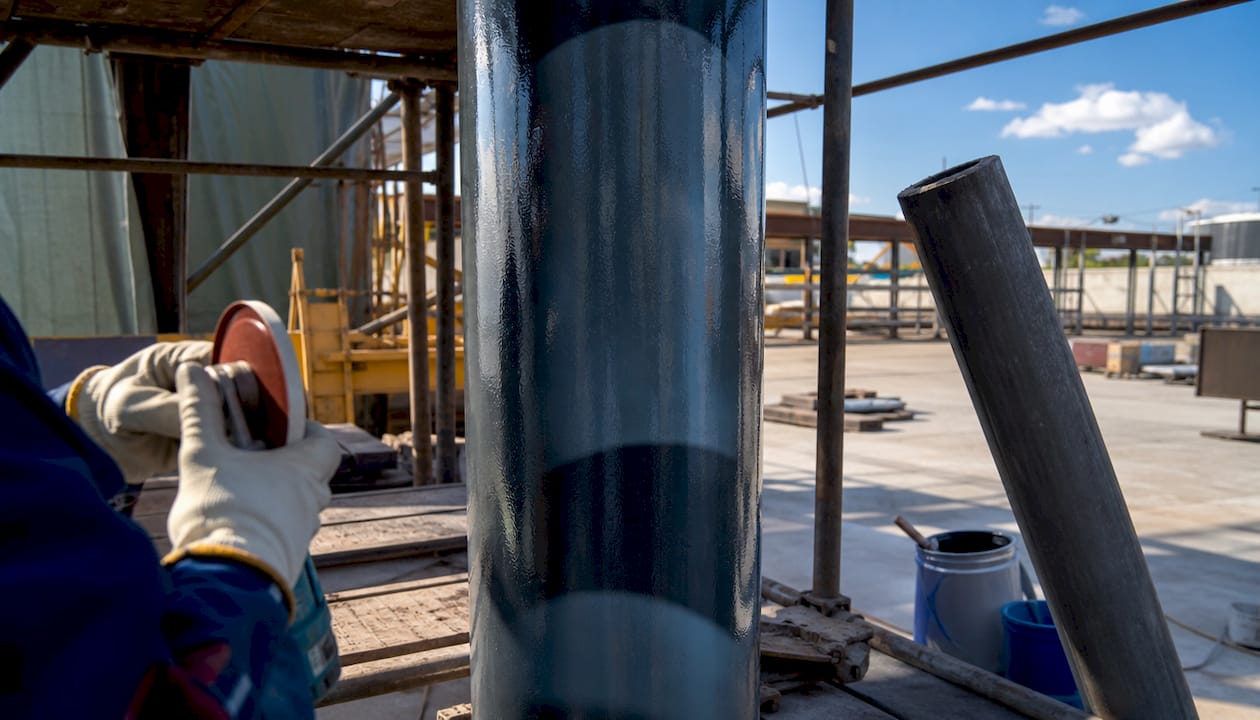
Coatings protect process equipment by creating a physical barrier between the substrate and its operating environment. That barrier blocks moisture, oxygen, and aggressive chemicals from reaching the metal surface. When the barrier holds, electrochemical corrosion cannot start. When it fails, even at a microscopic level, the consequences accelerate quickly.
The mechanisms coatings defend against fall into three categories:
- Electrochemical corrosion: Moisture and oxygen penetrate to the metal surface and trigger oxidation. Zinc-rich primers add galvanic protection by sacrificing themselves before the steel corrodes.
- Chemical attack: Acids, solvents, and process fluids dissolve or swell standard coatings. Novolac epoxy and ceramic-filled systems resist this by forming dense, chemically inert barriers.
- Abrasion and erosion: Slurries, particulates, and mechanical contact wear through soft coatings. Polyurea coatings provide exceptional tensile strength and elongation that absorbs impact without cracking, outperforming epoxy in mechanically aggressive environments.
Adhesion quality determines whether any of these mechanisms actually hold. Corrosion under coatings is caused primarily by poor adhesion or microscopic gaps, not by chemistry failure alone. A coating with perfect chemistry but weak adhesion will delaminate and allow under-film corrosion to spread laterally, often invisibly, until the damage is severe.
Pro Tip: Use a holiday detector on all immersion-service coatings before commissioning. A single pinhole in a tank lining can initiate corrosion that spreads under the film and causes full relining within two years.
What factors influence coating selection for process equipment?
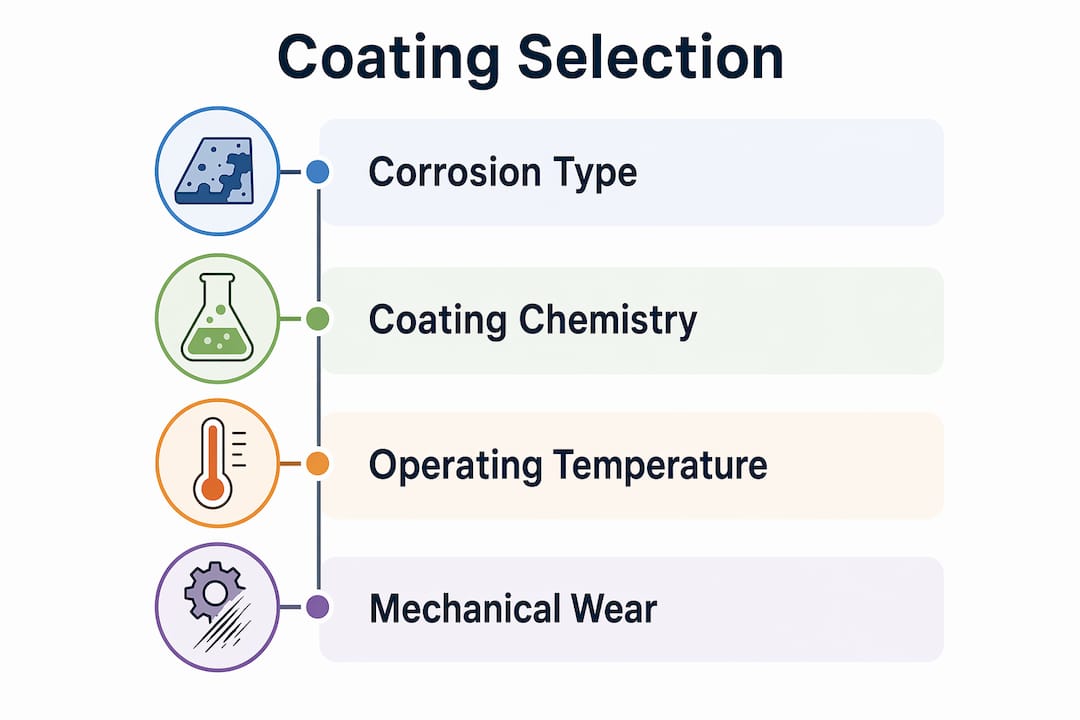
Coating selection depends on four variables: the corrosion mechanism at work, the coating chemistry, the operating temperature, and the quality of surface preparation. Failure in any one of these areas risks premature coating failure, regardless of how well the other three are managed. That interdependence is what makes coating specification a technical discipline, not a catalog exercise.
Matching chemistry to environment
Solvent-borne two-component epoxy and zinc-rich systems are the standard for high-exposure environments. Waterborne epoxy suits moderate conditions where VOC restrictions apply. Novolac epoxy systems cure without shrinkage and form dense barriers for acidic immersion service. Standard epoxy shrinks during curing, creating microporosity that accelerates corrosion under acidic conditions. 100% solids novolac epoxy systems eliminate that shrinkage and are the correct choice for chemical storage tanks and reactor vessels.
ISO 12944 classifies corrosivity environments from C1 (very low, indoor) through C5 and CX (very high, offshore and industrial). Matching your coating system to the correct corrosivity category is the first step in specification. A C3-rated system applied in a C5 environment will fail years ahead of schedule.
Coating types at a glance
| Coating type | Best application | Key limitation |
|---|---|---|
| Zinc-rich epoxy primer | Structural steel, high-humidity exposure | Requires topcoat for chemical resistance |
| 100% solids novolac epoxy | Chemical tanks, immersion service | Requires precise mixing and fast application |
| Polyurea | Complex geometries, mechanical wear zones | Higher material cost than standard epoxy |
| Ceramic-filled epoxy | Pump housings, pipe elbows, abrasion zones | Brittle under impact if applied too thick |
| Waterborne epoxy | Indoor equipment, VOC-restricted environments | Lower chemical resistance than solvent-borne |
Pro Tip: When specifying coatings for equipment that sees both chemical exposure and mechanical wear, a polyurea topcoat over a zinc-rich primer gives you galvanic protection at the substrate and impact resistance at the surface. That combination outperforms single-system approaches in mixed-stress environments.
What are best practices for applying coatings to process equipment?
Application quality determines whether a coating performs to its rated service life. The best coating chemistry in the world fails if the substrate is contaminated, the film is uneven, or the application window is missed. Early coating failure is caused more often by inadequate surface preparation than by coating chemistry. That finding should reset how facility managers allocate quality control attention and budget.
The critical application steps are:
- Blast clean to ISO 8501-1 Sa 2.5 or Sa 3. Sa 2.5 is the minimum for most industrial coatings. Sa 3 is required for immersion service and high-chemical-exposure environments. Anything below Sa 2 produces adhesion values that guarantee early failure.
- Apply the primer coat within the re-rust window. Blasted steel begins to oxidize within hours in humid conditions. Proper application requires coating within the re-rust time specified for the ambient conditions. Missing that window means reblasting.
- Control dry film thickness at every pass. Underthickness leaves the substrate underprotected. Overthickness on brittle systems like ceramic-filled epoxy causes cracking under thermal cycling.
- Test for holidays and pinholes. Use wet sponge testing for coatings below 500 microns and high-voltage spark testing for thicker systems. Pinhole-free application is a critical success factor that quality control must verify before any coating is accepted.
- Conduct adhesion pull-off testing. ASTM D4541 pull-off tests confirm that the coating has bonded to the substrate at the required strength. Failing this test after application is far less costly than failing it in service.
Pro Tip: Schedule coating application for early morning when temperatures are rising. Applying to a surface that is cooling causes solvent entrapment and blistering. A rising surface temperature drives solvents out of the film cleanly.
For a detailed breakdown of preparation requirements, the surface prep workflow for industrial projects covers each stage with specification-level detail.
How does proactive coating maintenance reduce long-term costs?
Proactive coating maintenance is the practice of inspecting and repairing coatings on a scheduled basis before corrosion reaches the substrate. Reactive maintenance, which means waiting for visible failure, always costs more. Emergency repairs carry rush fees and operational disruption costs that dwarf the price of a scheduled inspection and spot repair.
The recommended maintenance cycle follows this structure:
- Annual visual inspection. Walk the equipment and document coating condition with photographs. Note any chalking, cracking, blistering, or rust staining.
- Dry film thickness measurement. Compare current readings against the original specification. Significant loss indicates active erosion or weathering.
- Trigger spot repairs at 5% rust surface area. Repairs triggered at 5% rust coverage prevent localized corrosion from spreading to adjacent sound coating.
- Full recoating at 15–20% rust coverage. At this threshold, spot repair is no longer cost-effective. Full surface preparation and recoating is the correct response.
- Budget 2–5% of the original coating project cost annually for inspections and spot repairs. This annual allocation prevents cost spikes from emergency recoating after advanced corrosion has developed.
Digital record-keeping, including photographs, dry film thickness logs, and adhesion test results, is the foundation of condition-based coating maintenance. Facilities that maintain complete coating histories make better repair decisions, support warranty claims more effectively, and avoid the guesswork that leads to over-spending on unnecessary full recoats.
Condition-based monitoring is the future of coating maintenance in chemical plants. Combining fixed annual inspections with condition-based triggers gives facility managers a hybrid approach that responds to actual equipment condition rather than calendar dates alone. For guidance on building that program, the coating maintenance guide for long-lasting protection provides a practical framework.
Key Takeaways
The role of coating in process equipment is to function as an engineered protective system that, when correctly specified, applied, and maintained, extends service life by 15–25 years and prevents the corrosion costs that consume 3.4% of global GDP annually.
| Point | Details |
|---|---|
| Coatings are engineered systems | Select coating chemistry based on corrosion mechanism, temperature, and chemical exposure, not cost alone. |
| Surface prep drives performance | Blast cleaning to ISO 8501-1 Sa 2.5 or Sa 3 is the minimum for industrial coating adhesion. |
| Application quality is non-negotiable | Holiday testing and pull-off adhesion tests must be completed before any coating is accepted. |
| Proactive maintenance saves money | Budget 2–5% of original coating cost annually to avoid emergency recoating expenses. |
| Digital records improve decisions | Photograph and log every inspection to support condition-based maintenance and warranty claims. |
What most coating decisions get wrong
The most persistent mistake I see in industrial coating programs is treating chemistry as the primary variable and everything else as secondary. Facility managers spend weeks debating epoxy versus polyurea while the surface preparation specification gets a single line in the scope of work. That is backwards.
Surface preparation and application quality account for the majority of coating failures in the field. A zinc-rich primer applied over Sa 1 surface cleanliness will delaminate faster than a waterborne epoxy applied over Sa 2.5. The chemistry matters, but it cannot compensate for what happens before the first coat goes on.
The second mistake is deferring maintenance until failure is obvious. Coatings do not fail suddenly. They degrade progressively, and the window for low-cost intervention is wide. Waiting until rust coverage exceeds 20% turns a spot-repair job into a full shutdown, reblast, and recoat. The cost difference is not marginal. It is often a factor of five or more.
The third mistake is treating the coating decision as a one-time event. Coatings are systems with service lives. They require scheduled inspection, condition monitoring, and planned reinvestment. Facilities that build coating maintenance into their asset management programs consistently outperform those that treat coating as a capital expense to be deferred as long as possible.
The practical lesson: specify the coating system correctly, execute the application to standard, inspect on a fixed schedule, and repair at the first trigger threshold. That sequence, applied consistently, is what separates facilities with 20-year coating service lives from those recoating every five years.
— Results
Southernsandblastingandpainting: surface preparation and coating services for process equipment
Process equipment coating performance starts with surface preparation. Without the right blast profile and cleanliness level, no coating system performs to specification.
Southern Sandblasting and Painting brings over 20 years of experience in professional sandblasting and industrial coating application for commercial, municipal, and government facilities across Central Florida. From water tanks and pipelines to manufacturing equipment and city infrastructure, the team delivers surface preparation to ISO 8501-1 standards and coating application with full quality control documentation. The sandblasting equipment guide details the preparation methods that support long-term coating performance on critical assets.
FAQ
What is the role of coating in process equipment?
Coatings function as engineered protective barriers that prevent corrosion, chemical attack, abrasion, and environmental damage on process equipment surfaces. Correctly specified and applied coatings extend maintenance-free service life by 15–25 years.
What types of industrial coatings are used on process equipment?
The most common types include zinc-rich epoxy primers, 100% solids novolac epoxy, polyurea, ceramic-filled epoxy, and waterborne epoxy. Each system suits a different combination of chemical exposure, temperature, and mechanical stress.
Why does surface preparation matter so much for coating performance?
Early coating failure is caused more often by inadequate surface preparation than by coating chemistry. Blast cleaning to ISO 8501-1 Sa 2.5 or Sa 3 is required for strong adhesion on industrial equipment.
How often should coatings on process equipment be inspected?
Annual visual inspections are the baseline. Spot repairs should be triggered when rust coverage reaches 5% of the surface area, and full recoating is warranted at 15–20% coverage.
How much should a facility budget for coating maintenance annually?
Maintenance budgets should allocate 2–5% of the original coating project cost each year for inspections and spot repairs. This prevents the far higher costs of emergency recoating after advanced corrosion develops.
Recommended
- Role of Coatings in Longevity – Extending Asset Lifespans
- Industrial Coating Terminology: Keys for Asset Longevity
- What Is Protective Coating and Why Asset Longevity Depends On It
- How to Maintain Coatings for Long-Lasting Protection
- Sandblasting Contractor Baldwin Park FL
- Sandblasting Services Oviedo FL


