

What agency coating specifications actually do
A coating specification is a legally binding document that tells a contractor exactly what to do, when to do it, and where. It is not a suggestion or a general reference. When a project goes sideways and legal action follows, the specification becomes the central document in the dispute. Every agency involved in infrastructure work, from municipal water authorities to federal reclamation offices, relies on these documents to define scope, enforce quality, and protect public assets.
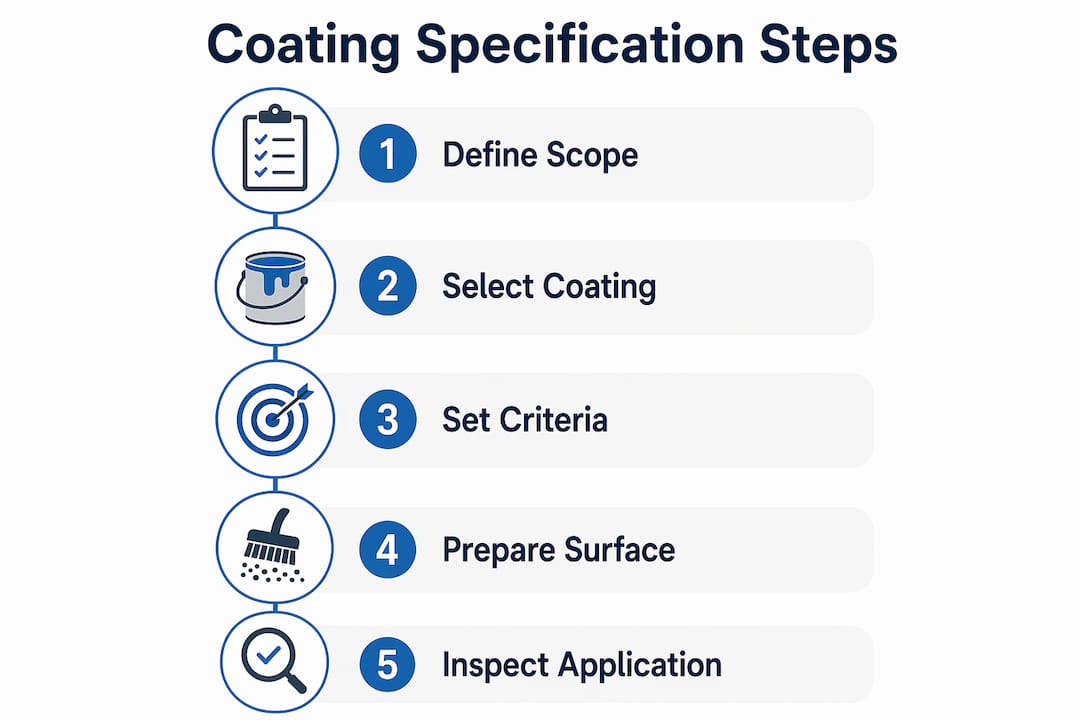
The core elements every agency coating specification should include:
- Scope of work: Surfaces to be coated, surfaces excluded, and project boundaries
- Materials: Approved coating systems, product data sheet requirements, and substitution criteria
- Surface preparation: Cleanliness standards, surface profile range, contamination limits, and hold points
- Application methods: Environmental limits, mixing procedures, film thickness requirements, and recoat windows
- Inspection criteria: Test methods, acceptance and rejection thresholds, inspector qualifications, and reporting requirements
- Closeout documentation: Batch records, condition logs, dry film thickness reports, and warranty references
- Change control: Written request procedures, cost adjustment rules, and addendum processes
The U.S. Bureau of Reclamation defines a specification as “a written, detailed, technical description of work to be performed, describing the materials, quantities, and mode of construction.” That definition captures the contract function precisely. The specification is not just technical guidance. It is the agreement itself.
Why coating specifications determine project success
Poor specifications cost far more than the coating work itself. One documented case shows a project where coating and application costs were far exceeded by subsequent rework expenses due to application failures, leading to dramatically increased overall costs. That figure does not include lost production time.
The same source found that a significant portion of coating failures were attributed to applicators, with specifications contributing to a smaller share. Many projects lacked inspection oversight, and a minority had certified inspectors present. Those numbers point to a systemic gap between what specifications require and what actually gets verified in the field.
Clear specifications serve several functions beyond technical direction:
- Fair bidding: All contractors price the same scope, reducing disputes over what was and was not included
- Legal protection: Documented requirements protect owners, contractors, and inspectors when claims arise
- Measurable acceptance: Objective thresholds replace subjective judgment, so compliance is verifiable
- Dispute prevention: Ambiguous language invites conflicting interpretations; precise language closes that gap
A specification written with measurable acceptance criteria, referencing recognized agency coating standards like SSPC-PA2 for dry film thickness or ISO 8501 for surface cleanliness, gives every party a shared benchmark. When the inspector and the contractor are reading the same numbers, arguments about “acceptable” become rare.
How to select and specify the right coating system
Choosing the wrong coating system is the fastest way to render the rest of the specification irrelevant. If the products specified are wrong for the exposure, nothing else in the document matters. System selection depends on a set of conditions that must be evaluated before a single product is named.
Key factors that drive coating system selection:
- Substrate type: Steel, concrete, galvanized metal, and aluminum each require different surface preparation and primer chemistry
- Exposure conditions: Immersion, splash zones, UV exposure, hydrogen sulfide, thermal cycling, and chemical contact all affect system performance
- Maintenance schedule: A facility with annual access can specify systems that require periodic recoating; a buried pipeline cannot
- Environmental regulations: VOC limits set by the EPA and state agencies constrain product selection, particularly for field-applied coatings
- Service life target: A 10-year system and a 30-year system have different film build, chemistry, and inspection requirements
The difference between prescriptive and performance-based specifications matters here. A prescriptive spec tells the contractor exactly which products to use and how to apply them. A performance-based approach defines the end result required, such as achieving SSPC-SP10 Near-White Blast with a 2–3 mil angular surface profile, and leaves the means to the contractor. Prescriptive specs can tie the contractor’s hands and, if the prescribed method fails to achieve the result, expose the owner to claims. Performance-based specs give contractors flexibility while holding them accountable for outcomes.
Involving coating manufacturers early in the design phase is one of the most practical steps a specifier can take. Manufacturers can flag compatibility issues, confirm cure windows for the project’s climate, and identify whether the specified system has a track record in similar service conditions. That input is far cheaper to get during design than to discover missing during construction.
Pro Tip: Avoid setting numeric pass/fail thresholds without accounting for test method variability. Two products with abrasion resistance values of 115 mg loss and 125 mg loss against a 120 mg limit are practically equivalent, yet a strict reading disqualifies one. Build tolerance ranges that reflect real-world test precision, not laboratory ideals.
How to write coating specification language that holds up
The language in a specification determines whether it can be enforced. Vague wording creates room for interpretation, and interpretation under pressure tends to favor whoever has the most leverage at that moment. The goal is to write a document that a project manager, a field foreman, and an inspector can all read and reach the same conclusion.
Structural best practices for coating specification documents:
- Definitions section: Resolve regional dialect differences and technical ambiguities before they reach the field
- Scope section: State exactly what is and is not included; surfaces excluded are as important as surfaces included
- Materials section: List approved products, substitution criteria, and submittal requirements
- Surface preparation section: Reference specific standards (SSPC, NACE, ISO) with measurable profile and contamination limits
- Application section: Specify environmental windows, mixing procedures, induction times, pot life, and recoat intervals for each coat
- Inspection section: Name hold points, test methods, acceptance criteria, and inspector qualification requirements
- Closeout section: Define the documentation package required before final payment is released
Project specifications override manufacturer technical data sheets because they capture site-specific requirements that general product guidance cannot anticipate. Writing “apply per manufacturer’s data sheet” is not a specification. It transfers decision-making to the manufacturer and removes the owner’s ability to enforce project-specific requirements.
The Construction Specification Institute (CSI) format, which the U.S. Bureau of Reclamation adopted for its coating work, uses imperative language and concise section structure. That format reduces the need for lengthy explanatory prose and makes compliance verification straightforward. Referencing recognized standards like ASTM, NACE, and SSPC within that structure further reduces the word count while increasing enforceability.
How specifications define surface preparation and application requirements
Surface preparation is where most coating failures begin. A well-written specification does not describe preparation in general terms. It defines every measurable condition the contractor must achieve before the first coat touches the substrate.
Critical preparation and application requirements to specify:
- Cleanliness standard: Reference SSPC-SP10 (Near-White Blast) or SSPC-SP6 (Commercial Blast) with the specific visual standard required
- Surface profile: State the minimum and maximum anchor profile in mils, with the test method (Testex Press-O-Film or digital gauge)
- Contamination limits: Define maximum soluble salt levels, dust rating per ISO 8502, and oil/grease removal requirements
- Moisture conditions: Require substrate temperature at least 5°F above dew point; state maximum relative humidity
- Environmental windows during application: Maximum and minimum air and substrate temperature, wind speed limits, and humidity ceilings
- Film thickness: Specify minimum, maximum, and target dry film thickness per coat, measured per SSPC-PA2
- Cure windows: Define minimum and maximum recoat intervals for each coat under the project’s expected temperature range
- Holiday testing: Specify voltage settings, equipment type, and acceptance criteria per NACE SP0188 for immersion-service linings
Hold points are the mechanism that makes these requirements enforceable. A hold point stops work until the inspector verifies and documents that a specific condition has been met. Without hold points, coating inspection becomes a post-application audit rather than a real-time quality check. By then, the substrate is buried under coating and rework costs multiply.
Collaborative approaches that produce better specifications

The most technically complete specification still fails if it was written in isolation. Collaborative delivery models that engage coating manufacturers, engineers, owners, and contractors early in the design phase produce specifications that reflect actual field conditions, not just laboratory assumptions.
For water and wastewater infrastructure, this means reviewing service conditions such as immersion, sludge contact, and hydrogen sulfide exposure before the coating system is selected. It means coordinating with other trades on sequencing, access, and substrate readiness so the specification does not require conditions the construction schedule cannot deliver. And it means writing a document with a non-adversarial tone, one that communicates expectations clearly rather than anticipating conflict.
Best practices for collaborative specification development:
- Engage coating manufacturers during preliminary design to review service conditions and propose appropriate chemistries
- Involve the contractor in constructability review to confirm that specified preparation methods are achievable on the actual structure
- Require the inspector to review the specification before work begins and document any ambiguous points in writing
- Use independent certified inspectors (AMPP/NACE) on large-scale projects; their early involvement clarifies requirements and their reports serve as legal documentation
- Treat the specification as part of the asset’s life cycle strategy, not a one-time procurement document
Generic boilerplate specifications written for a different project increase the risk of ambiguity and legal exposure. Every project has unique environmental and operational conditions that a recycled document cannot address. The time invested in a project-specific specification pays back in fewer field disputes, fewer change orders, and longer coating service life.
Pro Tip: Integrate coating requirements into the asset management plan from the start. Owners who treat coatings as a core element of asset strategy, addressing sequencing, access, and substrate integrity before construction begins, consistently see better long-term outcomes than those who treat coatings as a finish-line item.
How specifications play out in real infrastructure projects
The Yuba County Water Agency (YCWA) Technical Specification for field-applied coatings illustrates how agency coating specification guidelines translate into enforceable field requirements. The document requires dry film thickness measured per SSPC-PA2 Level 1 with no averaging, surface cleaning to ISO 8085 Class 3, and application per SSPC-PA1. Those are not general references. They are specific, measurable thresholds that an inspector can verify with calibrated instruments and record in a signed report.
Pipeline operators working under federal gas transmission regulations follow a similar structure. The American Gas Association’s guide material for pipeline coatings requires operators to specify surface preparation for field-applied coatings with explicit reference to NACE No. 2/SSPC-SP10 for blast cleaning, substrate temperature requirements, and compatibility between field-applied and factory-applied coatings. The specification must address weld joints, service tees, buried valves, and repair areas as distinct conditions, not as a single generic requirement.
Water and wastewater treatment facilities present a different challenge. Because many remain operational during renovation, sequencing is critical. A coating specification for an active clarifier must address cure times relative to the facility’s production schedule, access constraints that affect blast equipment selection, and the chemical environment the coating will face from day one of service. That level of detail only appears in a specification written for the specific project, not adapted from a previous job. Surface coating examples from infrastructure projects consistently show that the specifications with the clearest measurable criteria and the most thorough hold-point documentation produce the fewest field disputes and the longest service intervals.
Key Takeaways
Agency coating specifications function as legally binding contracts that define every measurable requirement from surface preparation through final inspection, and the quality of that document directly determines whether a coating system delivers its intended service life.
| Point | Details |
|---|---|
| Specifications are legal contracts | They govern contractor obligations and serve as the primary document in any dispute or legal action. |
| Poor specs carry real cost | One documented project saw costs rise dramatically due to rework from inadequate specification. |
| Performance-based specs reduce owner risk | Prescribing outcomes rather than methods gives contractors flexibility and protects owners from claims when prescribed methods fail. |
| Measurable criteria prevent disputes | Referencing SSPC-PA2, SSPC-SP10, and ISO standards replaces subjective language with verifiable thresholds. |
| Collaborative development improves outcomes | Early engagement of manufacturers, contractors, and certified inspectors produces specifications that reflect actual field conditions. |


