
For large new fabrication, abrasive blasting is the right call. For field welds, tight access, or spot repairs, mechanical power tools or a grit-free impact tool get you there without containment headaches. Acid pickling belongs in a controlled shop, on complex geometries, followed by mechanical profiling. Whichever method you pick, target SSPC-SP10 / Sa 2½ for most industrial coatings, and never skip respiratory protection or dust containment to save an hour.
TL;DR:
- Abrasive blasting remains the most effective method for large areas and projects requiring a near-white metal finish, achieving SSPC-SP10 and Sa 2½ standards reliably.
- Mechanical power tools, especially impact tools like the Bristle Blaster, are suitable for confined spaces, field joints, and spot repairs, with near-SP10 cleanliness achievable without containment.
- Chemical pickling works best in controlled shop environments for complex geometries but requires neutralization, disposal permits, and usually needs additional profiling before coating.
- Flame cleaning is a limited, touch-up method that only loosens loose scale and seldom meets full SSPC-SP10 standards, with high fire risk and potential warping issues.
- Proper verification, including visual standards and anchor profile measurement, is essential to prevent coating failures caused by incomplete scale removal or inadequate surface prep.
Table of Contents
- What Is Mill Scale Removal and Why Does It Matter?
- Which Mill Scale Removal Methods Actually Work?
- How Does Abrasive Blasting Remove Mill Scale?
- When Should You Use Power Tools Instead of Blasting?
- Is Chemical Pickling Right for Your Project?
- What Can Flame Cleaning Actually Achieve?
- How Do You Verify Mill Scale Is Fully Removed?
- What Safety and Environmental Steps Does Mill Scale Removal Require?
- When Should You Hire a Mill Scale Removal Contractor?
- What 20+ Years of Surface Prep Teaches You About Mill Scale
- Get Professional Mill Scale Removal Done Right
- Sources
What Is Mill Scale Removal and Why Does It Matter?
Mill scale is the blue-black iron oxide layer that forms on steel during hot rolling. It looks tough, but it’s not protective. It’s brittle, it flakes unevenly, and it sits on the steel as a separate electrochemical layer rather than bonding to it. Coat over it and you’re painting a surface that will eventually let go, taking your topcoat with it.
That’s the core reason mill scale must be removed before coating: it’s mechanically and electrochemically incompatible with modern coating systems, and it causes premature adhesion failure even when the paint job looks fine on day one. The industry term for what you’re chasing isn’t just “clean steel.” It’s a defined cleanliness grade plus a measurable anchor profile, which is the microscopic roughness that gives a coating something to grip. Removing mill scale from steel without hitting both targets is half a job.
Which Mill Scale Removal Methods Actually Work?
Four approaches dominate real-world scale removal, and each one earns its place under different conditions.
- Abrasive blasting (shot, grit, or sand media) is the industry benchmark. It removes scale fast, profiles the steel simultaneously, and scales up for large areas. It requires containment, compressed air, and dust management.
- Mechanical power tools (wire brushes, flap discs, needle guns, impact tools) work where blasting isn’t practical. Standard tools are slower and less thorough; specialized impact tools close the gap.
- Chemical pickling dissolves scale in acid baths, ideal for complex shapes with recesses blasting can’t reach. It needs a controlled shop, neutralization, and follow-up profiling.
- Flame cleaning loosens scale through thermal shock. It’s a niche, low-precision option with real fire and distortion risk.
Many shops combine methods: mechanical pre-cleaning to knock down loose scale, followed by blasting or pickling for the finish work. That hybrid approach often balances cost, quality, and environmental limits better than any single method run alone, particularly on retrofit jobs with mixed surface conditions.
How Does Abrasive Blasting Remove Mill Scale?
Abrasive blasting propels media, steel shot, angular grit, or sand, at high velocity to fracture and strip scale while simultaneously roughening the steel underneath. That dual action is why it’s the default choice for new fabrication, tank interiors, structural steel, and any job with a demanding coating spec.
Shot media tends to produce a rounder, shallower profile; angular grit cuts deeper and creates the sharper anchor pattern many epoxy and polyurethane systems call for. Abrasive blasting reliably achieves SSPC-SP10 (near-white metal) and Sa 2½, which covers the large majority of industrial coating specs. When a project calls for Sa 3 (white metal), full removal of every trace of scale and rust, blasting is really the only method that gets there consistently on large areas.
Pro Tip: Run a test patch before committing to a media type. Switching grit size or shape mid-project to fix a profile problem wastes more time than testing upfront.
- Containment (tarps, blast rooms, vacuum shrouds) is not optional on occupied sites.
- Productivity varies based on media, pressure, and scale thickness, typically measured in square feet per hour.
- Blasting becomes impractical in tight interiors, near sensitive equipment, or where spent media disposal is restricted, which is where mechanical or chemical methods take over.
When Should You Use Power Tools Instead of Blasting?
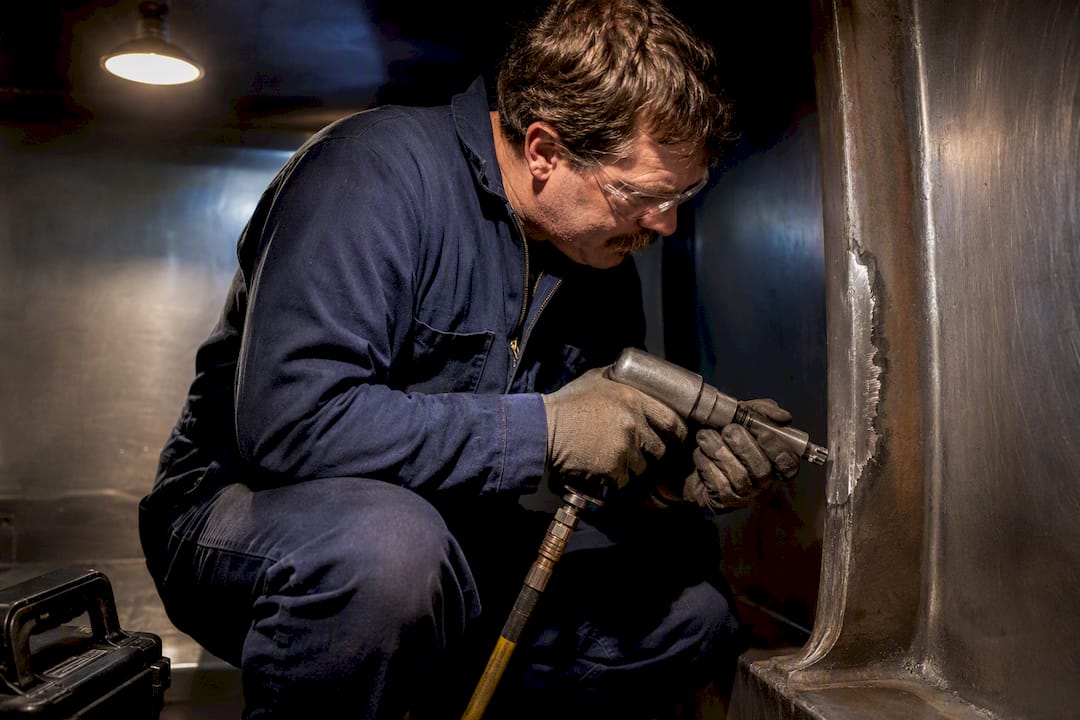
Field joints, confined spaces, and spot repairs are where mechanical tools earn their keep. Wire brushes and flap discs handle light, loosely adherent scale and typically land you around SP2 to SP6, decent surface cleanliness, but not the near-white standard most high-performance coatings demand.
Standard hand and power-tool cleaning is generally less effective than blasting at removing tightly bonded mill scale, and it usually can’t get there without a specialized tool. That’s where grit-free impact tools, the Bristle Blaster class of equipment, change the math. These tools use spring-loaded steel wires or tips to fracture scale through repeated impact rather than abrasive cutting, and they can achieve near-SP10 cleanliness on field work without any blast containment at all.
- Wire brushes: fast, cheap, limited to light scale, poor on pitted steel.
- Flap discs and grinders: effective but risk polishing the surface too smooth for good adhesion if overworked.
- Impact tools: closest field alternative to blasting, ideal for pipeline joints and hot-work repairs.
Pro Tip: Never let a grinder linger in one spot. A shiny, polished patch on otherwise profiled steel reads as a coating defect waiting to happen.
Portable impact tools also work in areas where dust or spark containment rules out blasting, including many ATEX-classified or hazardous-area repairs.
Is Chemical Pickling Right for Your Project?
Acid pickling, typically hydrochloric or sulfuric acid, works by dissolving the scale layer chemically rather than mechanically knocking it off. That makes it the go-to option for parts with threads, welded seams, tubing, or other geometry that a blast nozzle or grinder simply can’t reach.
Immersion baths handle batch processing of small to mid-size parts; spray systems suit larger or oddly shaped pieces that won’t fit a tank. But pickling requires careful pH neutralization and effluent treatment, which is why it’s almost never a field method. Spent acid is hazardous waste, and flash rust can form within hours if pickled steel isn’t primed or dried properly.
- Works best on complex geometry in a controlled shop, not on-site.
- Leaves little to no anchor profile, so pickled steel usually needs mechanical profiling before high-build coatings go on.
- Neutralization and wastewater disposal require permits in most jurisdictions.
What Can Flame Cleaning Actually Achieve?
Flame cleaning uses an oxy-fuel torch to heat the steel surface rapidly. The mill scale and base steel expand at different rates, and that mismatch pops the scale loose. It’s a narrow tool for a narrow job, not a primary removal method for anything beyond touch-up work.
Flame cleaning typically reaches SSPC-SP4, well short of the SP10 most coatings require, and it’s usually finished with a wire brush pass to clear loosened debris. Thin steel sections risk warping under the heat, and open flame near flammable coatings or vapors is an obvious fire hazard. Use it sparingly, and never as the sole prep step on a spec’d job.
- Fire watch required near any combustible material or vapor source.
- Not suitable for thin plate, sheet metal, or precision components.
- Best reserved for rust and loose scale touch-up, not full mill scale removal.
How Do You Verify Mill Scale Is Fully Removed?
Verification is where a lot of otherwise good prep work falls apart, because “looks clean” and “meets spec” are not the same thing. Confirming cleanliness and profile takes a few minutes and prevents callbacks.
- Compare the surface against ISO 8501-1 visual standards or SSPC-VIS 1 photographic guides to confirm the grade, typically SP10 / Sa 2½ for most industrial coatings, or SP5 / Sa 3 (white metal) for immersion service and lining work.
- Measure the anchor profile with Testex replica tape per ASTM D4417 Method C, checking against the coating manufacturer’s specified range, usually 1 to 4 mils depending on the system.
- Run a Bresle patch test for soluble chloride salts if the steel has prior corrosion or marine exposure; most coating warranties require levels under roughly 7 micrograms per square centimeter.
- Log the results, photos, comparator grade, profile reading, salt test, with date and location before coating begins.
Skipping step four is the most common paperwork failure on warrantied jobs. If a coating fails in year two, that record is what proves the prep met spec.
What Safety and Environmental Steps Does Mill Scale Removal Require?
Every method here carries its own hazard profile, and treating them all the same is how people get hurt. Abrasive blasting generates silica or metal dust that demands supplied-air respirators and containment; grinding throws sparks and metal particulate; acid pickling produces caustic fumes and corrosive liquid waste; flame cleaning is a live fire risk.
- Respiratory protection matched to the dust or fume hazard, not a generic dust mask, for blasting and grinding work.
- Containment tarps, negative-air vacuum shrouds, or blast rooms to keep media and debris off adjacent surfaces and out of storm drains.
- Acid neutralization tanks and licensed disposal for pickling effluent; never discharge spent acid to a floor drain.
- Confined-space monitoring and ATEX-rated equipment where dust or vapor concentrations create explosion risk.
- Permits for outdoor blasting or acid discharge, which vary by municipality and are worth confirming before mobilization.
Reviewing industrial safety best practices for surface prep before a project starts catches most of these requirements early, when they’re cheap to fix.
When Should You Hire a Mill Scale Removal Contractor?
Some jobs are genuinely DIY-friendly: a single steel gate, a small bracket, a repair patch under a few square feet. Once you’re looking at structural steel, tank interiors, pipeline runs, or anything with a coating warranty attached, the calculation changes.
- Does the scope require a documented cleanliness standard? If a spec calls for SSPC-SP10 or Sa 2½ with recorded profile data, that’s a sign the job needs equipment and documentation most DIYers don’t have on hand.
- Can the contractor show a waste handling plan? Ask specifically how spent media, acid effluent, or contaminated water will be contained and disposed of, and get it in writing.
- Do they carry insurance and have verifiable references on comparable projects? A contractor working on municipal or commercial assets should have both readily available, not “on request.”
A facility manager’s sandblasting guide is worth a read before soliciting bids, since it frames the right questions to ask before a crew shows up.
What 20+ Years of Surface Prep Teaches You About Mill Scale
The biggest misconception in this field is that mill scale removal is a single step. It’s really a chain: remove the scale, verify the profile, protect the surface until coating, and document all of it. Break any link and the coating fails regardless of how good the paint is.
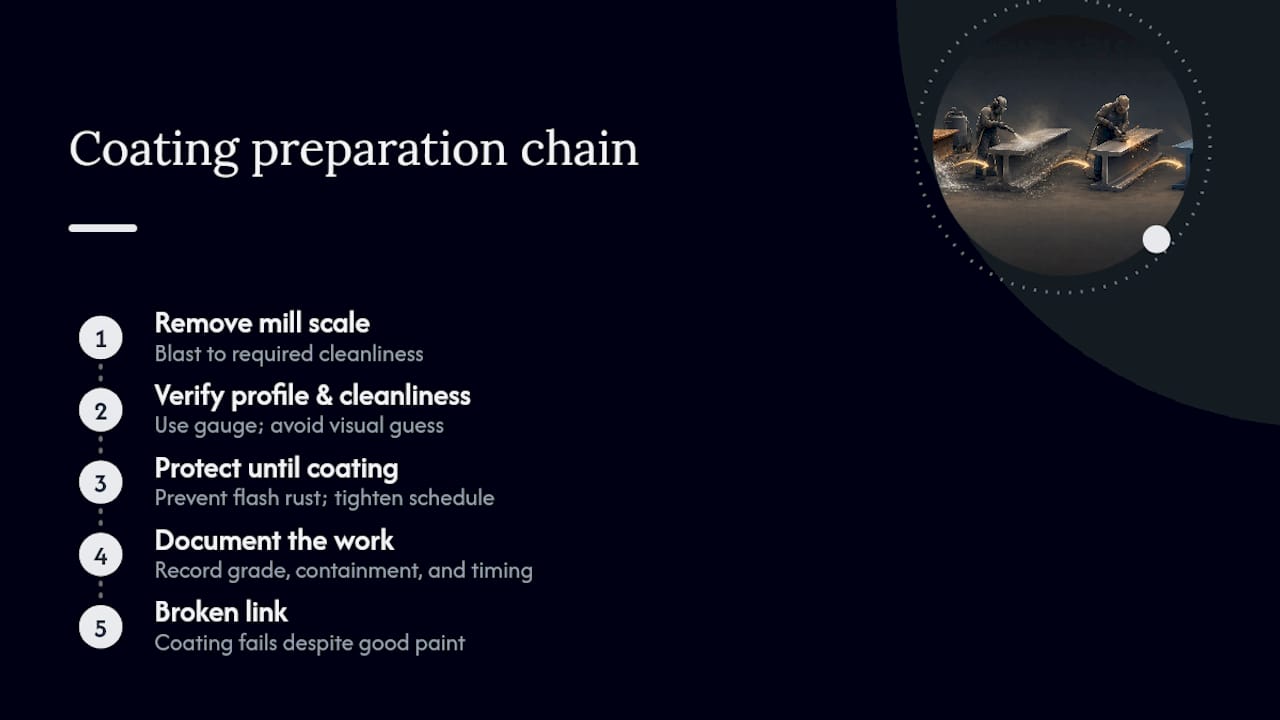
The most common failure Southernsandblastingandpainting sees isn’t a bad blast job. It’s flash rust forming in the gap between prep and painting, or a profile that technically passed but sits at the low end of the coating manufacturer’s range. Both are avoidable with tighter scheduling and an actual gauge reading instead of a visual guess.
Before calling a contractor, walk the asset and ask: what cleanliness grade does the coating spec require, how will scale and waste be contained, and what’s the plan for the hours between prep and paint? Those three answers separate a job that lasts from one that doesn’t.
— Results
Get Professional Mill Scale Removal Done Right
Southernsandblastingandpainting is the direct alternative to guessing your way through a DIY blast job or gambling on a low-bid crew that skips documentation. With 20+ years handling surface prep for municipal, commercial, and industrial clients across Central Florida, the team runs SSPC and ISO-compliant blasting, manages containment and waste disposal on-site, and hands over the profile and cleanliness records your coating warranty actually requires.
A typical quote starts with a site survey to confirm scale thickness, access constraints, and coating spec, followed by a timeline built around your operational schedule rather than a generic crew rotation. If your project needs coating-ready steel and a paper trail to back it up, request an estimate through Southernsandblastingandpainting’s sandblasting services and get a scope built around your asset, not a one-size-fits-all package.
Sources
- How to remove mill scale from steel, and why you must before coating | MontiPower
- Surface preparation for coating (Corrosion Guide No. 2) | NPL


