
The industrial painting trends shaping 2026 are not incremental. They are compliance-driven, technology-accelerated, and directly tied to how long your assets last and whether your facility passes inspection. Here is what you need to know before your next coating project:
- Sustainability and low-VOC compliance are now mandatory, not optional, with the EPA’s VOC limits targeting a significant reduction in ground-level ozone by late 2026
- Methylene chloride is banned for most commercial and industrial uses after april 28, 2026, forcing a full switch to safer stripping alternatives
- Smart coatings with nanoparticles now self-heal and signal corrosion, reducing unplanned downtime in high-stakes infrastructure
- Automation and AI-driven application systems are replacing manual spray processes, cutting overspray and improving coverage consistency
- Waterborne coatings are the fastest-growing technology segment, with a forecasted CAGR of 7.5% through 2030
- Hybrid epoxy and polyurethane systems now deliver multi-decade protection cycles in oil, gas, and offshore environments
- Color and design choices are shifting toward functional palettes that signal safety zones and asset condition
- Health and safety practices are tightening around respiratory protection, exposure monitoring, and PPE requirements
Industrial painting trends 2026: sustainability and environmental compliance
Regulatory pressure is the single biggest driver reshaping coating choices this year. The EPA has finalized mandatory VOC thresholds across all industrial painting and coating operations, with a hard compliance deadline in October 2026. Facilities must exhaust old solvent-heavy stock and transition to certified low-VOC inventories, and they must submit annual digital usage logs verifying that all purchased coatings meet the new toxicity profiles.
The methylene chloride ban is the most disruptive single change. After April 28, 2026, most commercial and industrial uses are prohibited. Facilities still operating under limited permitted conditions face strict exposure monitoring requirements, air exposure limits of only 2 ppm over an 8-hour shift, mandatory respiratory protection, and recordkeeping obligations that add real operational costs.
Statistic callout: Waterborne coatings are projected to grow at a CAGR of 7.5%, the fastest of any technology segment, as solvent-borne systems face tightening restrictions globally.
The shift toward water-based, bio-based, and high-solids formulations is not just about avoiding fines. Facilities that adopt these systems early gain procurement flexibility and avoid supply chain disruptions as solvent-borne products become harder to source. High-efficiency spray systems and electrostatic application methods are now mandated to reduce overspray and atmospheric waste by at least 15%, which also lowers total coating consumption per project.
Key compliance actions for facility managers in 2026:
- Audit current coating inventories against EPA VOC thresholds before October 2026
- Verify regional air district rules, which often exceed federal minimums
- Confirm application equipment meets the new efficiency mandates
- Establish digital reporting workflows for annual compliance submissions
How smart coatings and nanotechnology are changing industrial protection
Smart coatings have moved out of the laboratory. They are now in active use on offshore platforms, aerospace structures, and critical infrastructure where early corrosion detection prevents catastrophic failures. The technology works by embedding nanoparticles into the coating matrix, enabling self-healing of microcracks and visual or electrical signaling when corrosion begins beneath the surface.

According to research published in Advanced Composites and Hybrid Materials, nanostructured coatings can incorporate superhydrophobicity, anti-icing properties, anti-fouling behavior, and embedded corrosion sensors in a single system. Fluorescing or conductivity-sensitive nanomaterials act as real-time corrosion indicators, letting operators identify damage before failure occurs. That shift from reactive repair to predictive maintenance is where the real cost savings accumulate.
Dr. Eugene Caldona of North Dakota State University’s Department of Coatings and Polymeric Materials explains the mechanism clearly: “Inclusion of nanoparticles at very low loadings not only enhances the thermal, mechanical, and electrical aspects of coatings but also offers added functionalities, including microbial resistance, self-cleaning property, switchable wettability, and fire retardancy.”
What makes or breaks smart coating performance is surface preparation. The self-healing and corrosion-indicating functions depend entirely on correct surface profile depth and interfacial bonding. Poor prep does not just reduce adhesion; it negates the smart functions entirely.
Benefits driving adoption:
- Reduced unplanned downtime on high-value assets
- Earlier corrosion detection before structural damage occurs
- Extended service intervals without sacrificing protection
- Lower long-term maintenance costs on offshore and pipeline infrastructure
How automation and digital tools are reshaping coating application
Industry 4.0 practices are now standard in forward-looking coating operations. AI and IoT integration in paint application equipment allows real-time monitoring of film thickness, coverage uniformity, and environmental conditions during application. Deviations trigger immediate alerts rather than post-application rework.
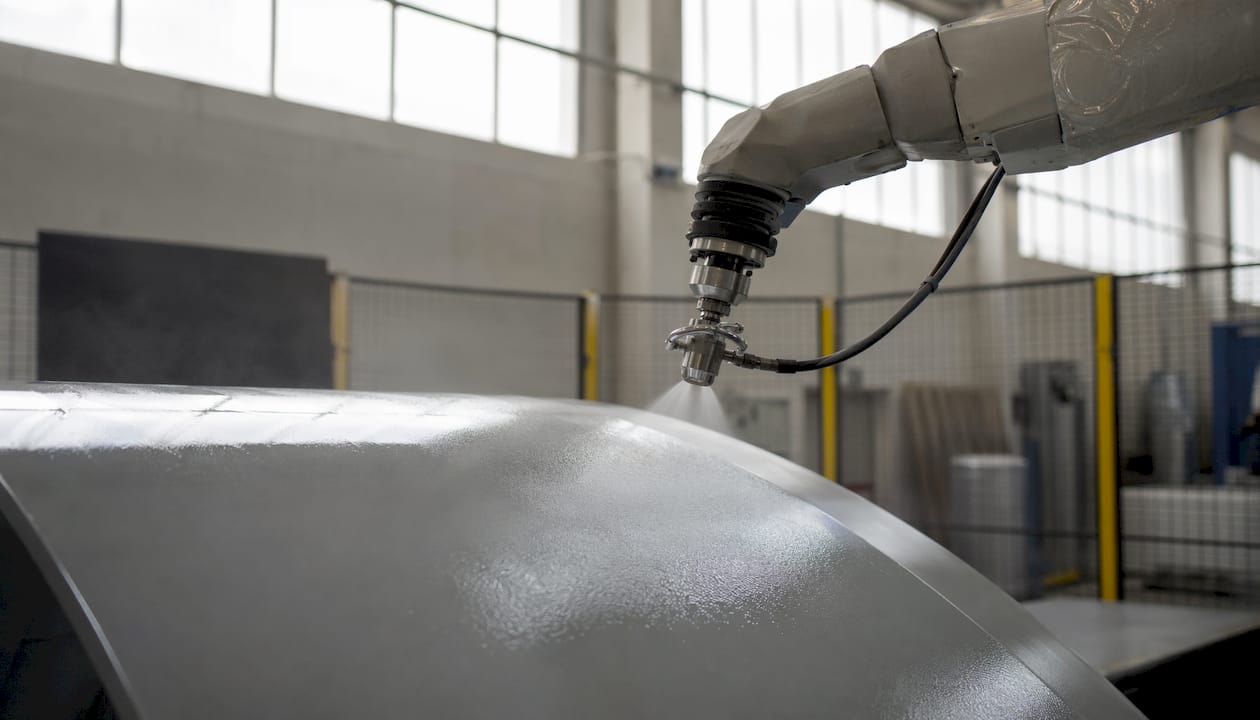
Automated spray systems eliminate the variability of manual application. Robotic arms maintain consistent gun distance, angle, and speed across complex geometries, which matters on structures like water tanks, pipelines, and airport infrastructure where uniform coverage is a safety requirement. Predictive analytics platforms pull IoT sensor data from coated assets to flag degradation before it reaches a maintenance threshold, converting reactive repair schedules into planned interventions.
Digital twins are gaining traction for large projects. A virtual replica of the coating system lets engineers simulate behavior under temperature cycling, chemical exposure, and UV load before physical application begins. That reduces material waste, shortens project timelines, and produces documentation that satisfies regulatory reporting requirements.
Practical applications across industrial projects:
- IoT-enabled spray equipment with real-time film thickness feedback
- Predictive maintenance dashboards pulling corrosion sensor data
- Digital reporting systems generating annual VOC compliance logs automatically
- Robotic application on confined or elevated structures to reduce worker exposure
Durability and performance: what the 2026 market demands
Asset owners are demanding longer protection cycles, and coating technology is delivering. Hybrid systems combining nanostructured designs with proven epoxy and polyurethane chemistry now offer 20–40 year protection cycles in harsh environments, including offshore oil platforms, chemical processing facilities, and coastal infrastructure.
Statistic callout: The global protective coatings market was valued at $16.47 billion in 2025 and is projected to reach $27.83 billion by 2035, growing at a CAGR of 5.4%. Epoxy coatings held 39.1% of revenue share in 2022 and continue to lead the market. Epoxy coatings held 39.1% of revenue share in 2022 and continue to lead the market.
Multi-layer protective systems are the specification standard in oil and gas, marine, and infrastructure sectors. NACE International and ISO 12944 set the engineering benchmarks, with total dry film thicknesses often exceeding 400 microns on offshore assets. The US Bipartisan Infrastructure Law is generating sustained coating procurement demand across bridges, water treatment plants, and transmission towers, all of which require coatings that extend asset lifespans across decades of service.
Renewable energy infrastructure is an emerging growth sector. Wind turbine towers, solar mounting structures, and hydroelectric facilities all require corrosion protection in environments that combine UV exposure, moisture cycling, and mechanical stress. Coating specifications for these assets are pulling demand toward high-performance polyurethane topcoats and zinc-rich primers.
Practical insights from over 20 years of industrial painting experience
Southernsandblastingandpainting has worked on water tanks, airports, pipelines, and city infrastructure across Central Florida for more than two decades. The 2026 regulatory shift is real, and the facilities that are struggling are the ones that waited to audit their coating inventories and application equipment.
Pro Tip: Federal VOC limits are the floor, not the ceiling. Local air quality districts in Florida and across the US regularly impose stricter thresholds than EPA minimums. Always verify your regional rules before procurement, not after a compliance inspection.
Transitioning to low-VOC water-based or bio-derived coatings requires more than a product swap. These systems have different cure cycles, different surface prep requirements, and different sensitivity to ambient humidity and temperature. Facilities that skip retraining their applicators see coating failures and warranty disputes within the first year. The transition to new coating chemistries demands longer testing periods and hands-on training before full deployment.
Key lessons from large-scale project experience:
- Surface profile depth is non-negotiable for smart coating performance; verify it before application, not after
- Water-based systems applied over inadequately prepared steel fail at the interface, not the topcoat
- Digital documentation of application conditions protects contractors during compliance audits
- Phased coating transitions on operating facilities reduce downtime better than full shutdowns
What color and design trends look like in industrial painting for 2026
Color choices in industrial painting are increasingly functional rather than purely aesthetic. Safety-coded color systems are expanding beyond OSHA’s traditional yellow and red conventions. Facility managers are specifying colors that communicate asset condition, zone hazard levels, and maintenance status at a glance, reducing reliance on signage and improving worker orientation in complex facilities.
Neutral industrial palettes in gray, slate, and muted earth tones are gaining ground on exterior structures where UV stability and heat reflectance matter. Light-reflective topcoats on rooftop equipment and storage tanks reduce surface temperatures and lower cooling loads, which connects color selection directly to energy performance. Architectural metalwork in manufacturing and processing facilities is also seeing a shift toward powder-coated finishes in muted industrial tones that resist fading under Florida’s UV intensity.
Texture is another variable getting more attention. Anti-slip textured coatings on walkways, platforms, and loading areas are being specified more aggressively as facilities tighten slip-and-fall liability management. These coatings serve a safety function while also extending the service life of high-traffic surfaces.
Health and safety advancements in industrial painting practices
The methylene chloride ban is the most visible safety change, but the broader shift in industrial painting health practices goes further. Respiratory protection requirements are tightening across all solvent-containing coating applications, with exposure monitoring now a documented obligation rather than a best practice recommendation.
Enclosed application environments and negative-pressure spray booths are becoming standard on projects where worker exposure to isocyanates, epoxy hardeners, and residual solvents is a documented risk. Supplied-air respirators are replacing air-purifying respirators on high-hazard applications. PPE requirements now include chemical-resistant gloves, coveralls, and eye protection specified to the coating chemistry rather than generic industrial standards.
Digital exposure monitoring tools are entering the field. Wearable sensors that track real-time VOC exposure levels for individual applicators are moving from pilot programs into standard practice on large infrastructure projects. These devices generate the exposure records that satisfy OSHA documentation requirements and protect both workers and contractors in liability disputes.
Case studies: how facilities are adopting 2026 coating innovations
Water treatment facilities represent one of the clearest adoption stories. Municipal operators managing aging concrete and steel infrastructure are specifying waterborne epoxy systems that meet both EPA VOC limits and NSF/ANSI 61 standards for potable water contact. The switch from solvent-borne coatings eliminates the extended ventilation periods that previously took tanks offline for days after application.
Pipeline operators in the oil and gas sector are piloting smart coating systems with embedded corrosion sensors on high-consequence segments. Early detection data from these sensors feeds directly into integrity management programs, allowing operators to schedule recoating during planned maintenance windows rather than responding to failures. The cost differential between a planned recoat and an emergency repair on a pressurized pipeline is substantial.
Airport infrastructure projects are adopting automated application systems for runway markings and structural steel coatings. Robotic spray systems maintain the film thickness tolerances required by FAA specifications while reducing applicator exposure to isocyanate-containing topcoats. Southern Sandblasting and Painting’s experience with industrial painting services on airport and municipal infrastructure positions it directly in these adoption scenarios, where compliance documentation and application precision are both non-negotiable.
Key Takeaways
The dominant force in industrial painting trends for 2026 is regulatory compliance, with EPA VOC mandates and the methylene chloride ban compelling facilities to adopt waterborne systems, smart coatings, and automated application technology before late 2026 deadlines.
| Point | Details |
|---|---|
| Methylene chloride ban | Most commercial and industrial uses are prohibited after April 28, 2026, requiring immediate transition to compliant alternatives. |
| Waterborne coatings growth | Waterborne systems are the fastest-growing technology segment, forecasted at a CAGR of 7.5% through 2030. |
| Smart coating dependency | Self-healing and corrosion-sensing functions only work with correct surface profile depth; prep quality determines performance. |
| Market scale | The protective coatings market was valued at $16.47 billion in 2025 and is projected to reach $27.83 billion by 2035, growing at a CAGR of 5.4%. |
| Regional VOC rules | Local air districts often exceed federal EPA VOC limits; always verify regional thresholds before procurement. |


