

TL;DR:
- Unplanned downtime costs industries trillions annually, highlighting the importance of proactive maintenance strategies. Successful deployment of AI and RCM depends on quality data, skilled execution, and aligned organizational goals, not just technology adoption. Modern maintenance emphasizes mobile work execution, cybersecurity, outcome-based contracts, and leadership-driven cultural shifts to optimize asset reliability.
Unplanned downtime is not a minor operational inconvenience. It is a trillion-dollar problem costing top manufacturers roughly 11% of total revenue every year, and yet most industrial facilities are still reacting to failures instead of preventing them. The industrial maintenance trends 2025 brought to the forefront reveal a clear divide: teams that align technology with sound strategy are gaining measurable ground, while those chasing tools without execution frameworks keep losing ground. This guide cuts through the noise to show facility managers exactly which trends carry real weight and how to act on them.
Key Takeaways
| Point | Details |
|---|---|
| AI alone is not enough | Deploying AI without fixing work execution and data quality will not reduce downtime. |
| RCM must follow SAE JA1011 | Only maintenance programs answering all seven RCM questions in sequence qualify as genuine. |
| Mobile-first execution accelerates results | Nearly half of work orders run on mobile apps, reducing search time and improving backlog management. |
| Cybersecurity is now a maintenance risk | Industrial cyber incidents causing physical disruptions more than doubled, demanding integrated planning. |
| Outcome-based contracts shift the equation | About 90% of operators now want pay-for-uptime models that put performance risk on providers. |
Industrial maintenance trends 2025: AI and predictive maintenance go mainstream
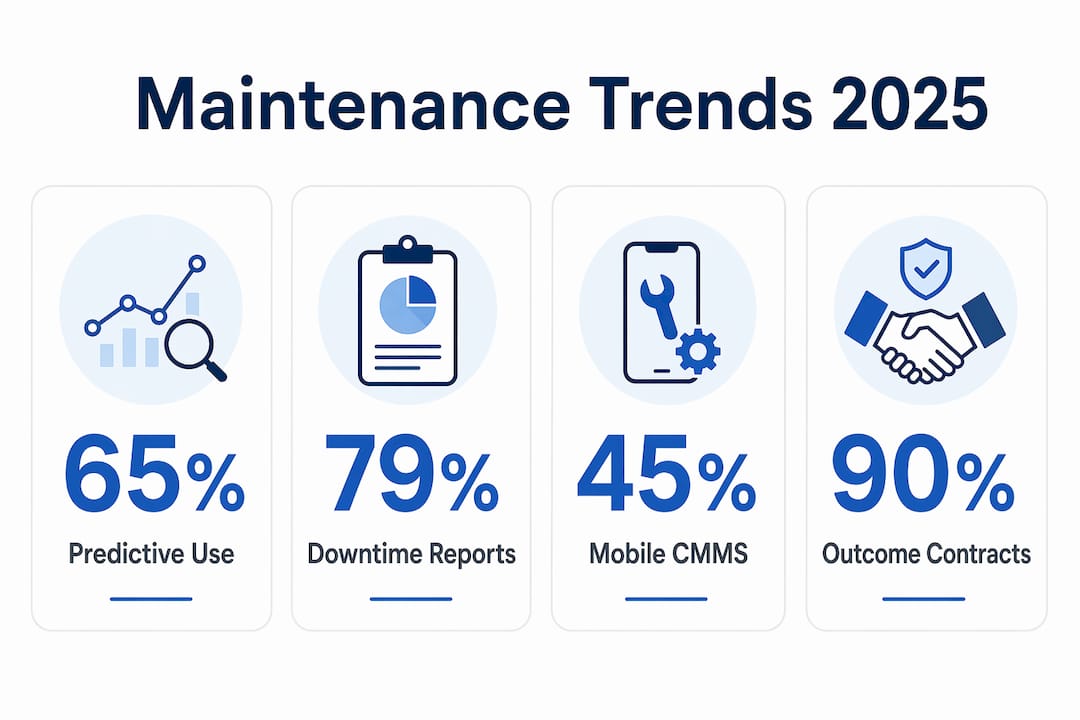
Predictive maintenance has been a concept for years. In 2025, it crossed into mainstream deployment. 65% of maintenance teams plan AI deployment within 12 months, and those already using it report 70 to 90% reductions in unplanned downtime alongside cost savings between 10 and 40%. Those are numbers that get executive attention.

The picture is not uniformly positive, though. A separate study found that 79% of teams using AI still report downtime staying the same or getting worse. That number should stop every facility manager cold. How do 58% of teams use AI with most reporting measurable ROI, yet the majority see no reliability improvement? The answer lies in execution gaps.
Technology identifies the problem. Skilled technicians, quality work orders, and integrated parts management actually fix it. The gap from detection to repair is where most AI programs fail to close the loop. Labor shortages and skills gaps remain the top causes of downtime regardless of what the sensor data says.
The path forward requires treating AI as a decision-support layer, not a replacement for solid maintenance fundamentals. KPMG’s industrial manufacturing report confirms that scaling AI successfully depends on moving from isolated pilots to enterprise platforms with strong data foundations and cross-functional integration.
Key factors that separate successful AI rollouts from failed ones:
- Clean, standardized asset data feeding the AI models
- Technician training on interpreting AI alerts and acting on them
- Work order systems connected to AI outputs so nothing falls through the cracks
- Leadership alignment so maintenance KPIs tie to business outcomes
Pro Tip: Before purchasing any predictive maintenance platform, audit your existing asset data quality. Garbage in, garbage out. AI built on unreliable sensor history will generate false alerts that erode technician trust faster than any budget cut.
Reliability-Centered Maintenance: doing it the right way
Reliability-Centered Maintenance, or RCM, is the most frequently misapplied methodology in the industry. The term gets attached to everything from basic PM schedules to vendor-led inspections, diluting what should be a disciplined, structured process. If your program does not answer all seven questions defined by SAE JA1011, it is not genuine RCM.
The 2024 revision of SAE JA1011 remains the definitive benchmark. It specifies minimum criteria that any methodology must meet before calling itself RCM. The process works through failure mode analysis systematically before any task is selected.
A proper RCM sequence follows this logic:
- Define the functions and performance standards of each asset
- Identify all functional failures for each function
- Determine the failure modes that cause each functional failure
- Assess the effects of each failure mode on operations and safety
- Classify the consequences as hidden, safety, environmental, or operational
- Select the appropriate maintenance task based on consequences
- Validate that the task addresses the failure mode effectively
Programs that skip steps two through five and jump straight to writing PM tasks are not RCM. They are educated guesswork with a respectable name.
Here is how genuine RCM compares to common alternatives:
| Approach | Basis for task selection | Failure mode analysis | SAE JA1011 compliant |
|---|---|---|---|
| Genuine RCM | Consequence-driven decision logic | Full seven-question sequence | Yes |
| PM Optimization | Existing task review and adjustment | Partial, limited scope | No |
| OEM-recommended PMs | Manufacturer schedules | Rarely performed | No |
| Basic interval-based PM | Time or cycle counts | Not performed | No |
PM Optimization is a legitimate and useful methodology for mature programs that already have established PM libraries. It improves existing schedules rather than building from first principles. For facilities new to structured reliability, though, applying RCM to critical assets identified through Pareto analysis delivers the highest return on reliability investment.
Pro Tip: Start your RCM program on the top 20% of assets driving 80% of your downtime costs. Applying it universally burns resources and delays results. Pareto first, then scale.
Modernizing how maintenance work gets done
The strategy is only as good as the execution supporting it. In 2025, the execution layer is shifting fast. 45% of maintenance work orders are now completed via mobile apps, a change that may sound minor but carries real operational weight.
Technicians spending 20 minutes hunting for a paper procedure or chasing down a supervisor for a part number is time that compounds across every shift and every asset. Mobile-first maintenance management attacks that problem directly by putting work instructions, asset history, parts lookups, and photo documentation in one place at the point of work.
Cloud-based CMMS platforms are accelerating this shift. Smaller facilities and municipalities that previously could not justify enterprise software licensing costs now have access to subscription-based platforms with enterprise-grade capabilities. That levels the playing field considerably for the organizations managing aging infrastructure on constrained budgets.
The most underappreciated AI use case emerging in 2025 is knowledge capture. With knowledge capture leading AI applications at 39% adoption, facilities are finally addressing the retirement time bomb. When a 30-year veteran walks out the door, they take decades of tribal knowledge with them. AI-assisted documentation tools are being used to record diagnostic reasoning, failure histories, and repair sequences before that happens.
Key benefits driving mobile and cloud CMMS adoption:
- Faster work order completion through step-by-step mobile guidance
- Real-time backlog visibility for supervisors and planners
- Consistent data capture that improves asset history accuracy
- Reduced onboarding time for newer technicians learning complex systems
- Better parts integration cutting wait times during planned maintenance
Operationalizing maintenance in 2025: data, security, and workforce
Technology investments only deliver if the operational infrastructure underneath them holds. Three areas are creating friction for facility teams trying to modernize.
Data quality is still the limiting factor. Unreliable data is cited as a top risk to AI impact across virtually every recent industry survey. Sensor readings tied to assets without consistent naming conventions, duplicate asset records in aging CMMS platforms, and manual entries riddled with errors all undermine the models built on top of them. Fixing data is unglamorous work, but it is the prerequisite for everything else on this list.
Cybersecurity is now a physical threat. Industrial cyber incidents causing operational disruptions more than doubled in 2025, and 48% of industrial executives plan significant cybersecurity investment increases. Connected sensors, cloud CMMS platforms, and remote monitoring tools all expand the attack surface. A compromised OT network is not just a data breach; it can trigger real equipment failures and safety events.
Pro Tip: Treat your OT (operational technology) network separately from your IT network. Segment them with proper firewalls and limit remote access points. Your CMMS vendor’s security certifications matter as much as their feature list.
Workforce evolution is non-negotiable. The skills gap is not closing on its own. The most forward-looking facilities are pairing technology adoption with structured training programs that build AI-human collaboration capabilities. KPMG projects these skills will be essential within five years, but the teams building them now are already gaining a competitive edge.
Areas demanding workforce development investment:
- Interpreting predictive analytics alerts with appropriate judgment
- Using digital tools for planning, scheduling, and work execution
- Cross-functional communication between maintenance, operations, and IT
- Data literacy for technicians entering structured observations into CMMS
Beyond technology: contracts, sensors, and board-level visibility
Some of the most significant developments shaping the future of industrial maintenance have nothing to do with software. Three shifts deserve attention from anyone building a 2025 maintenance strategy.
Outcome-based service contracts are gaining serious traction. About 90% of operators express interest in pay-for-uptime models where OEMs and service providers carry performance risk. This restructures vendor relationships fundamentally. Instead of billing for hours and parts, providers earn by keeping equipment running. That alignment changes how they prioritize reliability work.
Multi-sensor fusion is reducing one of predictive maintenance’s biggest practical problems: false positives. Combining vibration, thermal, acoustic, and electrical data to confirm fault signatures, rather than acting on a single sensor alarm, dramatically improves diagnostic accuracy. Technicians stop chasing phantom failures. Work orders become purposeful.
Here is a snapshot of how key emerging trends stack up:
| Trend | Adoption stage | Primary benefit |
|---|---|---|
| Outcome-based contracts | Growing interest, early adoption | Vendor risk alignment with uptime goals |
| Multi-sensor fusion | Early to mid adoption | Lower false positives, better diagnostics |
| Board-level maintenance KPIs | Expanding into larger enterprises | Connects reliability to financial performance |
| Sustainability-driven maintenance | Emerging priority | Reduces energy use and waste alongside downtime |
Maintenance KPIs are becoming boardroom metrics. Asset reliability, OEE (Overall Equipment Effectiveness), and cost of unreliability are no longer just for maintenance managers to track internally. Organizations that monitor industrial reliability as an enterprise performance indicator are making better capital decisions and avoiding the reactive spending patterns that drain budgets year after year.
My take on why technology is not the problem
I have watched facilities spend six figures on AI platforms and predictive maintenance subscriptions, then come back twelve months later with the same downtime numbers and a lot of frustration. What I have learned watching that pattern repeat is consistent: the technology was never the barrier. The execution framework was.
Teams that succeed with modern maintenance tools are not necessarily the ones with the best software. They are the ones that did the hard work of defining what “good” looks like for each critical asset before they bought anything. They ran a Pareto analysis. They applied RCM best practices to their highest-consequence failure modes. They trained their technicians to close the loop between a sensor alert and a completed work order.
The cultural shift is harder than the technology decision. Moving a team from reactive firefighting to proactive reliability requires leadership commitment, consistent metrics, and patience. Facility managers who treat maintenance modernization as a one-time project rather than an ongoing operating discipline will keep struggling regardless of their tech stack.
My advice: pick one high-impact asset class, apply structured analysis, get the execution right, and then scale. That sequence works. The reverse order almost never does.
— Southernsandblastingandpainting
How surface prep fits your 2025 maintenance strategy

Every maintenance trend covered here ultimately serves one goal: protecting physical assets from degradation and unplanned failure. Surface preparation and protective coatings are a direct expression of that goal and one of the most cost-effective maintenance investments available to facility managers. Corrosion, oxidation, and surface contamination accelerate mechanical failure and drive repair costs up faster than almost any other factor.
At Southern Sandblasting and Painting, we work with municipalities, airports, utilities, and industrial facilities throughout Central Florida, applying over 20 years of expertise in professional sandblasting and industrial coating systems. Our sandblasting equipment and coating applications are specified to extend asset life on infrastructure like water tanks, pipelines, and structural steel that maintenance programs depend on. If your 2025 strategy includes reducing the total cost of asset ownership, explore our coating application process to see how surface protection fits your reliability goals.
FAQ
What are the biggest industrial maintenance trends in 2025?
AI-driven predictive maintenance, mobile-first work execution, cloud CMMS adoption, outcome-based service contracts, and cybersecurity integration are the dominant trends. Each reflects a shift from reactive to proactive reliability management.
Does AI actually reduce downtime in industrial facilities?
AI adopters report 70 to 90% reductions in unplanned downtime, but 79% of teams using AI still see no improvement because technology without aligned execution frameworks and quality data cannot close the gap between detection and repair.
What is RCM and how is it different from regular PM?
Reliability-Centered Maintenance (RCM) is a structured methodology defined by SAE JA1011 that selects maintenance tasks based on failure mode consequences rather than fixed intervals. Standard PM schedules are time-based and do not perform failure mode analysis.
Why is data quality so critical for maintenance technology?
Unreliable asset data produces inaccurate AI model outputs, false alerts, and poor planning decisions. Standardized data in your CMMS is the foundation every predictive maintenance tool, mobile app, and analytics platform depends on to function correctly.
How do outcome-based service contracts work?
Under pay-for-uptime or outcome-based contracts, OEMs and service providers earn based on equipment performance metrics rather than hours billed. This aligns vendor incentives directly with the facility’s reliability goals and shifts performance risk to the provider.
Recommended
- Industrial maintenance best practices for asset longevity
- Facility maintenance checklist: Essential steps for Florida managers
- Best Practices for Industrial Painting 2025 Guide
- Industrial Painting Trends 2025: Impact on Facility Longevity
- Sandblasting Contractor Baldwin Park FL
- Sandblasting Services Oviedo FL


