
TL;DR:
- Choosing the correct application method is crucial for ensuring coating adhesion, film thickness, and long-term durability in industrial projects. Large-scale applications favor airless spray for speed, while precision tasks like edges require brushing, and extreme conditions may necessitate thermal or automated spray systems. Surface preparation, operator skill, and hybrid approaches significantly influence coating performance and asset longevity.
Selecting the wrong application methods for industrial coatings doesn’t just affect finish quality. It accelerates corrosion, shortens asset lifespan, and drives up maintenance costs at a scale that compounds quickly across a facility. Whether you’re protecting structural steel at an airport, lining a municipal water tank, or recoating pipeline infrastructure, the method you choose controls how well the coating bonds, how uniformly it builds thickness, and how long it performs under real-world conditions. This guide breaks down every major method, compares them directly, and tells you when to use each one.
Table of Contents
- Key Takeaways
- 1. Criteria for selecting an application method
- 2. Airless spray: the workhorse of large-scale industrial projects
- 3. Air-assisted and HVLP spray methods
- 4. Thermal spray processes for extreme conditions
- 5. Brush application: precision where spray can’t reach
- 6. Roller application: controlled coverage for flat and semi-flat surfaces
- 7. Dip coating and flow coating for components
- 8. Robotic and automated application
- 9. Comparison of methods across key performance dimensions
- 10. Situational recommendations for choosing your method
- My perspective on what actually goes wrong in the field
- How Southernsandblastingandpainting delivers coating results that last
- FAQ
Key Takeaways
| Point | Details |
|---|---|
| Method drives performance | Choosing the right application method directly affects adhesion, film thickness, and long-term durability. |
| Surface prep comes first | Blast cleaning to ISO 8501-1 Sa 2½ is the most common failure point and must precede any coating method. |
| Spraying wins on large scale | Airless spray covers 300-400 sq ft/hr, making it the fastest option for structural and infrastructure projects. |
| Non-spray methods fill critical gaps | Brush and roller techniques deliver precision on edges, repairs, and detailed surfaces that spray can’t reliably reach. |
| Operator skill beats equipment | Technique and equipment knowledge matter more than machine specs when achieving consistent, quality results. |
1. Criteria for selecting an application method
Before comparing specific techniques, you need a framework for evaluating them. No single method is universally superior. Your decision should be based on six measurable criteria.
- Surface type and condition: Rough, pitted, or irregular substrates require methods that can penetrate and fill. Airless spray handles this better than a roller on heavily corroded steel.
- Coating type and viscosity: High-build epoxies and zinc-rich primers behave very differently from thin polyurethane topcoats. Method compatibility with the coating’s viscosity range is non-negotiable.
- Project scale and complexity: A 100,000 sq ft tank exterior calls for a different approach than touch-up work on a mechanical room ceiling.
- Film thickness requirements: Some coatings like high-performance systems require two coats at 15 mils each with spark testing at 3 kV per NACE SP0188. Achieving this consistently demands the right equipment.
- Environmental and safety conditions: Enclosed spaces, VOC limits, and wind exposure all constrain method selection. Overspray in a confined space isn’t just wasteful. It’s a safety hazard.
- Operator skill and equipment access: Controlled environment conditions and precise mixing ratios contribute significantly to coating success beyond just application method selection. Matching method complexity to crew capability prevents costly mistakes.
Pro Tip: Before finalizing any method, run a test patch on a representative surface section. Measure dry film thickness at three points. This takes 20 minutes and can prevent days of rework.
2. Airless spray: the workhorse of large-scale industrial projects
Airless spray is the dominant method for large infrastructure work, and for good reason. A hydraulic pump pressurizes coating material and forces it through a small spray tip, atomizing the fluid without air. The result is fast, even coverage with minimal overspray compared to air-assisted methods.
Airless spray technology reduces overspray and increases transfer efficiency compared to air-assisted spraying, which directly lowers material waste and cleanup time. That matters on a job coating several thousand square feet of structural steel.
Tip selection is where most operators make mistakes. Spray tip choice influences fan width, flow rate, and quality, governing both efficiency and application defects. Wrong tip size causes tailing, orange peel texture, or uneven film build. Maintaining 300 to 400 mm distance with 50% overlap on each pass produces a uniform finish. Go too close and you pile up coating. Go too far and you get dry spray.
Pro Tip: Always test tip size on scrap material before starting a production run. A tip that’s one size too large on a zinc-rich primer can double your material consumption per sq ft.
Common applications via airless spray include epoxy primers, polyurethane topcoats, intumescent fireproofing, and moisture-cure urethanes on infrastructure like bridges and water tanks.
3. Air-assisted and HVLP spray methods
High-volume low-pressure (HVLP) spray uses a high volume of air at low pressure to atomize coating. The result is better directional control and significantly less overspray than conventional air spray, making it well-suited for detailed architectural metalwork or equipment in semi-enclosed facilities.
HVLP does have limits. It works best with lower-viscosity coatings. Thick epoxies or high-build primers often need thinning beyond acceptable ratios to flow through HVLP equipment, which can compromise film integrity and void manufacturer warranties. For most heavy industrial projects, airless spray outperforms HVLP on both throughput and material compatibility.
Air-assisted airless spray sits between these two methods. It uses a low-pressure air cap combined with hydraulic pressure to provide a finer finish than pure airless while maintaining better transfer rates than HVLP. It’s a strong choice for topcoat work where finish appearance matters alongside performance.
4. Thermal spray processes for extreme conditions
Thermal spray is a category of manufacturing coating techniques used when a substrate faces extreme conditions such as high-temperature oxidation, severe abrasion, or aggressive chemical exposure. Common thermal spray methods include flame spray, arc wire spray, and plasma spray.
In arc wire spray, two electrically charged wires melt on contact and a compressed air stream directs the atomized metal particles onto the substrate. This method works well for applying zinc or aluminum corrosion-protection coatings on structural steel before a sealer coat is applied. The spray painting machine market is projected to reach US$7.2 billion by 2033, driven in part by demand for advanced thermal and precision spray systems.
Plasma spray handles ceramics and refractory materials that can’t be applied by any other method, making it standard in aerospace and power generation. It requires highly specialized equipment and trained operators, so it isn’t a general-purpose field technique. For most facility managers, the decision between thermal spray and conventional coating systems comes down to substrate temperature exposure and abrasion requirements.
5. Brush application: precision where spray can’t reach
Brushing is indispensable for detailed work requiring precision, especially on edge trim and corners. In industrial applications, this means weld seams, bolt heads, pipe penetrations, and areas with complex geometry that spray fans can’t reliably coat.
Brush selection matters more than most crews acknowledge. A natural bristle brush loaded with epoxy resin will stiffen quickly, reducing paint release and leaving drag marks in the wet film. Synthetic bristle brushes with chisel-tip profiles handle most industrial coatings better and keep working longer before needing replacement. Technique is everything. Work the coating into the surface with deliberate strokes, then lay off in one direction to avoid brush marks in the cured film.
Brush application is the slowest method, covering roughly 50 to 75 sq ft per hour depending on surface complexity. But speed is not the point. For critical spot priming, coating touch-up after holiday testing, or stripe coating welds before a full spray coat, brush is the only practical choice.
6. Roller application: controlled coverage for flat and semi-flat surfaces
Rolling sits between spraying and brushing in both speed and control. Rolling offers better control over film thickness, which can enhance durability compared to spraying in some cases. Roller nap length should match surface texture for optimal results. Short nap on smooth steel. Medium nap on slightly textured concrete. Long nap on rough masonry.
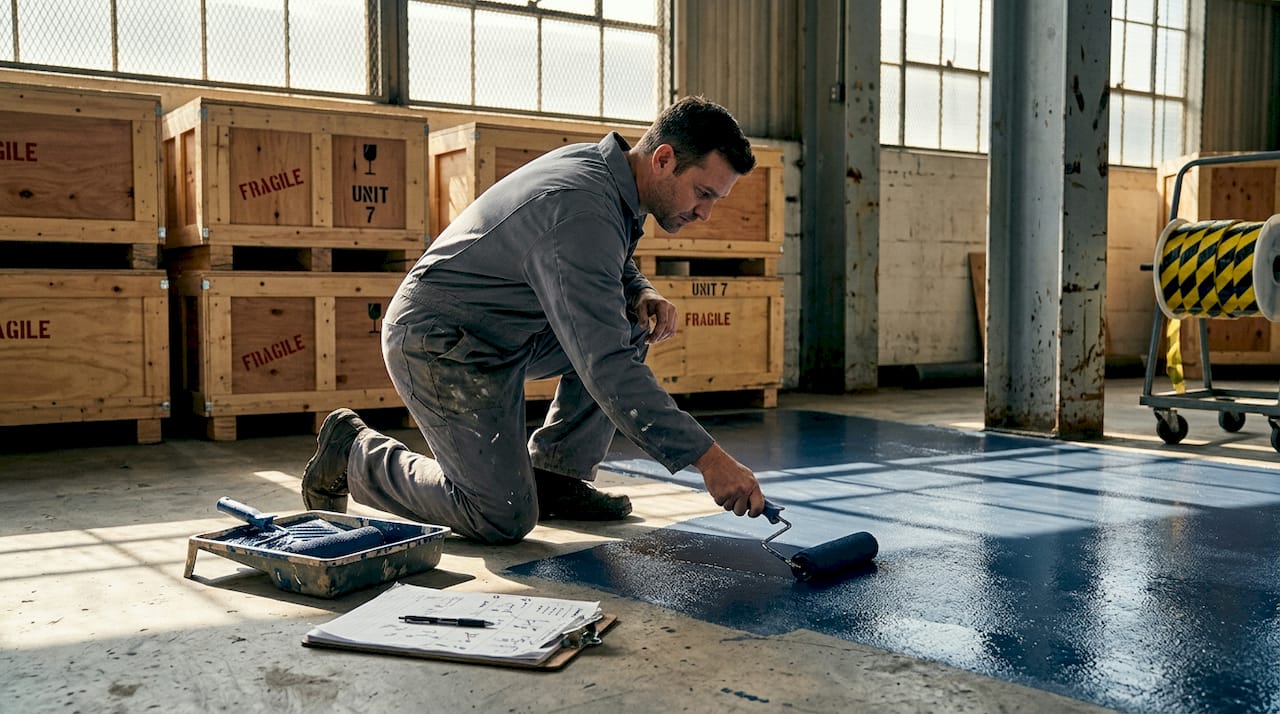
On large flat surfaces like tank floors, machinery platforms, or concrete warehouse floors, rolling is an efficient method with low overspray risk. It’s also the method of choice when VOC restrictions or fire safety rules prohibit spray application in an occupied building.
Rolling has real limitations in industrial work. It can’t achieve the film build that airless spray delivers in a single pass, and it struggles to penetrate pits and crevices in corroded steel. For this reason, the best practice for infrastructure work is to use rolling as a companion method to spraying, not a replacement for it.
7. Dip coating and flow coating for components
Dip coating immerses parts fully in a tank of liquid coating material and withdraws them at a controlled rate, allowing the coating to drain and cure uniformly. Flow coating runs coating material over a stationary part. Both methods suit small, high-volume components like fasteners, pipe fittings, or fabricated assemblies.
These are not field application methods. They require controlled manufacturing environments and specialized equipment. But for facility managers procuring pre-coated components or specifying protective finishes on replacement parts, understanding these processes helps you ask the right questions of your suppliers and verify that specifications are met before parts arrive on site.
8. Robotic and automated application
Automated spray systems are increasingly standard for large, repetitive industrial surfaces. Fixed spray heads on programmable tracks coat pipeline sections, structural beams, and vessel interiors with consistent pass speed and tip distance. The result is uniform film thickness with fewer human variables affecting quality.
The spray painting machine market growth reflects real adoption of automation in industrial coating application. Robotic systems reduce worker exposure to coating fumes in confined spaces and improve throughput on production-style projects. The tradeoff is setup time and cost. Robotic application isn’t practical for one-off field repairs or complex geometry, but for long-run infrastructure projects it delivers consistency that manual application rarely matches.
9. Comparison of methods across key performance dimensions
Use this table when you’re narrowing down coating application processes for a specific project scope.
| Method | Speed | Film build control | Overspray | Best suited for |
|---|---|---|---|---|
| Airless spray | 300-400 sq ft/hr | Moderate | Low to moderate | Large structural steel, tanks, pipelines |
| HVLP spray | 150-250 sq ft/hr | Good | Very low | Detailed metalwork, light topcoats |
| Air-assisted airless | 250-350 sq ft/hr | Good | Low | Finish topcoats on complex shapes |
| Brush | 50-75 sq ft/hr | Excellent | None | Edges, welds, stripe coats, touch-ups |
| Roller | 150-200 sq ft/hr | Good | None | Flat surfaces, occupied buildings |
| Thermal spray | Varies | Moderate | Moderate | Extreme temperature or abrasion conditions |
| Automated/robotic | Highest | Excellent | Low | High-volume, repetitive industrial runs |
Coverage speed data confirms spraying outpaces rolling at 300 to 400 sq ft/hr versus 150 to 200 sq ft/hr for rolling.
Pro Tip: Specify the acceptable dry film thickness range in your project scope before selecting a method. If the coating data sheet calls for 8 to 12 mils DFT, confirm your selected method can hit that range on the actual substrate texture with your available crew.
10. Situational recommendations for choosing your method
Applying criteria and comparison data to real project types is where the decision becomes practical.
- Large infrastructure and structural steel: Airless spray is the default choice. It handles high-viscosity epoxy primers, delivers the required film build quickly, and integrates well with surface preparation workflow that precedes coating.
- Repair and maintenance work: Brush and roller are the right tools. Isolated corrosion spots, repaired welds, and tight access areas need precision over speed.
- High-build or corrosion-resistant coatings: Airless spray or specialized application per manufacturer specifications. Some systems must be spray-applied to achieve adequate film integrity. Consult the top industrial painting methods guide for coating-specific recommendations.
- Occupied or VOC-restricted facilities: Rolling or brush. Zero overspray, lower VOC dispersion, and compliance with air quality requirements.
- Hybrid approaches: The most effective industrial projects combine methods. Brush stripe coat all edges and welds first, spray the broad field surfaces, then back-roll immediately to work the coating into texture. This sequence improves adhesion and reduces holidays in the cured film.
Blast cleaning to ISO 8501-1 Sa 2½ remains the most common failure point affecting coating adhesion. No application method compensates for inadequate surface preparation.
My perspective on what actually goes wrong in the field
I’ve seen more coating failures traced back to method selection and surface prep than to coating product quality. And in most cases, the crew knew the right answer. They were just working under time pressure.
The uncomfortable truth is that operator technique matters more than machine specs in achieving high-quality airless spray results. A skilled applicator with a mid-range pump and a well-chosen tip will outperform an inexperienced crew using top-spec equipment every single time. Training and documented application procedures are worth more than equipment upgrades in most facilities.
What I’ve also learned is that facility managers often underestimate the value of a hybrid method strategy. Defaulting to full-spray because it’s fast, and skipping the brush stripe coat, is a tradeoff that costs more in premature failure than it saves in labor. The edges and welds are where corrosion starts. That’s where brush application earns its place.
Budget pressure is real. But the question shouldn’t be “how do we apply this coating fastest?” The question should be “what combination of methods gives this asset the longest service life at this budget?” Those are different problems with very different answers.
— Southernsandblastingandpainting
How Southernsandblastingandpainting delivers coating results that last
When the application method matters as much as the coating product itself, you need a contractor who treats both with equal rigor. Southern Sandblasting and Painting brings over 20 years of industrial coating experience across water tanks, airports, pipelines, and municipal infrastructure throughout Central Florida.
From blast cleaning to ISO compliance standards to multi-method application strategies that combine spraying and brush work for complete protection, the team at Southernsandblastingandpainting structures every project around coating performance, not just speed. If you’re evaluating your next project, start with the industrial coating application guide to understand the full application process, or explore the full range of industrial coating services available for commercial, municipal, and government clients.
FAQ
What is the fastest application method for industrial coatings?
Airless spray is the fastest method, covering 300 to 400 sq ft per hour, compared to 150 to 200 sq ft/hr for rolling and 50 to 75 sq ft/hr for brushing. It is the standard choice for large-scale structural and infrastructure projects.
Why does surface preparation affect coating application so much?
Blast cleaning to ISO 8501-1 Sa 2½ removes contaminants that prevent adhesion. Without proper surface prep, even the best application technique and highest-quality coating will fail prematurely at the substrate interface.
When should you use brush application instead of spray?
Brush application is the right choice for edges, weld seams, bolt heads, and tight or complex geometry where spray fans can’t achieve reliable coverage. It is also used for touch-up work and stripe coats before full-field spray application.
Can you combine multiple application methods on one project?
Yes, and you should on most industrial projects. A typical best-practice sequence is to brush stripe coat all edges and welds, spray the broad field surfaces, then back-roll immediately to improve penetration into surface texture. This combination reduces coating holidays and improves long-term durability.
How do you choose a spray tip for airless spray application?
Match the tip to the coating’s viscosity and the surface area being coated. Tip size controls fan width and flow rate. The wrong tip causes defects like tailing or uneven film build. Always test on scrap material before starting production application.


