

The Bresle test extracts water-soluble salts from a steel surface and measures the extract’s conductivity to estimate NaCl-equivalent surface density, expressed in mg/m² or µg/cm². Inspectors run it after blasting, before coating, as a go/no-go checkpoint. A valid result depends on a proper blank measurement, temperature-compensated readings, and following the salt contamination limit written into the project’s inspection and test plan, not a generic industry number.
TL;DR:
- A blank water sample must be measured and recorded before any contact with steel to ensure valid Bresle test results.
- Testing involves applying a sealed patch, injecting deionized water, and measuring conductivity after a set dwell time to determine salt contamination.
- Correct calculation of surface salt density depends on using the proper conversion factor, patch area, volume, and temperature compensation.
- Repeated failure after washing and re-blasting indicates the need for ion chromatography or lab analysis rather than continued field testing.
- Consistent on-site salt testing, documented procedures, and proper equipment maintenance significantly reduce the risk of rework and coating failures.
Table of Contents
- What Is the Bresle Test for Salt, and Why Does It Matter?
- Equipment, Materials, and Preparatory Checks
- How Do You Perform a Bresle Test Step by Step?
- Converting Conductivity to Surface Density: The Formula Explained
- Common Errors That Skew Bresle Test Results
- Acceptance Limits, Remediation, and Documentation
- Field-Tested QA Practices That Reduce Rework
- When Bresle Testing Is Enough, and When It Isn’t
- A Contractor’s View on Making Bresle Testing Work on Real Jobs
- On-Site Salt Testing and Remediation Without the Guesswork
- Sources
What Is the Bresle Test for Salt, and Why Does It Matter?
The Bresle patch method, standardized under ISO 8502-6, isolates a fixed area of steel with an adhesive dam, floods it with a measured volume of deionized water, and pulls the soluble contaminants into solution. A conductivity meter then reads the extract under ISO 8502-9, and that reading converts to a surface density figure. The method treats every dissolved ion as if it were sodium chloride, which is a practical shorthand rather than a chemical fact, and it keeps results comparable across job sites even though actual salt composition varies.
Why bother? Because residual chlorides sitting under a fresh coat of paint pull water through the film by osmosis, and that trapped moisture builds pressure until the coating blisters and lifts. It is one of the most common and preventable causes of early coating failure on tanks, pipelines, and marine steel.
There is no single number that applies everywhere:
- ISO 8502 sets the measurement method, not a pass/fail threshold.
- NORSOK M-501 and ISO 12944 publish reference figures, but the governing spec is whatever the project’s ITP states.
- Two identical readings can pass on one job and fail on another, depending on service environment.
Equipment, Materials, and Preparatory Checks
You cannot run a defensible Bresle test with mismatched or unverified kit. Before a crew touches steel, confirm this list:
- Bresle patches sized to the project’s spec (standard adhesive patches for most flat steel).
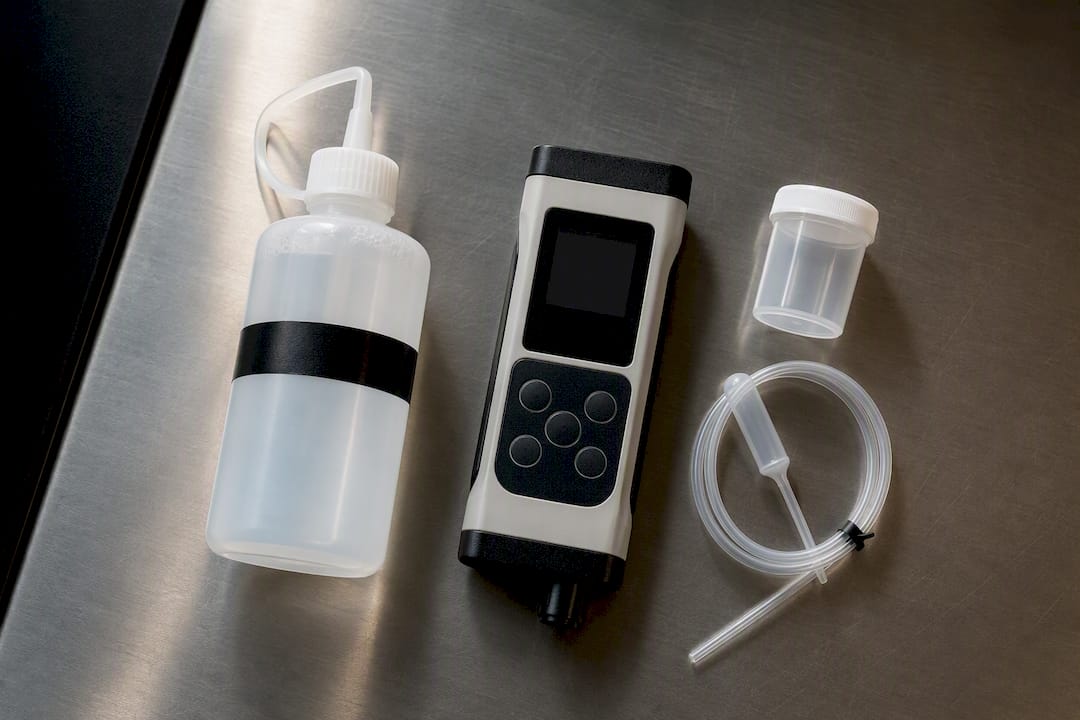
- A syringe, typically 3 to 5 ml, matched to the patch’s fill volume.
- High-purity deionized water with conductivity under roughly 5 µS/cm.
- A calibrated conductivity meter with automatic temperature compensation.
- Spare patches, syringes, and a clean storage container for the DI water.
Water quality is where most kits quietly fail. DI water left open in a shop for weeks absorbs airborne contaminants and stops being a neutral extraction medium. Run a blank on every fresh container before the shift starts, and if it reads above the accepted threshold, replace the water rather than trying to “correct” for it mathematically.
A full test cycle, blank through evaluation, generally runs 5 to 10 minutes per point, so budget your test density accordingly on large tanks or pipeline runs.
Pro Tip: Keep DI water in a sealed, labeled squeeze bottle dedicated only to salt testing. A shared bottle that also rinses brushes or hands will contaminate your blank without you ever noticing.
How Do You Perform a Bresle Test Step by Step?
Follow this sequence and you will produce a result that holds up under a client audit or a disputed rework claim.
- Run the blank first. Draw a fresh syringe of DI water straight from the source container and measure its conductivity before touching the steel. Record it. This is your baseline, and skipping it is the single most common reason a Bresle reading gets thrown out later.
- Select the test location. Pick a representative, accessible area. Avoid pooling water, standing dust, or a spot right at a weld toe unless the ITP specifically calls for weld-zone sampling.
- Apply the patch. Press the adhesive dam firmly against the surface, working out air pockets from the center outward. A leaking patch is the number one cause of a low, falsely clean reading.
- Inject the DI water. Use the syringe to fill the patch cavity to its rated volume, typically 2.5 to 10 ml depending on patch and kit design.
- Agitate and dwell. Massage the patch gently to work the water across the sealed area, then let it sit. Extraction dwell time commonly runs 2 to 10 minutes, and the exact figure should be fixed in the project’s agreed test parameters so every inspector on the job uses the same timing.
- Withdraw the extract. Pull the solution back into the syringe, noting the recovered volume. It rarely matches the injected volume exactly.
- Measure conductivity. Dispense into the meter’s sample well or measure directly, per your instrument’s method, and record both the reading and the sample temperature.
- Subtract the blank. The corrected conductivity, often written as ∆γ, is the extract reading minus the blank reading. This step is where most manual calculations go wrong.
- Log everything. Location ID, blank value, extract value, ∆γ, temperature, recovered volume, and the calculated surface density all belong in the test record.
Blank measurement under 5 µS/cm is the accepted benchmark most conductivity meters and QC programs treat as clean DI water, with modern instruments auto-compensating readings to 25°C so a hot afternoon on a tank roof doesn’t skew your numbers.
A test log entry that only records the final mg/m² number is a liability. If a dispute arises months later, you need the raw inputs to defend the math.
Converting Conductivity to Surface Density: The Formula Explained
ISO 8502-9 defines the calculation that turns a conductivity reading into a number you can compare against a spec limit. The standard formula is:
ρA = c × 10² × V × ∆γ / A
Where ρA is surface density in mg/m², c is a conversion factor tied to the assumed salt composition and patch geometry, V is the extraction volume in milliliters, ∆γ is the blank-corrected conductivity in µS/cm, and A is the tested area in cm².
| Term | Meaning | Typical value |
|---|---|---|
| c | Conversion factor for NaCl-equivalent salts | Approximately 5, kit-dependent |
| V | Volume of DI water used | 2.5 to 10 ml |
| ∆γ | Blank-corrected conductivity | Measured per test |
| A | Patch test area | Fixed by patch size |
The factor of approximately 5 is typical but not universal. It shifts with patch geometry and the salt-composition assumption built into your specific kit, so changing patch brands or volumes without rechecking the factor will quietly skew your results.
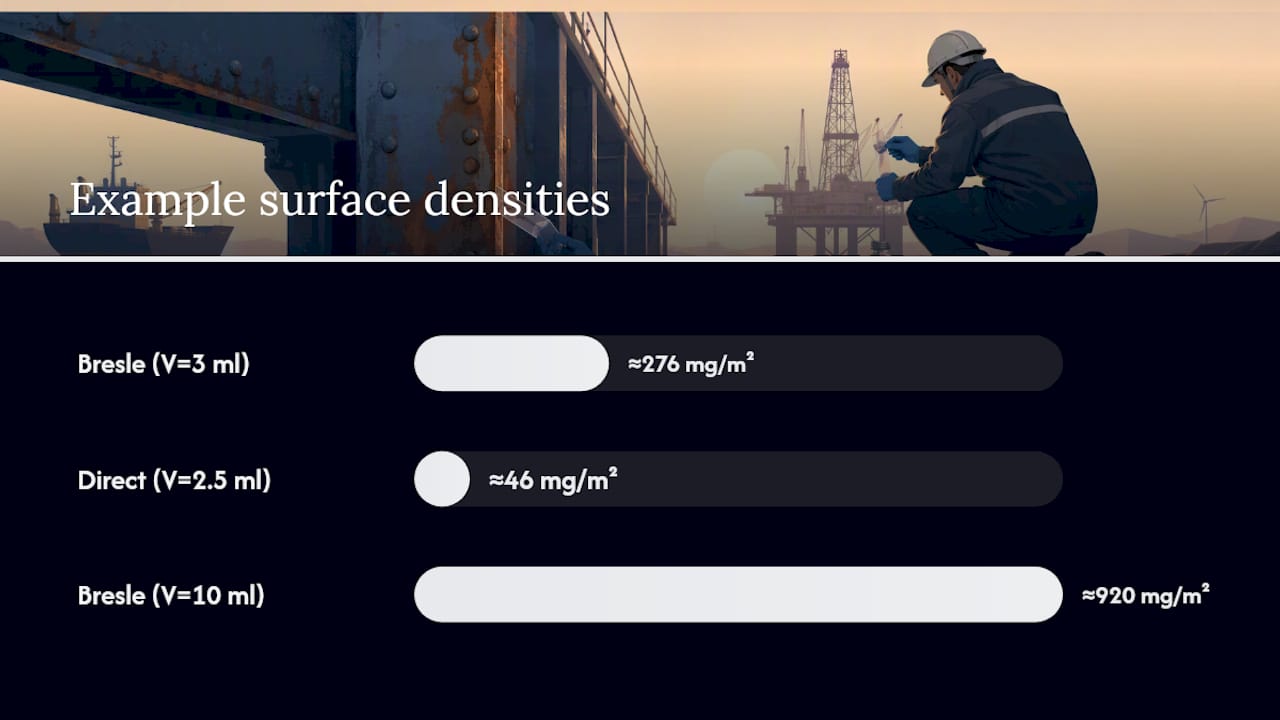
Worked example: a 43.5 cm² patch, 3 ml extraction volume, and a corrected conductivity of 8 µS/cm might yield roughly ρA = 5 × 100 × 3 × 8 / 43.5, which lands around 276 mg/m² using that simplified relationship, though your instrument’s built in constants may differ slightly from this illustration. Direct sampling procedures (DSP) simplify this further by measuring roughly 2.5 ml directly, sometimes reducing the effective factor to 1, and most modern conductivity meters run the whole calculation internally once you enter patch area and volume.
Common Errors That Skew Bresle Test Results
A clean-looking blast profile tells you nothing about chloride hiding underneath it. Salts collect in crevices, under thin corrosion films, and in weld porosity that a visual inspection will never flag, and the patch simply won’t reach contamination it can’t physically contact.
Field mistakes compound the problem:
- Skipping the blank, which makes every reading that follows unverifiable.
- Using DI water that’s absorbed contamination from an open container.
- Forgetting temperature compensation, which shifts conductivity readings independent of actual salt content.
- Applying the wrong conversion factor after switching patch brands or volumes.
- Confusing raw µS/cm output with the final mg/m² figure when reporting to a client.
Pro Tip: Require every technician to write the blank value and the corrected ∆γ on the test log, not just the final mg/m² number. It forces the subtraction to actually happen and gives you a paper trail if a reading gets challenged.
For critical infrastructure or a disputed failure, escalate to ion chromatography or another ion-specific lab method to identify the exact contaminant and its likely source.
Acceptance Limits, Remediation, and Documentation
Published reference figures give you a starting conversation, not a universal rule. NORSOK M-501 commonly cites around 20 mg/m², while ISO 12944 coating categories span a wider range depending on service severity. Your project’s ITP is the only document that actually governs pass or fail.
When a reading exceeds the limit:
- Wash the surface with high-pressure fresh water, targeting crevices and weld zones specifically.
- Allow the surface to dry fully before retesting; testing damp steel gives an unreliable reading.
- Re-blast if washing alone doesn’t bring the reading under the limit.
- Retest at the same location and log the new result against the original failed reading.
- Escalate to lab analysis if repeated washes fail to resolve the contamination.
Every retest belongs in the inspection log alongside the original failure, with both readings, the remediation method used, and a supervisor sign-off. That record is what protects everyone if a coating fails years later and the contractor’s surface prep documentation gets pulled into the conversation.
Field-Tested QA Practices That Reduce Rework
Crews that run Bresle tests daily develop habits that the standard itself doesn’t spell out. Rotate DI water on a fixed schedule rather than waiting for a bad blank to catch you off guard. Run paired blanks at the start and end of a shift, not just once in the morning. Keep a labeled inventory of spare patches by lot number so a bad batch doesn’t quietly contaminate a week of readings.
- Cross-check a sample of readings with a second operator on high-value or disputed areas.
- Build the blank and ∆γ fields directly into your reporting template so nobody can skip them.
- Fold Bresle results into the same report that documents surface prep steps and dry film thickness, rather than filing salt data separately.
Curved tanks and vertical pipe sections make patch adhesion harder, and wind or rain can wreck a test in progress. On those surfaces, expect more failed patch seals and budget extra time.
Pro Tip: On vertical or curved steel, apply the patch and check the seal by lightly pressing the edges before injecting water. A patch that shifts under light pressure will leak during the dwell time and hand you a falsely low reading.
When Bresle Testing Is Enough, and When It Isn’t
The Bresle method is the right field tool for routine go/no-go decisions on most coating jobs. Run the blank, compensate for temperature, and hold the result against your project’s ITP limit, not a generic number. If a surface repeatedly fails after washing and re-blasting, or if the asset is high-consequence infrastructure, order ion-specific lab testing and bring in a contractor for remediation before coating proceeds.
A Contractor’s View on Making Bresle Testing Work on Real Jobs
Salt testing works best when it’s scheduled as close to coating time as possible, not the day before mobilization. Weather changes, dust settles, and a surface that tested clean on Monday can fail by Thursday. We build wash-and-retest cycles directly into the project timeline rather than treating them as a surprise delay, and every result gets tied to a specific ITP hold point before a coating crew is cleared to start.
— Results
On-Site Salt Testing and Remediation Without the Guesswork
Running a Bresle test correctly takes calibrated equipment, a documented blank, and someone who knows what a failed patch seal looks like before it wastes an hour of dwell time. Southernsandblastingandpainting handles that testing on-site as part of the same crew that blasts, washes, and recoats, so a failed reading doesn’t mean waiting for a separate inspector to show up days later.

We run high-pressure fresh-water washing, abrasive blasting, and retesting as one continuous workflow for municipal water tanks, pipelines, and industrial facilities across Central Florida, backed by documented test logs your ITP can reference directly. If a coating project is stalling on a contamination failure or you need a crew that tests, washes, and reblasts under one contract, get a quote through our sandblasting services in Orlando and we’ll schedule an inspection.
Sources
Keep ISO 8502-9’s conductometric method and NORSOK/ISO 12944 acceptance examples close at hand when writing or reviewing an ITP.
- Bresle method / related procedural description (PMC)
- How to interpret soluble salt test results (DeFelsko)
- ISO 8502-9 conductometric analysis (IndustrialPhysics summary)


