
TL;DR:
- Repainting pipelines with high-performance coatings is essential to prevent corrosion and extend asset life. Regular inspections and proper surface preparation ensure coatings perform reliably, reducing costly failures. Incorporating repainting into maintenance plans conserves costs, enhances safety, and maintains regulatory compliance.
Pipeline repainting is defined as the scheduled application of protective coatings to restore or replace degraded surface barriers on steel and metal pipelines. The practice sits at the center of any serious pipeline maintenance program, and the reasons to repaint pipelines go well beyond appearance. Corrosion is the leading cause of pipeline failure worldwide, and a compromised coating is the first step toward structural deterioration. For infrastructure and maintenance professionals, understanding the full scope of pipeline coating necessity means fewer emergency repairs, stronger regulatory compliance, and assets that perform for decades rather than years.
Why repaint pipelines: the core reasons explained
Repainting pipelines protects steel from the corrosion mechanisms that cause most failures. Soil contact, moisture, microbial activity, and seawater exposure all attack unprotected metal continuously. External corrosion is the leading cause of pipeline failure worldwide, which means the coating is not a cosmetic layer. It is the primary structural defense.
The benefits of repainting pipelines extend well beyond corrosion prevention:
- Lifespan extension. High-quality epoxy or Fusion Bonded Epoxy coatings can extend pipeline system performance over 30–40 years. That lifespan directly reduces capital replacement costs.
- Energy efficiency. Smooth internal coatings reduce surface roughness and improve flow. Internal epoxy coatings reduce pumping energy needs by 15–30%, which compounds into significant savings over the life of a system.
- Regulatory compliance. Environmental and safety standards require pipelines to maintain coating integrity. Failing to repaint on schedule creates exposure to regulatory penalties and liability.
- Leak prevention. Coating degradation accelerates corrosion pitting, which leads to leaks. Repainting before pitting reaches the pipe wall is far cheaper than emergency leak repair or environmental remediation.
- Cathodic protection efficiency. Protective coatings work in combination with cathodic protection systems. A sound coating lowers the current demand on cathodic protection anodes, reducing wear and extending the life of the entire corrosion control system.
Pro Tip: Schedule repainting to coincide with cathodic protection inspections. Addressing both systems together reduces mobilization costs and gives you a complete picture of corrosion risk at one time.
The impact of pipe wear and tear compounds over time. A coating that loses adhesion in one section creates a moisture trap, which accelerates corrosion in that zone faster than on bare steel. Catching coating failures early and repainting promptly is the most cost-effective form of pipeline maintenance available.
How does repainting fit into a pipeline maintenance program?
Repainting does not happen in isolation. It integrates with inspection cycles, pressure monitoring, and repair schedules to form a connected maintenance program. Pipeline integrity programs must treat maintenance tasks as a connected ecosystem. Isolated repainting efforts risk inconsistent safety outcomes and wasted resources.
The inspection signals that trigger a repaint decision are specific and observable:
- Visible rust or surface oxidation on external pipe sections, especially at welds and fittings.
- Coating blistering, cracking, or delamination detected during routine visual inspection.
- Discoloration or staining that indicates moisture infiltration beneath the coating.
- Valve and fitting condition changes, including corrosion at connection points that suggests the surrounding coating has failed.
- Dampness or condensation on insulated sections that points to coating breakdown under the wrap.
Regular visual inspections detect these early warning signs before they become structural problems. Consistent record-keeping then allows maintenance teams to recognize patterns, such as a specific pipe section that degrades faster due to soil chemistry or drainage issues.
Scheduled repainting intervals depend on the coating type, the operating environment, and the pipeline’s age. Coastal and high-humidity environments demand shorter intervals than dry inland installations. Internal coatings on water or chemical pipelines face different degradation rates than external coatings on buried lines.
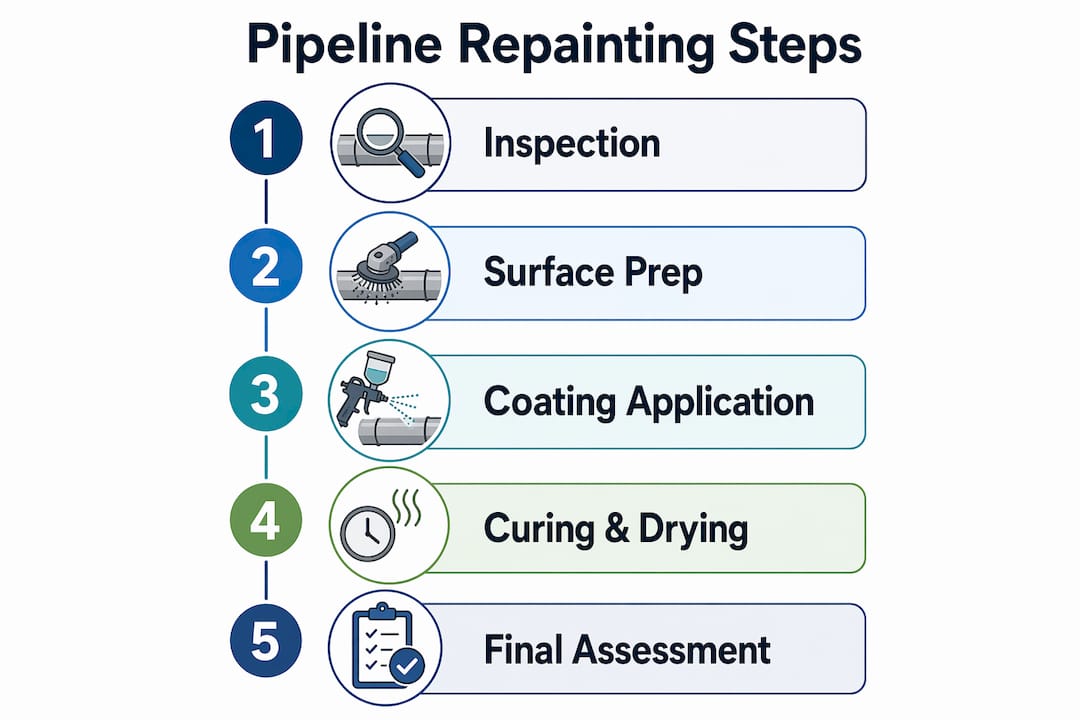
Surface preparation is the most critical step before any repaint. Applying new coating over degraded or contaminated steel produces adhesion failure within months. Proper surface prep removes rust, mill scale, and old coating residue to the standard required by the new coating system.
Pro Tip: Document every inspection with photographs and condition ratings. A three-year photo record of a specific pipe section tells you more about degradation rate than any single inspection report.
Coordination with other repairs matters too. If a section requires leak sealing or valve replacement, schedule the repaint for the same mobilization. Live pipeline repair techniques can avoid costly shutdowns, drain-downs, and reinstatements, which means repainting can often proceed without taking the system offline.
What coating types and methods work best for pipeline repainting?
Coating selection determines how long a repaint lasts and how well it performs under operating conditions. The choice between standard industrial paint and high-performance coatings is not a budget decision. It is a performance decision.
External coating systems
External coatings protect against soil corrosion, moisture, and mechanical damage. Fusion Bonded Epoxy is the industry standard for buried steel pipelines. It bonds directly to the steel surface at high temperature, creating a dense, holiday-free barrier. Three-layer polyethylene and three-layer polypropylene systems add mechanical protection over an epoxy primer for aggressive soil environments.
Field joint coatings require special attention because they are applied in the field rather than in a controlled factory environment. These joints cover only 1–3% of the pipe surface but account for a disproportionate share of corrosion-related failures. Poor application technique or incompatibility with the mill-applied coating creates the weakest points in the entire system.
Internal coating systems
Internal coatings serve two functions: corrosion protection and flow efficiency. Liquid epoxy coatings are the most common choice for water and gas pipelines. They resist chemical attack, prevent tuberculation in water lines, and create the smooth surface that reduces pumping energy by 15–30%. For more aggressive chemical service, high-build epoxy phenolic or novolac coatings provide additional chemical resistance.
High-performance industrial coatings withstand harsh immersion and humidity conditions far better than standard paints. This distinction matters most in wastewater treatment pipelines and coastal infrastructure, where standard paint fails within one to two seasons.
Surface preparation and application methods
The table below summarizes the key differences between preparation and application approaches:
| Method | Best use case | Key advantage |
|---|---|---|
| Abrasive sandblasting | Heavily corroded or mill-scaled steel | Achieves SSPC-SP 6 to SP 10 surface cleanliness |
| Wet abrasive blasting | Environmentally sensitive sites | Suppresses dust, suitable for confined spaces |
| Power tool cleaning | Minor surface rust, maintenance repaints | Lower mobilization cost for small areas |
| Airless spray application | Large diameter pipe, full repaints | Fast, uniform film build |
| Brush and roller | Spot repairs, field joints | Precise application in tight areas |
Pro Tip: Always verify that the surface profile (anchor pattern) matches the coating manufacturer’s specification. A profile that is too shallow reduces adhesion. A profile that is too deep creates coating voids at the peaks.
Abrasive sandblasting remains the most effective method for achieving the surface cleanliness and profile required by high-performance coatings. Industrial coating application steps follow a strict sequence: surface preparation, primer application, intermediate coat, and finish coat, with cure time verification between each stage.
What happens when pipeline repainting is neglected?
Deferred repainting accelerates every failure mechanism that protective coatings are designed to prevent. The consequences are not gradual. They compound.
- Accelerated corrosion. Once a coating fails, bare steel corrodes at a rate determined by the local environment. Buried pipelines in clay soils or near stray electrical currents can lose wall thickness measurably within a single season.
- Leak risk. Corrosion pitting that reaches the pipe wall creates pinhole leaks. In gas or chemical pipelines, a single leak triggers regulatory notification requirements and potential shutdown orders.
- Environmental contamination. Product leaks from corroded pipelines create soil and groundwater contamination. Remediation costs routinely exceed the cost of a full pipeline repaint by an order of magnitude.
- Safety hazards. Structural weakening from corrosion creates burst risk under operating pressure. Personnel working near degraded pipelines face exposure to hazardous materials and pressure-related incidents.
- Regulatory penalties. Pipeline operators are required to maintain coating integrity under federal and state regulations. Documented coating failures that are not addressed expose operators to fines and forced outages.
- Higher long-term costs. Emergency repairs cost multiples of scheduled maintenance. A repaint deferred for two years to save budget often results in a repair bill five to ten times larger.
Neglecting pipeline repainting does not defer costs. It multiplies them. Every year a degraded coating goes unaddressed, the corrosion damage beneath it grows exponentially, not linearly. The coating is cheap. The pipe replacement is not.
Live maintenance approaches reduce exposure to hazardous conditions and thermal cycling damage during repainting works. Scheduling repaints before failure occurs keeps the work manageable, safe, and within budget.
Key Takeaways
Pipeline repainting is the most cost-effective tool available for preventing corrosion, extending asset life, and maintaining regulatory compliance across industrial infrastructure.
| Point | Details |
|---|---|
| Corrosion drives failure | External corrosion is the leading cause of pipeline failure; repainting is the primary defense. |
| Coatings extend asset life | Epoxy and Fusion Bonded Epoxy systems can extend pipeline performance over 30–40 years. |
| Field joints are the weak point | Joints covering 1–3% of pipe surface cause a disproportionate share of corrosion failures. |
| Surface prep determines coating life | Abrasive sandblasting to the correct cleanliness standard is required before any high-performance repaint. |
| Deferral multiplies costs | Skipping scheduled repaints leads to emergency repairs that cost multiples of routine maintenance. |
The case for treating repainting as a capital investment, not a maintenance line item
After more than two decades working on industrial infrastructure in Florida, the pattern I see most often is this: repainting gets cut from the budget when money is tight, and then a catastrophic repair shows up three years later that costs ten times what the repaint would have. The math is not complicated, but the organizational pressure to defer visible maintenance costs is real.
The detail that most teams miss is the field joint. Every pipeline inspection I have been involved with has found coating failures at joints first. The mill-applied coating on the pipe body holds up. The field-applied joint coating, done under pressure and in variable conditions, fails early. If your inspection program does not specifically target joints, you are missing the highest-risk locations on the system.
The other oversight I see consistently is treating repainting as a standalone task rather than part of an integrated pipeline protection strategy. Repainting without addressing cathodic protection, drainage, or soil contact issues just delays the next failure. The coating is one layer of a system. It works best when the whole system is managed together.
My recommendation is straightforward: build repainting into your capital plan on a fixed cycle, document every inspection with photographs, and never apply a new coating without proper surface preparation. The professionals who do this consistently are the ones who avoid the emergency calls.
— Results
Southernsandblastingandpainting: pipeline repainting done right
Pipeline repainting requires the right equipment, the right coatings, and surface preparation that meets the standard the coating demands. Southernsandblastingandpainting has delivered industrial sandblasting and painting services for pipelines, water tanks, and municipal infrastructure across Central Florida for over 20 years.

The team at Southern Sandblasting and Painting handles the full sequence: abrasive blasting to the specified cleanliness standard, primer application, and high-performance coating systems built for Florida’s humidity and coastal conditions. Whether you are managing a scheduled repaint or responding to a coating failure, Southernsandblastingandpainting brings the equipment and experience to get the system back to full protection. Contact the team to discuss your pipeline maintenance schedule and coating requirements.
FAQ
Why repaint pipelines instead of just replacing them?
Repainting with high-performance coatings extends pipeline service life by 30–40 years at a fraction of replacement cost. Replacement is warranted only when wall thickness loss from corrosion makes the pipe structurally unsafe.
How often should pipelines be repainted?
Repainting intervals depend on coating type, environment, and operating conditions. Coastal and high-humidity installations typically require shorter cycles than dry inland pipelines. Visual inspection results and coating condition ratings drive the final schedule.
What is the best coating for pipeline repainting?
Fusion Bonded Epoxy is the industry standard for buried external surfaces. Liquid epoxy coatings are the most common choice for internal surfaces in water and gas pipelines. Coating selection depends on the service environment, operating temperature, and chemical exposure.
Does surface preparation really matter that much?
Surface preparation is the single most important factor in coating performance. Applying new coating over contaminated or inadequately prepared steel causes adhesion failure within months, regardless of coating quality.
Can pipelines be repainted without shutting down operations?
Live pipeline repair and repainting techniques exist that avoid costly shutdowns and drain-downs. These methods reduce financial and operational risk while maintaining safety during the work.
Recommended
- Top Pipeline Protection Strategies for Asset Longevity
- Infrastructure painting: why asset longevity depends on it
- Painting safety tips 2026: best practices for compliance
- Why paint piping systems: enhance durability and compliance
- Sandblasting Contractor Baldwin Park FL
- Sandblasting Services Oviedo FL


