
TL;DR:
- Following safety standards reduces workplace injuries and legal risks while delivering high return on safety investments.
- Inspections promote accountability and continuous safety improvements, lowering injury and non-compliance risks.
Safety standards are defined as the minimum requirements organizations must meet to protect workers from preventable harm, and the case for following them extends far beyond legal obligation. Workplace injuries and illnesses cost US employers over $170 billion annually, a figure that does not include the human cost of lost lives and long-term disability. For safety managers and compliance decision-makers, understanding why follow safety standards matters is the foundation of every program worth running. OSHA, the Health and Safety at Work Act, and international frameworks like ISO 45001 exist because voluntary good intentions alone have never been enough to protect workers at scale.
Why follow safety standards: the core business case
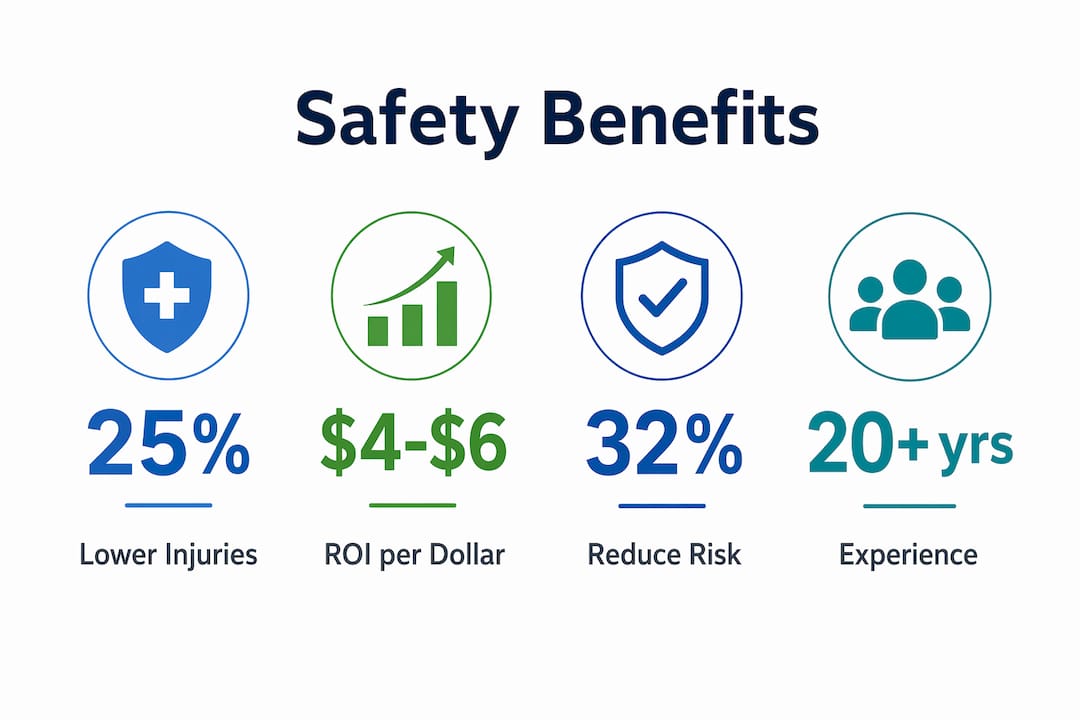
The most direct answer is financial. For every $1 invested in effective workplace safety programs, employers typically realize a return of $4 to $6 in saved accident and illness costs. That ratio makes safety one of the highest-return investments available to any operations budget.
The benefits of safety regulations reach well beyond cost avoidance. Strong compliance programs deliver measurable advantages across multiple areas:
- Injury prevention: Fewer incidents mean fewer lost workdays. The UK alone reported 40.1 million working days lost in 2024/25 due to work-related injury and ill health.
- Legal protection: Documented risk assessments, training records, and audits form essential evidence of due diligence during litigation or enforcement actions.
- Insurance cost reduction: A strong safety record lowers workers’ compensation premiums and employers’ liability insurance costs directly.
- Workforce morale: Workers who trust that their employer takes safety seriously show higher engagement and lower turnover.
- Competitive positioning: Contractors with clean safety records win more bids. A low Experience Modification Rate (EMR) signals reliability to clients and insurers alike.
The EMR metric deserves particular attention. A single recordable incident can raise workers’ compensation premiums for three years. That means one preventable accident carries a financial penalty that outlasts the incident itself by a significant margin.
Pro Tip: Track your EMR quarterly, not just at renewal. Catching a trend early gives you time to correct it before it affects your next bidding cycle.
How do safety standards improve operational consistency?
Safety standards function as an operational roadmap, not just a compliance checklist. When procedures are written, trained, and enforced consistently, work gets done the same way every time. That consistency reduces variation, which is the root cause of most industrial accidents and quality failures.

The most underused tool in operational safety is near-miss tracking. Operations managers who monitor near-misses treat them as leading indicators of future failures, enabling preemptive corrective action before a serious incident occurs. Near misses are free lessons. Ignoring them is the equivalent of discarding a warning light on a control panel.
Consider how this applies in industrial surface preparation. Following safety essentials for sandblasting does not just protect workers from silica dust and abrasive rebound. It also standardizes the prep process so coating adhesion is consistent, rework rates drop, and project timelines hold. Safety and quality are the same discipline viewed from different angles.
The gap between paper compliance and floor-level reality is where most programs fail. Template safety plans lacking site-specific details lead to weak compliance and increased liability. Workers recognize immediately when safety procedures are genuine versus theatrical, and that recognition shapes whether they follow the program or work around it.
Pro Tip: Conduct unannounced walk-throughs using your own written procedures as a checklist. If your crew cannot follow the procedure without looking it up, the procedure needs rewriting, not the crew.
What role do inspections play in safety outcomes?
Government workplace inspections are among the most effective tools for driving safety improvements. A meta-review of 37 studies confirmed that inspected workplaces show a 25% lower risk of work-related injuries and a 32% lower risk of non-compliance compared to non-inspected sites. Those numbers cover workplaces across Europe and North America, making the finding broadly applicable.
Inspections work because they create accountability that internal programs sometimes lack. The anticipation of an inspection motivates organizations to close gaps they might otherwise defer. More importantly, the follow-up process after an inspection finding forces documented corrective action, which builds the kind of evidence trail that protects organizations in enforcement proceedings.
| Inspection outcome | Impact on workplace |
|---|---|
| Injury risk reduction | 25% lower risk at inspected sites vs. non-inspected |
| Non-compliance risk reduction | 32% lower at inspected sites |
| Corrective action documentation | Creates legal defense evidence |
| Proactive safety investment | Organizations improve before scheduled inspections |
“Inspections act as a protective barrier against safety failures, not just a mechanism for punishment. The data shows that the inspection process itself changes organizational behavior, independent of whether a citation is issued.”
The practical implication for compliance managers is clear. Treat every inspection as a free audit. Use the findings to update your site-specific risk assessments and close the loop with documented corrective actions. Organizations that treat inspections as adversarial miss the operational value entirely. For practical guidance on OSHA zone marking standards, current 2026 requirements provide a useful reference for compliance teams managing mixed-use industrial spaces.
How can organizations build a true culture of safety?
Moving beyond minimum compliance requires treating safety as a core value rather than a regulatory burden. Leadership that shifts from reactive compliance to proactive safety culture produces higher employee morale, reduced turnover, and a more sustainable operation. The shift is not cosmetic. It requires leaders to make decisions that prioritize safety even when it costs time or money in the short term.
The three pillars of safety management are moral, legal, and financial. Most organizations focus on the legal pillar because it carries the most immediate consequences. The moral pillar, the obligation to send every worker home unharmed, is the one that actually changes behavior at the crew level when leaders communicate it consistently.
Building a culture-based safety program involves several concrete practices:
- Leadership visibility: Safety managers and executives who conduct regular site visits signal that safety is a leadership priority, not a compliance department function.
- Worker involvement: Crews who help write and revise procedures are more likely to follow them. Involvement creates ownership.
- Documentation as an asset: Risk assessments, training records, and incident logs are not just regulatory requirements. They are the evidence base that defends the organization in court and guides future improvements.
- Turnover reduction: Workers who feel safe stay longer. Lower turnover reduces the proportion of inexperienced workers on site at any given time, which directly reduces incident rates.
International health and safety standards function as an architectural blueprint, providing measurable and verifiable actions that protect workers regardless of location. ISO 45001, for example, gives organizations a framework to convert safety intentions into auditable practices. Applying compliance standards in industrial painting is one concrete example of how sector-specific standards translate that blueprint into daily operations.
Pro Tip: Review your safety culture annually using a structured survey, not just incident data. Incident rates are lagging indicators. Worker perception scores tell you where the next incident is likely to come from.
Key Takeaways
Following safety standards protects workers, reduces costs, and creates a legal and operational foundation that reactive programs cannot replicate.
| Point | Details |
|---|---|
| Financial ROI of safety | Every $1 invested in safety programs returns $4 to $6 in avoided costs. |
| Inspections reduce risk | Inspected workplaces show 25% lower injury risk than non-inspected sites. |
| EMR affects bidding power | A single recordable incident raises premiums for three years, hurting contract competitiveness. |
| Culture beats compliance | Proactive safety culture reduces turnover and builds a more stable workforce than checklist compliance. |
| Documentation is a legal asset | Documented risk assessments and training records form the primary defense in enforcement actions. |
The gap between knowing and doing is where organizations get hurt
After working in and around industrial safety for years, the pattern I see most often is not ignorance of the standards. It is the distance between what the safety manual says and what actually happens on the floor at 7:00 AM on a Monday. Organizations invest in writing programs and then underinvest in making those programs real.
The most dangerous assumption in safety management is that a written procedure equals a followed procedure. Workers adapt to their environment. If the procedure does not match the actual conditions of the job, workers will improvise. That improvisation is where incidents happen. The fix is not more paperwork. It is more time on the floor, more conversation with crews, and more willingness to rewrite procedures that do not reflect reality.
Leadership buy-in is not a soft concept. It is the single variable that most reliably predicts whether a safety program works. When a site manager stops a job because a safety condition is not met, every worker on that site learns something. When a manager walks past the same condition without acting, they learn something different. The importance of safety standards is not communicated through training slides. It is communicated through decisions made under pressure.
My advice to compliance decision-makers is this: audit your program against what your workers actually do, not against what your documents say they should do. Close that gap, and your incident rate will follow.
— Results
Southernsandblastingandpainting: safety-compliant industrial services
Safety standards compliance does not stop at the planning stage. It has to be built into every phase of execution, including surface preparation and protective coating application.

Southern Sandblasting and Painting brings over 20 years of experience delivering sandblasting and industrial coating services that meet OSHA and industry-specific requirements for municipal, commercial, and government clients across Central Florida. Every project follows documented safety protocols from surface prep through final coating inspection. For facility managers and contractors who need work done right the first time, the sandblasting equipment guide covers the equipment standards and asset protection outcomes that define compliant, durable results. Contact Southernsandblastingandpainting to discuss your next infrastructure project.
FAQ
Why do safety standards matter beyond legal compliance?
Safety standards reduce injury rates, lower insurance costs, and protect organizations during litigation. Effective safety management is a first line of legal defense and a driver of operational quality.
What is the ROI of workplace safety programs?
Employers typically return $4 to $6 for every $1 invested in safety programs through avoided accident and illness costs. That return includes lower workers’ compensation premiums and reduced lost-workday expenses.
How do inspections improve safety outcomes?
Inspected workplaces show a 25% lower injury risk and 32% lower non-compliance risk compared to non-inspected sites, based on a meta-review of 37 studies across Europe and North America.
What is the difference between paper compliance and real safety?
Paper compliance means having documented procedures. Real safety means those procedures match actual site conditions and workers follow them consistently. Template plans without site-specific detail increase liability rather than reduce it.
How does EMR affect a contractor’s business?
The Experience Modification Rate directly affects workers’ compensation premiums and contract eligibility. A single recordable incident can raise premiums for three years, making a strong safety record a direct competitive advantage in project bidding.
Recommended
- Industry Standards for Coatings: Ensuring Compliance in 2026
- Compliance Standards in Industrial Painting: Florida Impact
- Painting safety tips 2026: best practices for compliance
- Surface Preparation Standards 2025: Raising Compliance in Florida
- Sandblasting Contractor Baldwin Park FL
- Sandblasting Services Oviedo FL


